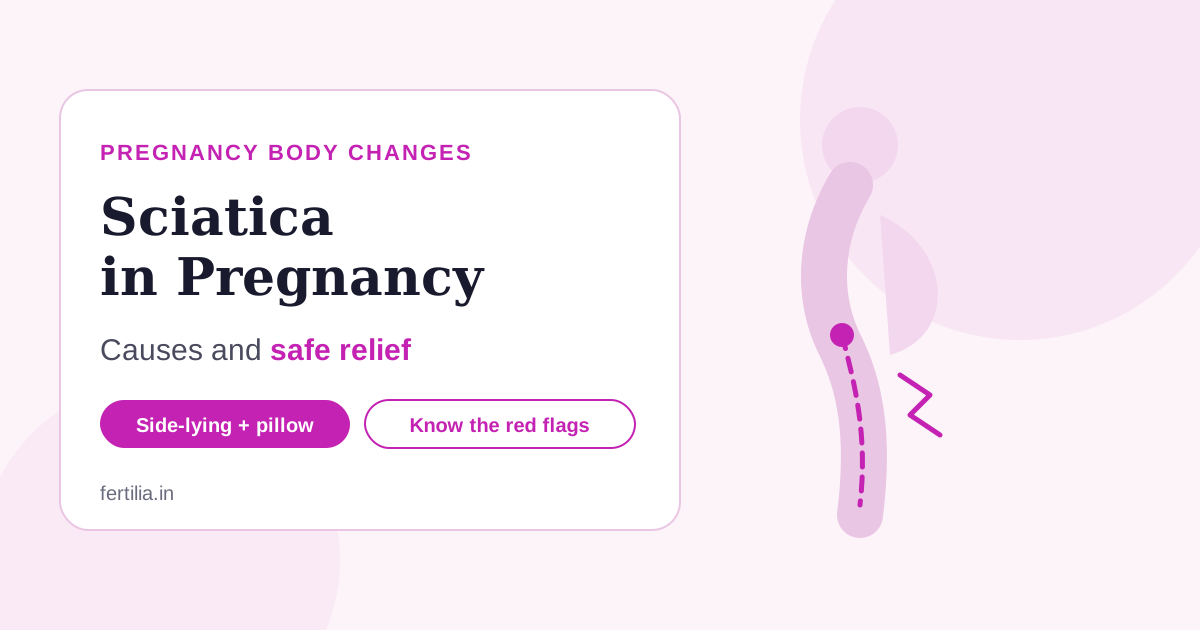
You stand up from the sofa and a hot, electric pain shoots from your buttock down the back of one leg, sometimes all the way to your foot. For a second you cannot put weight on it. Then it fades, until the next time you turn in bed or get out of an autorickshaw.
Most women call this “sciatica”, and it is one of the most common things pregnant women describe to me. I’m Dr. Suganya Venkat, an OB-GYN with over fifteen years of experience, and in my video consultations I find that the label is often only half right. The pain is real, but the cause is usually not the sciatic nerve itself. That matters, because it changes what helps, and because it means most of this pain settles with simple, safe steps.
Here is what this post covers:
- What sciatica is, and why most “sciatica” in pregnancy is something else
- How to tell nerve pain apart from back and pelvic pain
- Why it happens in pregnancy
- Positions, movements and physiotherapy that are safe
- What to avoid, including medicines on your own
- The few signs that need urgent, same-day review
What Sciatica Is
The sciatic nerve is the longest nerve in your body. It is formed from nerve roots in the lower spine, runs through the buttock, and travels down the back of each leg into the foot.
True sciatica means one of those nerve roots is being irritated or pressed, most often by a bulging disc in the lower back. It typically causes:
- Shooting, burning or electric pain that travels below the knee, often into the foot
- Pins and needles or numbness in a strip along the leg or foot
- Pain on one side, which can be worse with coughing or sneezing
- In more marked cases, weakness in the foot or ankle
Most Pregnancy “Sciatica” Is Not the Nerve
Here is the part that surprises women. In a study that followed 855 pregnant women from 12 weeks until delivery, almost half had back pain at some point, but true sciatica following a nerve-root pattern occurred in only 10 women, about 1% (Ostgaard HC et al., Spine, 1991, PMID 1828912). Many more women had pain in the sacroiliac area, the joints at the back of the pelvis, which tended to increase as pregnancy went on.
Pain from those pelvic joints and the buttock muscles often spreads into the back of the thigh, and it can feel very much like sciatica. The difference is usually in the details:
| Feature | Pelvic joint or buttock pain (common) | True sciatica (uncommon) |
|---|---|---|
| Where it starts | Deep in the buttock, over the back of the pelvis | Lower back or buttock |
| How far it goes | Usually stops above the knee | Often travels below the knee into the foot |
| Feeling | Deep ache, catching pain on turning or climbing stairs | Shooting, electric, burning |
| Numbness or tingling | Rare | Common, in a strip down the leg |
| Leg weakness | No | Possible |
You do not need to diagnose yourself from this table. It simply explains why your doctor or physiotherapist will ask exactly where the pain goes and whether you feel numbness. If your pain sits mainly at the front of the pelvis or in the hips, our post on pelvic girdle pain in pregnancy covers that pattern in detail.
Why It Happens in Pregnancy
Several normal pregnancy changes add up:
- Looser ligaments. Pregnancy hormones soften the ligaments around the pelvis so it can open for birth. The joints move more, and the muscles around them work harder to hold things steady.
- A shifting centre of gravity. As your bump grows, your lower back curves more and your posture changes, which loads the lower spine and buttock muscles differently.
- Weight gain and fluid. Normal and healthy, but they add load to the back and pelvis.
- The deep buttock muscles. When these tighten or go into spasm, they can irritate the sciatic nerve as it passes beneath them, giving leg pain that feels nerve-like.
- A disc problem. Much less often, a lower back disc bulges and presses on a nerve root. A systematic review describes symptomatic lumbar disc herniation as affecting about 1 in 10,000 pregnant women (Whiles E et al., Global Spine J, 2020, PMID 32905728).
The baby’s position can make pain come and go, which is why some days are far better than others.
💜 Shooting pain down your leg in pregnancy? Message Dr. Suganya on WhatsApp to book a ₹399 video consultation. Tell us how many weeks pregnant you are, where the pain starts, how far down the leg it goes, and whether you have any numbness.
What Helps
The reassuring news is that most pregnancy back and leg pain responds to simple, low-risk measures. A Cochrane review of 34 trials with 5,121 pregnant women found low-quality evidence that land-based exercise reduced low-back pain, and moderate-quality evidence that an eight- to 12-week exercise programme reduced the number of women reporting low-back and pelvic pain (Liddle SD et al., Cochrane Database Syst Rev, 2015, PMID 26422811). The studies were not specifically about sciatica, so treat these as sensible first steps rather than a guaranteed cure.
1. Sleep and rest positions
- Lie on your side, with a pillow between your knees and ankles so your top leg does not drop forward and twist the pelvis.
- Many women find lying on the side that does not hurt more comfortable.
- A pillow under the bump and one behind your back can stop you rolling.
- When turning in bed, keep your knees together and roll as one unit.
Our guide to the best sleeping position in pregnancy explains which positions are comfortable and safe as pregnancy advances.
2. Everyday movement
- Get up in stages. Roll onto your side, push up with your arms, then stand.
- Get in and out of a car or auto with knees together: sit first, then swing both legs in.
- Avoid standing on one leg to put on a saree petticoat, salwar or pants. Sit down to dress.
- Sit with support behind your lower back and both feet flat. Avoid crossing your legs and long spells sitting on the floor if they bring the pain on.
- Change position often. A short walk every 30 to 45 minutes helps more than long periods of sitting.
3. Gentle stretches and strengthening
Gentle movements that loosen the buttock and lower back often ease nerve-like leg pain. Useful ones, if they are comfortable for you, include:
- Cat-cow on hands and knees, slowly arching and rounding the back
- Pelvic tilts, either on hands and knees or standing against a wall
- A gentle seated buttock stretch: sitting on a chair, rest the ankle of the sore side on the opposite knee and lean forward slightly until you feel a mild stretch
Stop any movement that sends pain shooting down the leg. Skip stretches that need you to lie flat on your back for long periods later in pregnancy. Our pregnancy-safe exercises guide and post on safe workouts for each trimester have more options.
4. Warmth and support
- Warm (not hot) compresses on the buttock or lower back can relax tight muscles. Avoid heating pads directly on the bump.
- A pregnancy support belt helps some women, especially when pelvic joints are part of the picture.
- Swimming or simply walking in water takes weight off the back and is often comfortable.
5. Physiotherapy
If pain is limiting your day, a physiotherapist with experience in pregnancy is often the most useful step. They can work out whether the pain comes from the pelvic joints, the buttock muscles or a nerve root, and give you exercises matched to that. At Fertilia, women in our pregnancy program also have pelvic floor and antenatal movement support from Dr. Maitri Daga, our women’s health physiotherapist, over video, as part of a plan I lead.
What to avoid
- Painkillers on your own. Some common pain medicines are not advised in pregnancy, particularly later on. Please ask your doctor before taking anything, even an over-the-counter tablet or a balm. Our post on paracetamol and fever in pregnancy explains how we think about medicine safety.
- Deep-tissue massage or spinal manipulation from someone without pregnancy training.
- Heavy lifting and twisting, including lifting an older child onto your hip.
If your pain is mainly in the lower back rather than the leg, see our post on back pain in pregnancy. For pain right at the base of the spine when sitting, our tailbone pain in pregnancy post covers that. And if the pain in your calf is a sudden tight knot at night rather than a shooting line down the leg, it may be a cramp, explained in our leg cramps during pregnancy post.
When It Needs Urgent Attention
Most leg pain in pregnancy is uncomfortable but not dangerous. A small number of signs mean the nerves need to be checked straight away, because acting early gives the best recovery.
Go to the emergency department or your maternity unit straight away if you have:
- Numbness around the vagina, anus or inner thighs (the area that would touch a saddle)
- New difficulty passing urine, losing control of your bladder, or bowel leakage
- Weakness in one or both legs, such as your foot slapping down or the leg giving way
- Sciatica-type symptoms in both legs at the same time
These can be signs of cauda equina syndrome, where the bundle of nerves at the base of the spine is compressed. It is rare, but it is an emergency. Pregnancy can change bladder habits, but any one of the signs above is enough on its own. New difficulty passing urine or numbness in the saddle area needs emergency assessment, so please do not wait for a second symptom.
Also contact your doctor the same day if:
- Leg pain comes with a swollen, warm, red or tender calf, which can point to a blood clot rather than a nerve problem
- You have fever, feel unwell, or the back pain is constant and severe even at rest
- Back pain comes in regular waves or tightenings, especially before 37 weeks, which could be early labour
If a disc problem is suspected, your obstetrician will work with a spine specialist. The 2020 systematic review found the evidence on managing disc herniation in pregnancy limited, and advises that decisions be made by a multidisciplinary team (Whiles E et al., Global Spine J, 2020, PMID 32905728). An MRI without contrast can be used when needed; X-rays and CT are usually avoided.
After Delivery
For most women, pain that comes from the pelvic joints and buttock muscles eases in the weeks after the birth, as hormones settle and the load of the bump is gone. Lifting, feeding and carrying a baby can keep it going, so the same habits help: bend your knees, keep the baby close when you lift, and support your back during feeds. If leg pain or numbness is still there at your postnatal check, mention it. Our post on back pain after delivery covers recovery in those months.
Practical Takeaways
- Shooting pain into the buttock and leg is common in pregnancy, but true sciatica from a nerve root is uncommon.
- Pain that stops above the knee with no numbness usually comes from the pelvic joints or buttock muscles.
- Side-lying with a pillow between the knees, getting up in stages and keeping knees together when turning help daily.
- Gentle stretches, warmth, a support belt and physiotherapy are safe first steps.
- Do not take painkillers on your own; ask your doctor first.
- Saddle numbness, new difficulty passing urine, loss of bladder or bowel control, or leg weakness need emergency assessment straight away, even if only one is present.
Frequently Asked Questions
Is sciatica normal in pregnancy?
Buttock and leg pain is common in pregnancy, but true sciatica, where a nerve root in the spine is pressed, is uncommon. In a study of 855 pregnant women, only about 1% had true sciatica. Most “sciatica” in pregnancy comes from the pelvic joints and buttock muscles, and usually settles with simple measures.
Can sciatica in pregnancy harm my baby?
No. The pain affects your nerves, muscles and comfort, not your baby. The reason to treat it is to protect your sleep and mobility, and to make sure the rare warning signs are not missed.
What is the best sleeping position for sciatica in pregnancy?
Lie on your side with a pillow between your knees and ankles. Many women find the side that does not hurt more comfortable. Keep your knees together when you turn over.
Which trimester does sciatica start in?
It can start at any time, but leg and pelvic pain often becomes more noticeable in the second and third trimesters, as the bump grows and posture changes.
Can I take a painkiller for sciatica while pregnant?
Please ask your doctor before taking anything. Some common pain medicines are not advised in pregnancy, especially later on. Your doctor can tell you what is safe for your stage of pregnancy.
Will sciatica go away after delivery?
For most women, pain from the pelvic joints and buttock muscles eases in the weeks after birth. If pain or numbness continues, tell your doctor at your postnatal check, because physiotherapy can still help.
When should I go to hospital for leg pain in pregnancy?
Go straight away if you have numbness around the vagina or anus, new difficulty passing urine, new bladder or bowel control problems, weakness in a leg, or symptoms in both legs. Any one of these is enough. A swollen, red, painful calf also needs review by your doctor the same day.
Talking It Through
Leg pain that wakes you at night or stops you walking is not something you have to just put up with. If you are not sure whether your pain is sciatica, pelvic joint pain or something else, you can talk it through with Dr. Suganya Venkat over a video consultation at Fertilia, and get a plan that fits your stage of pregnancy.
💜 Want help with sciatica or leg pain in pregnancy? Message Dr. Suganya on WhatsApp to book a ₹399 video consultation, available online across India. You can also download our free pregnancy guide for trimester-by-trimester support.