She was happy about the pregnancy. She had wanted it for a long time. And yet on a Tuesday evening, watching an advertisement for biscuits, she started crying and could not stop. Her husband looked at her, unsure whether to laugh or worry. So did she.
If something like this has happened to you, you are in very large company. Emotional changes are among the most common experiences of pregnancy, and most women are given far less information about them than about folic acid or scan dates. Many women quietly wonder whether feeling tearful, irritable or flat while pregnant means something is wrong with them, or with how they feel about the baby. In most cases it means neither.
I am Dr. Sandhiya Loganathan, a psychiatrist (MD Psychiatry) who sees women over video consultations at Fertilia, and the emotional side of pregnancy is something women bring to me often, usually after weeks of keeping it to themselves. This post is the conversation I wish more of them had heard earlier.
What this post covers:
- Why pregnancy changes how you feel, in plain terms
- What the emotional picture often looks like in each trimester
- Simple things that help day to day
- How to tell ordinary mood swings from antenatal depression or anxiety
- How to ask for support, and what that support looks like
Why Pregnancy Changes How You Feel
There is rarely one cause. Several things stack on top of each other, and they shift as the weeks go on.
Hormones change quickly. Oestrogen and progesterone rise steeply in early pregnancy, and the brain systems that regulate mood are sensitive to these changes. Many women who notice mood changes before their periods find they are more reactive in early pregnancy too. This is not weakness. Some nervous systems simply respond more strongly to hormonal shifts.
Sleep gets broken. Tiredness in the first trimester, then later the night-time bathroom trips, heartburn and difficulty finding a comfortable position all chip away at rest. Short or broken sleep makes almost anyone more tearful and short-tempered. If nights have become difficult, our guide to insomnia in pregnancy goes through the common causes and safe ways to ease them.
The body feels unfamiliar. Nausea, vomiting, aches, a changing shape, and a body that no longer does what it used to can be quietly exhausting. Feeling sick every day lowers mood for its own reasons, and our post on morning sickness covers what helps.
Life is changing at the same time. Pregnancy brings questions about work, money, family roles, in-laws, where to deliver, and who you will become as a mother. Advice comes from every direction. Even very welcome change is a load on the mind.
Your own history matters. Women who have had depression or anxiety before, who have lost a pregnancy, who went through a long journey to conceive, or who are under strain at home tend to feel these changes more. That is a reason for extra support, not a sign that something will go wrong.
What Each Trimester Often Feels Like
Every pregnancy is different, so treat this as a rough map, not a checklist.
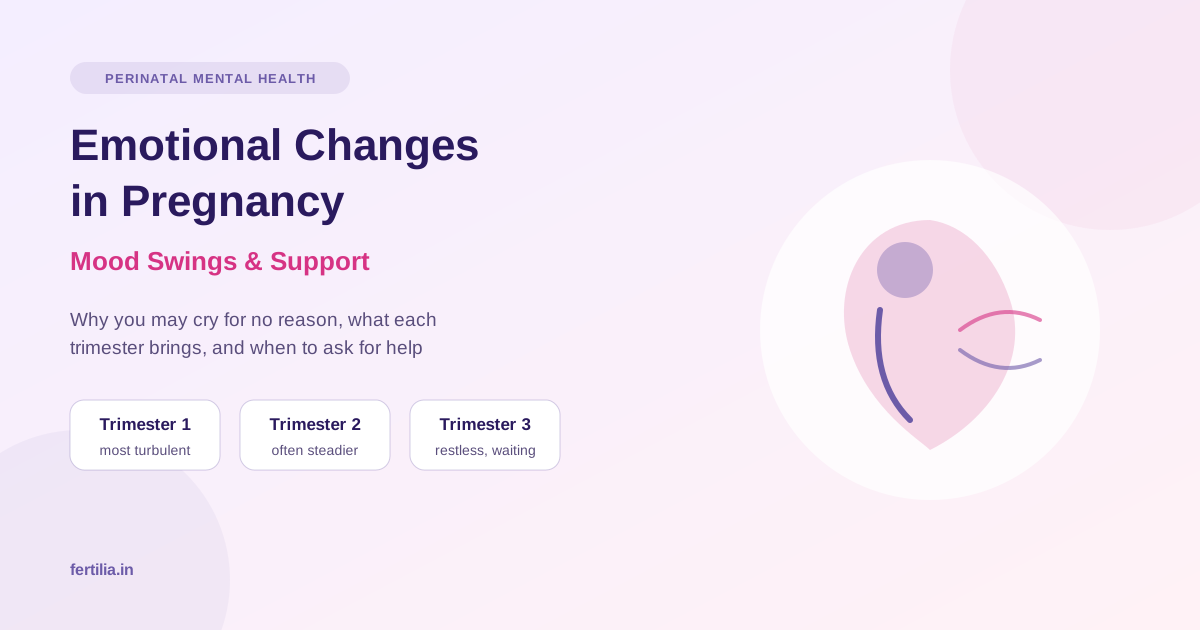
First trimester (weeks 1 to 12)
This is often the most emotionally turbulent stretch. Many women feel a mix of joy, disbelief and worry, sometimes within the same hour. Tiredness and nausea are at their peak for many, and you may not yet have told anyone, which means carrying all of it alone. Crying easily, feeling irritable, or snapping at people you love is very common now. If you want the physical side of these weeks laid out, see first trimester symptoms and tests.
Second trimester (weeks 13 to 27)
For many women the nausea eases and energy returns, and mood often steadies with it. This is when the pregnancy can start to feel real, especially once movements begin. It is also a time when some worries become more specific: scan results, weight, work plans. If your mood has not lifted at all by now, or has got heavier, that is worth paying attention to.
Third trimester (weeks 28 to birth)
Physical discomfort and poor sleep usually return. Thoughts turn towards labour and the newborn weeks, and it is normal to feel restless, impatient, or anxious about delivery. Some women find themselves busily preparing; others feel oddly flat. Both are common.
What Helps Day to Day
None of these are cures for a mental health condition, but for ordinary pregnancy mood swings they make a real difference, and they are safe for almost everyone.
- Name what is happening. Simply saying “this is a hormonal, tired evening, not the truth about my life” can take the edge off a wave of tears or anger.
- Protect sleep where you can. A short afternoon rest, an earlier night, or handing over one evening task can matter more than any tip.
- Eat regularly. Long gaps without food, especially with nausea, make irritability worse. Small, frequent meals like idli, curd rice or a banana help many women stay steadier.
- Move gently, if your doctor has cleared you. A short walk after dinner or prenatal yoga lifts mood for many women.
- Tell one person the whole truth. Not the polished version. A partner, a sister, a close friend. Carrying feelings alone makes them heavier.
- Ask for specific help. “Can you handle dinner on Thursdays?” works better than waiting for people to notice.
- Limit the advice and the forums. If reading other people’s stories leaves you more frightened, step away for a while.
💬 Finding your moods harder to manage than you expected? You can talk it through with Dr. Sandhiya Loganathan over a ₹399 online video consultation, from anywhere in India. Message Fertilia on WhatsApp and tell us a little about how you are feeling.
When It Is More Than Mood Swings
Mood swings come and go. You have bad evenings and then good days. Antenatal depression and anxiety are different: the low mood or worry stays, takes up most of the day, and starts to affect how you live.
These conditions are common. A systematic review pooling studies of pregnant women found depression in about 7.4% of women in the first trimester, 12.8% in the second and 12.0% in the third (Bennett HA et al., Obstet Gynecol, 2004, PMID 15051562). Anxiety is at least as common: a meta-analysis found self-reported anxiety symptoms in 18.2% of women in the first trimester, 19.1% in the second and 24.6% in the third (Dennis CL et al., Br J Psychiatry, 2017, PMID 28302701). If this is happening to you, you are far from alone, and it is treatable.
It is worth speaking to a doctor if you notice any of the signs below for two weeks or more, and sooner if they are severe, getting worse, or making it hard to cope with work or daily life:
- Feeling low, empty or hopeless most of the day, on most days
- Losing interest in things you usually enjoy, including the pregnancy
- Worry that you cannot switch off, or that keeps you from sleeping even when you are tired
- Panic attacks, a racing heart, or feeling constantly on edge
- Feeling guilty, worthless, or like a burden
- Changes in appetite or sleep beyond what the pregnancy itself explains
- Pulling away from people, or finding it hard to get through work or daily tasks
- Feeling disconnected from the pregnancy, or not wanting to think about the baby
Some of these overlap with ordinary pregnancy symptoms, such as tiredness and appetite changes. That is exactly why it helps to talk to someone trained to tell them apart, rather than guessing alone.
If you feel you cannot keep yourself safe, or feel close to acting on thoughts of harming yourself, get emergency help now. Call 112 or go to the nearest emergency department straight away, and ask someone to stay with you until you are seen. If you are having thoughts of harming yourself but feel safe right now, please seek help the same day. Tell someone near you, contact your doctor, or call Tele-MANAS, India’s free national mental health helpline, on 14416. These thoughts can happen in pregnancy, they are a sign of illness and not of who you are, and help works.
Why It Is Worth Asking for Help Now
Many women wait, hoping the feelings will pass once the baby comes. Some do. But getting support during pregnancy means you go into the birth and the newborn weeks steadier, with a plan already in place. Low mood that starts in pregnancy can continue after delivery, and our post on postpartum depression covers what that looks like and how it is treated.
Asking for help also has nothing to do with being a “good” or “bad” mother. Looking after your mind is part of looking after your pregnancy, in the same way as your blood pressure or your iron levels.
What Support Looks Like
Support is usually step by step, matched to how you are feeling:
- Talking it through. For many women, a single open conversation with a clinician, and a clear sense of what is normal, brings real relief.
- Psychological therapy. Talking therapies such as cognitive behavioural therapy (CBT) are a first-line option for mild to moderate depression and anxiety in pregnancy. They teach practical skills for worry, low mood and sleep. If you are unsure who does what, see psychiatrist vs psychologist vs counsellor.
- Medication, when it is needed. For more severe symptoms, some medicines can be used in pregnancy. The decision is made carefully, weighing your symptoms against the options, together with your obstetrician. If you are already taking medicine for anxiety or depression, please do not stop it suddenly on finding out you are pregnant. Speak to your doctor first, so any change is planned.
- Joined-up care. Your obstetrician, a psychiatrist or therapist, and your family all have a part. It works best when they are talking to each other.
If you have had a loss before and the fear is centred on this pregnancy ending the same way, our post on pregnancy after miscarriage and anxiety goes into that specifically.
A Note for Partners and Family
If someone you love is pregnant and struggling emotionally, the most useful things are often the simplest. Listen without rushing to fix it. Avoid “you should be happy” or “it is just hormones”. Take something practical off her plate. And if her low mood or worry has lasted two weeks or more, gently encourage her to speak to a doctor, and offer to help her arrange it.
Frequently Asked Questions
Is it normal to cry for no reason during pregnancy?
Yes. Crying more easily is very common in pregnancy, especially in the first trimester, and is linked to hormonal change, tiredness and the sheer amount of adjustment going on. It becomes a concern when crying is frequent, comes with persistent low mood or hopelessness, and lasts for two weeks or more.
When do mood swings start in pregnancy?
Many women notice them within the first few weeks, sometimes before they know they are pregnant. They are often strongest in the first trimester, may ease in the second, and can return in the third as sleep becomes harder and delivery approaches.
How can I tell pregnancy mood swings from antenatal depression?
Mood swings come and go, with good days in between. Antenatal depression is a low mood or loss of interest that lasts most of the day, on most days, for two weeks or more, and affects daily life. If you are unsure which it is, a short conversation with a doctor can help sort it out.
Can stress or mood swings harm my baby?
Ordinary mood swings and everyday stress are part of pregnancy and are not something to feel guilty about. Ongoing depression or anxiety is worth treating, mainly because you deserve to feel better, and support during pregnancy also sets you up well for after the birth.
Is it safe to take medicine for depression or anxiety while pregnant?
Some medicines can be used in pregnancy when the benefit is clear, and the choice is made together with your obstetrician and psychiatrist. If you already take one, do not stop it abruptly when you find out you are pregnant. Talk to your doctor so any change is planned safely.
Who should I talk to about emotional changes in pregnancy?
You can start with your obstetrician, who sees you regularly anyway, or with a psychiatrist or psychologist. Many women find it easier to start with the doctor they already trust, who can then involve a mental health specialist if needed.
Does feeling low in pregnancy mean I will get postpartum depression?
Not necessarily. Many women who feel low in pregnancy feel better after the birth, especially with support. Low mood in pregnancy is one of the reasons to put a plan in place early, so that if difficulties continue after delivery, help is already there.
You Do Not Have to Wait It Out
Feeling emotional in pregnancy is common, and most of the time it settles. When it does not, there is good, safe help available, and reaching out earlier makes the road easier.
If you would like to talk through what you are feeling, message Fertilia on WhatsApp to book a ₹399 online video consultation with Dr. Sandhiya Loganathan. You can also download our free pregnancy guide for the practical side of the months ahead.