You look in the mirror one morning and your face seems rounder than you remember. Your cheeks feel full, your eyelids look a little heavy, and your wedding ring has started to leave a groove on your finger. Someone at home says, kindly, “You’re glowing.” You are not sure whether it is a glow or something you should mention to your doctor.
I’m Dr. Suganya Venkat, an OB-GYN with more than fifteen years of clinical practice, and “Is this puffiness normal?” is one of the most common questions I hear from women in the second half of pregnancy. Most of the time, the answer is yes. Occasionally, the answer is “let’s check your blood pressure today.” This guide explains how to tell the two apart, calmly and practically, so you know exactly what to do.
In this post, we will cover why the face and hands swell in pregnancy, what the normal pattern looks like, the specific changes that call for an urgent check, how to check your BP at home properly, and simple things that ease everyday puffiness.
Swelling of the feet and ankles has its own guide: swollen feet in pregnancy, causes and red flags. This post focuses on the face and hands.
Why Your Face Looks Fuller in Pregnancy
Your body holds more water during pregnancy. That is not a fault; it is part of how the body supports a growing baby and placenta. The NHS explains that swelling in pregnancy is caused by the body holding more water than usual, and that this fluid tends to gather in the lowest parts of the body through the day (nhs.uk, “Swollen ankles, feet and fingers in pregnancy”, reviewed April 2024).
So why the face? A few everyday reasons:
- Lying flat overnight. When you are horizontal for seven or eight hours, fluid redistributes towards the face and eyelids. That is why puffiness is often worst on waking and settles as you move about.
- Hormonal changes. Pregnancy hormones make small blood vessels a little more permeable and encourage the body to hold on to salt and water.
- Normal weight gain. Some fullness in the cheeks is simply healthy pregnancy weight, not fluid at all.
- Salt, heat and long days. A salty dinner (think pickle, papad, chips or restaurant food), a hot Chennai or Coimbatore afternoon, or a long day of standing can all make puffiness more noticeable the next morning.
- Nasal congestion. Many pregnant women have a stuffy nose, which can make the area around the eyes look heavier.
Fingers often swell for the same reasons, which is why rings start to feel tight. If your hands also tingle or go numb at night, that is a related but separate issue, explained in our guide to carpal tunnel and numb hands in pregnancy.
The Reassuring Pattern
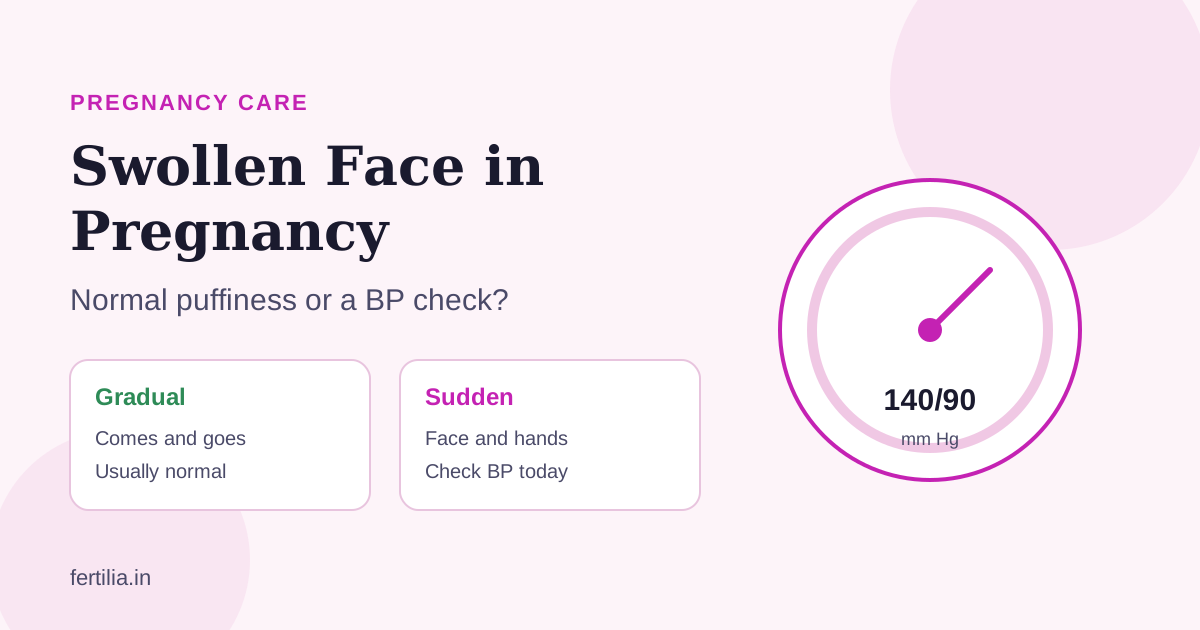
Normal pregnancy puffiness usually looks like this:
- It builds gradually over weeks, not overnight.
- It comes and goes: worse on waking or at the end of a long day, better after you have been up and moving or after rest.
- It affects both sides evenly.
- You otherwise feel well: no severe headache, no vision changes, no pain under the ribs.
- Your BP readings at antenatal visits have been normal.
The NHS describes swelling that comes on gradually as not usually harmful to you or your baby, though it can be uncomfortable. If this matches your experience, you can mention it at your next routine visit and use the comfort measures further down.
The Change That Needs a Check Straight Away
The single word that matters most is sudden. A face that looks noticeably more swollen today than it did yesterday, or puffiness that appears quickly and does not settle after you get up and move around, deserves an urgent check. Call your doctor or maternity unit straight away rather than waiting to see if it settles.
The reason is preeclampsia, a blood pressure disorder that usually develops after 20 weeks of pregnancy, often in the third trimester, and can also appear in the weeks after delivery. ACOG lists swelling of the face or hands among its possible symptoms, along with a headache that will not go away, seeing spots or changes in eyesight, upper abdominal or shoulder pain, nausea and vomiting in the second half of pregnancy, sudden weight gain, and difficulty breathing (acog.org, “Preeclampsia and High Blood Pressure During Pregnancy” patient FAQ). ACOG also notes that preeclampsia can develop quietly, and that a high blood pressure reading may be the first sign.
That last point is why we do not try to judge swelling by eye alone. A two-minute BP reading answers the question far better than the mirror does.
Call your doctor or maternity unit straight away if you notice
The NHS advises contacting your midwife, GP or labour ward immediately if you have any of the following (nhs.uk, reviewed April 2024):
- a sudden increase in swelling in your face, hands or feet
- a very bad headache
- problems with your vision, such as blurring or flashing lights
- severe pain just below your ribs
- heartburn that does not go away with antacids
- feeling very unwell
- nausea and vomiting
If you notice any of these, please do not wait for your next scheduled visit, and do not wait to take a home BP reading first. A normal home reading does not rule out a problem, so call anyway. Getting checked is quick, and when preeclampsia is picked up early, it can be monitored and managed well. For more on two of these companion symptoms, see our guides to headaches in pregnancy and blurred vision in pregnancy and when to check your BP.
Not sure whether your puffiness fits the normal pattern? You can describe it to Dr. Suganya Venkat over a video consultation at Fertilia, available to women across India. Message us on WhatsApp
Normal Puffiness vs Swelling That Needs a Check
| Usually normal | Get checked urgently | |
|---|---|---|
| Onset | Gradual, over weeks | Sudden, over a day or two |
| Timing | Worse on waking, eases as you move | Persists through the day |
| Where | Mild fullness of cheeks, eyelids, fingers | Clear swelling of face and hands together |
| Other symptoms | None | Headache, vision changes, rib pain, nausea, feeling unwell |
| BP readings | Normal at visits | Not yet checked, or 140/90 or higher |
The table is a guide, not a diagnosis. If you are unsure which column you are in, treat it as the right-hand column and get checked. A normal result is a good outcome, not a wasted trip.
How to Check Your BP at Home Properly
Many women in India now keep a digital BP monitor at home, especially in the third trimester. A reading is only useful if it is taken well:
- Use an automatic upper-arm monitor, not a wrist device, and a cuff that fits your arm.
- Sit quietly for five minutes first, back supported, feet flat on the floor, legs uncrossed.
- Rest your arm on a table at roughly heart level.
- Avoid tea, coffee or a brisk walk in the 30 minutes before.
- Take two readings a minute apart and write both down with the date and time.
What the numbers mean. In pregnancy, a reading is considered high if the top number is 140 mm Hg or higher or the bottom number is 90 mm Hg or higher (either one on its own counts). If you get a reading at this level, share it with your doctor or maternity unit that day. ACOG lists a systolic pressure of 160 mm Hg or higher, or a diastolic pressure of 110 mm Hg or higher, as a severe feature of preeclampsia (acog.org patient FAQ); a reading in this range, or any reading with a severe headache or vision changes, means going to hospital now.
If you have no monitor at home, a nearby pharmacy, a primary health centre or your hospital’s antenatal OPD can check it for you. Our guide to gestational hypertension explains what happens if your readings run high, and the preeclampsia guide walks through what to expect if you are admitted.
Who Should Be Extra Attentive
Some women have a higher chance of developing preeclampsia. ACOG’s patient FAQ lists high-risk factors including preeclampsia in a past pregnancy, twins or more, chronic high blood pressure, kidney disease, diabetes, and autoimmune conditions such as lupus. Moderate-risk factors include a first pregnancy, age 35 or older, a BMI over 30, a family history of preeclampsia in your mother or sister, a gap of more than 10 years since a previous pregnancy, and pregnancy through IVF.
Having a risk factor does not mean you will develop it. It simply means your doctor will watch your BP more closely, and that new swelling is worth a reading sooner rather than later. If any of these apply to you, ask your obstetrician whether home BP monitoring makes sense for you.
Simple Ways to Ease Everyday Puffiness
When your BP is normal and the swelling follows the reassuring pattern, these measures are safe and often help:
- Sleep on your side with your head slightly raised. An extra pillow can reduce morning puffiness around the eyes. Our guide to sleeping positions in pregnancy covers what is comfortable and safe.
- Keep moving through the day. The NHS recommends regular walks and avoiding standing for long periods.
- Take off rings early. If your fingers are swelling, remove rings and bangles before they get tight. Many women wear their ring on a chain until after delivery.
- Drink water regularly. Staying hydrated does not make swelling worse.
- Go easy on very salty foods. You do not need a salt-free diet, but cutting back on pickles, papad, packaged namkeen and restaurant meals can help. Home food with dal, vegetables, curd and rice or roti is perfectly fine.
- Cool compress for puffy eyes. A clean, cool, damp cloth over the eyes for a few minutes in the morning is soothing.
- Stay cool on hot days. Rest in the shade or under a fan during the hottest part of the afternoon.
What I would avoid: water pills (diuretics) or herbal “detox” remedies to bring swelling down. These are not a treatment for pregnancy swelling and should only ever be used if your own doctor prescribes them for a specific reason.
What It’s Called in Tamil and Hindi
Many women search for this in their own language. Facial swelling is commonly described as mugam veekkam in Tamil and chehre par sujan in Hindi, as in “pregnancy mein chehre par sujan”. Whichever words you use, the guidance is the same: gradual puffiness is usually normal, sudden swelling deserves a call to your doctor or maternity unit straight away.
Frequently Asked Questions
Is a swollen face normal in pregnancy?
Yes, a mildly fuller or puffy face is common, especially in the second and third trimesters. It usually comes from the extra fluid your body holds, plus normal weight gain. If it builds slowly, is worse on waking and eases during the day, and your BP readings are normal, it is usually nothing to worry about.
When should I worry about face swelling during pregnancy?
When it is sudden. A sudden increase in swelling of your face or hands over a day or two, or swelling that comes with a bad headache, blurred vision, pain below the ribs or nausea, means calling your doctor or maternity unit straight away for an urgent check. Do not wait to take a home BP reading first, and do not let a normal home reading delay that call.
Is facial swelling always a sign of preeclampsia?
No. Most facial puffiness in pregnancy is simple fluid retention. Swelling on its own does not diagnose preeclampsia; a blood pressure reading and, if needed, a urine and blood test do. That is why a quick BP check is the most useful next step if you are unsure.
Why is my face more swollen in the morning?
Lying down overnight lets fluid redistribute towards your face and eyelids. Once you are up and moving, gravity draws it back down, so morning puffiness that settles by mid-morning is a typical, reassuring pattern.
Can facial swelling happen after delivery?
Yes. Some puffiness can persist for a few days after birth as your body clears the extra fluid. Preeclampsia can also develop in the weeks after delivery, so new swelling with a headache or vision changes after birth needs an urgent check: call your doctor or hospital straight away. New breathlessness after birth needs emergency care immediately, even if your BP reading is normal, because it can have other serious causes, such as a blood clot in the lungs or a heart problem, that a BP reading does not rule out.
What BP reading is too high in pregnancy?
A reading is considered high in pregnancy if the top (systolic) number is 140 mm Hg or higher, or the bottom (diastolic) number is 90 mm Hg or higher. Either one on its own counts, and it should be shared with your doctor that day. If the top number is 160 mm Hg or higher, or the bottom number is 110 mm Hg or higher (for example, 165/95), go to hospital straight away. A high reading that comes with a severe headache or vision changes also means going to hospital now.
Does drinking less water reduce swelling?
No. Cutting back on water does not reduce pregnancy swelling and can leave you dehydrated. Keep drinking regularly through the day and reduce very salty foods instead.
The Bottom Line
A softer, rounder face is part of many healthy pregnancies. The pattern to watch is not how puffy you look, but how quickly it changed and what came with it. Gradual and coming-and-going: mention it at your next visit. Sudden, or with headache, vision changes or rib pain: call your doctor or maternity unit straight away.
At Fertilia, Dr. Suganya Venkat, an OB-GYN with over 15 years of experience and more than 1,000 pregnancies in her care, supports women through every trimester with personalised, evidence-based guidance alongside their own obstetrician. Our pregnancy care program and free pregnancy guide are good places to start.
Have a question about swelling, BP readings or anything else in your pregnancy? Speak with Dr. Suganya Venkat over a video consultation, ₹399 in India. Message us on WhatsApp