Your IVF calendar has one more appointment on it than you expected. Somewhere between the baseline scan and the injections, the clinic has written “mock ET” or “trial transfer.” There is no embryo involved and no pregnancy test at the end of it, yet you are asked to come in, lie on the same couch, and have a thin catheter passed through your cervix.
It is natural to wonder why. Has the doctor seen a problem with your uterus? Is it an extra charge? Will it hurt?
I’m Dr. Suganya Venkat, an OB-GYN with more than 15 years of experience, and women in Fertilia’s IVF Support program often send me their clinic’s treatment calendar and ask about exactly this line on it. A mock transfer is one of the simplest steps in the whole IVF process. Knowing what it is for takes a good deal of the uncertainty out of transfer day.
What This Post Covers
- What happens during a mock embryo transfer, and how it feels
- What your doctor learns from it
- Why the ease of the real transfer matters
- What the research shows about doing a trial run
- When it is done, including in frozen embryo cycles
- What happens if the trial run is difficult
- Questions to ask your clinic
- Frequently asked questions
What Happens During a Mock Embryo Transfer
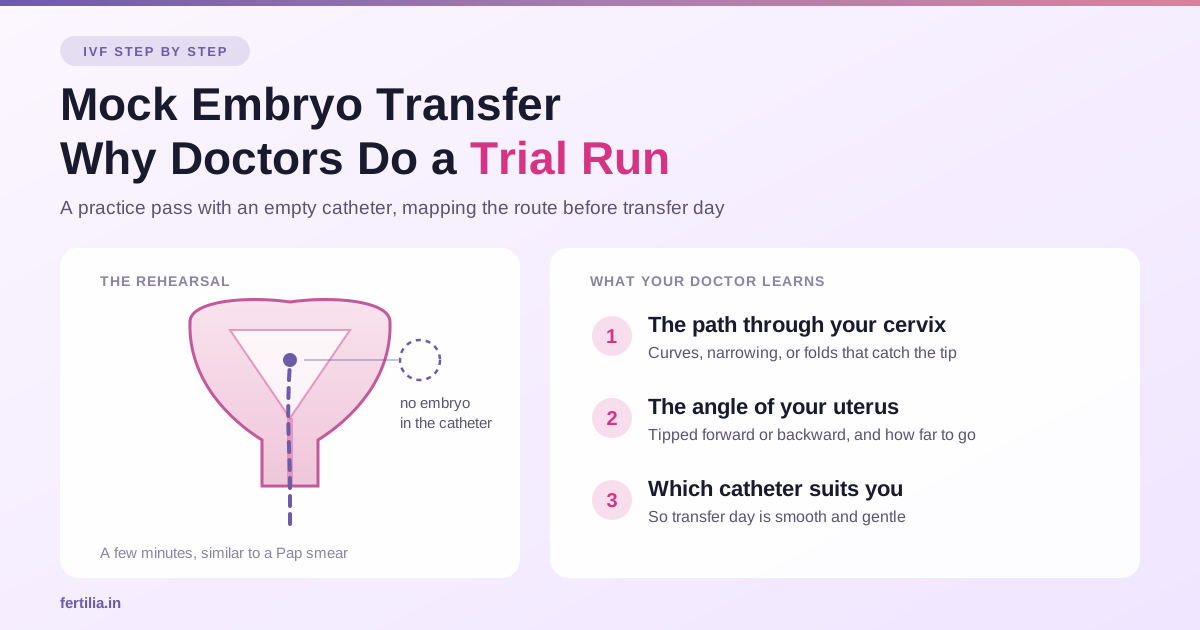
A mock embryo transfer, also called a trial transfer or a dummy transfer, is a rehearsal of the real embryo transfer with no embryo in the catheter.
The steps are usually these:
- You lie on your back with your legs supported, much as you would for a Pap smear or an IUI.
- The doctor places a speculum and gently cleans the cervix.
- A thin, soft catheter is guided through the cervical canal towards the uterine cavity. Many clinics watch this on an abdominal ultrasound, which is why you may be asked to come with a comfortably full bladder.
- The doctor notes how easily the catheter passed, the direction it had to take, and how far it travelled to reach the cavity.
- The catheter is withdrawn. The whole procedure usually takes a few minutes.
Most women describe the feeling as close to a Pap smear or an IUI: some pressure, and perhaps a brief cramp. It is usually done without anaesthesia, and most women go back to work or home the same day. A little spotting afterwards can happen from the speculum or the cervix and usually settles on its own. If you have pain that keeps getting worse, a fever, or heavy bleeding, call your clinic.
What Your Doctor Learns From It
A real embryo transfer is done partly by feel. The doctor cannot see the inside of the cervical canal, so the trial run is a way of learning the route in advance.
- The path through the cervix. The cervical canal is not a straight tube in every woman. In some it curves, in some it is narrow, and in some the catheter tip catches on a fold. The trial run shows which way the catheter needs to go.
- The angle of the uterus. Most uteri tip forward (anteverted), and some tip backward (retroverted). Knowing this helps the doctor shape and direct the catheter.
- The length of the route. The doctor can note how far the catheter travels before it reaches the cavity, which helps plan how far to advance it on the real day.
- Which catheter suits you. Transfer catheters come in softer and firmer designs. In the Cairo study described below, choosing the most suitable catheter for each woman was the whole purpose of the trial run (Mansour R et al., Fertil Steril, 1990, PMID 2209889).
- Whether anything needs sorting out first. If the cervix is very tight or the catheter cannot pass, the clinic can plan for it now, on a day when no embryo is waiting.
Why an Easy Transfer Matters
Embryo transfer comes at the end of weeks of injections, scans and lab work, and it takes only a few minutes. Those minutes still count.
An analysis of 4,807 transfers classed a transfer as difficult if it was time-consuming, the catheter met great resistance, the catheter had to be changed, the cervix needed sounding or dilating, or blood was found on the catheter. After allowing for age, type of treatment and number of embryos, easy or intermediate transfers had a 1.7-fold higher pregnancy rate than difficult ones (Tomás C et al., Hum Reprod, 2002, PMID 12351540).
A study of 584 transfers of good-quality embryos looked at similar factors and found that blood on or in the catheter was the one most strongly linked to lower implantation and pregnancy rates. In that study, a transfer the doctor judged difficult, and a trial pass done just before the real transfer, did not change the pregnancy rate (Alvero R et al., Hum Reprod, 2003, PMID 12923137).
The two studies measured this in different ways. The larger one grouped several signs, including resistance and blood, into one definition of a difficult transfer and found that easier transfers did better. The smaller one looked at each factor separately and found that blood on the catheter mattered, while how difficult the transfer felt to the doctor did not. Blood on the catheter appears in both: as one of the signs of a difficult transfer in the larger study, and as the factor that mattered most in the smaller one. That is the thinking behind a mock transfer. If the route is going to be tricky, it is better to find out on a day when there is no embryo in the catheter.
What the Research Shows About Mock Transfers
The early study
One of the earliest trials comes from Cairo. In 1990, Mansour and colleagues divided 335 women starting IVF into two groups. One group had a dummy transfer before treatment, used to choose the most suitable catheter for each woman, and the other did not. Difficult transfers occurred in 29.8% of the women without a dummy transfer and in none of the women who had one. The pregnancy rate was 22.8% with a dummy transfer and 13.1% without, and the researchers linked the difference to the very low pregnancy rate (4%) among the difficult transfers (Mansour R et al., Fertil Steril, 1990, PMID 2209889).
That study is more than 30 years old and comes from a single centre, and IVF technique has changed a great deal since then.
A newer randomised trial
A London trial randomised 200 women having their first IVF cycle to either a mock transfer or no mock transfer. Clinical pregnancy rates and live birth rates were similar in both groups. The authors concluded that a mock transfer before the first cycle may not improve success in young women without risk factors for a difficult transfer (Borkar A et al., Int J Reprod Biomed, 2020, PMID 33349803). Their paper also notes that a mock transfer may be beneficial for women who have had a difficult transfer before.
What the Cochrane review found
When the Cochrane review of preparation techniques before embryo transfer searched for randomised trials, it did not identify any eligible studies of dummy transfer (Derks RS et al., Cochrane Database Syst Rev, 2009, PMID 19821435). Its 2026 update did not include dummy transfer among the techniques it analysed, and it made no specific recommendations for practice for the preparation steps it did study, such as a full bladder or removing cervical mucus (Yamaji N et al., Cochrane Database Syst Rev, 2026, PMID 42556821).
Putting it together
The evidence supports a mock transfer as a planning tool. In the early trial it helped avoid unexpected difficult transfers, and the authors of the newer trial note it may be beneficial for women who have had a difficult transfer before. There is no good evidence that a routine trial run raises pregnancy rates for every woman. That is why clinics differ in how they use it, and why both approaches are reasonable.
💜 Your clinic has scheduled a mock transfer and you want to understand your transfer plan? Message Dr. Suganya’s team on WhatsApp A ₹399 video consultation goes through your scans, your history and your clinic’s plan with you, alongside your IVF team, from anywhere in India.
Who Is Most Likely to Benefit
Clinics vary, but a mock transfer is especially worth discussing if:
- you have had a difficult embryo transfer, IUI or other procedure through the cervix before
- you have had treatment on the cervix, such as a cone biopsy or LEEP after an abnormal smear, which can sometimes narrow the canal
- a previous examination or scan showed a sharply angled or tilted uterus
- it is your first transfer and your clinic does a trial run for everyone as routine
If a previous mock or real transfer was smooth and nothing has changed since, some clinics do not repeat it. Either way, it is a fair question to ask.
When a Mock Transfer Is Done
Clinics schedule the trial run at different points, and each has its reasons.
- Before the treatment cycle starts. This is the traditional timing, as in the Cairo study. It gives the clinic time to arrange a different catheter or treat a narrow cervix before the real cycle.
- At egg collection. Some clinics do it while you are already sedated for your retrieval, usually 34 to 36 hours after your trigger injection. A US study found that doing the mock transfer at egg collection, 3 to 5 days before the real transfer, did not affect implantation or pregnancy rates and had no harmful effect on the endometrium (Katariya KO et al., Fertil Steril, 2007, PMID 17362942). For what the rest of that day and the next few days feel like, see our guide to recovery after egg retrieval.
- Just before the real transfer, in the same session. A Birmingham team described doing a mock transfer with a full bladder immediately before the real one in 113 transfers, which saves a separate visit and means the trial run is done with the uterus in the same position as for the transfer (Sharif K et al., Hum Reprod, 1995, PMID 8582967).
One reason timing is discussed at all is that the uterus can move. In a review of 996 transfer cycles, only 2% of uteri that tipped forward at the mock transfer had tipped backward by a fresh transfer, while 55% of those that tipped backward at the mock transfer had moved forward (Henne MB and Milki AA, Hum Reprod, 2004, PMID 14998953). A series of 386 cycles found the same pattern on a smaller scale, with 18% of backward-tipped uteri moving forward (Yang WJ et al., Taiwan J Obstet Gynecol, 2007, PMID 17638625). Both groups suggested ultrasound guidance on transfer day, the second of them specifically where the uterus was retroverted at the mock transfer, so the doctor sees the uterus as it is at that moment.
Women sometimes worry that passing a catheter might disturb the uterus. In a study of 80 women, passing a catheter up to the inner opening of the cervix, as is usually done in a mock transfer, did not change how often the uterus contracted, whatever the stiffness of the catheter (Torre A et al., Fertil Steril, 2010, PMID 19131058).
In a frozen embryo cycle
If your embryos are frozen and transferred later, there is often more flexibility about when the trial run happens, because there is no fresh egg collection to plan around. Your clinic may do it before your lining preparation begins or combine it with the transfer visit. Our guide to the frozen embryo transfer cycle, step by step shows where the scans and visits fall, and the frozen vs fresh embryo transfer guide explains how clinics decide between the two.
If the Trial Run Is Difficult
This is the finding a mock transfer is designed to catch, and catching it early is the good outcome. Your clinic has time to plan, and there are several well-established options.
A review of cervical stenosis (a narrowed cervical canal) lists approaches including cervical-ripening medicines, osmotic dilators placed beforehand to widen the canal gently, ultrasound guidance, manual dilatation, and hysteroscopic removal of the tissue that blocks the canal (Wood MA et al., Obstet Gynecol Surv, 2018, PMID 30468239). In practice, your clinic may:
- choose a different catheter, for example one with a firmer outer sheath
- plan the real transfer under ultrasound guidance
- gently dilate the cervix in the cycle before the transfer
- in a small number of women with a very narrow or scarred canal, suggest a short hysteroscopic procedure to reshape it
A case series followed 11 women who had very difficult transfers despite cervical dilatation in an earlier cycle. After a hysteroscopic procedure to reshape the cervical canal, all 11 had an easy transfer in their next IVF cycle (Mahajan N and Gupta I, J Hum Reprod Sci, 2011, PMID 21772733). It is a small series, so read it as a sign of what is possible rather than a success rate to expect.
Questions to Ask Your Clinic
- Do you do a mock transfer for everyone, or only for some women? If it is recommended for you in particular, ask what prompted it.
- When will it be done? Before the cycle, at egg collection, or just before the transfer?
- Is it included in the package, or charged separately?
- Should I come with a full bladder, and how full?
- If the trial run is difficult, what will you do differently on transfer day?
- Will the real transfer be done under ultrasound guidance?
Transfer day brings its own decisions too, such as how many embryos to transfer. It helps to raise those at the same appointment, while you have the doctor’s attention.
Practical Takeaways
- A mock embryo transfer is a rehearsal with an empty catheter. It maps the route through your cervix and the angle of your uterus.
- It usually takes a few minutes, feels similar to a Pap smear or IUI, and needs no recovery time.
- A gentle transfer without blood on the catheter is linked to better pregnancy rates, and the trial run helps the doctor plan for one.
- It is a planning tool, and it is most worth discussing if you have a higher chance of a difficult transfer. Routine use for everyone has not been shown to raise pregnancy rates.
- A difficult trial run is useful information. There are well-established ways to make the real transfer easier.
- After your real transfer, our guide to the two-week wait explains what to expect while you wait for your result.
The weeks before a transfer are also a good time to steady your sugars, thyroid, weight and sleep. Our free guide to getting pregnant is a place to start.
Frequently Asked Questions
What is a mock embryo transfer? A mock embryo transfer, also called a trial or dummy transfer, is a practice run of the real embryo transfer with no embryo in the catheter. The doctor passes a thin catheter through the cervix to learn the route, the angle of the uterus and which catheter suits you, so the real transfer goes as smoothly as possible.
Is a mock embryo transfer painful? Most women feel pressure and sometimes a brief cramp, similar to a Pap smear or an IUI. It usually takes a few minutes and is done without anaesthesia. Some clinics do it during egg collection, when you are already sedated.
Does a mock embryo transfer improve IVF success? It depends on who is having it. An older Cairo study found fewer difficult transfers and a higher pregnancy rate with a dummy transfer (Mansour R et al., Fertil Steril, 1990, PMID 2209889). A newer London trial of 200 women having their first IVF cycle found similar pregnancy and live birth rates with or without one (Borkar A et al., Int J Reprod Biomed, 2020, PMID 33349803). The authors of that trial note it may still be beneficial for women who have had a difficult transfer before.
When is a mock embryo transfer done? Clinics use different timings: before the treatment cycle, at egg collection, or just before the real transfer. One study found that doing it at egg collection, 3 to 5 days before the real transfer, did not affect implantation or pregnancy rates (Katariya KO et al., Fertil Steril, 2007, PMID 17362942).
Do I need a mock transfer before a frozen embryo transfer? Not always. If an earlier mock or real transfer was smooth, your clinic may not repeat it. The position of the uterus can differ between the trial and the real transfer: in one large review, 33% of backward-tipped uteri at the mock transfer had moved forward by a frozen transfer (Henne MB and Milki AA, Hum Reprod, 2004, PMID 14998953). Ultrasound guidance on the day allows for this.
What happens if the mock transfer is difficult? Your clinic has time to plan. Options include a different catheter, ultrasound guidance, gentle dilatation of the cervix before the transfer cycle, or, for a small number of women, a hysteroscopic procedure to open a narrow canal.
Can I go to work after a mock embryo transfer? Yes, most women go back to their normal day straight away. Light spotting can happen and usually settles on its own. Call your clinic if you have worsening pain, fever or heavy bleeding.
💜 Preparing for your embryo transfer and want someone to walk you through the plan? Talk to Dr. Suganya’s team on WhatsApp A ₹399 video consultation gives you time to understand each step and prepare your body for transfer, working alongside your IVF team, wherever you are in India.