Most women who receive an adenomyosis diagnosis ask the same question, often the same day: does this mean I cannot have children?
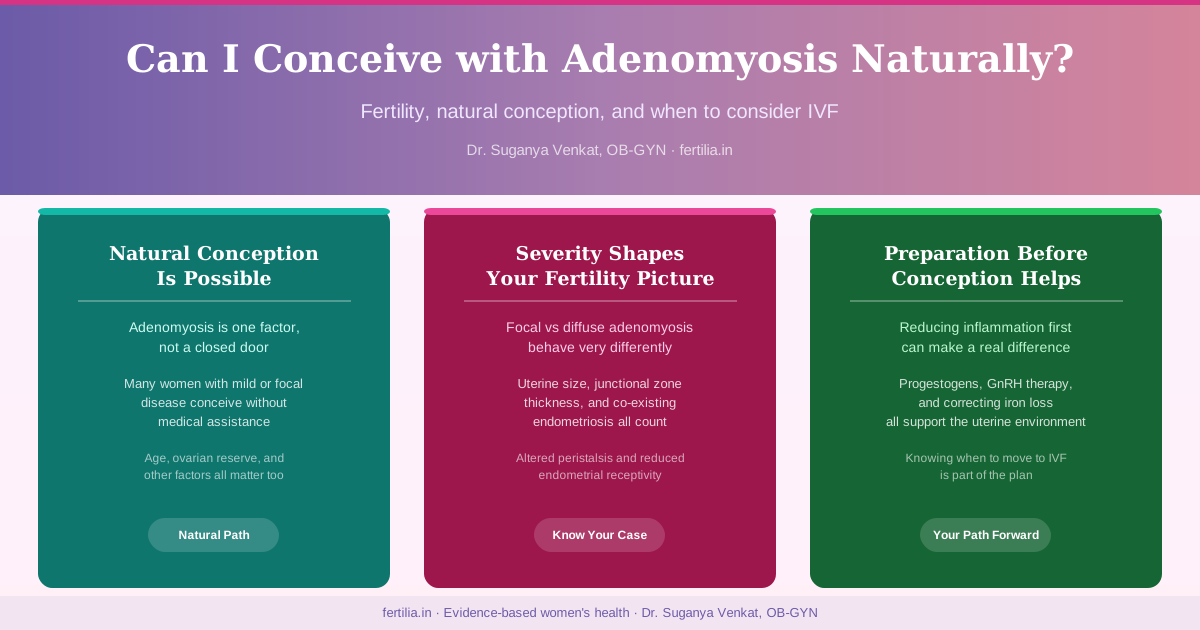
The answer is that many women with adenomyosis conceive naturally and carry healthy pregnancies. Adenomyosis is one factor in your fertility picture, not a closed door. The longer answer is more nuanced, because adenomyosis does affect the uterine environment in real ways, and how much it affects your individual situation depends on how extensive the disease is, your age, and what else is going on.
This post covers what adenomyosis does to the uterus from a fertility standpoint, how severity shapes the outlook, what can be done before trying to conceive, and when assisted reproduction is the better route.
For more on this, read our guide on Trying to Conceive & Mental Health. If you have not yet read our guide to the condition itself, that is a useful place to start: Adenomyosis: Symptoms, Causes and Treatment Options.
What Adenomyosis Does to the Uterine Environment
To understand the fertility question, it helps to know what adenomyosis does to the uterus.
In adenomyosis, tissue that normally lines the uterine cavity grows into the muscular wall of the uterus where it does not belong. That misplaced tissue still responds to hormonal signals each month, bleeding and swelling within the muscle with nowhere to drain. The result, over time, is a bulkier, less elastic uterus and a disrupted environment in which an embryo would need to implant.
Three things are particularly relevant to fertility:
Altered uterine contractions. A healthy uterus has coordinated, wave-like contractions that help sperm travel toward the fallopian tubes and, after fertilisation, help an embryo settle into the lining. In an adenomyotic uterus, these contractions become irregular and sometimes incoordinated. This altered peristalsis can make the early stages of conception harder for both sperm and embryo.
Reduced endometrial receptivity. The lining of the uterus has a brief period, sometimes called the implantation window, when it is most receptive to an embryo. Research consistently shows that this window is altered in women with adenomyosis, with changes in the proteins and signalling molecules that normally help an embryo attach and embed into the lining. The endometrial environment is less hospitable than it would otherwise be.
A pro-inflammatory uterine environment. The trapped bleeding inside the muscle wall sets off a persistent low-grade inflammatory process within the uterus. This altered biochemistry affects both implantation success and early pregnancy continuation, which is why adenomyosis is associated in several studies with a modestly higher rate of early pregnancy loss.
None of this means natural conception cannot happen. It means the conditions are somewhat less optimal, and by how much varies considerably from one woman to the next.
Severity Makes a Real Difference
Adenomyosis exists on a spectrum. Focal adenomyosis, where small areas of misplaced tissue are present in one part of the muscle wall, behaves very differently from diffuse adenomyosis, where disease has spread extensively throughout the uterine wall and the uterus becomes significantly enlarged and boggy.
Women with mild or focal adenomyosis frequently conceive without difficulty. Some never know they had the condition until it appears on a scan done for an unrelated reason. Women with more extensive disease, particularly a substantially enlarged uterus and a heavily involved muscle wall, tend to experience a more pronounced effect on fertility.
The features that matter most when assessing the fertility impact include:
- Whether the disease is focal or diffuse
- Uterine size (a significantly enlarged uterus is a stronger predictor of fertility difficulty than a mildly affected one)
- Junctional zone thickness on MRI (the junctional zone is the boundary between the lining and the muscle wall; thickening here is the hallmark of adenomyosis on MRI and correlates with disease extent)
- Whether adenomyosis co-exists with endometriosis (the two conditions share hormonal drivers and frequently occur together; the combination can compound the fertility impact, and you can read more about that at Endometriosis and Fertility: What to Know)
A gynaecologist assessing your situation for fertility will want to know these specifics, not simply whether adenomyosis is present on a report.
If you have been diagnosed with adenomyosis and want to understand what it means for your fertility, you can speak with Dr. Suganya in a video consultation.
What the Evidence Shows on Natural Conception
The evidence on natural conception rates in women with adenomyosis is largely inferred from IVF outcome studies, where conception rates can be tracked carefully and compared with matched control groups. This means we know more about adenomyosis in assisted cycles than in natural ones, but the underlying biology of the uterine environment is the same in both.
A systematic review by Younes and Tulandi, published in the Journal of Minimally Invasive Gynecology in 2017, brought together data from multiple studies of women with adenomyosis undergoing IVF. The review found consistently lower clinical pregnancy rates and live birth rates in women with adenomyosis compared with matched controls, with the difference more pronounced in women with more extensive disease. This confirms that adenomyosis has a real effect on the uterine environment, one that matters even in assisted cycles where egg quality and fertilisation are optimised separately.
For natural conception, the practical picture is this: women who are younger, who have mild or focal adenomyosis, who ovulate regularly, and who have no other significant fertility-affecting factors (no blocked tubes, normal ovarian reserve, a partner with a normal semen analysis) have a reasonable chance of conceiving naturally, and many do. Whether to allow time for natural attempts, and how much time, depends on the balance of these factors alongside your personal timeline.
Before You Start Trying: What Can Help
The most useful preparation for conception with adenomyosis is to reduce the inflammatory activity in the uterus before you begin trying. The evidence base for specific pre-conception interventions is still developing, but the following strategies are used in clinical practice.
A period of progestogen therapy. Some gynaecologists recommend a course of progestogen treatment before trying to conceive, to reduce disease activity and allow the uterine environment to settle. The levonorgestrel intrauterine system (Mirena) is effective for this purpose, as are oral progestogens in certain protocols. This requires careful planning: you use the treatment for a defined period, remove or stop it, and then try to conceive in the window that follows. It suits women with moderate disease who have some flexibility in their timeline.
GnRH analogue therapy before IVF. A course of GnRH analogue injections, which temporarily suppress ovarian function and reduce the hormonal stimulation driving adenomyosis activity, is used in some fertility protocols before IVF in women with adenomyosis. Several studies suggest that a period of down-regulation before starting an IVF cycle may improve endometrial receptivity and outcomes. This is primarily relevant if you are moving toward assisted conception rather than a universal recommendation for natural conception attempts.
Correcting iron deficiency before conception. Heavy periods are one of the hallmarks of adenomyosis (for the full picture on why, see Heavy Periods After 35: Fibroids, Adenomyosis or PCOS?). If you have been losing significant blood each month, checking your ferritin and correcting iron deficiency before pregnancy is an important step. Going into a pregnancy already iron-deficient compounds the demands on your body once your blood volume expands in early pregnancy.
General health before conception. Keeping a healthy weight, managing chronic inflammation through diet, and attending to your general hormonal health supports the overall environment. This is not a substitute for clinical management, but it matters alongside it.
When Assisted Reproduction Makes More Sense
Natural conception is not always the most efficient first step, even when it is technically possible. Moving more quickly toward a fertility clinic assessment, and potentially toward IVF or IUI, is worth considering in several situations:
- Age 37 or above with adenomyosis, particularly if the disease is anything beyond very mild
- Diffuse adenomyosis with a substantially enlarged uterus
- Two or more early pregnancy losses that may be related to adenomyosis (if this applies, a miscarriage workup before trying again is worth doing: Recurrent Miscarriage: Tests After Two Losses)
- Co-existing blocked fallopian tubes or significantly reduced ovarian reserve
- A partner with moderate or significant semen analysis abnormality
- One year of trying naturally without conception (or six months if you are over 35)
Moving to IVF does not mean giving up or admitting defeat. It means choosing the route that gives you the best chance at the point in time where you are. Many women with adenomyosis conceive, carry, and deliver healthy babies through IVF or IUI. The conversation with your gynaecologist or fertility specialist should cover your scan findings, your age, your ovarian reserve, your partner’s results, and how much time you are willing to allow for natural attempts. These are clinical and personal decisions together.
IVF outcomes in adenomyosis are improved when the protocol accounts for the condition, including appropriate endometrial preparation and, where relevant, a period of pre-IVF hormonal down-regulation.
Pregnancy with Adenomyosis: What to Know Once You Conceive
Once you are pregnant, there are a few additional considerations worth knowing.
A modestly higher rate of early pregnancy loss has been reported in women with adenomyosis, related to the altered implantation environment. This is not a reason to avoid trying, but it is a reason to have close early monitoring once a pregnancy is confirmed, so that any issues are detected promptly.
Later in pregnancy, some studies report slightly higher rates of placental complications and a higher caesarean delivery rate in women with adenomyosis, though the absolute increases are modest and adenomyosis alone does not mean a complicated pregnancy. Letting your obstetrician know the diagnosis from the start ensures that your antenatal care is appropriately tailored.
FAQ: Adenomyosis and Conceiving
Can I conceive naturally with adenomyosis if my disease is mild? Yes, many women with mild or focal adenomyosis conceive without medical assistance. Mild disease has a much smaller effect on the uterine environment than extensive diffuse adenomyosis. Whether to attempt natural conception and for how long depends on your age, your other fertility parameters, and what your scan shows about the extent and location of disease.
Does adenomyosis stop ovulation? Adenomyosis does not prevent ovulation. The condition affects the uterine muscle wall and the endometrial environment, not the ovaries or the process of egg release. Women with adenomyosis ovulate normally unless another co-existing condition (such as PCOS or a thyroid problem) is affecting ovulation separately.
Why does adenomyosis increase miscarriage risk? The higher rate of early pregnancy loss seen in some studies of adenomyosis is thought to be related to altered uterine contractility and a less receptive endometrial environment in the implantation window. An embryo trying to implant in a uterus with active adenomyosis may encounter a biochemical and mechanical environment that is less supportive of early placentation. The risk is not absolute, and many pregnancies in women with adenomyosis continue without loss.
Can surgery improve my chances of conceiving with adenomyosis? Surgical removal of localised adenomyosis (adenomyomectomy) is technically possible in selected cases. However, it carries risks including weakening of the uterine wall, which may require a caesarean delivery and, in rare cases, could lead to uterine rupture in a future pregnancy. It is not routinely recommended before trying to conceive unless the disease is genuinely focal, surgically accessible, and other approaches have not helped. Most gynaecologists prefer medical management and optimised timing before considering surgery. This is a decision that requires an individual assessment.
How long should I try naturally before considering IVF if I have adenomyosis? For women under 35 with mild adenomyosis and no other significant fertility-affecting factors, a six-to-twelve month trial of natural attempts is usually a reasonable starting point. For women over 35, or with more significant disease, or with an additional factor alongside the adenomyosis, moving to a full fertility assessment within six months makes more practical sense. The right timeline is specific to you and your circumstances.
Can adenomyosis be diagnosed without surgery? Yes. Adenomyosis is typically diagnosed on transvaginal ultrasound or MRI scan. An ultrasound showing a bulky, heterogeneous uterus with asymmetrical muscle wall thickening or small cysts within the muscle is highly suggestive. MRI offers more detail, particularly about junctional zone thickness and disease extent. A surgical procedure is not required to make the diagnosis in most cases. If you have already had an ultrasound or MRI showing features of adenomyosis, that report is the starting point for a fertility-focused discussion.
How is adenomyosis different from endometriosis in terms of fertility impact? They are related but distinct conditions. In endometriosis, tissue similar to the uterine lining grows outside the uterus, on the ovaries, tubes, or pelvic surfaces. In adenomyosis, similar tissue grows into the uterine muscle wall. They share hormonal drivers and frequently co-exist (around four in ten women with endometriosis also have adenomyosis). The fertility implications overlap but differ in detail: endometriosis primarily affects the tubes, ovaries, and the pelvic environment, while adenomyosis primarily affects the uterine environment for implantation and early pregnancy. A woman with both conditions needs assessment and, where appropriate, management of each.
Adenomyosis is a condition with real fertility implications, but it is not a final answer to the question of whether you can have a baby. Many women with adenomyosis conceive, carry healthy pregnancies, and become mothers. The path involves understanding where you sit on the severity spectrum, preparing the uterine environment as well as possible before trying, and knowing at what point to move to assisted reproduction if natural conception is not progressing. A clear clinical assessment by a gynaecologist who understands the condition is where that conversation starts.