The baby has finally latched after forty minutes of crying. Your husband walks in and asks, quite innocently, whether you have eaten. And something in you snaps. You hear yourself shouting. Later, sitting with the baby asleep on your chest, you feel the shame arrive: What kind of mother gets this angry? What is wrong with me?
If this sounds familiar, I want you to hear one thing before anything else: you are not a bad mother, and you are not alone. Anger after delivery is common, it is under-discussed, and it responds well to the right support.
I am Dr. Suganya Venkat, an OB-GYN with more than 15 years of caring for women through pregnancy and the months after it. When new mothers in my video consultations finally describe the shouting, the slammed doors or the sudden urge to throw something, it is almost always the part of their story they were most afraid to say out loud. This post is for you if that is where you are.
What this post covers:
- What postpartum rage looks like, and how common it is
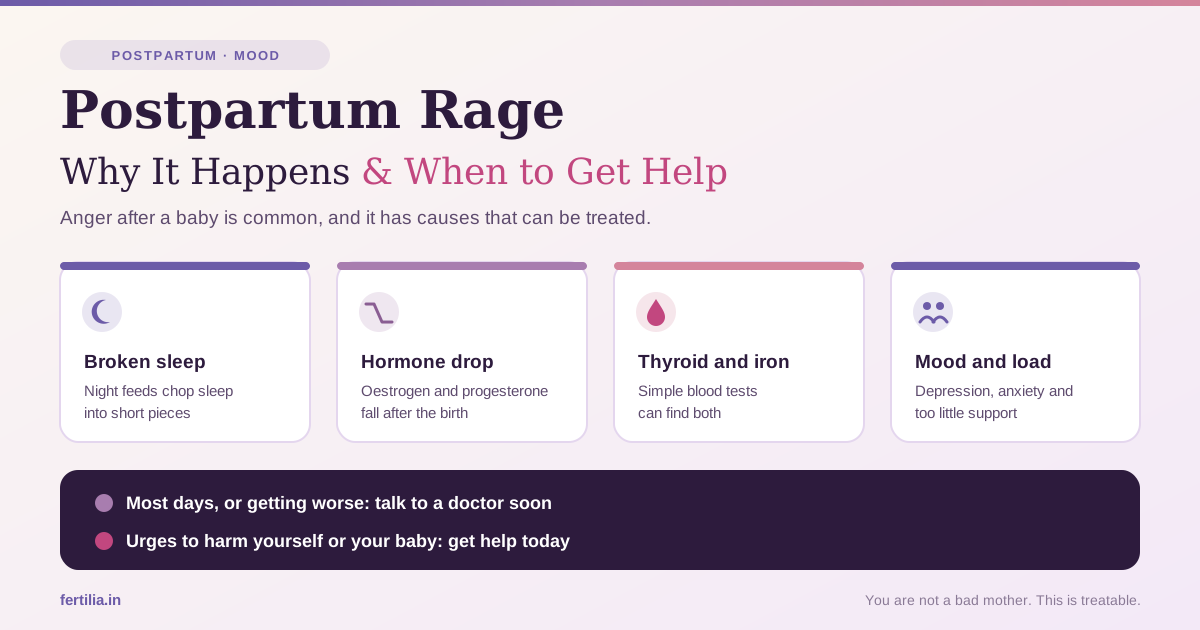
- Why it happens: sleep, hormones, thyroid, depression and the load you are carrying
- How it overlaps with postpartum depression and anxiety
- What helps, starting this week
- When anger is a sign to get help quickly
What Postpartum Rage Looks Like
Postpartum rage is not a formal diagnosis on its own. It is the name mothers have given to a pattern of anger after childbirth that feels out of proportion and hard to control. It usually looks like some of these:
- A short fuse with your partner, your mother or your mother-in-law over things that would not have bothered you before
- Anger that goes from zero to shouting in seconds, then drains away and leaves guilt behind
- Feeling furious when the baby will not sleep, will not feed, or cries for a long time
- Strong urges to hit a wall, throw something or slam a door, even if you do not act on them
- Replaying arguments in your head long after they are over
- Crying after an outburst, and a heavy sense of being a “bad mother”
Many women hide this part. Sadness after a baby is something people are beginning to talk about. Anger still feels shameful, so mothers describe it as “I’m just tired” or “I’m a bit irritable”, even to their doctor.
How Common Is It?
More common than most families realise. In a Canadian survey of 278 mothers with babies aged 6 to 12 months, 31% reported intense anger on a standard anger scale, and 26% had probable depression (Ou CH et al., BMC Pregnancy Childbirth, 2022, PMID 35227249). A larger American study of 1,383 postpartum women receiving home-visiting support found that about 21% had problematic anger on a brief screening questionnaire (Plummer Lee C et al., J Trauma Stress, 2025, PMID 39432439).
In India, the closest numbers we have are for postpartum depression, which often travels with anger. A 2026 meta-analysis pooling 62 Indian studies and 21,262 women estimated postpartum depression at 23.5% (Junaid KP et al., Women Health, 2026, PMID 41736649). That is roughly one in four mothers.
Why It Happens
There is rarely one cause. In my experience, most women have three or four of these stacked on top of each other.
Broken sleep
This is the biggest one, and the most underrated. A 2024 meta-analysis of 154 experimental studies found that every kind of sleep loss, whether a full night missed, shortened sleep or repeatedly broken sleep, reduced positive mood and increased anxiety in healthy volunteers (Palmer CA et al., Psychol Bull, 2024, PMID 38127505). Night feeds are exactly that third kind: sleep chopped into short pieces, night after night.
In the Canadian survey above, mothers’ own sleep quality, and how angry they felt about their baby’s sleep, both predicted how much anger they reported. So did depressive symptoms, having more than one child and lower income (Ou CH et al., BMC Pregnancy Childbirth, 2022, PMID 35227249). A tired brain has far less room between a trigger and a reaction.
The hormone drop after delivery
Oestrogen and progesterone rise steadily through pregnancy, then fall sharply within days of the birth. That shift is part of why the “baby blues” (tearfulness, mood swings, irritability in the first two weeks) are so common. For most women this settles on its own. When irritability keeps going well past the first few weeks, or gets worse, it is worth looking at the other causes on this list rather than blaming hormones and waiting.
Thyroid changes
The thyroid can become temporarily inflamed in the year after delivery. A quantitative review across 21 studies put postpartum thyroid dysfunction at about 8%, or roughly 1 in 12 women (Nicholson WK et al., Thyroid, 2006, PMID 16839259). In the overactive phase, women can feel jittery, restless, irritable and unable to sleep even when the baby does. It is easily mistaken for “new mother stress”. A simple TSH blood test sorts it out, and our guide to postpartum thyroiditis explains the phases and treatment.
Low iron and physical depletion
Blood loss at delivery, breastfeeding and months of pregnancy demands can leave iron stores low. Anaemia shows up as exhaustion, breathlessness and a short temper. If you are angry and constantly drained, ask for a haemoglobin and ferritin check. Our guide on postpartum anaemia covers how it is found and corrected.
Expectations that did not match reality
An integrative review of 24 studies found that anger in new mothers clustered around three themes: anger that came with depression, a sense of powerlessness, and anger when expectations of motherhood were violated (Ou CH et al., Birth, 2018, PMID 29781142). The birth that did not go to plan. The breastfeeding that hurts. The partner who sleeps through the night. The advice that arrives from every direction.
The Indian family setting
Many Indian mothers recover inside a joint or extended family, sometimes in their mother’s home for the first few months. That brings real help, and it also brings unasked-for advice, little privacy, rules about what you may eat or do, and very little space to say “I am not coping”. A small 2026 qualitative study, built on in-depth interviews with two urban Indian mothers, described anger tied to the emotional burden of care, lack of support, and having to stay silent (Mazumdar K et al., Front Glob Womens Health, 2026, PMID 42080191). Anger is often the only feeling that breaks through when everything else is being swallowed.
How Rage Connects to Depression and Anxiety
Anger can be a symptom of postpartum depression, and for some women it is the most visible one. The 2018 review found anger could coexist with postnatal depression and be directed at the mother herself, her children and her family (Ou CH et al., Birth, 2018, PMID 29781142). The American study found problematic anger co-occurred with depression, anxiety and post-traumatic stress symptoms (Plummer Lee C et al., J Trauma Stress, 2025, PMID 39432439).
This matters for screening. The Edinburgh Postnatal Depression Scale, a screen for postnatal depression, is a 10-question self-report questionnaire (Cox JL et al., Br J Psychiatry, 1987, PMID 3651732). None of its ten questions asks directly about anger. A mother whose main struggle is rage can score in a reassuring range and still be struggling. So if anger is your main symptom, say the word “anger” to your doctor.
It also helps to know the neighbouring conditions:
- If low mood, hopelessness and loss of interest sit underneath the anger, read our guide to postpartum depression signs and recovery.
- If the anger comes with racing thoughts, constant checking and a sense that something will go wrong, our guide to postpartum anxiety describes that pattern.
- If you are struggling to concentrate and forgetting things, which can make a stressful day feel even more out of control, baby brain after delivery explains what is behind it.
💬 Finding yourself angrier than you have ever been since the baby came? You can talk it through with Dr. Suganya Venkat over a ₹399 online video consultation, from anywhere in India. She will look at sleep, thyroid, iron and mood together, so the plan covers the whole picture. Message Dr. Suganya on WhatsApp
Thoughts That Frighten You
Some mothers are not just angry. They also have sudden, unwanted thoughts or images of the baby being hurt: dropping her on the stairs, the baby stopping breathing, or even an image of themselves doing something harmful. These thoughts can be terrifying, and many women keep them secret.
A Canadian study that followed 763 women from pregnancy and interviewed them after the birth found that 95.8% had unwanted thoughts of accidental harm to their baby and 53.9% had unwanted thoughts of intentional harm, most often thoughts of neglect. These thoughts were most intense in the first two months, and for most women they faded or stopped by six months (Collardeau F et al., J Clin Psychiatry, 2024, PMID 39145681).
An unwanted thought that horrifies you is a very different thing from an urge you feel pulled to act on. The first is common and usually settles. The second needs help the same day, as described below. If you cannot tell which one you are having, that is itself a good reason to talk to a doctor.
What Helps, Starting This Week
In the moment
- If the baby is crying and you feel yourself losing control, lay the baby down on their back in an empty cot or cradle with a firm, flat mattress, and walk out of the room for a few minutes. A baby crying safely in a cot is fine. Never shake a baby, however frustrated you feel.
- Breathe out slowly, longer than you breathe in, for a minute. Splash cold water on your face.
- Call or message someone. Even one sentence (“I’m about to lose it, can you come?”) helps.
Protect a block of sleep
Protecting one longer, unbroken stretch of sleep can help, because broken sleep is so closely tied to mood. If you are breastfeeding, once feeding is established, expressed milk lets someone else take one night feed. If you are formula feeding, a partner or family member can take a full shift. This is a medical need, and it is reasonable to ask your family for it in those words.
Find the pattern
For one week, note each outburst on your phone: time, what happened just before, how long since you last slept, and whether you had eaten. Most women find a pattern within days, often late evening, hunger, or a particular person or topic.
Eat and drink regularly
Long gaps without food make irritability worse. Keep something easy within reach while feeding: a banana, a handful of roasted chana, curd rice, a ragi ladoo, or a glass of buttermilk.
Say it out loud to the right person
Tell your partner what the anger feels like when you are calm, and agree on a signal that means “I need you to take over now”. If someone in the household keeps triggering you, a doctor can sometimes help the family understand that the new mother needs rest and fewer instructions.
Get the medical causes checked
Ask for TSH, haemoglobin and ferritin if they have not been checked since delivery. Your 6-week postpartum check-up is a natural moment to raise anger, but you do not need to wait for it.
Treatment works
When anger is part of postpartum depression or anxiety, treating that condition usually brings the anger down too. Talking therapy is effective, and when medication is needed, there are options that many breastfeeding mothers use. Your doctor will weigh this with you. At Fertilia, our postpartum program brings mental-health support together with recovery, lactation and nutrition care, so you are not juggling separate appointments.
When to Get Help
Talk to a doctor soon (within the next week or two) if:
- The anger is happening most days, or getting worse instead of settling
- It has lasted beyond the first few weeks after delivery
- It comes with low mood, hopelessness, constant worry or poor sleep even when the baby sleeps
- It is affecting how you feel about your baby or your relationships
- You feel exhausted or shaky (thyroid and iron are worth checking)
Get help today if:
- You have urges, not just unwanted thoughts, to hurt your baby, yourself or someone else
- You have thoughts that your family would be better off without you
- You are afraid of what you might do while angry
- You notice new or unexplained breathlessness. Get it checked the same day rather than putting it down to iron or thyroid. Sudden or severe breathlessness, breathlessness at rest, chest pain or fainting needs emergency care: call 112
- You (or your family) notice confusion, seeing or hearing things others do not, very little need for sleep, or behaviour that seems unlike you. These can be signs of postpartum psychosis, a rare emergency that needs same-day care
If you may act on thoughts of harm or cannot stay safe, call India’s emergency number 112 or go to the nearest emergency department, and ask someone you trust to stay with you and the baby. For mental-health support at any hour, Tele-MANAS, the government’s national mental health helpline, can be reached free on 14416 or 1800-89-14416 (dghs.mohfw.gov.in).
Frequently Asked Questions
Is postpartum rage normal?
Anger after delivery is common. In one survey, 31% of mothers of babies aged 6 to 12 months reported intense anger. Common does not mean you have to put up with it, though. If it is frequent, getting worse or frightening you, it is worth getting checked, because the causes are usually treatable.
Why am I so angry after having a baby?
Usually because several things are stacked together: broken sleep, the hormone drop after birth, physical depletion such as low iron, sometimes thyroid changes, the gap between what you expected and what is happening, and the pressure of family life. Anger can also be a sign of postpartum depression or anxiety.
Is postpartum rage a sign of postpartum depression?
It can be. Research shows anger often coexists with postnatal depression, and for some women it is the most noticeable symptom. Because the standard depression screen does not ask about anger directly, mention it to your doctor in plain words so it is not missed.
How long does postpartum rage last?
It varies. Irritability in the first two weeks often settles with the baby blues. Anger that continues for months usually has a cause, such as ongoing sleep deprivation, depression, anxiety or thyroid problems, and it tends to improve once that cause is treated.
Can postpartum rage be caused by thyroid problems?
Yes, it can contribute. Postpartum thyroid dysfunction affects about 1 in 12 women, and the overactive phase can cause irritability, restlessness and poor sleep. A TSH blood test checks for it.
Is it normal to feel angry at my baby?
Many mothers feel flashes of anger at a baby who will not stop crying, and then feel guilty about it. Feeling it is human. What matters is what you do with it: put the baby down safely and step away when you feel overwhelmed. If you feel urges to hurt your baby, or fear you might, get help the same day.
Who should I talk to about postpartum anger?
Start with your gynaecologist or family doctor, who can check thyroid, iron and mood and arrange counselling or psychiatric care if needed. You can also speak to Dr. Suganya over an online video consultation. If you are in immediate danger, call 112.
You Do Not Have to Hold This Alone
Anger after a baby says nothing about how much you love your child. It is a signal that something, often sleep, support, or your body’s recovery, needs attention.
If the anger has been building and you want a plan for it, Dr. Suganya consults online across India for ₹399. Tell her what has been happening in your own words, and she will help you work out what is behind it and what to do next. WhatsApp Dr. Suganya to book a consultation