A woman who has just had a baby stops sleeping, not because the baby is waking her, but because she cannot settle even when the house is quiet. Within a day or two she is talking faster than usual, convinced she can suddenly see connections nobody else notices, or frightened that people on the television are sending her messages. Her family assumes exhaustion. It is not exhaustion.
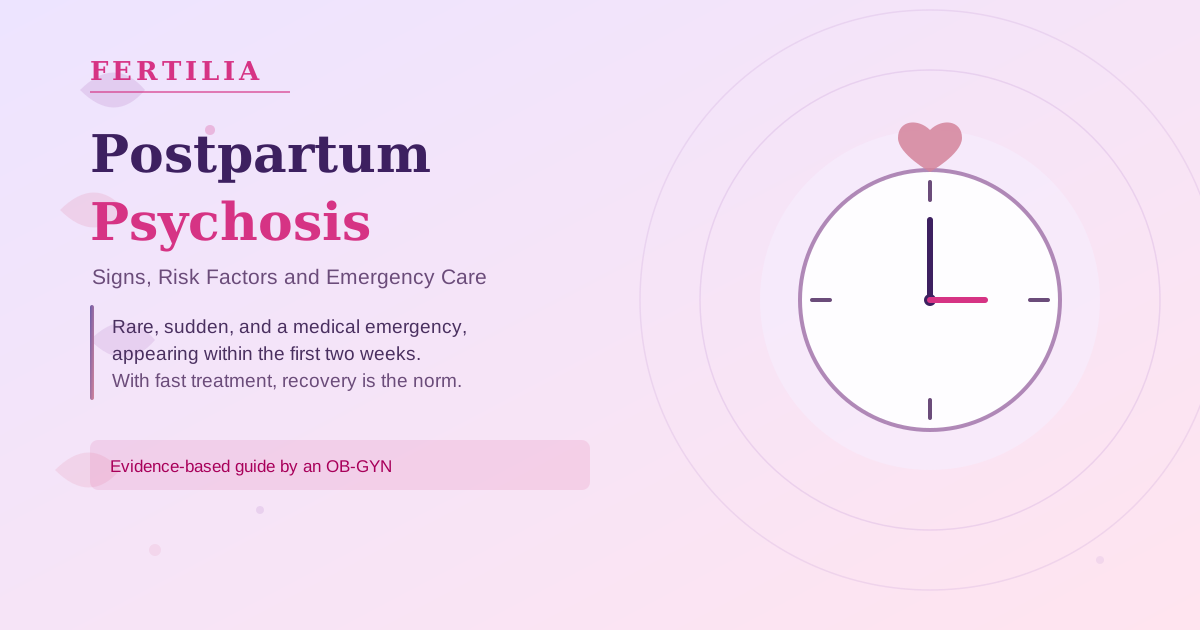
This is postpartum psychosis, and it is one of the few true psychiatric emergencies in obstetric care. It is also rare, sudden in onset, and, with fast treatment, highly treatable. Those three facts need to sit together, because most of what circulates about this condition emphasises only the frightening part.
I’m Dr. Suganya Venkat, an OB-GYN with over 15 years of experience, and I want to walk through this carefully: what postpartum psychosis actually looks like, how it differs from postpartum depression and anxiety, who is at higher risk, and precisely what emergency care involves. This is the third piece in a series, alongside our guides on postpartum depression and postpartum anxiety, because these three conditions are different in kind, not just in severity, and knowing which one you or someone you love may be facing changes what happens next.
What This Post Covers
- How postpartum psychosis differs from baby blues, postpartum depression, and postpartum anxiety
- The specific signs and symptoms, and how quickly they can appear
- Who is at higher risk, and why bipolar disorder matters more than any other factor
- What emergency care actually involves, and why it works
- What partners and family should do in the first hours
- Answers to the questions I am asked most often about this condition
Postpartum Psychosis Is a Different Condition, Not a Worse Version of PPD
It is easy to assume postpartum psychosis sits at the far end of a spectrum that starts with baby blues and moves through postpartum depression. It does not work that way. Postpartum psychosis is a distinct clinical condition with its own biology, its own timeline, and its own treatment pathway.
Baby blues involves tearfulness and mood swings that resolve within two weeks on their own.
Postpartum depression involves persistent low mood, numbness, or disconnection from the baby that lasts beyond two weeks and needs treatment, but the woman’s grip on reality is intact throughout. She knows what is real.
Postpartum anxiety involves racing thoughts and excessive worry, again with reality intact.
Postpartum psychosis is different in kind. It involves a break from reality itself, confusion about what is happening, delusions (fixed false beliefs), hallucinations (seeing or hearing things that are not there), or a mood that swings so rapidly and extremely that it no longer resembles ordinary sadness or worry. This is not a mood symptom that has become severe. It is a different category of illness that happens to be triggered by childbirth.
A large systematic review of the global literature found reported incidence estimates for postpartum psychosis ranging from roughly 1 to 2 per 1,000 births, making it far rarer than either postpartum depression or postpartum anxiety (VanderKruik et al., 2017, BMC Psychiatry, PMID 28754094). Rare does not mean it can be ignored. It means that when the signs appear, they need to be taken seriously immediately, not watched for a few days to see if they settle.
The Signs: What to Watch For
The defining feature of postpartum psychosis is how quickly it appears and how quickly it can change. Symptoms typically begin within the first two weeks after delivery, most often between day 3 and day 10, though onset can occasionally be even sooner in women with an existing bipolar diagnosis (Bergink, Rasgon, and Wisner, 2016, American Journal of Psychiatry, PMID 27609245). This is not a gradual decline over weeks. Family members often describe it as someone becoming a different person within 24 to 48 hours.
Early warning signs
- Severe insomnia that is not about the baby. She cannot sleep even when someone else is caring for the baby and the opportunity to rest is right there.
- Restlessness or agitation that feels out of proportion, pacing, an inability to sit still, or speech that is unusually fast or hard to follow.
- Rapid, extreme mood swings, moving between elation, irritability, and despair within hours, unlike the more gradual mood changes of PPD.
- Uncharacteristic confusion, appearing disoriented about the day, the time, or familiar surroundings.
Signs that mean this is now an emergency
- Delusions: fixed false beliefs that do not respond to reassurance or evidence, for example a conviction that the baby is unwell when every check says otherwise, that she has a special mission or power, or that people around her intend harm.
- Hallucinations: hearing voices or seeing things that are not there, particularly voices commenting on her or the baby.
- Delusions or thoughts specifically about the baby, including confusion about whether the baby is truly hers, or beliefs that something is deeply wrong with the baby that cannot be reasoned away.
- Disorganised behaviour or speech that is difficult for family to follow or that does not track logically.
- Any thought of harming herself or the baby. This requires the same response as every other sign on this list: immediate medical attention, not observation.
If you are reading this list and recognising a family member, or recognising this in yourself even faintly, the next step is the same regardless of how many boxes are ticked: go to hospital or call your doctor now. This is not a condition where waiting to see if it passes is the safer choice.
Why This Happens: Risk Factors
Postpartum psychosis can occasionally appear in women with no known risk factors at all, but for most women it is closely linked to an underlying vulnerability to bipolar-spectrum illness, whether or not that vulnerability was recognised before pregnancy.
Bipolar disorder is the single strongest risk factor. Women with an existing bipolar I or II diagnosis carry a materially higher risk of postpartum psychosis than the general population, and the risk rises further if mood-stabilising medication was stopped during pregnancy. In a prospective study of women managed through pregnancy and the postpartum period, untreated bipolar disorder was associated with substantially more recurrences of illness than treated bipolar disorder (Bergink et al., 2012, American Journal of Psychiatry, PMID 22407083). This is one of the clearest reasons a psychiatric history should never be hidden from your obstetric team out of embarrassment. It changes the plan for how closely you are watched after delivery, and it can mean the difference between prevention and crisis response.
A previous episode of postpartum psychosis is the second strongest predictor. Women who have experienced it once carry a substantially elevated risk of it recurring after a future delivery. Research following women with bipolar affective puerperal psychosis found a high rate of recurrence after a subsequent birth (Robertson, Jones, Haque, Holder, and Craddock, 2005, British Journal of Psychiatry, PMID 15738508). If this describes your history, the right time to build a plan with a psychiatrist is before you conceive again, not after delivery.
A family history of bipolar disorder or postpartum psychosis in a first-degree relative also raises risk, even without a personal diagnosis. This is a genetic and biological vulnerability, not something anyone did.
Other contributing factors include a first pregnancy, a complicated or traumatic delivery, and significant sleep deprivation in the days immediately after birth, though these tend to act as triggers on top of an underlying vulnerability rather than causes on their own.
What does not cause it: postpartum psychosis is not caused by weak character, insufficient love for the baby, or poor parenting. It is a biologically driven psychiatric emergency, closely related to bipolar illness, triggered by the dramatic hormonal shifts of childbirth in a brain that is already vulnerable to this kind of episode.
Why This Is a Genuine Emergency, Stated Plainly
Postpartum psychosis needs urgent psychiatric assessment because a woman experiencing delusions or hallucinations may act on beliefs that are not real, which can create risk to herself or her baby. This is why the standard of care is immediate evaluation, not a wait-and-watch approach, and why hospital admission (often to a specialist mother-baby psychiatric unit where available) is the usual first step.
What matters just as much, and gets far less attention: postpartum psychosis responds extremely well to treatment. In a study following women through a staged treatment protocol for first-episode postpartum psychosis, most women achieved complete remission, and the majority remained well at nine months (Bergink, Burgerhout, Koorengevel, et al., 2015, American Journal of Psychiatry, PMID 25640930). Longer-term follow-up research also found that a substantial share of women who experience postpartum psychosis go on to have no further severe psychiatric episodes outside the postpartum period (Gilden, Kamperman, Munk-Olsen, et al., 2020, Journal of Clinical Psychiatry, PMID 32160423).
The frame I want you to hold onto is this: this is a medical emergency with a genuinely good outlook when it is treated quickly. Fear of the diagnosis should never be a reason to delay getting help. Delaying help is the only thing that makes the outlook worse.
📞 If You Recognise These Signs, Please Do Not Wait
If you or someone you love is showing confusion, unusual beliefs, hallucinations, or extreme mood swings in the weeks after delivery, go to the nearest hospital emergency department now, or call your obstetrician or a psychiatrist immediately. If there is any thought of harm to the mother or the baby, this is a call-108-or-go-to-hospital situation, not a wait-until-morning one.
Message Dr. Suganya on WhatsApp →
If you are not sure whether what you are seeing rises to this level, message us anyway and describe it. We would always rather answer a call that turns out to be nothing than miss one that mattered.
What Emergency Care Involves
Knowing what happens next can make an already frightening moment less disorienting.
1. Immediate assessment. A doctor will evaluate mental state, rule out other medical causes of confusion or altered behaviour (such as thyroid disturbance, severe infection, or a complication like eclampsia, since these can sometimes mimic psychiatric symptoms), and determine the safest immediate setting for care.
2. Hospital admission. Most cases of postpartum psychosis are managed with inpatient psychiatric care in the initial phase, both to stabilise symptoms quickly and to ensure the mother and baby are safe while treatment takes effect. Where a specialist mother-baby psychiatric unit is available, this allows treatment to happen while supporting the bond with the baby under supervision.
3. Medication. Treatment typically combines medication to calm acute agitation and restore sleep, an antipsychotic to address the psychotic symptoms directly, and often a mood stabiliser such as lithium, particularly when the picture suggests an underlying bipolar-spectrum vulnerability. This combination is why remission rates with prompt treatment are high.
4. Family involvement. Family are usually brought into the treatment plan early, both to support the mother through recovery and to help supervise safely around the baby until the treating psychiatric team confirms it is appropriate to resume unsupervised care.
5. Follow-up and relapse planning. Once the acute episode resolves, ongoing psychiatric follow-up matters, both to support full recovery and, for women who may consider another pregnancy in the future, to build a proactive plan with a psychiatrist well before conceiving again.
Recovery is not always instant. Acute symptoms often improve substantially within weeks of starting treatment, but rebuilding sleep, confidence, and the sense of bonding with the baby can take longer and does not always move in a straight line. That is a normal part of recovering from a serious illness, not a sign that treatment has failed.
What Partners and Family Need to Know
Family recognition often makes the difference in how quickly a woman gets help, because she herself may not recognise that what she is experiencing is not real.
Do:
- Take sudden changes in behaviour, speech, or beliefs seriously, even if she insists she is fine
- Go with her to the hospital or call her doctor directly rather than waiting to see if it passes
- Stay with her and the baby, or arrange for someone trustworthy to, until she has been assessed
- Speak to the treating doctor honestly about everything you have observed, however alarming it feels to say out loud
- Remember that this responds well to treatment, and your steady presence matters more than finding an explanation
Don’t:
- Dismiss unusual beliefs or behaviour as “just tiredness” if it involves confusion, hallucinations, or thoughts that do not track logically
- Wait for a scheduled appointment when symptoms are escalating quickly. This situation calls for same-day or immediate care
- Leave her alone with the baby if you have safety concerns, until a treating clinician has assessed the situation
- Blame yourself or her. This is her biology reacting to childbirth, and blame has no place in an emergency
If you have a family history of bipolar disorder or a previous episode of postpartum psychosis in the family, mention this to the obstetric team as early as the first antenatal visit. This single piece of information changes how closely a woman is monitored in the days after delivery, and forewarned monitoring is one of the most effective tools we have.
Frequently Asked Questions
How is postpartum psychosis different from postpartum depression?
Postpartum depression involves persistent sadness, numbness, or disconnection, but the woman’s sense of reality stays intact throughout. Postpartum psychosis involves a break from reality itself: delusions, hallucinations, or confusion. It also develops much faster, often within days rather than weeks, and requires emergency psychiatric care rather than outpatient support. Both conditions are treatable, but they need different responses.
How soon after delivery does postpartum psychosis appear?
Most cases begin within the first two weeks after birth, most commonly between day 3 and day 10 (Bergink, Rasgon, and Wisner, 2016, PMID 27609245). In women with a known bipolar diagnosis, symptoms can occasionally begin even sooner. Onset is typically sudden rather than gradual, family members often notice a clear change within a day or two.
Is postpartum psychosis common?
It is rare. Reported incidence estimates across studies range from roughly 1 to 2 per 1,000 births (VanderKruik et al., 2017, PMID 28754094), making it far less common than postpartum depression, which affects a much larger proportion of new mothers. Rarity does not lessen the urgency when signs do appear.
Who is most at risk of postpartum psychosis?
Women with a personal history of bipolar disorder carry the highest risk, particularly if mood-stabilising medication was stopped during pregnancy. A previous episode of postpartum psychosis and a family history of bipolar disorder or postpartum psychosis in a first-degree relative also raise risk substantially. Many women who develop it, however, have no previously recognised psychiatric history, which is why the signs matter regardless of background.
Can postpartum psychosis happen again in a future pregnancy?
Women who have experienced postpartum psychosis carry a meaningfully higher risk of it recurring after a later delivery (Robertson, Jones, Haque, Holder, and Craddock, 2005, PMID 15738508). This is exactly why a proactive plan with a psychiatrist, built before conceiving again rather than after delivery, matters so much for women with this history. With planning and close monitoring, many women go on to have a well-supported subsequent pregnancy and postpartum period.
Does postpartum psychosis mean someone will need lifelong psychiatric treatment?
Not necessarily. With prompt treatment, most women achieve full remission of the acute episode (Bergink et al., 2015, PMID 25640930), and longer-term studies show that a substantial share of women have no further severe psychiatric episodes outside the postpartum period (Gilden, Kamperman, Munk-Olsen, et al., 2020, PMID 32160423). Some women do go on to have an underlying bipolar-spectrum diagnosis that benefits from ongoing psychiatric care, which is a separate but manageable conversation with a psychiatrist.
What should I do right now if I think someone is showing these signs?
Go to the nearest hospital emergency department, or call your obstetrician or a psychiatrist immediately. Do not wait to see if it passes on its own, and do not leave the mother alone with the baby if you have any safety concern until she has been assessed. In India, the Tamil Nadu ambulance service can be reached at 108, and Tele-MANAS, the government mental health helpline, is available 24/7 at 14416 for guidance on where to go.
You Are Not Meant to Navigate This Alone
If any part of this description feels close to what you or someone you love is going through right now, please act on it today rather than waiting for reassurance that it will pass. Postpartum psychosis is frightening precisely because it moves fast, and that same speed is why quick action leads to genuinely good outcomes.
Dr. Suganya Venkat and the Fertilia team work alongside psychiatric care throughout the postpartum period, as part of the same Postpartum Recovery program that supports physical healing, infant feeding, and mental health together. If you are further along in recovery and want to understand the wider picture of what postpartum mental health can look like, our guides to postpartum depression and postpartum anxiety are a good next read, alongside our full guide to postpartum warning signs for the physical side of recovery.
Talk to Dr. Suganya on WhatsApp →
You do not have to work out on your own whether this is serious enough to reach out. Reach out, and let a doctor help you decide.