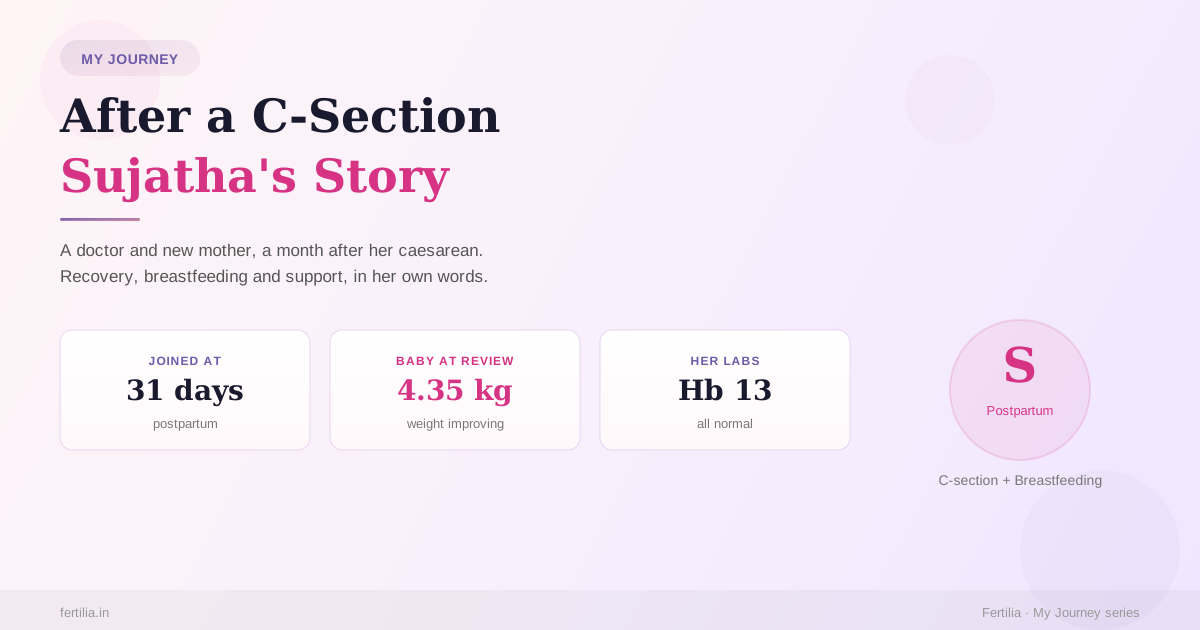
This story was written by Sujatha in her own words. Her name has been changed to protect her privacy. Published with her consent.
A note from Fertilia: Some readers may remember Sujatha from our Stories from June roundup. Here she tells her postpartum story in full. Sujatha is a doctor, and she joined Fertilia’s postpartum program about a month after her caesarean. Her words are lightly edited for clarity, with headings and a few short notes from our team. It follows her through the first weeks of feeds and recovery to the day her baby reached 4.35 kg and she began cutting down formula top-ups.
A New Chapter
Welcoming my baby was one of the happiest moments of my life. After the many challenges of my fertility journey and pregnancy, becoming a mother marked a very special new chapter in my life.
As a doctor, I understood the importance of postpartum recovery, but experiencing it myself while adjusting to motherhood brought a whole new perspective. The transition into motherhood was not easy, especially as I adjusted to breastfeeding, caring for my newborn, and looking after my own well-being.
The First Few Weeks
The first few weeks were a period of adjustment. Like many new mothers, I was managing frequent night feeds and interrupted sleep, which made it difficult to focus on my own recovery. I was also concerned about my baby’s weight gain and wanted to ensure she was getting enough nourishment through exclusive breastfeeding.
With the demands of caring for my newborn, I found it difficult to prioritise my own nutrition and manage the changes in my body after pregnancy. The frequent feeds, lack of sleep, and challenges of establishing a breastfeeding routine were physically and emotionally draining. Balancing my own recovery with my baby’s needs wasn’t easy, and I felt I needed guidance and support to navigate this phase.
That was when I joined Fertilia, when my baby was just 31 days old, around one month postpartum.
Guidance at Fertilia
My journey at Fertilia began with a consultation with Dr. Suganya. She reviewed my medical history, my reports and my current health challenges, and discussed my postpartum recovery and breastfeeding concerns. The focus was not on rushing into weight loss. At that stage, I needed to recover from my C-section, nourish my body, and support my baby’s growth while breastfeeding.
Following this, I had my nutrition consultation and received a personalised meal plan to support my recovery and breastfeeding needs, along with simple, practical guidance on regular meals, adequate protein and fibre, fluids, foods that may support lactation, and foods to avoid during this phase. The focus was on nourishing my body and rebuilding my strength, rather than on weight loss alone.
From our team: In the first weeks after a caesarean, a mother is healing from major surgery while feeding a baby around the clock. That is why weight loss was not the starting point for Sujatha. Steady meals, enough protein and fluids, and rest wherever it can be found come first. Our week-by-week C-section recovery guide explains what the body is doing in this phase.
Breastfeeding Support That Made a Difference
One of the most helpful parts of my journey was the dedicated lactation counselling session arranged with Dr. Manjari.
As a new mother, I had several questions about breastfeeding, and the session gave me practical guidance on breastfeeding and latch. It was reassuring to have someone I could reach out to whenever I had further questions or needed support. With the guidance I received, I gradually became more confident in managing my breastfeeding routine. I also felt more at ease with the new challenges this phase of motherhood brought.
From our team: Dr. Manjari is Fertilia’s Lactation Professional. A good latch is often the single biggest change in how feeding feels for mother and baby. If you are working on yours, our guide on how to get a deep latch walks through it step by step.
A Team in My Pocket
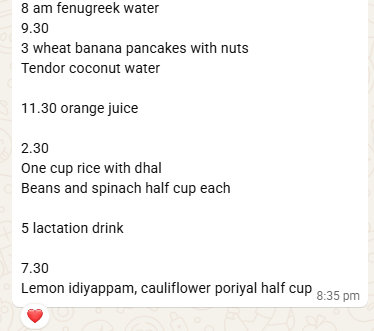
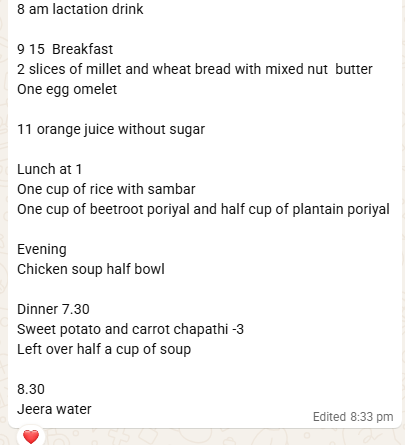
As part of the program, I had a dedicated WhatsApp group where I received regular updates and daily tips relevant to my postpartum stage. I shared my food intake and updates about my baby, and the team was always available whenever I needed guidance.
These are two of the days I shared with the team:
A wellness session was also arranged to support my emotional well-being during this period. Having consistent support meant I never felt I had to figure out postpartum life on my own.
Seeing the Progress
Over the following weeks, I became more confident with my breastfeeding routine, and seeing my baby’s weight improve brought me great reassurance. I also noticed positive changes in my own health, with more stable weight and improved energy levels.
After my baby’s paediatric review, I sent this update to the group:
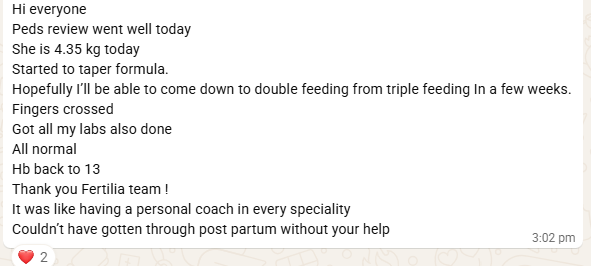
“Hi everyone. Peds review went well today. She is 4.35 kg today. Started to taper formula. Hopefully I’ll be able to come down to double feeding from triple feeding in a few weeks. Fingers crossed. Got all my labs also done. All normal. Hb back to 13. Thank you Fertilia team! It was like having a personal coach in every speciality. Couldn’t have gotten through post partum without your help.”
From our team: Sujatha was “triple feeding”, a demanding routine (explained in the FAQ below), and moving towards fewer steps is a real milestone. Temporary top-ups are common and are not a failure of breastfeeding; for many mothers they are a bridge while supply and feeding settle. A baby’s weight is judged by the paediatrician against her own growth curve over time, not against another baby’s number.
Her haemoglobin returning to 13 was another milestone: low haemoglobin after delivery is common and easy to miss, as we explain in our post on postpartum anaemia.
If the weeks after your delivery feel harder than you expected, with feeds, recovery and your own meals all competing, you do not have to work it out alone. Dr. Suganya and the Fertilia team support new mothers online, wherever you are in India. Talk to Dr. Suganya on WhatsApp
In My Own Words
I also left this review for the team:
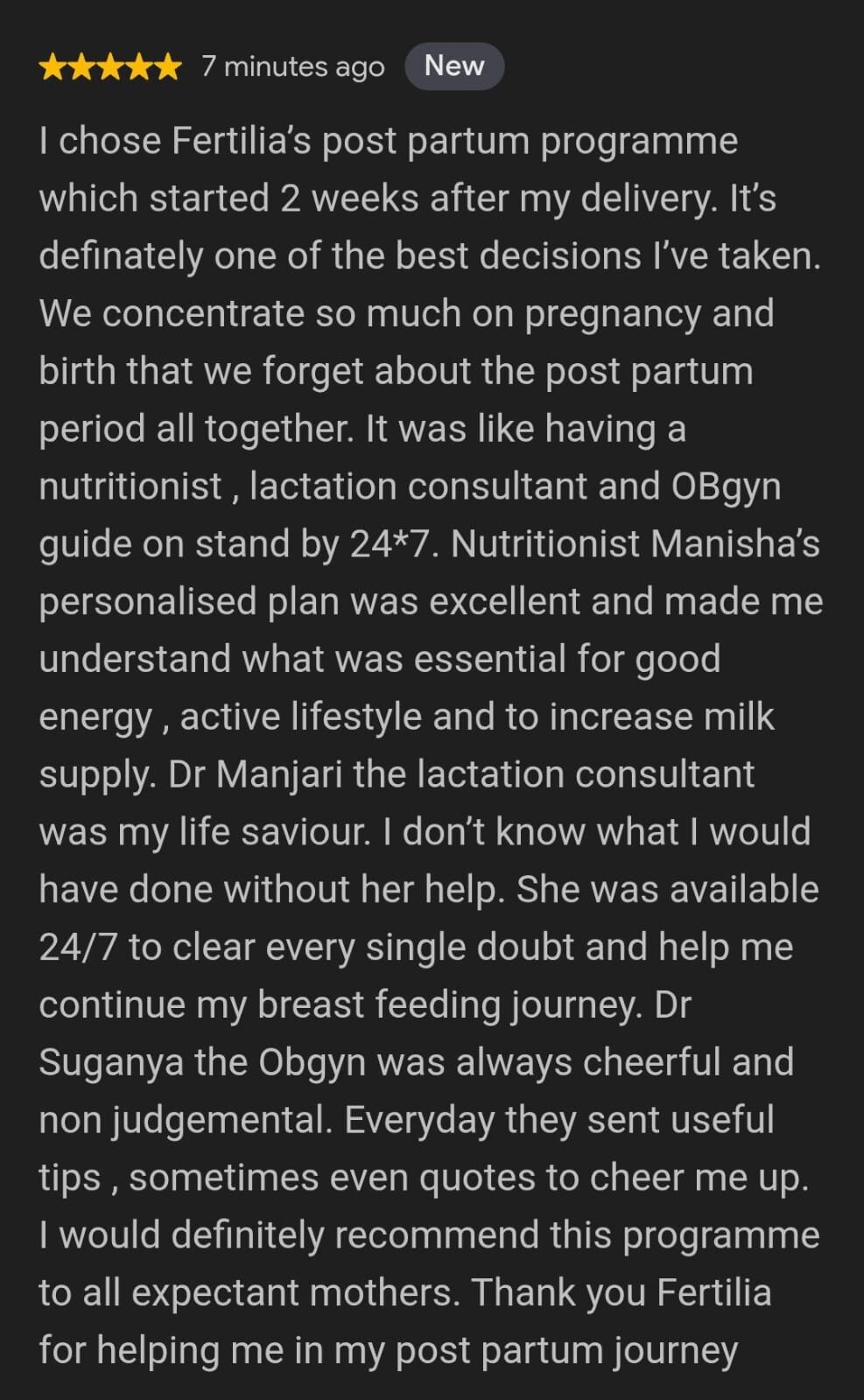
Her review recalls starting two weeks after delivery; her fuller written account gives 31 days. We have left both in her words.
“We concentrate so much on pregnancy and birth that we forget about the post partum period all together. It was like having a nutritionist, lactation consultant and OBgyn guide on stand by 24*7.”
Looking Back
Looking back, my postpartum journey has been a period of learning, recovery, and gradual progress. The medical, lactation, nutrition, and wellness support I received helped me manage this phase while taking care of my baby and my own health. I’m thankful to the Fertilia team for their guidance and support during this important phase of motherhood.
You can read more journeys like Sujatha’s on our stories page.
Whether you are a few days or a few months after delivery, Dr. Suganya, Dr. Manjari and the Fertilia nutrition team can help with recovery, breastfeeding and your own nourishment, fully online by video call. Start a conversation with Dr. Suganya on WhatsApp
Frequently Asked Questions
Answered by the Fertilia team.
When can I join Fertilia’s postpartum program?
At any stage after delivery. Sujatha joined when her baby was about a month old, after a caesarean. The plan is built around where you are when you start.
Should I focus on losing weight right after a C-section?
Not in the early weeks. After a caesarean your body is healing from surgery and, if you are breastfeeding, also making milk. The priority is regular meals, enough protein and fluids, and recovery. Gentle, gradual weight change can come later, once you are healing well and feeding is settled.
What does lactation support at Fertilia involve?
A dedicated session with Dr. Manjari, our Lactation Professional, over a video call, covering breastfeeding, latch and the questions that come up in the early weeks, with the option to reach out afterwards. Sujatha found the latch guidance and having someone to ask especially reassuring.
What is triple feeding?
It means three steps at each feed: breastfeeding, then a top-up of expressed milk and/or formula, then pumping or expressing to build milk supply. It is often advised for a time when a baby needs extra support with weight gain, and should be guided by your baby’s paediatrician or a lactation professional. Many mothers gradually reduce the steps as feeding and weight gain improve, as Sujatha was working towards after her baby’s paediatric review. When to reduce top-ups is a decision to make with your paediatrician, based on how your baby is growing over time. Fewer wet nappies than expected, a sleepy baby who is hard to wake for feeds, or weight that is not picking up are reasons to speak to your paediatrician promptly rather than wait.
Can diet help with breast milk supply?
Eating enough, drinking enough fluids and eating regularly all support a breastfeeding mother. Frequent, effective feeding with a good latch is the main driver of supply; specific lactation foods or drinks are a supporting extra at most. Our guide to increasing breast milk supply covers what helps most.
Is the program online?
Yes. All consultations, including Dr. Suganya’s, Dr. Manjari’s lactation session and the nutrition consultation, happen online by video call, with day-to-day support on WhatsApp, anywhere in India.
Every story we share is real, verified, and published with the patient’s consent. Her name has been changed, and her screenshots are shared with her consent with identifying details removed.