In the first weeks after a baby arrives, contraception is usually the last thing on anyone’s mind. Then, somewhere around the six-week checkup, the question lands all at once: which method, and is it safe while I am feeding?
Most of the advice a new mother hears is either a single-method answer (“just get a Copper-T”) or a vague reassurance (“you won’t get pregnant while breastfeeding”). Neither helps her choose.
I’m Dr. Suganya Venkat, an OB-GYN with more than 15 years of experience, and this is the comparison I walk women through when they are deciding. It puts the main options side by side, explains when each one can start after delivery, and shows how breastfeeding changes the picture.
What This Post Covers
- How soon fertility returns after delivery, with and without breastfeeding
- Breastfeeding as contraception, and the three conditions it depends on
- The progestin-only pill, combined pill and Chhaya
- The Antara injection and the implant
- The Copper-T and hormonal IUD after delivery
- A side-by-side table, and a simple way to decide by what matters most to you
- What these methods are called in Tamil and Hindi, and frequently asked questions
How Soon Fertility Returns After Delivery
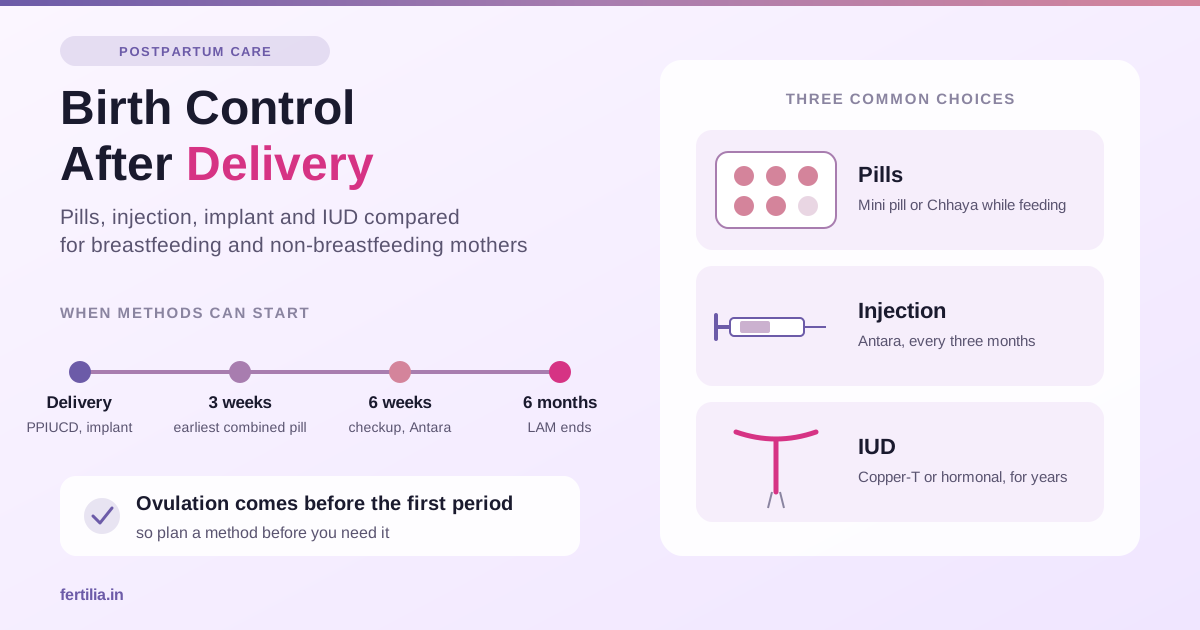
Ovulation comes back before the first period does, so you can become pregnant without having seen a single period since delivery.
If you are not breastfeeding, a systematic review found that the average first ovulation fell between day 45 and day 94 after delivery in the studies it included. Most women did not ovulate before six weeks, though a small number did ovulate earlier (Jackson E and Glasier A, Obstet Gynecol, 2011, PMID 21343770). Our guide to the first period after delivery explains that sequence in more detail.
The National Health Mission’s family planning booklet for community health officers (NHM, 2022, section 1) gives these practical markers for when pregnancy can occur again:
- about 4 weeks after delivery if you are not breastfeeding at all
- about 6 weeks if you are breastfeeding but not exclusively
- about 6 months if you are exclusively breastfeeding
Treat these as rough guides, not protected windows. Ovulation timing varies from woman to woman, and the six-month figure holds only while all three breastfeeding conditions in the next section apply. If you are having sex again and those conditions do not all apply, use a method from the start rather than waiting for a particular week.
The same booklet suggests waiting at least 24 months after a birth before becoming pregnant again. This is for your own recovery as much as the baby’s: a large meta-analysis linked intervals shorter than six months between pregnancies with higher odds of preterm birth and low birth weight in the next baby (Conde-Agudelo A et al., JAMA, 2006, PMID 16622143). Having a plan in place by the time you resume intimacy is the simplest way to give yourself that choice.
Breastfeeding as Contraception (LAM)
Breastfeeding can work as a temporary method, called the lactational amenorrhoea method (LAM), only while all three of these are true at once:
- Your periods have not returned.
- You are fully or nearly fully breastfeeding. The US guidance defines this as feeds no more than 4 hours apart in the day and 6 hours apart at night.
- Your baby is less than 6 months old.
These criteria come from the US Medical Eligibility Criteria for Contraceptive Use, 2024 (Nguyen AT et al., MMWR Recomm Rep, 2024, PMID 39106314). When they are all met, protection is good. A Cochrane review found six-month life-table pregnancy rates of 0.45% and 2.45% in the two controlled studies of LAM users (Van der Wijden C and Manion C, Cochrane Database Syst Rev, 2015, PMID 26457821).
The difficulty is how quickly real life moves outside those conditions. Formula top-ups, a baby who starts sleeping a long stretch at night, returning to work, or starting solids can each end LAM, often without anyone noticing. If any one condition stops applying, it is time to start another method. Many women use LAM as a bridge while they decide on a longer-term option.
Pills After Delivery: Three Different Kinds
“The pill” covers three quite different tablets, and after delivery the difference matters.
The progestin-only pill (mini pill)
This contains a progestin only, with no oestrogen. Under the US 2024 criteria, the progestin-only pill can be used from the time of delivery if you are breastfeeding (the benefits generally outweigh any theoretical risk in the first 30 days) and without restriction after that (Nguyen AT et al., 2024, PMID 39106314). The same document summarises studies in which starting progestin-only pills, injections or implants within six weeks of delivery showed no harmful effect on breastfeeding or on the baby’s growth and development in the first year, while noting that those studies were mostly of limited quality.
The mini pill needs to be taken at the same time every day, and missed-pill rules depend on the exact formulation, so read the leaflet for the brand you are given. It is available through private prescription; it is not part of the free government contraceptive basket.
The combined pill
The combined pill contains oestrogen as well as a progestin. After delivery it is the method with the clearest timing rules, for two reasons.
Clotting risk. The risk of a blood clot is raised after childbirth. The US 2024 criteria describe it as most pronounced in the first three weeks and falling to near-baseline levels by 42 days. Oestrogen adds to that risk, so the combined pill should not be used in the first 21 days after delivery, and is usually avoided until six weeks if you have extra risk factors. The listed risk factors include age 35 or above, a caesarean delivery, pre-eclampsia, heavy bleeding after delivery, a blood transfusion at delivery, a BMI of 30 or above, smoking, and a previous clot (Nguyen AT et al., 2024, PMID 39106314).
Breastfeeding. Evidence on milk supply is mixed. A systematic review found inconsistent effects on breastfeeding when combined pills were started before or after six weeks, with some studies showing more supplementation and shorter breastfeeding and others showing no effect. Some studies found slower infant weight gain when the pill was started before six weeks; none found this when it was started after six weeks (Tepper NK et al., Contraception, 2016, PMID 26002804).
Guidance differs on exactly when to start. The US criteria allow the combined pill from 30 days in a breastfeeding woman with no extra clotting risk factors, and from six weeks in one who has them. Those dates only cover the extra clot risk that follows delivery. Some risk factors, such as a previous clot or smoking at age 35 or above, can make the combined pill unsuitable at any time, so your doctor will check for them before prescribing it. India’s national programme is more cautious: the NHM booklet (section 2.5) lists breastfeeding women under 6 months and non-breastfeeding women under 3 weeks among those who should not use the programme’s combined pill, Mala N. In practice, if you are breastfeeding and want a daily tablet, the progestin-only pill or Chhaya is usually the first choice, and the combined pill becomes an option later.
If you have used the combined pill before and want to know about its side effects in general, our guide to birth control pill side effects covers that.
Chhaya (centchroman)
Chhaya is an Indian non-hormonal weekly pill. It is taken twice a week for the first three months and once a week after that. The NHM booklet (section 2.4) states that it can be started earlier than four weeks after delivery, has no effect on the quantity or quality of breast milk, and allows fertility to return immediately on stopping. It is free through government health facilities and ASHAs. Periods can become delayed or scanty over time, which is worth knowing in advance so it does not cause worry.
Because Chhaya is an Indian product, it does not appear in the US or most international eligibility tables, so ask your doctor or health worker how to time the first dose after delivery.
💜 Six weeks after delivery and unsure which method suits you? Message Dr. Suganya’s team on WhatsApp A ₹399 video consultation lets you go through your delivery details, feeding pattern and plans for the next baby, so the method you choose fits your situation, wherever you are in India.
The Antara Injection and the Implant
Both are progestin-only, so neither contains oestrogen.
Antara (DMPA injection)
One injection gives about three months of protection. Under the US 2024 criteria it can be used from delivery in breastfeeding women, with benefits generally outweighing risks in the early weeks and no restriction from six weeks. The US document also notes limited evidence that DMPA might further raise clotting risk after delivery (Nguyen AT et al., 2024, PMID 39106314). India’s Antara programme (NHM booklet, section 2.2) offers it at 6 weeks after delivery if you are breastfeeding and 4 weeks if you are not, and states that it does not affect the quantity or quality of milk.
The main trade-off after delivery is timing of your next pregnancy. The same booklet notes a delay in return of fertility of about 7 to 10 months from the last injection. That is not permanent, but if you might want another baby within a year or two, a method with a prompt return is a better fit. Irregular bleeding is common in the early months, and many women stop having periods with continued use.
The implant
The single-rod implant is placed under the skin of the inner upper arm and lasts three years. The NHM booklet (section 2.3) states that it can be used safely immediately after delivery, including by breastfeeding women, and that fertility returns early after removal. It is inserted and removed by a trained doctor at designated facilities, so check whether your local hospital offers it. Bleeding patterns change unpredictably for many women.
Our guide to the injection and implant compares the two in more depth, including bleeding changes and who each one suits.
The Copper-T and Hormonal IUD After Delivery
An IUD can go in at one of two times:
- Straight after delivery. India’s programme offers the Copper-T as a postpartum IUCD (PPIUCD) within 48 hours of a vaginal delivery, or during a caesarean (NHM booklet, section 2.1). The main drawback is that the device is more likely to be pushed out than one placed later.
- At about six weeks or later (interval insertion), once the uterus has returned to its normal size.
If the 48-hour window passes, India’s programme waits until about six weeks for an interval insertion. The US criteria describe postpartum IUD placement as safe, with no increase in infection risk, and place no timing restriction on IUDs from four weeks after delivery (Nguyen AT et al., 2024, PMID 39106314). That is about timing only: an infection of the womb after delivery rules out insertion while it is present.
The Copper-T has no hormones and does not affect milk supply. The hormonal IUD releases its progestin mainly within the uterus. Both let fertility return promptly after removal. The Copper-T can make periods heavier and crampier, especially in the first months; the hormonal IUD usually makes them lighter.
For expulsion rates by timing, insertion after a caesarean, and warning signs to watch for, see our postpartum IUD guide.
Side by Side: The Main Options After Delivery
| Method | Typical-use pregnancies per 100 women in the first year | Earliest usual start after delivery | While breastfeeding | Fertility after stopping |
|---|---|---|---|---|
| Progestin-only pill | 7 | From delivery | Suitable | Prompt |
| Combined pill | 7 | 3 to 6 weeks (US guidance); later in India’s programme | Usually deferred | Prompt |
| Chhaya (weekly) | No comparable figure | Within 4 weeks (NHM) | Suitable (NHM) | Immediate |
| Antara injection | 4 | From delivery (US); 4 to 6 weeks in India’s programme | Suitable | Delayed, about 7 to 10 months |
| Implant | 0.1 | From delivery | Suitable | Prompt |
| Copper-T | 0.8 | Within 48 hours, during caesarean, or from about 6 weeks | Suitable, no hormones | Prompt |
| Hormonal IUD | 0.1 to 0.4 | Immediately after delivery where offered, or from about 4 to 6 weeks | Suitable | Prompt |
| Condoms | 13 | Whenever you resume sex | Suitable | Immediate |
Effectiveness figures: CDC’s contraception overview, dated August 6, 2024, checked September 30, 2026. These are US estimates. Timing and breastfeeding columns: US Medical Eligibility Criteria 2024 (PMID 39106314) and the NHM family planning booklet. Your own start date depends on your delivery, feeding and health history.
For methods beyond the postpartum period, including permanent options, our full contraception comparison for India covers the complete range.
Choosing by What Matters Most to You
There is no single right answer, but most women find one or two priorities decide it.
- “I want nothing to affect my milk.” The Copper-T is hormone-free. Chhaya, the mini pill, the implant and the hormonal IUD are all considered suitable while breastfeeding.
- “I don’t want to remember anything daily.” An IUD or implant covers years with nothing to do. If you are having a caesarean or a hospital delivery, ask in advance whether PPIUCD is offered, so the decision is made before labour rather than during it.
- “I may want another baby in one to two years.” Choose a method with a prompt return: pills, implant or IUD. The injection is less suited because of its delayed return.
- “I had a caesarean, pre-eclampsia or heavy bleeding at delivery.” These count as clotting risk factors, so progestin-only or non-hormonal methods are the usual choice in the first six weeks.
- “I prefer nothing inside my body.” The mini pill, Chhaya or condoms suit you, used consistently.
- “We are sure our family is complete.” Permanent methods for either partner can be discussed with your doctor, ideally during pregnancy, so the decision is made calmly rather than in the days after delivery.
In Dr. Suganya Venkat’s online consultations at Fertilia, the conversation usually starts with two questions: how is feeding going, and when, if ever, would you like another baby? The method almost always follows from those two answers.
Practical Takeaways
- Ovulation returns before your first period, so plan contraception before you resume intimacy, not after your period comes back.
- Breastfeeding protects you only while all three LAM conditions hold.
- Oestrogen-containing pills wait at least three weeks after delivery, and longer if you are breastfeeding or have clotting risk factors.
- Progestin-only methods, Chhaya and the Copper-T are all options while breastfeeding.
- If you want a Copper-T at delivery, raise it at your antenatal visits so it is part of your delivery plan.
- The six-week checkup is a natural time to settle this. Our guide to the 6-week postpartum checkup covers what else to raise at that visit.
What It Is Called in Tamil and Hindi
In Tamil, contraception is karuthadai (கருத்தடை). In Hindi, it is garbhnirodhak (गर्भनिरोधक), and many women search in Hinglish, for example “delivery ke baad garbhnirodhak goli” or “delivery ke baad Copper-T”. When you ask a pharmacist or health worker, name the specific method as well (mini pill, Chhaya, Antara, Copper-T), because the general word can mean any of them.
Frequently Asked Questions
Which contraceptive is best after delivery? There is no single best method. While breastfeeding, the progestin-only pill, Chhaya, the implant, the Copper-T and the hormonal IUD are all suitable choices. The right one depends on whether you want something daily or long-acting, and on when you might want another baby.
Can breastfeeding alone prevent pregnancy? Only while all three LAM conditions are true: no periods yet, full or nearly full breastfeeding, and a baby under six months. In controlled studies, six-month pregnancy rates with LAM were 0.45% and 2.45% (Van der Wijden C and Manion C, Cochrane Database Syst Rev, 2015, PMID 26457821). Once any condition changes, start another method.
Can I take birth control pills while breastfeeding? Yes, the progestin-only (mini) pill and the non-hormonal Chhaya are suitable while breastfeeding. The combined pill containing oestrogen is usually deferred: India’s national programme lists breastfeeding women under six months among those who should not use it, and US guidance allows it from 30 days without extra clotting risk factors, or from six weeks with them. A previous clot, or smoking at age 35 or above, can rule it out altogether.
Is the Antara injection safe while breastfeeding? Yes. India’s programme offers it from six weeks after delivery in breastfeeding women and states it does not affect milk quantity or quality. Keep in mind that fertility can take about 7 to 10 months to return after the last injection.
Can a Copper-T be put in during a C-section? Yes. India’s programme offers the postpartum Copper-T during a caesarean or within 48 hours of a vaginal delivery. If that window passes, it is usually inserted from about six weeks after delivery.
How soon after delivery should I start contraception? Before you resume sex. If you are not breastfeeding, most women do not ovulate before six weeks, but a small number ovulate earlier, so waiting for the six-week checkup can leave a gap (Jackson E and Glasier A, Obstet Gynecol, 2011, PMID 21343770). If you are breastfeeding, you are protected only while all three LAM conditions hold; if any one does not, you need a method too. Several methods, including the mini pill, the implant and condoms, can be started in the first weeks after delivery, so there is no need to wait for the checkup.
Can I get pregnant before my first period after delivery? Yes. Ovulation happens before the first period, so the first egg can be released, and fertilised, before you have seen any bleeding. This is why contraception is best planned before you resume sex.
💜 Want help choosing a method that fits your feeding and your plans? Talk it through with Dr. Suganya over WhatsApp A ₹399 video consultation, alongside your own gynaecologist’s care, gives you time to weigh the options for your situation. Fertilia’s Postpartum program and our free normal delivery postpartum care guide are good places to start.