You may want reliable contraception without a daily tablet, or a method you can stop yourself. You might be breastfeeding, managing heavy periods, or planning pregnancy later. Those preferences matter alongside effectiveness.
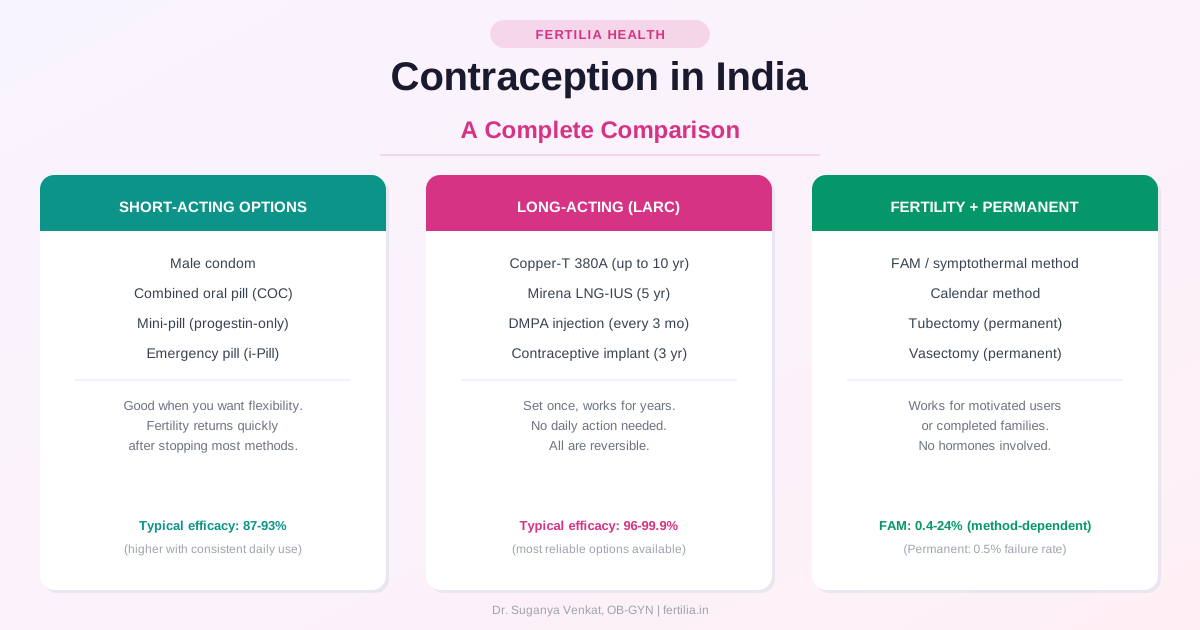
There is no single best contraceptive for every woman. IUDs and implants offer highly effective pregnancy prevention with little ongoing action. Condoms add protection against sexually transmitted infections (STIs). Pills and injections suit some women better, while permanent methods are for people who do not want future pregnancies.
I’m Dr. Suganya Venkat, an OB-GYN with 15+ years of experience. This comparison will help you discuss the options with your clinician: effectiveness, bleeding changes, fertility return and access in India. Fertilia consultations are online; procedures and any examination needed take place locally.
Typical use versus perfect use
Typical-use failure estimates how many users become pregnant during the first year, including missed pills, late injections and inconsistent use. Perfect use means following the method’s instructions correctly every time. A yearly failure percentage is not the chance of pregnancy from one episode of sex.
The table below uses one consistent source: CDC’s contraception overview, dated August 6, 2024, checked September 13, 2026. These are US comparison estimates, not measured Indian programme outcomes. A single method-specific rate cannot predict your personal risk.
Contraceptive methods at a glance
| Method | Typical-use pregnancies per 100 users in the first year | What you need to do | Fertility afterwards |
|---|---|---|---|
| External (male) condom | 13 | Use correctly for every act of sex | No delay |
| Combined oral pill | 7 | Follow the daily pack schedule | No expected lasting delay after stopping |
| Progestin-only pill | 7 | Take daily; missed-pill rules depend on formulation | No expected lasting delay after stopping |
| DMPA injection | 4 | Return for scheduled injections, usually every three months | Return can be delayed after the last injection |
| Single-rod implant | 0.1 | Trained insertion/removal; keep the replacement date | Prompt return after removal |
| Copper-T IUD | 0.8 | Trained insertion/removal; duration depends on model | Prompt return after removal |
| Hormonal IUD | 0.1-0.4 | Confirm the product and indication-specific duration | Prompt return after removal |
| Fertility-awareness methods | 2-23, depending on method | Learn the method; avoid unprotected sex during fertile days | No delay |
| Tubal surgery | 0.5 | Permanent procedure after informed counselling | Not intended to be reversible |
| Vasectomy | 0.15 | Permanent procedure; backup until clearance | Not intended to be reversible |
This table focuses on widely discussed Indian options. Other methods include internal condoms, combined vaginal rings or patches, and diaphragms; local product availability needs checking. The CDC overview describes these too. This is not a guarantee that every listed product is stocked in India.
Effectiveness source: CDC method comparison. India-specific product duration and access are discussed below using NHM’s family-planning booklet. Emergency contraception is not included as an annual method. Chhaya and breastfeeding-based contraception have separate sections; no unsupported rate is assigned to them.
Narrowing the choice
Start with your pregnancy plans and whether you want to stop a method yourself. Then discuss:
- Heavy bleeding or anaemia: consider the bleeding effects, not effectiveness alone.
- Oestrogen eligibility: migraine, blood pressure, smoking and clotting history can change the options.
- Breastfeeding and recent birth: choose both a method and a suitable starting date.
- STI protection: condoms may be needed alongside another method.
- Access: can you reliably get repeat prescriptions, injections or device removal?
Those considerations follow the choice and eligibility principles in the CDC overview and medical eligibility guidance. You can then compare the remaining options around your own preferences.
Condoms: pregnancy prevention and STI protection
External condoms are hormone-free, used for each act of sex, and do not delay fertility. Latex condoms reduce the risk of HIV and other STIs as well as pregnancy, although protection is not complete. Internal condoms are another barrier option; availability varies. Natural-membrane condoms should not be relied on for STI protection. See CDC’s barrier-method guidance.
Use a new condom each time and follow the packet instructions. Condoms can be used alongside an IUD, implant or pill for STI protection, not only on presumed fertile days. Other contraceptive methods in this guide do not provide STI protection.
Oral pills: check the formulation, not just the brand
Combined oral contraceptive pill
The combined pill contains oestrogen and a progestogen. It prevents ovulation and can also help manage menstrual symptoms. It is a reasonable option for many women, but needs a medical-history and blood-pressure check.
Migraine with aura, important clotting risks and smoking at age 35 or older can make oestrogen-containing contraception unsuitable. Eligibility depends on the specific condition; use the clinician’s assessment, not a friend’s prescription. The CDC medical eligibility table sets out these distinctions.
Ask what bleeding changes and side effects to expect, and what symptoms need review. Pregnancy can occur before the first natural period after stopping, so start the next method without an unintended gap if you still need contraception.
Progestin-only pill (mini-pill)
This contains no oestrogen and may suit women who cannot use the combined pill, including many breastfeeding women. It still needs an eligibility review; “oestrogen-free” does not mean suitable for every medical history.
Not every mini-pill has a three-hour window. NHS formulation-specific guidance distinguishes traditional pills (three hours), desogestrel (12 hours) and drospirenone (24 hours). These are examples of different formulations, not a statement that every product is available in India. Check your own Indian pack’s active ingredient and instructions, including backup and emergency-contraception advice after missed pills.
Tell the prescriber about other medicines and herbal products. Some interact with hormonal contraception, and vomiting or severe diarrhoea may affect oral-pill protection.
Chhaya (centchroman)
India’s public programme also includes Chhaya, a non-steroidal oral contraceptive usually described as a non-hormonal pill. Its schedule differs from daily contraceptive pills: NHM counselling material, section 2.4, specifies twice weekly for the first three months, then once weekly from the fourth month.
Ask the provider to explain starting, missed doses and eligibility. Periods may be delayed. This is a contraceptive schedule, not an emergency-pill regimen. We have not assigned it an efficacy number from a table that does not include it.
IUDs and implants: long-acting reversible options
Copper-T
Copper IUDs do not contain hormones. NHM’s programme booklet, section 2.1, lists 380A for ten years and 375 for five years. Keep the model and insertion date on your card rather than assuming every Copper-T has the same lifespan.
Periods can become heavier or more painful, particularly early on. If bleeding or anaemia is already a problem, discuss whether another method would fit better. Fertility returns promptly after removal. Our Copper-T and Mirena price and side-effects guide covers the practical costs and follow-up questions.
Hormonal IUD, including Mirena
A levonorgestrel-releasing IUD thickens cervical mucus and thins the womb lining. It often makes bleeding lighter and may be useful when contraception and treatment for heavy periods are both wanted. Some hormone reaches the bloodstream; mood symptoms, headaches and other adverse effects remain possible. See Bayer’s Mirena prescribing information.
Confirm the current Indian product insert and the indication before setting a replacement date. We could not verify a current publicly accessible Indian Mirena label during this review. The US label’s eight-year contraception and five-year heavy-bleeding durations are US authorisations, not Indian instructions.
If the main concern is avoiding surgery for heavy bleeding, read Mirena as an alternative to hysterectomy. For contraception alone, the Mirena-versus-Copper-T comparison helps separate the bleeding and hormone trade-offs.
Single-rod implant
The implant sits under the skin of the upper arm and releases a progestogen. A trained provider inserts and removes it. NHM’s booklet, section 2.3, describes its programme single-rod implant as effective for three years, with early return of fertility after removal.
NHM materials include the implant in the public contraceptive basket; this does not mean every facility has a trained provider or stock. Ask locally about access, the exact product, removal arrangements and its replacement date. Irregular bleeding is a common reason to seek advice; having no daily pill does not mean having no possible side effects.
Procedures and safety
An IUD or implant must be fitted by a trained provider after eligibility assessment. Pregnancy, current breast cancer and other medical conditions can restrict hormonal methods; an IUD also requires assessment for infection and suitability of the uterine cavity. CDC eligibility guidance explains why these are individual decisions.
For an IUD, ask about insertion-pain management beforehand, including local anaesthetic options. Pain varies and an oral painkiller alone does not reliably prevent it. CDC insertion guidance also covers backup contraception and switching, which depend on the method and timing.
DMPA injection: allow for delayed fertility return
DMPA is a repeat injection, not a device that can be removed to end its effect. Under India’s Antara programme, intramuscular MPA is scheduled every three months. Keep the appointment card and ask for advice if a dose is late.
Bleeding changes, absent periods, weight changes and mood symptoms can occur. Unlike most reversible methods, return of fertility can be delayed: NHM counselling material, section 2.2, describes 7-10 months from the last injection. This is not a deadline or a promise about when you will ovulate or conceive; some women take longer. It does not mean permanent infertility.
DMPA also needs a discussion of bone health and other risk factors. Pfizer’s Depo-Provera prescribing information warns about bone-mineral-density loss with use. The clinician should weigh this with your history and applicable local guidance rather than promise no effect on bones.
If you want to try for pregnancy soon, discuss whether another method’s timing would suit you better. This is a preference and planning discussion, not a blanket ban on DMPA for everyone considering pregnancy within a year.
For help choosing among these options, WhatsApp Dr. Suganya for a video consultation. Bring your medication list and tell us whether you are breastfeeding or planning pregnancy.
Emergency contraception
After unprotected sex or a contraceptive failure, seek advice as soon as possible. Levonorgestrel emergency pills delay or prevent ovulation; they do not end an established pregnancy. The copper IUD is another option and can provide ongoing contraception.
WHO emergency-contraception guidance describes options within five days of sex, with earlier use preferable; copper-IUD insertion within that window is more than 99% effective when suitable. If more than 72 hours have passed, contact a clinician promptly rather than assume nothing can be done. Product choice, its instructions and local availability matter.
Repeated emergency-pill use has no known general health risk, although bleeding irregularity can increase, according to the WHO fact sheet. It does not protect sex later in the cycle. A regular method offers more dependable ongoing protection, but needing emergency contraception again is not a reason to withhold it or feel ashamed.
Fertility awareness and breastfeeding-based contraception
Fertility-awareness methods use cycle dates, cervical mucus or temperature patterns, sometimes in combination. They require method-specific training and abstinence or barrier contraception during potentially fertile days. A calendar app’s prediction alone should not be treated as reliable contraception. The CDC overview gives a wide typical-use range, 2-23 pregnancies per 100 users in a year; it is misleading to apply a highly trained symptothermal-study result to all tracking methods.
Breastfeeding can provide temporary contraception through the lactational amenorrhoea method (LAM) only when all three conditions apply: no periods have returned, the baby is under six months old, and breastfeeding is full or nearly full. If any condition stops applying, use another method. These conditions are set out in CDC’s LAM guidance. Breastfeeding by itself is not a guarantee against pregnancy.
Permanent options: tubal surgery and vasectomy
Both are intended to be permanent. Reversal cannot be promised. The decision should be voluntary and made without pressure based on family size or a partner’s preference.
Tubal surgery blocks or removes parts of the fallopian tubes. Vasectomy blocks the tubes carrying sperm. Vasectomy is not immediately effective: use backup until the provider confirms success through the recommended semen testing. CDC’s permanent-contraception guidance recommends semen analysis 8-16 weeks after vasectomy; follow your local service’s protocol and clearance, not elapsed time alone.
Neither protects against STIs. Ask about procedural risks, recovery and alternatives before consenting.
India costs and public access
Checked September 13, 2026. NHM’s programme booklet, section 2, states that available programme methods are free through public facilities and ASHAs. Its basket includes condoms, combined pills, Chhaya, copper IUCDs, Antara, the single-rod implant and sterilisation services. Procedures require designated trained providers; an ASHA can help with referral rather than providing every procedure herself. Local stock and service availability should be confirmed.
For the 52 mg levonorgestrel-releasing IUD formulation, NPPA notification S.O. 1575(E), March 25, 2026, page 40, row 365, sets a device ceiling of ₹4,202.06 excluding applicable GST, effective April 1, 2026 (page 50, note (a)). Insertion and other service charges are separate; check the supplied brand’s pack price.
We have not verified comparable current private prices for every method, so a national rupee-range table would give false precision. Ask about the exact product, consultation, procedure, pain relief, follow-up and removal charges. Do not assume hormonal-IUD availability or price from the public copper-IUD programme.
Choosing with PCOS, breastfeeding or perimenopause
PCOS: contraception is still needed if pregnancy is not wanted, even with irregular cycles. Combined pills can help manage cycle and androgen-related symptoms when suitable. A hormonal IUD may provide lining protection; a copper IUD does not supply progestogen protection for infrequent periods. Discuss bleeding management separately from contraceptive choice. RCOG’s PCOS patient information describes lining protection with progestogen or an IUS.
Breastfeeding and after birth: combined oestrogen-containing methods should not be started immediately after delivery. Progestin-only pills, implants and IUDs may be options, but suitable starting times depend on weeks since delivery, feeding, clotting risks and the specific method. Avoid blanket statements that every progestin method can start at any time, or that every breastfeeding woman must follow one combined-pill start date. WHO’s Medical Eligibility Criteria, sixth edition (2025), provides the safety framework; your clinician should apply current guidance and local programme/product instructions. Arrange a plan before discharge or at postnatal review, since ovulation can precede a period.
Perimenopause: age over 40 does not by itself mean contraception is unnecessary. Absent bleeding on a hormonal method cannot reliably establish menopause, and a device should not simply remain beyond its approved duration. CDC’s stopping-contraception guidance recommends an individual assessment of age, method and health risks. Ask when you personally can stop rather than applying a universal one-year rule.
When to seek prompt help
After IUD insertion, get urgent local care for severe or worsening pelvic pain, fever with pelvic symptoms, a positive pregnancy test, or heavy bleeding with faintness. If threads change or cannot be felt when you have been taught to check them, use backup contraception and contact the inserting service. The Mirena prescribing information describes pregnancy, infection, perforation and expulsion warning signs.
After implant insertion, worsening redness, swelling, pain, pus or a rod coming through the skin needs prompt review by the provider, as described in NHM’s implant aftercare instructions, section 2.3.
While using oestrogen-containing contraception, a new painful swollen leg needs urgent assessment; chest pain or sudden breathlessness needs emergency care. NHS clot guidance explains these symptoms. Seek local care rather than wait for an online consultation. These are uncommon problems; knowing what action to take is part of a good contraceptive plan.
Contraception terms in Hindi and Tamil
You may see garbhnirodhak (गर्भनिरोधक) in Hindi and karuthadai (கருத்தடை) in Tamil. When asking for a method, also name the exact product or method, such as condom, Copper-T or Antara. Regional names alone may not distinguish pills, injections and devices.
Frequently asked questions
Which contraceptive is most effective without being permanent? IUDs and implants have very low typical-use failure rates because there is little ongoing user action. They still need eligibility assessment, correct placement and replacement on time. The best fit also depends on bleeding preferences, medical history and access to removal.
Can I use the pill if I have PCOS? Often, yes, if it is medically suitable. The combined pill can manage some PCOS symptoms while you use it; it does not cure the syndrome. The choice should also account for migraine, blood pressure, smoking, clotting risks and other medicines.
How quickly does fertility return? It generally returns promptly after IUD or implant removal and after stopping pills. You may ovulate before your first period. DMPA can cause a longer delay after the last injection. None of these timelines promises when an individual will conceive.
Is there free contraception in India? Yes. Public-programme options include condoms, pills, copper IUCDs and Antara, with designated services for implants and sterilisation. Confirm local availability through an ASHA or public health facility. Private services have their own charges.
Can Copper-T cause hormonal side effects? It contains no hormone, but it can cause heavier bleeding and cramps. A new mood or weight symptom should not be dismissed or automatically attributed to a device; discuss it with a clinician.
Can I take an emergency pill again this month? Repeat use is not generally harmful, but it can change bleeding patterns and will not protect later sex. Get prompt method-specific advice after another contraceptive failure, and discuss a regular method if you want more dependable ongoing protection.
Can I change methods without a gap? Usually a planned switch is possible, but backup and overlap rules differ. Tell the clinician when you last had sex, where you are in the pack or injection schedule, and which method you want next. Do not stop the current method before clarifying the plan.
If you would like to discuss your contraceptive choices, message Dr. Suganya for an online consultation. The aim is a method you understand and want to use, with a clear plan for side effects, switching and stopping.