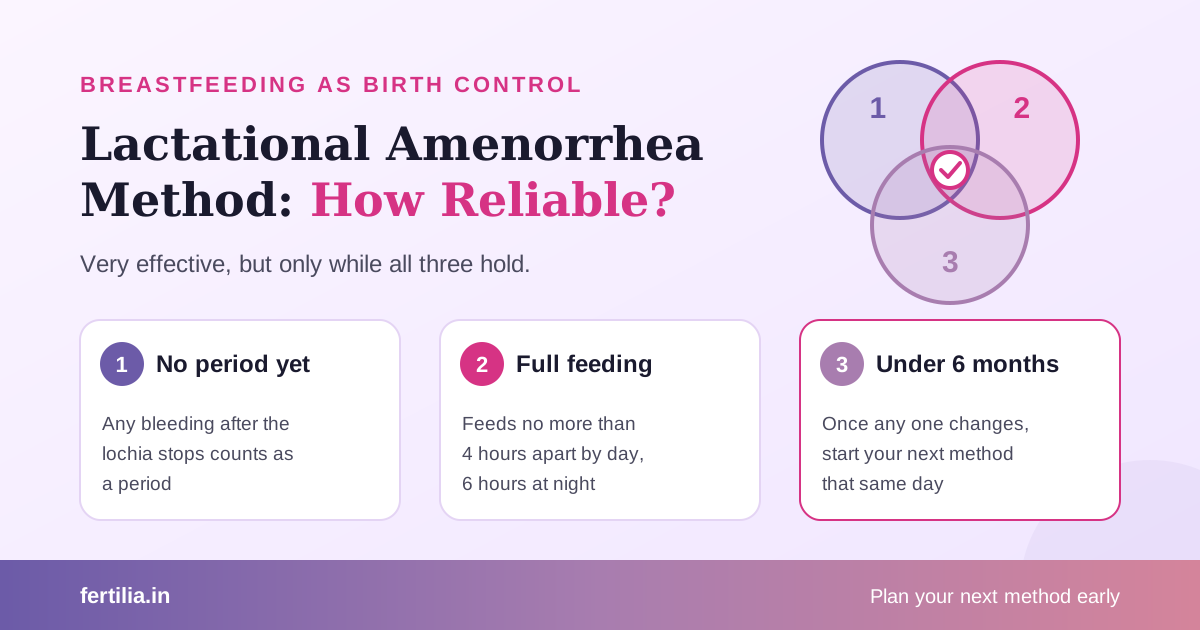

A common moment in my clinic: a woman who delivered six or eight weeks ago mentions, almost in passing, that she and her husband have already resumed being intimate, and she has not thought about contraception at all. She assumed her body “knew” it was not ready, or that breastfeeding was protecting her. Sometimes it was. Often it was not, and by the time this comes up, she is already anxious about the possibility of another pregnancy arriving before she has recovered from the last one.
The postpartum IUD, whether copper T or Mirena, solves this problem more completely than almost any other contraceptive option, because it can be placed within minutes of delivery and then largely forgotten for years. But the timing question genuinely matters here in a way it does not for most contraception, because inserting an IUD right after delivery is a different procedure, with different risks and trade-offs, than inserting the same device at the standard six-week visit.
What This Post Covers
- The two windows for postpartum IUD insertion: immediate postplacental versus interval
- What the actual expulsion-rate numbers are, and why they differ so much by timing and delivery type
- Insertion after a vaginal delivery versus after a caesarean
- Whether it affects breastfeeding and milk supply
- Practical timing if you did not get one right after delivery
- Expulsion warning signs to watch for
The Two Windows: Immediate and Interval
There are, broadly, two points at which an IUD gets placed after childbirth.
Immediate postplacental insertion means the device goes in within about ten minutes of the placenta being delivered, while you are still in the labour room or operating theatre. This can be done after a vaginal delivery, with the doctor inserting the IUD by hand through the already-dilated cervix, or during a caesarean section, placed directly into the uterus before the incision is closed.
Interval insertion means waiting until the uterus has involuted, typically at or after the six-week postpartum visit, and inserting the IUD the way it would be inserted in a non-pregnant woman, through a closed cervix in a clinic setting.
There is also a middle window, sometimes called early postpartum (more than ten minutes after delivery but before hospital discharge), which is less commonly practised in India and carries its own separate risk profile. Most Indian hospitals offer one of the two main windows above, so this post focuses on those.
Neither window is universally “correct.” The right one depends on what matters more to you: not having to remember a follow-up appointment for contraception, versus a lower chance of the device coming out.
The Expulsion-Rate Numbers
This is the number women are rarely given clearly, and it is the one that should drive the decision.
A 2020 systematic review and meta-analysis pooling 48 studies and 7,661 IUD placements found a complete expulsion rate of 10.2 percent for immediate postplacental insertion, compared with 1.8 percent for interval insertion at four weeks or later (Averbach SH et al. American Journal of Obstetrics and Gynecology, 2020;223(2):177-188, PMID 32142826). Put plainly: about 1 in 10 women who get an immediate postplacental IUD will have it come out on its own, versus roughly 1 in 55 who wait until the interval visit.
The same review found the expulsion risk with immediate insertion is not the same for everyone. It was substantially higher after vaginal delivery (14.8 percent) than after a caesarean section (3.8 percent), and higher for Mirena placed immediately after a vaginal delivery specifically (27.4 percent) than for a copper IUD placed the same way (12.4 percent). If you are delivering by caesarean and want a copper IUD placed immediately, your personal expulsion risk looks closer to the interval-insertion number than the headline immediate-insertion number.
None of this means immediate insertion is a poor choice. The same body of evidence, and the authors’ own conclusion, is that the convenience and contraceptive protection of immediate placement can reasonably outweigh a higher chance of it needing to be replaced, particularly for women who know they are unlikely to return for a six-week visit, or who want to close the door on pregnancy risk from the moment they leave the labour room. The point is that this is a real trade-off you are entitled to know about before you say yes to it, not an incidental detail.
Immediate Insertion After a Vaginal Delivery vs C-Section
Vaginal delivery: The IUD is inserted by hand or with a placental forceps within ten minutes of the placenta coming out, while the cervix is still dilated from labour. No additional anaesthesia is needed beyond what you already had for delivery. As above, this route carries the highest expulsion risk of any postpartum insertion timing, particularly with Mirena.
Caesarean section: The IUD is placed directly through the open hysterotomy incision before your doctor closes the uterus, so it adds only a minute or two to a procedure you are already having. Expulsion risk after a C-section insertion is markedly lower than after immediate vaginal insertion, likely because the fundus is directly visualised and the device can be placed precisely at the top of the uterine cavity under direct vision, rather than by feel.
If you already know you are having a planned caesarean and you are confident about wanting an IUD, this is often the setting where immediate insertion makes the most sense: you get the convenience of immediate placement with a meaningfully lower expulsion rate than immediate vaginal insertion. This is a conversation worth having with your obstetrician well before your delivery date, since it needs to be planned into the surgery, not decided on the table.
For a broader look at C-section recovery in general, the C-section recovery week by week guide covers what to expect physically in the weeks that follow.
Does It Affect Breastfeeding?
This is usually the first question mothers ask, and it is a reasonable one, because so many hormonal contraceptives genuinely do interact with milk supply.
The copper IUD has no hormonal content at all and does not affect breastfeeding in any way.
For Mirena, the hormone involved is levonorgestrel, a progestin, and it acts almost entirely locally within the uterus rather than circulating through your bloodstream in meaningful amounts, unlike combined hormonal contraceptives that contain oestrogen. A 2022 Cochrane review comparing immediate versus delayed postpartum insertion of progestin-releasing implants and IUDs found little or no difference in breastfeeding rates at six months between the two groups, and concluded that immediate postpartum provision of these methods may have little or no negative impact on breastfeeding (Sothornwit J et al., Cochrane Database Syst Rev, 2022;10:CD011913, PMID 36302159).
This is also reflected in the World Health Organization’s Medical Eligibility Criteria for Contraceptive Use, 5th edition, 2015 (iris.who.int/handle/10665/181468): a levonorgestrel IUD placed within 48 hours of delivery in a breastfeeding woman, or at four weeks or more postpartum, carries no meaningful restriction on use under WHO’s classification. The narrower window from 48 hours up to four weeks postpartum is where WHO guidance is more cautious, largely because of uterine and infection-related considerations at that stage, not because of any effect on lactation itself.
If you are exclusively breastfeeding and worried specifically about supply, this is one hormonal method where that particular worry is not well supported by the evidence. For more on how Mirena compares with the copper T more broadly, our Copper T and Mirena comparison guide goes into side effects and period changes for each device in more depth.
If You Did Not Get One Right After Delivery
Missing the immediate window is common and not a problem. Most women who get a postpartum IUD in India get it at the interval visit, and this remains the lower-expulsion-risk option regardless of when in your postpartum journey you decide you want one.
The natural point to have this conversation is the 6-week postpartum checkup, where contraception is a standard part of the visit alongside your physical exam and mood check-in. If you know before that visit that you want an IUD, you can simply tell the clinic in advance so it can be arranged for the same appointment, rather than needing a separate visit afterward.
There is no fixed cutoff after which interval insertion becomes unsuitable. Whether you are six weeks, six months, or a year past delivery, the procedure itself does not change once the uterus has fully involuted, and it is treated the same as an IUD insertion in any non-pregnant woman.
If you are still deciding between the copper T and Mirena for this stage, or want to weigh IUDs against other postpartum contraceptive options such as the progestin-only pill or the injectable, the full contraception comparison for India and the IUD comparison guide both walk through the choice in detail.
If you are unsure which timing or which device fits your specific delivery and feeding plan, this is exactly the kind of question worth a direct conversation. At Fertilia, Dr. Suganya Venkat, an OB-GYN with over 15 years of clinical experience, discusses postpartum contraception planning as a routine part of prenatal visits so the decision does not have to be made in the middle of labour. You can message her on WhatsApp to talk through your options.
Expulsion Warning Signs to Watch For
Since expulsion is the main risk that is specific to postpartum insertion, it is worth knowing what to watch for, particularly in the first three months.
- You cannot feel the IUD strings, or the strings suddenly feel longer or shorter than before. Ask your doctor to teach you how to check before you leave the hospital or clinic.
- You can feel the hard plastic of the device itself at or near the cervix, rather than just the soft strings.
- A sudden return to heavy bleeding after your lochia (the normal postpartum discharge) had already been tapering off.
- New or worsening cramping that feels different from your normal postpartum recovery pattern.
- Your partner reports feeling the device during intercourse, which can indicate it has shifted downward.
None of these definitively mean the device has come out, but any of them is a reasonable reason to see your doctor for a check, which typically just means an ultrasound to confirm the IUD’s position. If it has expelled and you still want an IUD, it can be reinserted, most straightforwardly at the interval timing rather than immediately again.
Frequently Asked Questions
Can I get an IUD immediately after a normal delivery?
Yes. It can be inserted by hand within about ten minutes of the placenta being delivered, using the same access the cervix already has from labour, with no separate anaesthesia required. The trade-off is a higher chance of expulsion (around 14.8 percent after vaginal delivery) than if you wait for the interval visit.
Is it safe to get an IUD placed during a C-section?
Yes, and this is one of the more efficient windows for placement, since the device goes in through the open incision before the uterus is closed and adds only a minute or two to the surgery. Expulsion rates after C-section insertion are lower than after immediate vaginal insertion. Discuss this with your obstetrician before your surgery date if you know you want it done this way.
Does a postpartum IUD affect my milk supply?
The copper IUD has no hormones and no effect on milk supply at all. For Mirena, the evidence from randomised trials and a 2022 Cochrane review shows little or no difference in breastfeeding rates whether the IUD is placed immediately or at the delayed interval visit, because the hormone acts locally in the uterus rather than through the bloodstream in any meaningful amount.
How likely is it that my IUD will fall out if I get it right after delivery?
Pooled data across nearly 4,500 immediate insertions found a 10.2 percent overall expulsion rate, but this varies a great deal by circumstance: about 14.8 percent after vaginal delivery versus 3.8 percent after caesarean, and higher for Mirena than for the copper IUD when placed immediately after a vaginal birth specifically.
If I missed the immediate window, is it too late to get an IUD later?
No. Most women who get postpartum IUDs in India get them at the standard six-week interval visit or later, and this timing carries a lower expulsion risk than immediate insertion. There is no cutoff date; once your uterus has involuted, insertion is done the same way it would be for any non-pregnant woman.
Will getting an IUD right after delivery hurt more than a normal insertion?
After a vaginal delivery, most women do not report the immediate postplacental insertion as more painful than the delivery process they have just been through, since the cervix is already dilated. After a caesarean, it adds no separate sensation since you already have anaesthesia in place for the surgery. Interval insertion at six weeks feels similar to a routine IUD insertion in any woman, typically a moderate cramping sensation lasting under a minute.
Can I use a postpartum IUD as my only contraception if I am not planning another pregnancy soon?
Yes. Both the copper T and Mirena are highly effective, reversible, long-acting methods, and either can remain in place for years (the copper T for up to ten years, Mirena typically for five to eight years depending on the specific device, per current labelling). If your family is complete or you want a long gap before the next pregnancy, a postpartum IUD is a reasonable single method, and it can be removed whenever you decide you want to try again.
If you are pregnant now and want to plan your postpartum contraception in advance rather than deciding it in the delivery room, message Dr. Suganya on WhatsApp and this can be built into your delivery plan alongside everything else your doctor is already preparing for that day.