A woman came to see me six weeks after her second delivery. She was breastfeeding, not planning another pregnancy for at least two years, and wanted contraception that did not require her to remember something every single day.
She had tried the combined oral pill after her first delivery and found it reduced her milk supply. A friend had mentioned “the injection.” Her sister-in-law had a small rod inserted in her arm. She arrived with a clear question: “How do these actually work, and which one would suit me?”
These are exactly the right questions. And they deserve more than a two-minute answer.
This guide covers both long-acting, progestin-only methods available in India: the DMPA contraceptive injection and the etonogestrel subdermal implant. I will explain how each works, what to expect with bleeding, what they mean for future fertility, and who each one suits.
For the full range of contraceptive options in India, see the complete contraception comparison guide. For the IUD options specifically (Copper-T and Mirena), see our IUD guide.
The DMPA contraceptive injection
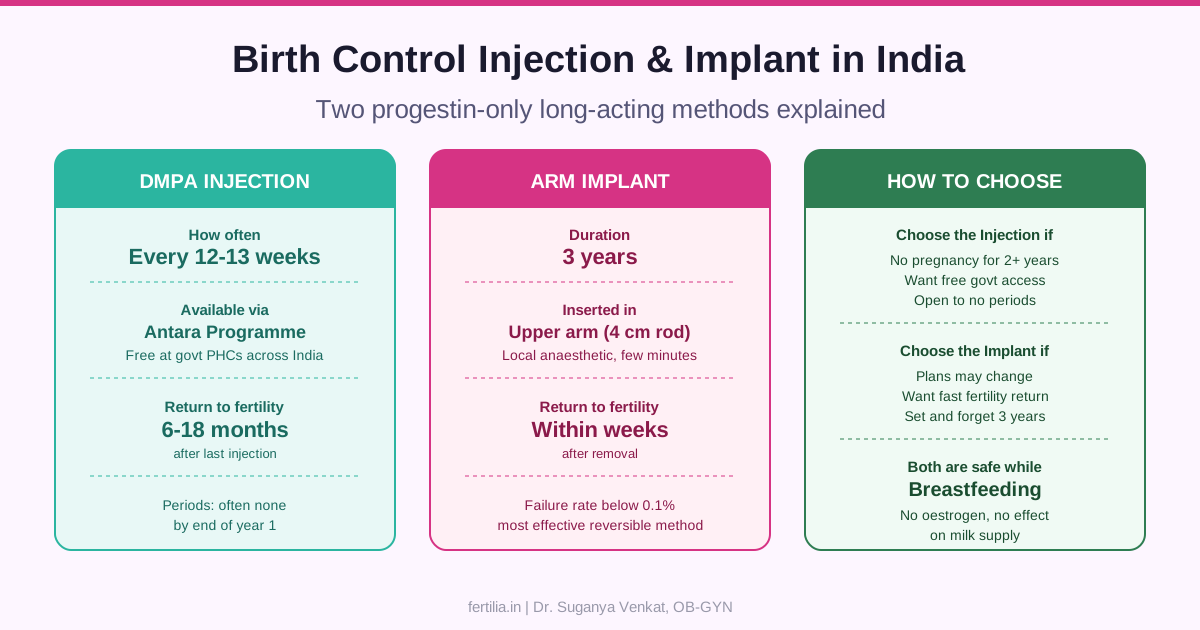
DMPA stands for depot medroxyprogesterone acetate. In India, the standard formulation is a 150 mg intramuscular injection given every 12 to 13 weeks. You may hear it called Depo-Provera (a common brand name), or simply “the injection.”
Through the government’s Antara family planning programme, this injection is available free at primary health centres, community health centres, and district hospitals across India. In private facilities, each injection typically costs Rs 100 to 300.
How the injection prevents pregnancy
DMPA is a progestin, a synthetic form of progesterone. At this dose, it suppresses the LH surge that normally triggers ovulation. Without that surge, no egg is released. It also thickens cervical mucus, making it more difficult for sperm to travel upward, and it keeps the uterine lining thin throughout use.
Injection is typically given into the upper arm or buttock. Protection is continuous for 12 to 13 weeks. The next injection must be given before that window closes for uninterrupted coverage.
What happens to your periods on the injection
This surprises many women, so it is worth understanding before starting.
In the first three to six months of use, bleeding often becomes irregular. You may have lighter periods than usual, some spotting between expected period dates, or unpredictable light bleeding that does not follow a pattern. Most women find this settles with continued use. By the end of the first year, roughly half of all women using DMPA have no periods at all. Some find this a significant benefit; others find the unpredictability of the early months difficult to manage.
The absence of periods on DMPA is not medically harmful. It does not mean blood is accumulating inside. The uterine lining remains thin, so there is very little to shed. Women with heavy periods often find the period suppression a welcome effect (see our guide on heavy period causes and treatment options).
After stopping the injection, periods return, though the timeline varies.
Return to fertility after the injection
This is the aspect of DMPA that matters most for women who plan to conceive in the future.
After the last injection, there is a delay before regular ovulation resumes. For most women this takes somewhere between six and eighteen months, with a median of around ten months. This delay is a well-documented feature of the method, not a side effect of something going wrong, and it is not permanent. Once ovulation resumes, fertility is equivalent to pre-injection levels.
What this means practically: if you are using the injection and you want to try to conceive, plan to stop it at least one year before you hope to become pregnant, not three months before. The delay is real. Many women are surprised by it because the three-month dosing interval creates the impression that fertility returns within three months of stopping. It does not.
The injection is a poor fit for women who might change their pregnancy plans in the short term. The implant (covered next) is a much better fit in that situation.
Side effects
Beyond the bleeding changes described above, some women using DMPA notice:
- Changes in appetite or weight. Evidence on this is mixed: some studies show a small average increase, others show minimal change. It varies between women.
- Mood changes, including low mood or irritability in some women, though many notice no change at all.
- A temporary reduction in bone mineral density with long-term use. This recovers after stopping. The World Health Organization does not restrict DMPA use on the basis of bone density concerns for women without pre-existing osteoporosis (WHO Medical Eligibility Criteria for Contraceptive Use, 5th Ed, 2015), and the effect is considered clinically reversible.
The contraceptive implant
The contraceptive implant is a small, flexible plastic rod, roughly the size of a matchstick (approximately 4 centimetres long and 2 millimetres wide). It is inserted just under the skin of the inner upper arm by a trained provider under local anaesthetic. The procedure takes a few minutes. The rod is not visible once placed, though it can be felt if you press the area.
In India, it is most commonly available as Implanon NXT (marketed as Nexplanon in some international markets). It is approved in India and available at private hospitals, tertiary care centres, and women’s health clinics, though it is not part of the government PHC programme the way DMPA is.
Combined device and insertion costs typically range from Rs 3,000 to Rs 8,000 depending on the city and facility. The implant remains effective for three years.
How the implant prevents pregnancy
The implant releases a hormone called etonogestrel, another progestin, continuously at a low dose over its three-year lifespan. Like DMPA, it primarily works by suppressing ovulation, and it also thickens cervical mucus.
Its failure rate is below 0.1% in both typical and perfect use, making it one of the most effective reversible contraceptive methods in the world (Trussell J, Contraception 2011, PMID 21172374). There is no daily compliance required. Once inserted, it works.
What happens to your periods on the implant
This is where the implant is less predictable than the injection, and it is worth being prepared for this before choosing it.
Unlike DMPA, where bleeding patterns tend to stabilise and move toward amenorrhea over time, the implant produces more varied and less predictable outcomes. Roughly one in five women using the implant have no periods at all. Around half experience infrequent or lighter bleeding, which most find manageable. A smaller proportion experience frequent or prolonged spotting, particularly in the first year.
There is no way to predict your pattern in advance. If irregular or frequent spotting would be particularly difficult to manage in your daily life, this is worth discussing honestly before deciding on the implant. The implant’s unpredictable bleeding profile is the most common reason women choose to have it removed before the three years are up.
Removal is straightforward: a small incision under local anaesthetic, the rod is drawn out. Most women find it quicker and less uncomfortable than they expected.
Return to fertility after the implant
This is where the implant is clearly different from the injection, and often the deciding factor.
After removal, ovulation typically resumes within days to a few weeks. Fertility returns rapidly. This means that if your plans change and you decide you want to try to conceive sooner than expected, the implant does not create a waiting period the way DMPA does.
If there is any chance your timeline for a future pregnancy might shift, the implant gives you more flexibility than the injection.
If you want to talk through which of these methods suits your specific situation, including your fertility plans and medical history, I am available directly:
WhatsApp Dr. Suganya on +91 99402 70499
Injection vs implant: comparing the two
| DMPA Injection | Contraceptive Implant | |
|---|---|---|
| Active hormone | Medroxyprogesterone acetate | Etonogestrel |
| How it is given | Intramuscular injection every 12-13 weeks | Subdermal rod inserted in upper arm, lasts 3 years |
| Failure rate (typical use) | 4% | Less than 0.1% |
| Bleeding | Irregular early months, often amenorrhea by year 1 | Variable throughout: no periods (20%), infrequent (50%), or frequent spotting |
| Return to fertility | 6-18 months after last injection | Weeks after removal |
| Cost in India | Free (Antara programme at govt PHC) or Rs 100-300 per injection | Rs 3,000-8,000 (device plus insertion, private facilities) |
| Availability | PHCs nationwide plus private clinics | Private hospitals and tertiary centres |
| Contains oestrogen | No | No |
| Safe while breastfeeding | Yes | Yes |
Who each method suits
The DMPA injection tends to suit women who:
- Want reliable contraception without daily compliance and are comfortable with a quarterly clinic visit
- Are breastfeeding and cannot use oestrogen-containing methods (the combined pill reduces milk supply; neither DMPA nor the implant does)
- Are open to having no periods over time, or actively want that effect
- Have convenient access to a government primary health centre where the Antara programme provides it free
- Are confident they do not plan to conceive for at least two years, ideally longer
The delayed return to fertility is the factor that most limits this method’s suitability. For women who might change their plans within a year or two, the injection does not give them that flexibility.
The DMPA injection is less suitable for women who:
- Are planning to conceive within the next year. The fertility return delay means stopping now still may not give you enough time for a pregnancy by your target date.
- Find irregular or unpredictable bleeding difficult to manage at work or in daily life.
- Have a personal or family history that leads their doctor to advise caution with progestin-based methods.
Women with PCOS who are planning to conceive after contraception are a group worth discussing separately, since irregular ovulation may take additional time to regularise after DMPA, on top of the already-delayed return. See our guide on PCOS symptoms, root causes, and treatment if this is relevant to you.
The contraceptive implant tends to suit women who:
- Want fully hands-off contraception for up to three years, with no quarterly visits required
- Are breastfeeding
- Cannot use oestrogen-containing methods (migraine with aura, certain cardiovascular risk factors)
- Want to preserve the option to conceive on relatively short notice, because fertility returns within weeks of removal
- Live in or near a city or facility with a trained provider for insertion and removal
The implant is less suitable for women who:
- Would find unpredictable bleeding very disruptive. There is no test that tells you in advance whether you will have amenorrhea or frequent spotting.
- Are planning to conceive very soon (the device lasts three years and is not designed for short gaps).
- Are not near a trained provider for insertion or removal.
In Hindi and Tamil
In everyday Hindi, the contraceptive injection is commonly called garbhnirodhak suyi (contraceptive needle/shot). The government programme name “Antara” is itself the most practical term to use when asking at a government health centre.
In Tamil, the injection is sometimes referred to as karuttadai oosi (Roman transliteration for contraceptive injection). The implant does not have a widely used common-language name in either language and is usually referred to by the brand name Implanon or simply as “the implant” or “arm rod” in clinical conversations.
Native script versions of the Tamil term are awaiting confirmation with Dr. Suganya before publication.
What this means for your contraceptive choice
Both the DMPA injection and the etonogestrel implant are effective, well-tolerated long-acting options. They are both progestin-only, compatible with breastfeeding, and avoid the daily compliance issue of the pill.
The most important single factor separating the two is the return-to-fertility timeline. If you want to preserve the ability to conceive on relatively short notice, the implant is the better fit. If you are certain you do not plan to conceive for two or more years and you want low-cost or free contraception through the government programme, the injection is a reasonable option, as long as you build the return-to-fertility delay into your planning.
Both choices sit alongside the broader options covered in our complete contraception comparison and the guide to the birth control pill. If you have an intrauterine device in mind instead, see the guide to Copper-T vs Mirena.
For women approaching contraception with a future pregnancy in view, getting clarity on your fertility picture beforehand makes the transition smoother. If you have PCOS, irregular cycles, or other concerns, the Fertilia Fertility Program supports that planning process.
WhatsApp Dr. Suganya on +91 99402 70499 to talk through your specific situation, your fertility plans, and any medical history before making a decision.
Frequently asked questions
Does the contraceptive injection affect future fertility permanently?
No. DMPA causes a temporary delay in the return of ovulation, typically six to eighteen months after the last injection. Once ovulation resumes, fertility is equivalent to what it was before using the method. The delay is real, but it is not permanent, and it does not damage the reproductive system.
How do I get the Antara injection in India?
The Antara programme provides DMPA free at government primary health centres, community health centres, and district hospitals across India. Ask by name for the Antara injection or the “garbhnirodhak suyi.” In private settings, a prescription from a doctor is required.
What if I am more than two weeks late for my next injection?
The injection should be given every 12 to 13 weeks. If you are significantly late, do not simply take the next injection without guidance. Consult your doctor first. A pregnancy test may be recommended and backup contraception may be needed in the interim.
For more on this, read our guide on i-Pill vs Unwanted 72. Is the implant painful to insert or remove?
The insertion site is numbed with local anaesthetic before the rod is placed. Most women describe the sensation as pressure rather than sharp pain, and the procedure takes only a few minutes. Some bruising or tenderness at the insertion site is normal for a few days. Removal is similarly brief and done under local anaesthetic.
Can I use the injection or the implant while breastfeeding?
Yes. Both are progestin-only and are considered safe during breastfeeding. Unlike the combined oral pill, they do not contain oestrogen, so they do not suppress milk supply. Both are commonly used in the months after delivery by breastfeeding mothers who want reliable contraception.
What happens to periods on the implant?
Periods become unpredictable. Roughly one in five women have no periods. Around half experience infrequent or light bleeding. A smaller group have frequent or prolonged spotting, especially in the first year. There is no reliable way to predict which pattern you will have before insertion.
After the implant is removed, how quickly can I try to conceive?
Ovulation typically resumes within days to a few weeks of removal. Fertility returns quickly, which is one of the implant’s main advantages over the injection for women who want to preserve flexibility about when they try to conceive.