After a miscarriage, many women find themselves waiting for one particular thing: the first period. It feels like a sign that the body has closed one chapter and is ready to move on. When it does not arrive on the day you expected, or when it comes heavier, lighter or more painful than usual, the waiting can bring a fresh wave of worry on top of the grief.
I’m Dr. Suganya Venkat, and in more than fifteen years as an OB-GYN I have sat with many women at exactly this point. The questions are almost always the same. When will it come? Is this much bleeding normal? Why is it so different from my usual period? This post answers them plainly, so you know what to expect and when it is worth asking for a check.
If you are still in the early days after a loss and want the bigger picture of why miscarriages happen, our guide to miscarriage causes, signs and recovery is a gentle place to start.
First, the bleeding of the miscarriage itself is not a period
This is the point that clears up the most confusion. The bleeding you have during and just after a miscarriage is the pregnancy tissue and the thickened lining leaving the uterus. It is not your first period, even though it can look like one.
That bleeding usually settles over one to two weeks. It is often heaviest in the first few days and then tapers to light spotting. Some women have on-and-off spotting for a little longer, especially after a medical (tablet) miscarriage.
So when you count towards your first period, count from the day the miscarriage bleeding started or the day of the procedure, not from the day the spotting stopped.
When does the first period come back?
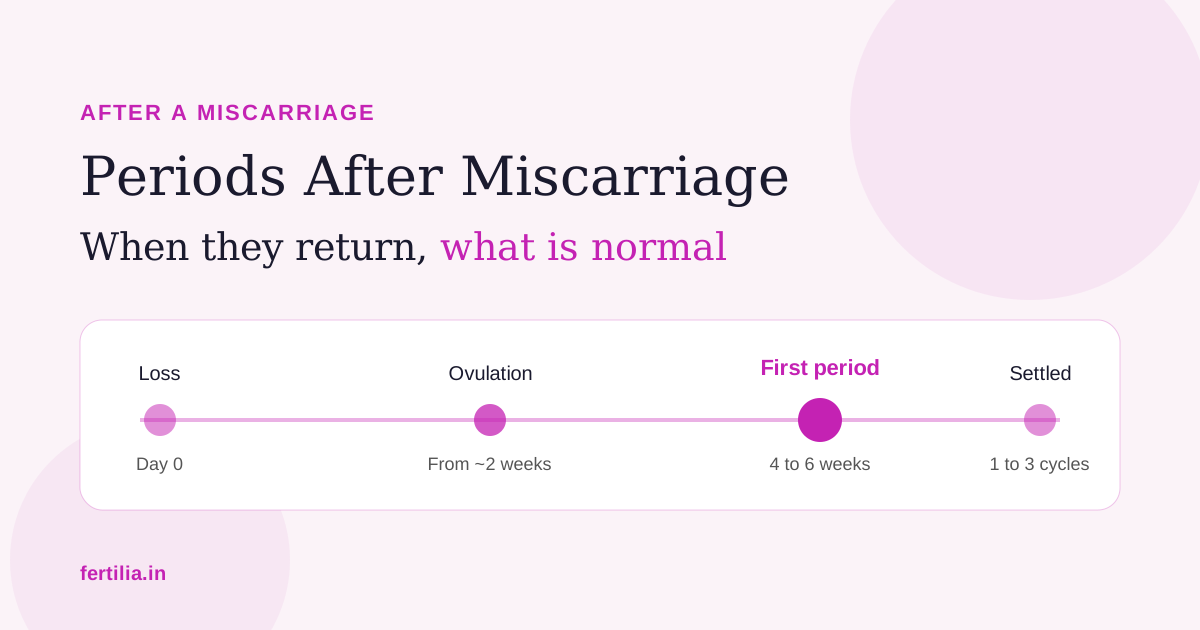
For most women, the first period after a miscarriage arrives about four to six weeks after the loss.
Here is why it takes that long. During pregnancy, the hormone hCG (human chorionic gonadotropin) keeps the body in “pregnant” mode. After a miscarriage, hCG falls back towards a non-pregnant level, and as it falls the brain and ovaries restart the normal cycle. An egg is then released (ovulation), sometimes even before a home pregnancy test has turned fully negative, and roughly two weeks after ovulation, the period follows.
A few things shift the timing:
- How far along the pregnancy was. An early loss at five or six weeks usually means hCG clears faster and the period returns sooner. A loss later in the first trimester or in the second trimester can take a little longer.
- How the miscarriage was managed. Whether it happened naturally, with tablets, or with a procedure (a D&C or a vacuum aspiration), the cycle generally restarts within the same window. If you had a procedure, our post on D&C after miscarriage and recovery covers what that recovery looks like.
- Your usual cycle. If your periods were irregular before the pregnancy, for example with PCOS or a thyroid condition, they are likely to be irregular afterwards too. The miscarriage does not usually create a new problem; it returns you to your old pattern.
- Breastfeeding an older child. If you are still nursing, ovulation may be delayed.
One important thing to know: because ovulation comes before the period, you can conceive before your first period returns. If you would rather not be pregnant again just yet, use contraception from the start. If you are hoping to try again, our post on how soon you can conceive after a miscarriage covers the timing question in detail.
What the first period may look like
Many women tell me their first period after a miscarriage felt “different”. That is common, and in most cases it is nothing to worry about.
It may be heavier than usual. The lining has had a full cycle to build up again, and the body is resetting its hormone rhythm. A heavier flow with a few small clots for a day or two is common. Our guide to blood clots in your period explains which clots are within the normal range.
It may be lighter, or shorter. Some women have a short, light first period. This is also normal, especially after an early loss.
It may be more crampy. Period pain can be stronger for the first cycle or two.
It may smell or look slightly different. Darker, brownish blood at the start or end is simply older blood.
Usually by the second or third cycle, the period settles back to its familiar pattern in timing, flow and pain.
Cycles in the first few months
The first cycle after a miscarriage is often a little longer or shorter than your usual cycle. You might have a 24-day cycle, then a 33-day cycle, then return to your usual 28 or 30. This variation in the first two or three months is expected while the hormone rhythm finds its feet.
If you track your cycles, simply note the dates and flow in a calendar or an app. That record becomes very useful if you do need to see a doctor, because it shows the pattern instead of relying on memory.
The emotional side of the first period
I want to name this because it is rarely talked about. For some women, the first period brings relief. For others, it brings a second grief, a physical reminder that the pregnancy has really ended. Both reactions are normal, and you may feel both on the same day.
If the sadness feels heavy or is not easing with time, please do not carry it alone. Our post on coping after pregnancy loss has practical ways to look after yourself and your partner, and it is completely reasonable to ask for support.
Not sure whether what you are experiencing is normal? You can talk it through with Dr. Suganya Venkat over a video consultation, from anywhere in India. WhatsApp Dr. Suganya to book a ₹399 online consultation.
When to get a check
Most women need nothing more than time. But there are a few situations where it is worth contacting your gynaecologist, so that anything that needs attention is picked up early and easily.
Get help the same day if you have
- Bleeding that soaks through a pad every hour for two hours in a row
- Fever, chills, or a foul-smelling discharge
- Severe lower abdominal pain that painkillers do not ease These can point to retained tissue or an infection, both of which are treatable, and are the reasons doctors ask you to watch for them.
Go to the nearest hospital emergency department straight away if you feel faint, dizzy or very weak, or collapse, especially alongside heavy bleeding. Do not wait to see whether the bleeding reaches the two-hour mark.
Book a routine review if
- No period by eight weeks after the loss. Your doctor will usually check a pregnancy test or a blood hCG level and may do an ultrasound. Sometimes hCG is still falling slowly, sometimes there is a new pregnancy, and sometimes the cycle just needs a little more time.
- A pregnancy test is still positive at your follow-up check. After a miscarriage that happened naturally or was managed with tablets, doctors usually ask you to do a pregnancy test about three weeks later. If that test is still positive, contact your doctor then rather than waiting longer. hCG can take a few weeks to clear, but a positive test needs a review. This may include a blood hCG level and an ultrasound to check for remaining tissue and, where relevant, a pregnancy outside the uterus (ectopic) or a molar pregnancy.
- Bleeding or spotting that has not stopped after two to three weeks. This can be a sign that some tissue remains, which an ultrasound can confirm.
- Periods that are very light or absent after a D&C. Rarely, scar tissue can form inside the uterus after a procedure, a condition called intrauterine adhesions or Asherman’s syndrome. In a review of prospective studies, adhesions were found on hysteroscopy in about one in five women after miscarriage, most of them mild, and the number of D&C procedures appeared to be the main driver (Hooker AB et al., Hum Reprod Update, 2014, PMID 24082042). Our post on Asherman’s syndrome explains how it is diagnosed and treated. Most women who have a D&C never develop this; I mention it so you know that a markedly lighter period after a procedure is worth reporting.
- Your cycles are still irregular after three months. This often reflects an old pattern, such as PCOS or a thyroid imbalance, that is worth looking at, especially if you are planning another pregnancy.
What you can do while you wait
There is no special diet or medicine needed to “bring on” the first period after a miscarriage. What helps is basic recovery care:
- Use pads, not tampons or menstrual cups, until the miscarriage bleeding has stopped. This lowers the chance of infection. Your doctor will tell you when it is fine to switch back.
- Eat regular, iron-rich meals. After heavy bleeding, foods like ragi, green leafy vegetables, dates, rajma and jaggery help rebuild iron. If you felt tired or breathless, ask your doctor whether you need a haemoglobin check.
- Rest when your body asks for it. Gentle walks are fine. Heavy exercise can wait until the bleeding settles and you feel ready.
- Keep a simple record. Note the day the miscarriage bleeding began, the day it stopped, and the date your first period arrives.
- Take a folic acid supplement if there is a chance you will conceive again soon.
What this looks like in practice at Fertilia
At Fertilia, the women we see after a miscarriage are often less worried about the period itself and more worried about what it says about the next pregnancy. A first period that comes on time is a reassuring sign that the cycle has restarted. When it does not, we look at the whole picture: hCG, an ultrasound if needed, thyroid function, and any long-standing cycle issues like PCOS. This is done alongside your own gynaecologist’s care, not instead of it.
Frequently Asked Questions
When will I get my first period after a miscarriage?
For most women the first period comes about four to six weeks after the miscarriage. An early loss usually means a slightly quicker return. If there is no period by eight weeks, check with your doctor.
Miscarriage ke baad period kab aata hai? (When does the period come after a miscarriage?)
Usually within four to six weeks of the loss. Count from the day the miscarriage bleeding started or the day of the procedure. The bleeding during the miscarriage itself is not counted as your first period.
Is a heavy first period after a miscarriage normal?
A first period that is somewhat heavier, with small clots and stronger cramps, is common. Seek help the same day if you soak a pad every hour for two hours or pass very large clots. If heavy bleeding comes with feeling faint, dizzy or very weak, or you collapse, go to the nearest hospital emergency department straight away. Do not wait to see whether the bleeding reaches the two-hour mark.
Can I get pregnant before my first period after a miscarriage?
Yes. Ovulation happens before the period, so it is possible to conceive before the first period arrives. Use contraception if you want to wait, and start folic acid if you are hoping to try again.
Why is my period late after a miscarriage?
The most common reason is that hCG is taking a little longer to clear, so ovulation is delayed. Other reasons include a new pregnancy, a pre-existing irregular cycle such as PCOS, thyroid changes or stress. A pregnancy test and, if needed, a blood test and scan will sort it out.
How long before my cycle goes back to normal after a miscarriage?
Most women are back to their usual pattern within one to three cycles. If cycles are still irregular after three months, it is worth a review.
Should I worry if my period is very light after a D&C?
A slightly lighter period is often fine. A period that is much lighter than before, or absent, after a D&C is worth mentioning to your doctor, who may check for scar tissue inside the uterus. It is uncommon and treatable.
You do not have to figure this out alone
Your body usually knows how to find its rhythm again after a loss, and for most women the first period arrives within a few weeks. If yours is late, heavier than you expected, or you simply want someone to look at the whole picture with you before trying again, Dr. Suganya Venkat consults online across India over video call.
WhatsApp Dr. Suganya to book a ₹399 online consultation.