You stand up from the sofa and feel it: a heavy, full feeling low down, as if something is pressing on the floor of your pelvis. Some women describe it as carrying a bowling ball between their hips. Others say it feels like the baby could slip out if they walk too fast. It is a strange feeling, and a very common question in my video consultations.
Most of the time, pelvic pressure is simply what it feels like to carry a growing baby, a heavier uterus and more blood in the pelvis. It tends to build in the third trimester and peaks once the baby settles low before birth. A few patterns do need a call to your doctor, and knowing them makes the rest much easier to live with.
Here is what this post covers:
- What pelvic pressure feels like, and how it differs from pain
- The usual causes in each trimester
- What “the baby has dropped” means
- Simple things that ease the heaviness
- The signs that mean you should call your doctor or hospital
If your discomfort is mainly a sharp, stabbing twinge in the groin, our guide to round ligament pain fits better. If it is pain in the pubic bone or the joints at the back of the pelvis, read about pelvic girdle pain. This post is about the sensation of pressure or heaviness itself.
What Pelvic Pressure Feels Like
Women describe it in many ways:
- A dull heaviness or fullness low in the tummy or vagina
- A feeling that something is “pushing down”, worse when standing or walking
- A sense of needing to pee, even right after you have been
- Pressure in the bottom, a bit like needing to open your bowels
- An achy, tired feeling in the pelvis by evening that eases when you lie down
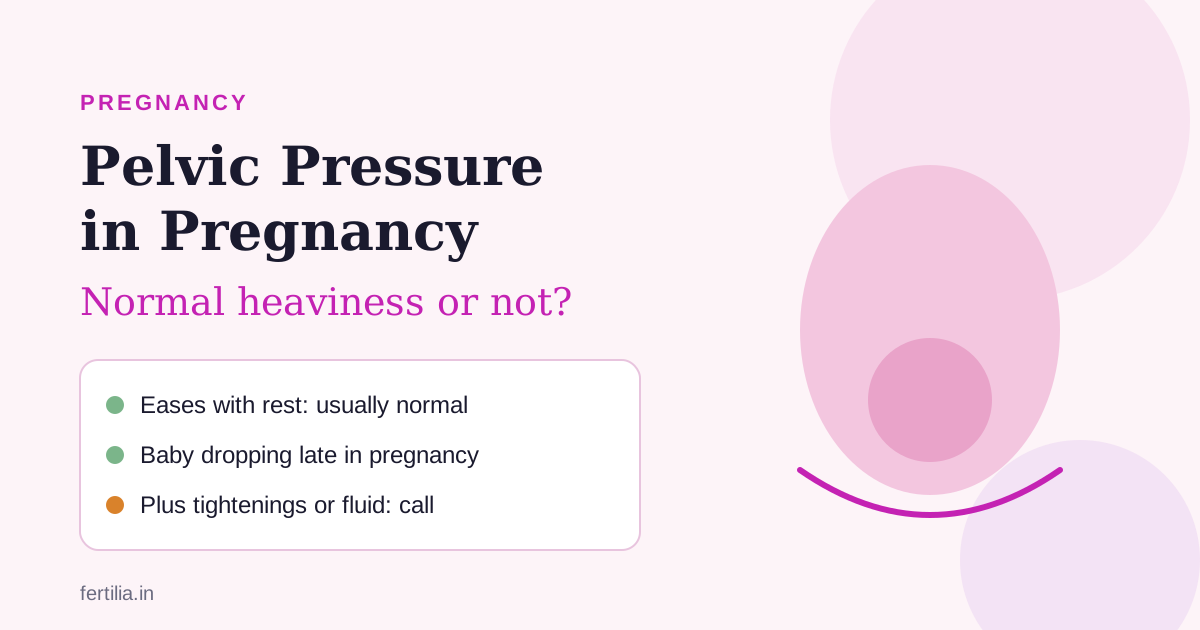
The ordinary kind usually comes and goes with what you are doing. It is worse after a long day on your feet and better after rest. It does not come in regular waves, and it does not bring bleeding or fluid with it.
Why It Happens: The Causes by Trimester
First trimester (weeks 1 to 13)
Early on, the uterus is still small and sits inside the pelvis. Even so, many women notice a fullness or mild heaviness low down. Blood flow to the pelvis rises sharply, and pregnancy hormones relax the walls of blood vessels and the bowel. Bloating and constipation are common, and they add to the sense of fullness. The growing uterus also sits right behind the bladder, which is why so many women feel they need to pee all the time in these weeks.
If early heaviness comes with cramping or spotting, our guide to cramps in early pregnancy walks through which patterns are expected and which need a same-day check.
Second trimester (weeks 14 to 27)
The uterus rises out of the pelvis, and for many women pressure eases in this middle stretch. Some still feel it, especially:
- After long periods of standing or walking
- When carrying twins
- In a second or later pregnancy, when the muscles of the tummy and pelvic floor are a little more relaxed
- With constipation, which is common in pregnancy and can make the whole pelvis feel heavy (our post on pregnancy constipation has Indian food remedies that help)
New, steady pressure in the second trimester, even on its own, needs a prompt call to your doctor or hospital, especially with a change in discharge or backache (more on this below).
Third trimester (weeks 28 to 40)
This is when pelvic pressure is most common. The baby and uterus are heavier, the ligaments and joints of the pelvis have loosened, and the pelvic floor muscles carry more weight every day. In the last weeks, the baby’s head moves down into the pelvis to get ready for birth.
What “The Baby Has Dropped” Means
You may hear an elder at home say, “The baby has come down.” Doctors call this engagement, and the old word for the feeling is lightening. The baby’s head settles deeper into the bony pelvis.
In a first pregnancy this often happens a few weeks before labour. In a second or later pregnancy, the head may not engage until labour starts. Both are normal, and the timing does not tell you whether your labour will go well.
When the baby drops, many women notice:
- Easier breathing and less heartburn, because there is less pressure under the ribs
- More pressure in the pelvis and bladder, and more trips to the toilet
- A waddling walk and a heavy feeling between the legs
At your antenatal check-ups, your doctor feels your tummy and notes how far the baby’s head has come down. If you are not sure whether your baby has dropped, ask at your next visit. It is a simple question and a good one.
💜 Feeling heavy and not sure if it is normal? Message Dr. Suganya on WhatsApp to book a ₹399 video consultation. Tell us how many weeks you are, when the pressure comes on, and anything else you have noticed, and we will go through it with you. If you are bleeding, leaking fluid or having regular tightenings before 37 weeks, call your hospital first.
When Pelvic Pressure Needs a Call to Your Doctor
The point of this section is not to make you watch your body all day. It is to give you a short, clear list, so that you can relax about everything else.
Before 37 weeks: new, steady pressure, or pressure with other signs. Pressure that comes and goes with activity and eases with rest is very common. Before 37 weeks, though, call your hospital promptly if the pressure is new and persistent, even with no other symptom, because early changes in the cervix do not always cause pain or bleeding. Pressure together with other signs also needs a call. In a study that interviewed 107 women in preterm labour, 102 women whose waters broke early and 106 women with ordinary pregnancies, the women in preterm labour more often had contractions (both painful and painless), period-like cramps, backache and an increase in vaginal discharge (Iams JD et al., Am J Obstet Gynecol, 1990, PMID 2137968). So call your hospital straight away if, before 37 weeks, pressure comes with:
- Regular tightenings, or cramps that come and go in a pattern and do not settle with rest
- A dull, low backache that is new for you
- A change in discharge: more watery, more mucus-like, or tinged with blood
- Any gush or trickle of fluid from the vagina
- A feeling that the pressure is new, steady, and building rather than coming and going
Our guide to preterm labour signs explains what the hospital will check. And if you are not sure whether your tightenings are practice or the real thing, read about Braxton Hicks contractions. Getting checked and being sent home is a good outcome, not a wasted trip.
At any stage: call your hospital or maternity unit straight away if you have:
- Vaginal bleeding (if it is heavy, go to the hospital immediately)
- Severe or constant pain in the tummy (go to the hospital immediately)
- Fever with pelvic pain
- Fewer movements from your baby than usual, once you have started feeling a regular pattern (do not wait until the next day)
- A bulge you can feel or see at the opening of the vagina
At any stage: get checked the same day if you have:
- Burning when you pee, blood in the urine, or pain in your side or back with fever (these can be signs of a urine infection, which needs treatment in pregnancy; see our guide to UTI in pregnancy)
At term (37 weeks or more): pressure with regular, strengthening contractions, a show (mucus with a little blood) or your waters breaking usually means labour is starting. Call your hospital and follow the plan you made with your doctor.
What Eases Ordinary Pelvic Pressure
Once you and your doctor are comfortable that the pressure is the ordinary kind, these steps help most women:
Take the weight off. Lie on your side for 15 to 20 minutes a few times a day, with a pillow between your knees. Sitting with your feet up also helps. Pressure that eases quickly with rest is reassuring.
Pace your day. Break up long periods of standing. If you cook, sit on a stool to chop vegetables or knead dough. Ask for help with lifting heavy buckets, gas cylinders or older children.
Try a belly support band. A soft maternity support belt lifts the bump slightly and takes some load off the pelvis. Many women find it helpful for walking or standing work. Wear it for part of the day, not all the time.
Hands and knees. Getting on all fours for a few minutes, or gently rocking your hips in this position, takes the baby’s weight off the pelvic floor for a while.
Keep your bowels moving. Water, fruit, dal, vegetables, and whole grains like ragi and jowar all help. Ask your doctor if your iron tablets are making constipation worse; often the timing or type can be changed.
Pelvic floor exercises. Gentle squeezes of the pelvic floor muscles, done correctly, help them cope with the extra load. Our guide to Kegel exercises shows how to find the right muscles. If you leak urine, feel a bulge, or are unsure you are doing them right, a women’s health physiotherapist can guide you.
Warm water. A warm (not hot) shower on your lower back and hips relaxes tired muscles.
Swimming or water walking, if you have access to a pool, takes the baby’s weight off your body for a while and many women find it a relief.
Pain relief. If you need a painkiller, paracetamol is the usual choice in pregnancy, at the dose your doctor advises. Avoid ibuprofen, diclofenac and similar painkillers unless your doctor has specifically recommended one.
How We Look at Pelvic Pressure in a Consultation
In video consultations with women in Fertilia’s pregnancy program, Dr. Suganya Venkat, an OB-GYN with more than 15 years of experience and over a thousand pregnancies in her care, usually starts with three questions. How many weeks are you? Does the pressure come and go with activity, or is it steady and building? And is anything else happening with it: tightenings, discharge, bleeding, fever, or burning urine?
For most women, the answers point to the ordinary heaviness of a growing pregnancy. We then work out practical changes for her day, her work and her sleep. When the pattern sounds different, we guide her to be examined in person by her treating obstetrician or local hospital without delay, because some checks (like a vaginal examination or a scan of the cervix) need hands and equipment. We work alongside your obstetrician, not instead of them.
Practical Takeaways
- Pelvic pressure is common, especially in the third trimester and in second or later pregnancies.
- Ordinary pressure comes and goes with activity and eases with rest.
- “The baby has dropped” often happens a few weeks before labour in a first pregnancy, and sometimes only in labour in later ones.
- Before 37 weeks, call your hospital promptly if pressure is new and persistent, or comes with regular tightenings, new low backache, a change in discharge, or any fluid.
- At any stage, call your hospital straight away for bleeding, fever, severe pain or fewer baby movements, and get burning urine checked the same day.
- Rest on your side, a support belt, hands-and-knees time, regular bowels and pelvic floor exercises ease the everyday heaviness.
Frequently Asked Questions
Is pelvic pressure normal in pregnancy?
Yes, for most women it is. The uterus, baby and extra blood flow all add weight and fullness to the pelvis, and it is most noticeable in the third trimester. It is worth calling your doctor if it comes with regular tightenings, bleeding, fluid, a change in discharge, or a new low backache before 37 weeks.
Pregnancy me neeche bhaari pan normal hai? (Is heaviness low down normal in pregnancy?)
Usually, yes. A heavy, pushing-down feeling that eases when you lie down is common, especially in the last few months. If it is steady and building, or comes with pain, bleeding or watery discharge, contact your doctor or hospital straight away.
Does pelvic pressure mean labour is near?
Not always. In a first pregnancy, the baby often drops into the pelvis a few weeks before labour, and pressure increases from then. Labour is more likely when pressure comes with regular contractions that get stronger and closer together, a show, or your waters breaking.
Is pelvic pressure in the second trimester a concern?
Some pressure after a long day on your feet, with twins, or in a later pregnancy is common. New, steady pressure in the second trimester should be checked promptly by your doctor or hospital, even on its own, and especially with backache, tightenings or a change in discharge, because these together can be early signs of preterm labour.
Can I keep working or walking with pelvic pressure?
Usually yes, with breaks. Pace yourself, sit for tasks you would normally stand for, and rest on your side when the heaviness builds. A support belt can help while you walk. If pressure is getting worse each day, talk to your doctor.
What is the difference between pelvic pressure and pelvic girdle pain?
Pressure is a heavy, full, pushing-down feeling inside the pelvis. Pelvic girdle pain is pain in the joints: the pubic bone at the front or the joints at the back of the pelvis, often worse when turning in bed, climbing stairs or standing on one leg. They can happen together, and both are treatable.
When should I go to the hospital for pelvic pressure?
Call your hospital or maternity unit straight away, and go in when they advise, for vaginal bleeding, a gush or trickle of fluid, regular contractions before 37 weeks, new and persistent pressure before 37 weeks, fever, or fewer baby movements than usual. For heavy bleeding or severe or constant pain, go to the hospital immediately. When in doubt, call your hospital. Being checked and reassured is always fine.
Talk It Through With Us
If the heaviness is making your days hard, or you simply want someone to look at your pattern and tell you it is fine, we are here.
💜 Message Dr. Suganya on WhatsApp to book a ₹399 video consultation from anywhere in India. You can also download our free Pregnancy Guide for week-by-week support.
This article is for general information and does not replace a personal medical assessment. If you are worried about a symptom, contact your doctor or hospital.