You look up from your phone and the words on the screen take a second to come back into focus. Or you notice that the bus number you could read last month is now a soft blur until it comes closer. You blink, rub your eyes, and wonder whether this is just tiredness or something you should tell your doctor about.
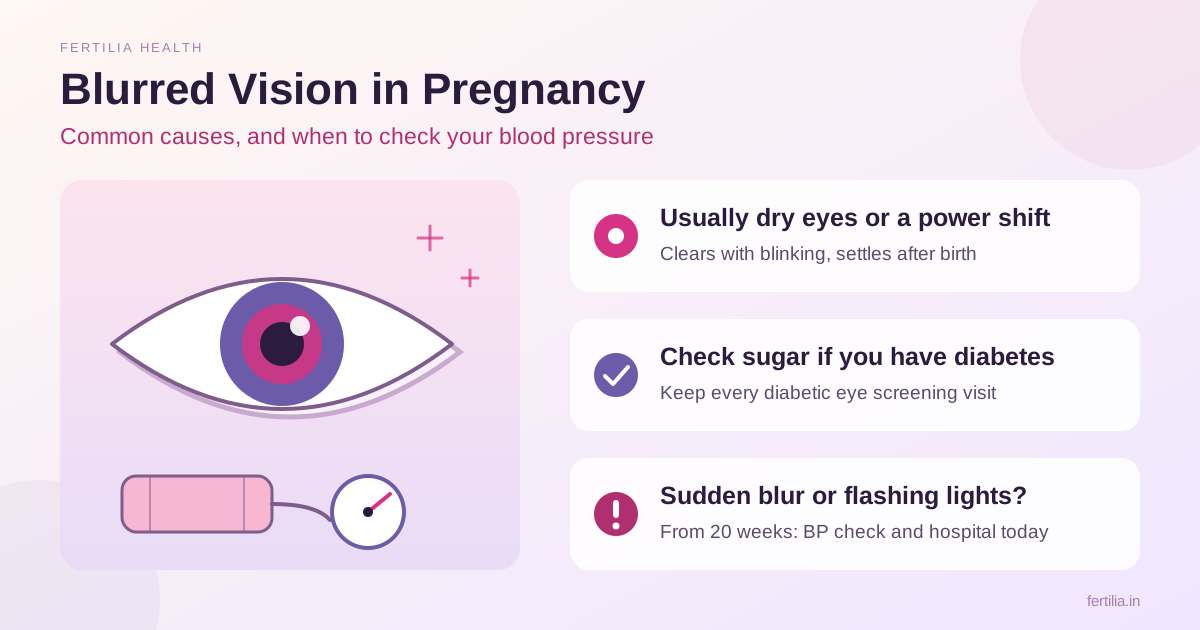
I’m Dr. Suganya Venkat, and in fifteen years as an OB-GYN I have found that a change in vision worries pregnant women more than almost any other new symptom, because it is the eyes. Most blurring in pregnancy comes from ordinary changes in the front of the eye: drier eyes, a slightly different shape to the cornea, and a glasses power that shifts for a few months. A smaller number of women have blurring linked to blood sugar or blood pressure, and one pattern, sudden blurring or flashing lights in the second half of pregnancy or after delivery, needs a blood pressure check and a doctor straight away.
This post explains how to tell these apart so that you know what to do with the blur in front of you.
Here is what this post covers:
- The everyday causes: dry eyes, a changing glasses power, and contact lens discomfort
- The blood sugar link, for women with gestational diabetes or diabetes from before pregnancy
- Why blood pressure matters, and the numbers that change what you do
- A simple guide: what to do right now, what to check today, and what can wait for your next visit
Why Your Eyes Change in Pregnancy
Pregnancy affects the eye in small, measurable ways. In a study that compared 60 pregnant women with 60 women who were not pregnant, the pregnant group had a slightly steeper curve to the front of the cornea and lower pressure inside the eye (Goldich Y et al., J Cataract Refract Surg, 2014, PMID 25217070). Neither change is harmful, but a small change in the shape of the cornea may be one reason your glasses do not feel quite right.
These changes are common enough that eye doctors see them often. A study from an eye emergency department in Israel looked at 562 women aged 18 to 50 who came in over three months. Among them, a diagnosis of passing visual disturbance with a completely normal eye examination was made in 48% of the pregnant women and 11% of the women who were not pregnant (Kapelushnik N et al., Sci Rep, 2025, PMID 40419630). The obstetric checks done on the pregnant women in that study were normal apart from two who had high blood pressure. That is the pattern I see too: most blurring has a harmless cause. A blood pressure check is one important part of finding the few causes that are not harmless, alongside an eye examination and, when needed, urine and blood tests.
The Common Causes of Blurred Vision in Pregnancy
Dry eyes
When the surface of the eye dries out, vision blurs for a moment and then clears when you blink. A 2025 review estimated that dry eye affects between 20% and 50% of pregnant women, most often in the second and third trimesters, while noting that pregnancy has not yet been firmly established as a cause (Jaruchowska M et al., Int J Mol Sci, 2025, PMID 41155290).
The NHS lists the signs of dry eyes as eyes that are itchy, sore, gritty, red, blurry, sensitive to light or more watery than normal. Long spells looking at a screen, air-conditioned rooms, wind, dust and smoke all make it more likely, and so do contact lenses (nhs.uk, dry eyes, reviewed January 2025). In our homes that means late-night phone scrolling, sleeping under a fan or AC, a two-wheeler ride without a visor, or standing over the stove while the tadka smokes.
What helps:
- Take regular breaks from your phone or laptop and look at something far away.
- Keep the screen just below eye level.
- Point the fan or AC away from your face, especially while you sleep.
- Clean your eyelids once a day with a warm (not hot) damp cloth pressed gently over closed eyes.
- If you wear contact lenses, switch to glasses for a few days to rest your eyes.
- Ask a pharmacist about lubricating eye drops, and tell them you are pregnant so they can suggest a suitable one.
Most of these steps come from the NHS self-care advice for dry eyes (nhs.uk, dry eyes, reviewed January 2025).
A change in your glasses power
Some women find that their distance vision is not as sharp as it was, even with their usual glasses. In a small study of pregnant women who reported a change in vision, every one of them had become slightly more short-sighted than before pregnancy, by just under one dioptre, and all of them returned to near their pre-pregnancy power after delivery (Pizzarello LD, Graefes Arch Clin Exp Ophthalmol, 2003, PMID 12736728). The study was small, but it matches what many eye doctors see.
If your vision has changed gradually and is the same in both eyes, an eye check with an optometrist or ophthalmologist is a sensible step. If the change is new from 20 weeks or after delivery, tell your maternity team the same day as well, so your blood pressure can be checked. If you need new glasses to drive, work or read safely, get them. Otherwise it is worth asking whether a permanent change in your prescription can wait until some months after delivery. Laser vision correction is generally put off during pregnancy and breastfeeding, and your eye doctor will want to see that your glasses power has stayed stable before considering it.
Contact lenses that suddenly feel uncomfortable
A drier eye surface and a slightly steeper cornea can make lenses that fitted well before pregnancy feel scratchy or cloudy. Wearing glasses more often during pregnancy is a simple fix, and an optometrist can refit your lenses if you prefer them.
Low blood pressure and getting up too quickly
The NHS lists blurred vision alongside dizziness and light-headedness as symptoms of low blood pressure, and lists being pregnant as one of its causes (nhs.uk, low blood pressure, reviewed July 2023). This kind of blurring is brief, usually comes when you stand up quickly or stand for a long time in the heat, and clears when you sit down. Our guide to dizziness in pregnancy explains what to do in the moment and how to prevent it.
💜 Your vision has changed and you are not sure why? Message Dr. Suganya on WhatsApp to book a ₹399 video consultation. Share how many weeks pregnant you are, when the blurring happens, and your latest blood pressure and blood sugar readings. If your blurring came on suddenly with a headache or swelling, go to your hospital first.
The Blood Sugar Link
Gestational diabetes
The NHS notes that gestational diabetes usually causes no symptoms, but that some women whose sugar runs high notice blurred eyesight, along with more thirst, passing urine more often, a dry mouth and tiredness. It also points out that some of these are common in pregnancy anyway (nhs.uk, gestational diabetes, reviewed December 2022). If you have blurred vision together with those other signs, mention it to your doctor; a sugar test settles the question. Our guide to gestational diabetes symptoms before the OGTT explains which signs are worth acting on.
Low sugar on insulin or tablets
If you are on insulin for diabetes, blurring can also be a sign of sugar dropping too low. The NHS lists changes in vision, such as blurred vision, among the symptoms of low blood sugar, together with hunger, sweating, shaking and feeling dizzy, and notes that it mainly affects people with diabetes on insulin or some other diabetes medicines (nhs.uk, low blood sugar, reviewed August 2023). Check your sugar and follow the plan your diabetes team gave you. Our guide to gestational diabetes in India explains the targets and how treatment is adjusted.
Diabetes that started before pregnancy
If you had type 1 or type 2 diabetes before you conceived, your eyes need a little more attention in pregnancy. The NHS advises regular diabetic eye screening during pregnancy, because the risk of diabetic eye disease is greater while you are pregnant, and it is treatable, especially when found early (nhs.uk, diabetes and pregnancy, reviewed May 2024). In a long-term trial of women with type 1 diabetes, pregnancy brought a temporary rise in the risk of the retinopathy getting worse, which is why the researchers advised closer eye checks through pregnancy and the first year after delivery. By the end of the trial, though, the eyes of women who had been pregnant were no different, on average, from those who had not (Diabetes Control and Complications Trial Research Group, Diabetes Care, 2000, PMID 10937502). So keep every eye screening appointment, and tell your team about any new blur between them.
When Blurred Vision Is About Blood Pressure
High blood pressure in pregnancy is often silent. You may feel completely well with a raised reading, which is why your blood pressure is checked at every antenatal visit. Sometimes, though, it shows up in the eyes.
The NHS lists vision problems, such as blurred vision or seeing flashing lights, among the symptoms of pre-eclampsia, together with a severe headache that does not go away with simple painkillers, pain below the ribs, sudden swelling of the face, hands or feet, feeling very unwell, heartburn that does not settle with heartburn medicines, and vomiting. It says any of these need to be checked immediately. Pre-eclampsia is most likely from 20 weeks of pregnancy onwards but can happen earlier, and it can also start in the days or weeks after the baby is born (nhs.uk, pre-eclampsia, reviewed March 2026).
In my experience, the vision problems that come with pre-eclampsia look different from dry eye. They are new and sudden, they do not clear when you blink, and they often come with other symptoms on that list. Women describe flashing lights, spots, or a haze over everything. Our full guide to pre-eclampsia explains how it is diagnosed and what happens in hospital.
The blood pressure numbers that matter
The NHS uses these cut-offs in pregnancy (nhs.uk, high blood pressure and pregnancy, reviewed November 2024):
| Reading | What it means |
|---|---|
| Below 140/90 mmHg | Not in the high range |
| 140/90 to 159/109 mmHg | High blood pressure in pregnancy; needs regular checks, and not always medicine |
| 160/110 mmHg or higher | Severe high blood pressure; needs treatment until the reading comes below 160/110 |
Either number counts. A top number of 140 or more, or a bottom number of 90 or more, is in the high range even if the other number is normal.
How to take a useful reading at home
If you have a home blood pressure machine, a careful reading gives your doctor real information:
- Sit in a chair with your back supported and both feet on the floor, and rest quietly for about five minutes first.
- Rest your arm on a table at about the level of your heart, with the cuff on bare skin of the upper arm.
- Do not talk or look at your phone while the cuff inflates.
- Take two readings a minute or two apart and write down both, with the time.
The NHS also notes that a reading may be taken a couple of times to make sure it is accurate (nhs.uk, blood pressure test, reviewed November 2025). If a number looks unexpectedly high, rest for a few minutes and repeat it. Our guide to gestational hypertension has more on home monitoring if your doctor has asked you to keep a log.
One important point: a home reading should never be the reason you stay home. If you have sudden blurred vision or flashing lights after 20 weeks, or after delivery, get checked straight away even if your home reading looks normal. The hospital will check your blood pressure properly, test your urine and usually do blood tests, which a home machine cannot do.
What to Do: A Simple Guide
Go to your hospital or labour ward now if
- Your vision blurs suddenly, or you see flashing lights or spots, from 20 weeks of pregnancy or in the weeks after delivery. The NHS says these need to be checked immediately (nhs.uk, pregnancy symptoms you need to get help for, reviewed June 2026).
- Blurring comes with a severe headache, pain below the ribs, sudden swelling of the face or hands, or vomiting. Our guide to headaches in pregnancy explains how this headache differs from an everyday one.
- Your reading is 160/110 or higher and stays there when you repeat it after a few minutes of rest, whether or not you have symptoms.
- Blurring of any kind comes with a reading of 140/90 or higher in the second half of pregnancy or after delivery.
Call your maternity unit on the way if you have the number. Do not drive yourself.
Call 108 or 112 if
- You suddenly lose vision or have double vision, or you have a sudden, extremely painful headache, confusion, difficulty speaking, or weakness on one side of the body. The NHS lists these among the reasons to call an ambulance (nhs.uk, migraine symptoms, reviewed March 2026).
- Someone has a seizure (fit) in pregnancy or after delivery.
Get an urgent eye check if
- You see a sudden shower of new floaters or flashes, or a dark curtain or shadow moving across your vision. The NHS advises an urgent eye appointment for these (nhs.uk, floaters and flashes, reviewed June 2023). If you are 20 weeks pregnant or more, or have recently given birth, go to your hospital first, because flashes can also be a pre-eclampsia symptom; the eye check can follow.
- Your eye is painful and red, especially if you wear contact lenses (nhs.uk, dry eyes, reviewed January 2025).
- Blurring is in one eye only and does not clear with blinking.
Mention it at your next antenatal visit, and book an eye check, if
- The blur comes and goes, clears when you blink, and your eyes feel dry or gritty.
- Your distance or reading vision has changed gradually in both eyes over weeks.
- Your contact lenses have become uncomfortable.
- You feel briefly blurry and light-headed when you stand up, and it settles when you sit.
From 20 weeks of pregnancy, or after delivery, do not wait for your next visit if a vision change is new and you cannot explain it. Call your maternity team the same day so your blood pressure can be checked, even if the change came on slowly and you have no headache.
If you have migraine with aura
Some women have migraines with visual aura, such as zigzag lines or flashing lights, before the headache. The NHS says aura should not last longer than one hour, and advises an urgent appointment if aura lasts longer, or if you have a migraine attack while pregnant or just after having a baby (nhs.uk, migraine symptoms, reviewed March 2026). In pregnancy, I would rather you have your blood pressure checked than assume it is your usual migraine, especially after 20 weeks.
What Your Doctor May Check
When you mention blurred vision at a visit, the usual checks are quick:
- Blood pressure, often repeated after a few minutes of rest.
- A urine test for protein.
- Blood tests, including platelets, liver and kidney tests, if blood pressure is raised or there are other symptoms.
- Blood sugar, if you have diabetes or signs of high sugar.
- A referral to an eye doctor, if the blurring is in one eye, there are new floaters or flashes, or your eyes need a closer look.
For most women, the result is reassuring: normal blood pressure, a dry eye surface, and a few simple changes to try.
What It Is Called in Hindi, Tamil and Telugu
Many women search for this in their own language, usually typed in Roman letters:
| Language | Common words and search terms |
|---|---|
| Hindi | Aankhon se dhundhla dikhna (आँखों से धुंधला दिखना); pregnancy me dhundhla dikhna; aankhon ke aage andhera |
| Tamil | Paarvai mangal; kan mangalaga theriyuthu; pregnancy la kan mangal |
| Telugu | Choopu masakabaaradam; pregnancy lo kallu masakaga kanipistunnayi |
| English (search) | Blurred vision in pregnancy; vision changes in pregnancy; spots before eyes in pregnancy |
When you call your doctor, saying “I am pregnant, my vision is blurred, and it started suddenly” (or “comes and goes”, or “with a headache”) tells them most of what they need.
Practical Takeaways
- Most blurred vision in pregnancy comes from dry eyes or a temporary change in glasses power, and it usually settles after delivery.
- Blurring that clears with blinking points to dry eyes: rest from screens, keep the fan off your face, and ask a pharmacist about lubricating drops.
- A gradual change in both eyes usually needs an eye check. From 20 weeks, or after delivery, a new vision change you cannot explain also needs a same-day call to your maternity team so your blood pressure can be checked.
- If you have diabetes, check your sugar when your vision blurs, and keep every diabetic eye screening appointment.
- Sudden blurring or flashing lights from 20 weeks, or after delivery, need a hospital check straight away, even if your home reading looks normal.
- A reading of 160/110 or higher that stays high on a repeat check needs care straight away, with or without symptoms.
For the bigger picture of what to expect month by month, see our pregnancy week-by-week guide.
Frequently Asked Questions
Is blurred vision normal in pregnancy? (Pregnancy me dhundhla dikhna normal hai?)
Mild blurring that comes and goes is common, and it usually comes from dry eyes or a small change in how your eyes focus. If it clears when you blink or rest your eyes, it is rarely a sign of a problem. Mention it at your next antenatal visit. Sudden blurring, flashing lights or spots, especially after 20 weeks or with a headache or swelling, need a same-day hospital check.
Can blurred vision be an early sign of pregnancy?
Blurred vision is not one of the usual early signs. In the first trimester, brief blurring is more often linked to low blood pressure when you stand up quickly, or to dry, tired eyes. If it keeps happening, mention it at your antenatal visit so your blood pressure can be checked.
Will my eyesight go back to normal after delivery?
For most women, yes. In a small study of pregnant women whose vision changed, all had returned to near their pre-pregnancy glasses power after delivery. Dry eye also tends to ease with time. If you have diabetes, keep having eye checks through the first year after delivery, as your diabetes team advises.
Should I change my glasses or get laser eye surgery during pregnancy?
If you need new glasses to see safely, get them. Otherwise, it is reasonable to ask your eye doctor whether a permanent change in prescription can wait until some months after delivery, since vision often shifts back after the baby is born. Laser eye surgery is generally put off during pregnancy and breastfeeding, and is only considered once your glasses power has been stable for a while.
Can high blood pressure in pregnancy cause blurred vision?
Yes. Blurred vision or flashing lights can be a symptom of pre-eclampsia, a condition that usually starts after 20 weeks and involves high blood pressure. It needs to be checked straight away, and the hospital will check your blood pressure, urine and blood tests together. Most women with blurred vision in pregnancy do not have pre-eclampsia, and the check is how you find out.
Can I use eye drops in pregnancy?
Lubricating eye drops for dry eyes are widely used. Ask a pharmacist or your doctor to suggest one, and always tell them you are pregnant. Do not use leftover medicated drops from a previous eye infection without asking first.
What blood pressure is too high in pregnancy?
The NHS treats a reading of 140/90 or higher as high in pregnancy and 160/110 or higher as severe. If you have any new vision change and a reading of 140/90 or above in the second half of pregnancy or after delivery, go to your hospital the same day. A reading of 160/110 or above that stays high when you repeat it needs care straight away, even without symptoms.
Talking It Through
Most women who come to me with blurry eyes in pregnancy leave with a simple explanation and a few changes to make at home. The value of the conversation is in ruling out the small number of causes that need more. At Fertilia, Dr. Suganya Venkat goes through your symptoms, your blood pressure log and your reports with you over a video consultation, and can work alongside your obstetrician and eye doctor so that you know exactly what to watch for in the weeks ahead. If you want care that continues through the whole pregnancy, our pregnancy program explains how that works.
💜 Want a doctor to look at your symptoms with you? Message Dr. Suganya on WhatsApp to book a ₹399 video consultation, available online across India. You can also download our free pregnancy guide for week-by-week support through each trimester.