You have PCOS, you are trying to conceive, and your period is late. Maybe it is five days late, maybe it is three weeks late. You test, and the line is blank. A week later you test again, still nothing. Or worse, you see the faintest shadow of a line and cannot tell whether it is real.
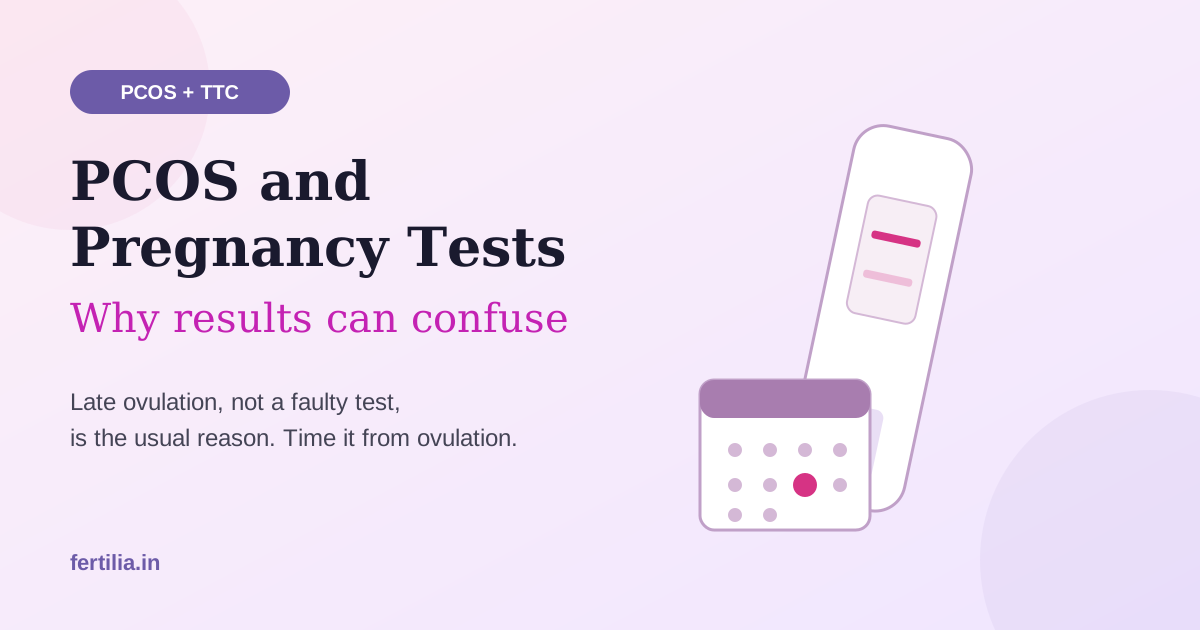
If this feels familiar, you are not reading the test wrong, and the test is usually not faulty. With PCOS, the confusion almost always comes from the calendar, not the stick.
I’m Dr. Suganya Venkat, an OB-GYN with over 15 years of experience, and this is one of the most common questions women in Fertilia’s PCOS program send me on WhatsApp. This post explains why pregnancy tests feel so unreliable with PCOS, when to actually test, what a negative or faint result can mean, and when a blood test is the better next step.
If you want the general guide to reading a home test, see how to take and read a home pregnancy test. This post is specifically about what changes when your cycles are irregular.
Does PCOS Affect the Pregnancy Test Itself?
No. A home pregnancy test looks for one hormone: hCG (human chorionic gonadotropin), which is made only after a fertilised egg implants. PCOS does not produce hCG, so PCOS by itself does not cause a positive result.
PCOS does raise LH (luteinising hormone) in many women, and that matters for ovulation kits, which detect LH. A woman with PCOS can see repeated “positive” ovulation strips without actually ovulating. But pregnancy tests are designed to read hCG, not LH, so this is a different problem from the one most women worry about.
So when results seem confusing with PCOS, the explanation usually sits in one of three places:
- You tested before hCG had risen enough to detect, because you ovulated later than you think.
- You did not ovulate this cycle at all, so the period is late for a reason other than pregnancy.
- Something else in your treatment (most often an hCG trigger injection) is being picked up by the test.
Let us take each one.
Why “Late Period” Means Something Different With PCOS
Every home test instruction leaflet says “test from the first day of your missed period.” That advice assumes a regular cycle, where ovulation happens around 14 days before the period is due.
With PCOS, that assumption breaks. PCOS is diagnosed using the Rotterdam criteria, and irregular or absent ovulation is one of its three core features. The 2023 international PCOS guideline further refined the individual diagnostic criteria and simplified the diagnostic algorithm (Teede HJ et al., Fertil Steril, 2023, PMID 37589624). In practice this means:
- Some cycles you ovulate on day 14. Others on day 25, or day 40.
- Some cycles you do not ovulate at all.
- Without tracking, you cannot know which kind of cycle this one was.
Here is why that matters for testing. hCG first appears in urine only after implantation. In a landmark study of 221 women trying to conceive, implantation was timed by the first appearance of hCG in urine. Among pregnancies that lasted at least six weeks past the last menstrual period, hCG first appeared 6 to 12 days after ovulation, and the authors concluded that in most successful pregnancies the conceptus implants 8 to 10 days after ovulation (Wilcox AJ et al., N Engl J Med, 1999, PMID 10362823). The clock starts at ovulation, not at your last period.
So if your cycle is “late” by your calendar but you actually ovulated on day 32, a test on day 35 is far too early. It will be negative even if you are pregnant. That is the single most common reason women with PCOS feel tests are “lying.”
A simple way to think about it
| What you know | When a test is meaningful |
|---|---|
| You know roughly when you ovulated (follicle-tracking scan or a clear temperature rise) | About 14 days after ovulation |
| You do not know when you ovulated | Count from your last unprotected sex: test about 3 weeks after it |
| Cycles are very long or absent | Test every 2 to 3 weeks if you are having regular unprotected sex, and plan a review |
The “three weeks after sex” rule is useful because it covers late ovulation without you needing to know the exact day.
When the Test Is Negative and the Period Still Has Not Come
This is the scenario that causes the most worry. A negative test, taken at the right time, plus no period, usually means this cycle did not have an ovulation, or the ovulation was very late.
With PCOS, this is often the expected pattern rather than a new problem. Without ovulation, there is no progesterone rise and fall, and it is that fall which normally triggers a period. The lining can keep building slowly until it sheds on its own, sometimes weeks later and sometimes heavier.
What you can do:
- Retest once, with first-morning urine, 3 weeks after your last unprotected sex. If that is negative, pregnancy is very unlikely.
- Note the dates. Write down when your last period started and when you tested. This saves time at a consultation.
- Do not keep testing every day. Daily testing in an anovulatory cycle rarely changes the answer and adds a lot of stress.
- Talk to your doctor if you go more than about three months without a period. For women with PCOS, a long stretch without a bleed is something a gynaecologist will usually want to address, because regular shedding protects the uterine lining. This is routine and very manageable.
For the wider list of reasons a period goes missing with a negative test (thyroid, stress, weight change, prolactin), see missed period, negative pregnancy test: what to do next.
Why Home Tests Vary in What They Detect
Not all strips are equally sensitive. A study that checked 15 home pregnancy test devices found their detection limits ranged from 6.3 IU/L to 50 IU/L of hCG, an eightfold difference, and most detected an early form of hCG less well than the standard form (Butler SA et al., Clin Chem, 2001, PMID 11719477).
In practical terms:
- Two different brands can give different answers on the same morning, especially very early.
- A “99% accurate from the day of your missed period” claim is calculated for regular cycles. For a woman with PCOS who ovulated late, the “day of the missed period” is not a fixed date.
- First-morning urine is more concentrated, so it is the best sample when hCG is still low.
If you see a faint line, it usually still means hCG is present. Our guide on what a faint line on a pregnancy test means covers how to confirm it.
Not sure whether to keep testing or get checked? Message Dr. Suganya on WhatsApp with your cycle dates and test results, and she will help you work out the sensible next step over a video consultation (₹399 in India).
Chat with Dr. Suganya on WhatsApp
When a Positive Result Can Mislead
True false positives are uncommon, but women with PCOS who are on fertility treatment meet one cause more often than anyone else: the hCG trigger injection.
Many ovulation induction cycles, with letrozole, clomiphene, or injections, end with a “trigger shot” to release the egg. Some triggers are hCG itself. A home test cannot tell injected hCG apart from hCG made by a pregnancy, so it can read positive for days after the injection, depending on the dose.
What helps:
- Ask your doctor which trigger you received, and when it is reasonable to test after it. Your fertility team usually gives a specific test date for this reason.
- Wait for the date they give you, whether you test at home or with a blood beta hCG test. A blood test also picks up injected hCG, so any earlier test needs your fertility team to plan it and interpret the result.
- Letrozole and clomiphene tablets do not contain hCG, so they do not cause a positive test by themselves.
For more on how trigger timing works, read IVF trigger shot timing and what to expect, and if you are on letrozole, the letrozole for PCOS guide.
The other reason a positive turns negative is a very early pregnancy that does not continue, often called a chemical pregnancy. This is common in all women, with or without PCOS, and a single one is usually not a sign of a long-term problem. Chemical pregnancy: signs, causes and what it means for fertility explains it gently.
When to Choose a Blood Test Instead
A blood beta hCG test measures the exact amount of hCG, not just yes or no. With PCOS, it is often the clearer choice when:
- You have had several faint or unclear home results.
- You had an hCG trigger and want a definite answer after the advised date.
- You need a starting number to compare with a repeat test 48 hours later.
Labs across India offer this as a same-day test. Our guide to beta hCG levels and what your numbers mean helps you read the report.
Spotting or pain with a positive test is different. Do not rely on a blood test alone. Contact your doctor promptly, because a single hCG number cannot show where the pregnancy is, and she may advise a scan along with repeat hCG. If you have severe pain, shoulder-tip pain, fainting or heavy bleeding, seek emergency care straight away.
Practical Steps: Testing With PCOS Without Losing Your Peace
- Track ovulation, not just periods. Ovulation scans (follicle tracking) or basal temperature charting can show roughly when you ovulated, which is when the 14-day count starts. A day-21 progesterone test timed to your cycle can show that you did ovulate, but it cannot tell you the exact day. See the day-21 progesterone test.
- Use the three-week rule when you do not know your ovulation date.
- Pick one brand and use first-morning urine, so results are comparable.
- Test less, not more. One well-timed test is worth more than ten early ones.
- Keep a small note of period dates, test dates and any medicines. It turns a confusing month into a clear picture for your doctor.
- Work on the drivers of PCOS. When cycles become more regular, testing becomes simpler. Our step-by-step guide to conceiving naturally with PCOS covers what helps.
What Women Call This at Home
Many women search in their own words. In Hindi it often sounds like “period nahi aaya, test negative hai,” and in Tamil, “period varala, test negative.” Whatever the words, the question is the same: is the test right, and what next? The answer for PCOS is usually to check the timing first, then talk to a doctor if the cycle stays long.
Frequently Asked Questions
Can PCOS cause a false positive pregnancy test?
PCOS itself does not cause a false positive, because pregnancy tests detect hCG and PCOS does not make hCG. A positive test with PCOS usually means hCG is present. The most common non-pregnancy reason is a recent hCG trigger injection during fertility treatment.
Can PCOS cause a false negative pregnancy test?
Not directly, but it often causes tests to be taken too early. With irregular cycles, ovulation may happen much later than expected, and hCG appears only 6 to 12 days after ovulation. Testing about three weeks after unprotected sex avoids most early negatives.
When should I take a pregnancy test if I have PCOS and irregular periods?
If you know when you ovulated, test about 14 days later. If you do not, test about three weeks after unprotected sex. Calendar-based “missed period” timing is less reliable with PCOS.
My period is 2 weeks late with PCOS but the test is negative. Should I worry?
Usually not. A late period with a negative, well-timed test most often means that cycle had late or no ovulation, which is common with PCOS. Retest once with first-morning urine, and speak to your doctor if you go about three months without a period.
Can letrozole or clomiphene make a pregnancy test positive?
No. These tablets do not contain hCG. So they do not make a test read positive by themselves; in fertility treatment, the usual non-pregnancy reason for a positive test is an hCG trigger injection, if one was given. Ask your fertility team which trigger you received and when to test.
Is a blood test better than a urine test with PCOS?
A blood beta hCG test gives an exact number and is more useful with repeated faint lines, or after a trigger shot once your fertility team’s advised test date has passed. If you have spotting or pain with a positive test, see a doctor promptly rather than relying on a test alone. For a simple yes or no at the right time, a home test is usually enough.
Do ovulation kits work with PCOS?
They can be misleading. Many women with PCOS have high baseline LH, so ovulation strips may show repeated positives without ovulation. A scan or a timed progesterone test confirms ovulation more reliably.
You Do Not Have to Decode This Alone
Confusing test results are rarely a sign that something is wrong with you. With PCOS, they are mostly a sign that your cycle runs on its own timetable. Once you know when you ovulate, the tests start to make sense again, and Fertilia’s 90-day PCOS Symptom Reversal program works on exactly that: steadier cycles and clearer answers.
Want help reading your cycle and test results? Send Dr. Suganya your dates on WhatsApp and book a video consultation (₹399 in India) to plan your next step calmly.