If you have been searching for “PMOS vs PCOS” or “what is the difference between PMOS and PCOS”, the quick answer is this:
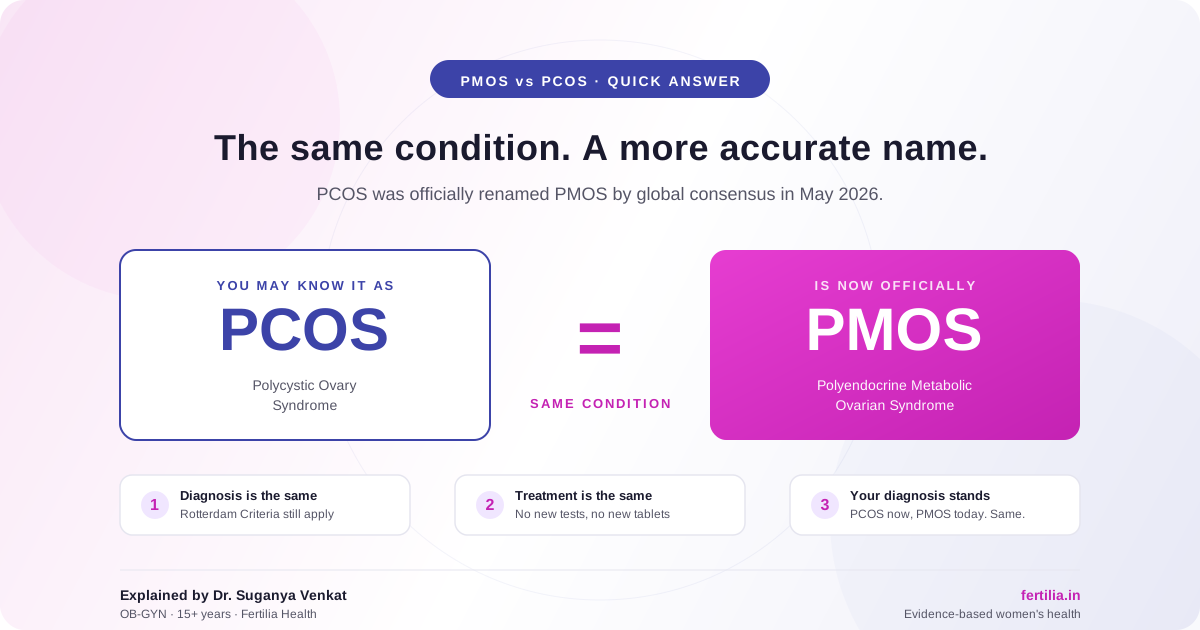
There is no difference. They are the same condition. PMOS is just the new official name for PCOS.
The change was made on 12 May 2026, when an international consensus of 56 medical organisations, drawing on 14,360 survey responses from patients and health professionals, published the rename in The Lancet. The condition itself, the way it is diagnosed, and the way it is treated, are all unchanged. Only the name is different.
If you want to understand exactly what changed and what did not, this article walks you through it. If you would prefer the full background story of why the name was changed, read our companion piece: PCOS Is Now PMOS: New Official Name Explained.
The 30-Second Comparison
Here is the side-by-side version of everything you might be wondering about.
| Aspect | PCOS (the old name) | PMOS (the new name) |
|---|---|---|
| Full form | Polycystic Ovary Syndrome | Polyendocrine Metabolic Ovarian Syndrome |
| The condition itself | The same | The same |
| Symptoms | Irregular periods, acne, hirsutism, weight gain, infertility, insulin resistance | Same. Nothing changes here. |
| Diagnostic criteria | Rotterdam Criteria (2 of 3 features) | Rotterdam Criteria (2 of 3 features). Identical. |
| Treatment | Lifestyle, metformin, oral contraceptives, ovulation induction with letrozole, anti-androgens | Identical. The treatment was never about the name. |
| Underlying problem | Hormonal and metabolic dysfunction | Hormonal and metabolic dysfunction. Same. |
| Whether you “have” it | If a doctor diagnosed you with PCOS, you have it | You still have it. It is now called PMOS. |
| Whether you need a new test | No | No |
| Whether you need a new prescription | No | No |
| When the name change happened | Used since 1935 (Stein-Leventhal first described it) | 12 May 2026 (Lancet consensus) |
| When the transition completes | — | By 2028, when international guidelines and the WHO ICD update |
What Changed (and What Did Not)
Three things changed
1. The name. Polycystic Ovary Syndrome became Polyendocrine Metabolic Ovarian Syndrome. The abbreviation moved from PCOS to PMOS.
2. How accurately the name describes the condition. The old name implied this was a problem of “cysts” on the ovaries. It is not. What the ultrasound shows is a crowd of immature follicles, not cysts. A 2026 JAMA Internal Medicine paper from Prof Terhi Piltonen confirmed women with this condition are not at higher risk of pathological ovarian cysts. The new name removes the word “cyst” and adds two words, polyendocrine and metabolic, that describe what is actually going on.
3. How the condition is framed in medical literature. The old name made many doctors and patients think of this as a gynaecological problem only. The new name makes it clear that this is a multi-system condition involving the ovaries, the pancreas (insulin), the adrenal glands (cortisol and androgens), and the brain (the GnRH pulse generator). It is not just a “woman’s reproductive problem”.
Six things did NOT change
1. The diagnostic criteria. The Rotterdam Criteria, established in 2003, are still the gold standard. To be diagnosed, you need at least 2 of these 3 features: irregular periods, signs of high androgens (clinical or on blood test), and a polycystic appearance on ovarian ultrasound (or high anti-Mullerian hormone on blood test).
2. The treatment. Lifestyle modification is still the first line. Metformin is still used for insulin resistance. Combined oral contraceptives are still used for cycle regulation, acne, and hirsutism. Letrozole is still the first-line ovulation induction drug. GLP-1 agonists (semaglutide and liraglutide) are emerging but the protocol is the same.
3. The symptoms you may have. Irregular periods, weight that is hard to shift, acne that does not respond to standard treatment, facial hair, hair loss on the scalp, dark patches on the neck or armpits (acanthosis nigricans), difficulty conceiving: all of these remain the recognised symptoms.
4. Your existing diagnosis. If your gynaecologist diagnosed you with PCOS at any point in the past, you have PMOS now. You do not need a re-evaluation just because the name changed. The condition you have is the same condition you had yesterday.
5. Your current prescription. Continue taking what your doctor has prescribed. The metformin, the oral contraceptive, the anti-androgen, the letrozole, the inositol supplement: none of these change because of a name update.
6. The fact that this is reversible with the right approach. What I have seen in 15 years of clinical practice, and what the Lancet paper itself acknowledges, is that lifestyle and metabolic correction can reverse the hormonal disturbance in most women. The new name does not make this any easier or harder. It just describes it more accurately.
What About PCOD?
A question I get from many Indian patients: “My doctor told me I have PCOD. Is PCOD the same as PCOS, and now PMOS?”
In India, both PCOD and PCOS have been used interchangeably for years. Strictly, PCOD (Polycystic Ovarian Disease) was an older term used when the polycystic appearance on ultrasound was thought to be the defining feature. PCOS (Polycystic Ovary Syndrome) replaced it once doctors recognised it as a syndrome with hormonal and metabolic components, not just an ovarian appearance.
Now, with PMOS (Polyendocrine Metabolic Ovarian Syndrome), the name finally reflects all the systems involved.
So the lineage is:
PCOD → PCOS → PMOS
All three names refer to the same underlying condition. If anyone in your family, your friend circle, or even a doctor uses any of these three terms, they are talking about what is now formally called PMOS.
In Indian clinical practice, PCOS and PCOD will probably continue to be used in everyday conversation for several years, simply because that is what patients know and ask for. That is normal during a transition. PMOS will gradually replace them as international guidelines update.
In Tamil and Other Indian Languages
For our Tamil-speaking patients, neither PCOS nor PMOS has a clean Tamil translation. Most women refer to it as “hormonal imbalance” (ஹார்மோன் சமநிலை குறைபாடு) or simply as PCOS / PCOD using the English abbreviation. We will continue to use PCOS and PCOD in our Tamil-language patient education while the medical community in India transitions. The condition does not change because of the language we use to describe it.
The Transition Period: What You Will See Over the Next Three Years
The Lancet consensus paper formally laid out a 3-year transition window from 2026 to 2028. During this period, you can expect:
- Medical journals, conference talks, and international guidelines will start using PMOS as the primary term, with “(formerly PCOS)” in brackets for clarity.
- Patient information materials, including those from the NHS, NIH, and the Endocrine Society, are gradually being updated.
- The WHO International Classification of Diseases (ICD) is expected to formally adopt PMOS by 2028. Until then, your diagnosis on hospital records may still appear as PCOS in coding systems.
- Indian medical bodies (FOGSI, ICMR, AIIMS) will most likely take 2 to 4 years longer to adopt PMOS in clinical guidelines and undergraduate curricula. This is the normal lag for any international guideline change in Indian medical practice.
- Most patient-facing materials, including blog posts, Instagram accounts, and YouTube channels, will use both names for the foreseeable future. You will see “PMOS (formerly PCOS)” or “PCOS / PMOS” frequently.
This is not a problem. It is the standard way medical terminology transitions, and it happened the same way when “manic depression” became “bipolar disorder” in the 1980s, and when “Wegener’s granulomatosis” became “granulomatosis with polyangiitis” in 2012. Both old and new names coexisted for years.
What This Means for You, Practically
If you are reading this because you were recently diagnosed, here is what to do:
- Continue your current treatment. Do not stop or change anything based on a name update.
- Use whichever term your doctor uses. If they still say PCOS or PCOD, that is correct. If they say PMOS, that is also correct. They are talking about the same thing.
- Know that the diagnostic criteria did not change. If you were diagnosed correctly under Rotterdam Criteria for PCOS, the same diagnosis stands under PMOS.
- If you want a deeper understanding of why this rename happened and what the Lancet paper actually said, read our full explainer.
- If you want personalised, evidence-based guidance on managing your PMOS (or PCOS, or PCOD, whichever you have been calling it), I consult online across India. You can WhatsApp me to start a conversation.
Frequently Asked Questions
Is PMOS the same as PCOS?
Yes. PMOS (Polyendocrine Metabolic Ovarian Syndrome) is the same condition as PCOS (Polycystic Ovary Syndrome). The name was officially changed on 12 May 2026 by an international consensus published in The Lancet. The diagnosis, symptoms, and treatment are unchanged. If you were diagnosed with PCOS, you have PMOS.
Do I need to change my treatment now that PCOS is called PMOS?
No. The name change does not affect treatment. Lifestyle modification, metformin, combined oral contraceptives, letrozole for ovulation induction, anti-androgens, and inositol supplements all continue to be used in the same way. Continue your current prescription as advised by your doctor.
Is PCOD the same as PMOS too?
Yes. PCOD (Polycystic Ovarian Disease) was an older Indian term for the same condition. PCOS replaced PCOD in international literature, and PMOS has now replaced PCOS. All three names refer to the same underlying syndrome. In Indian clinical conversation, PCOS and PCOD will continue to be used for some years, but they all mean PMOS.
Why was PCOS renamed to PMOS?
Three reasons. First, the “cysts” are not actually cysts. They are immature follicles, and women with PCOS are not at higher risk of true ovarian cysts. Second, the condition is not just a gynaecological problem, it involves multiple endocrine glands (ovaries, pancreas, adrenals, hypothalamus) and significant metabolic dysfunction. Third, the old name contributed to delayed diagnosis and stigma. PMOS reflects the multi-system nature of the condition more accurately.
Will my hospital records and reports still say PCOS?
Probably yes, for the next few years. The WHO International Classification of Diseases (ICD) is expected to formally adopt PMOS by 2028. Until then, hospital coding systems, lab reports, and discharge summaries in India will mostly continue to use PCOS or PCOD. This is normal during any medical terminology transition and does not affect the validity of your diagnosis.
Do I need to take a new test to confirm I have PMOS?
No. The Rotterdam Criteria, established in 2003 and used to diagnose PCOS, are still the diagnostic standard for PMOS. If you were diagnosed under Rotterdam Criteria before the rename, that diagnosis stands. No retesting is needed for the name change.
Is the rename only for Western countries, or does it apply in India too?
It applies globally. The consensus paper in The Lancet included input from 56 international organisations and patients from every world region, including India (Dr Madhuri Patil from Bengaluru is part of the consortium). The Indian medical community (FOGSI, ICMR, AIIMS) will most likely take 2 to 4 years to formally adopt PMOS in clinical guidelines and undergraduate teaching, but the condition and the name itself apply to Indian women too.
The One-Line Summary
PMOS is PCOS. New name, same condition, same diagnostic criteria, same treatment. The only thing that changed is that the name is now more medically accurate.
If a woman in your life was told she has PCOS, she has PMOS. If your aunt was told she has PCOD, she has PMOS. If a clinic in 2027 tells you that you have PMOS, you have what generations of women have known as PCOS. The condition is the same. The understanding of it just got better.
Read next:
- PCOS Is Now PMOS: New Official Name Explained (May 2026): the full backstory of the rename, why it happened, and what the Lancet paper said.
- Lancet 2026 PMOS Paper: 5 Clinical Takeaways: an OB-GYN’s deep-dive analysis of the actual paper, for the reader who wants what news articles missed.
- PCOS Symptoms, Root Causes & Treatment: the full evidence-based guide to understanding and managing the condition.
- Can PCOS Be Cured Naturally Without Medication?: what reversal actually means, and how to think about it.
- Insulin Resistance & PCOS: Signs, Diet & What to Do: the core metabolic driver in most cases.
Want personalised guidance? Dr Suganya Venkat is an OB-GYN with 15+ years of experience and has supported over 1000 pregnancies. She consults online across India for ₹399. Start a WhatsApp conversation. If you would like that guidance as an ongoing plan rather than a one-off chat, her 90-day PCOS (PMOS) Symptom Reversal program is the structured version.