You take the test, wait the two longest minutes of your week, and there it is: a second line, but so faint you have to tilt it toward the light to be sure it is really there. Then the questions start. Is that a line, or am I imagining it? Am I pregnant or not? Should I be excited or careful?
If you are standing in your bathroom right now squinting at a barely-there line, let me give you the reassuring answer first, and then explain it properly.
First, the reassuring answer
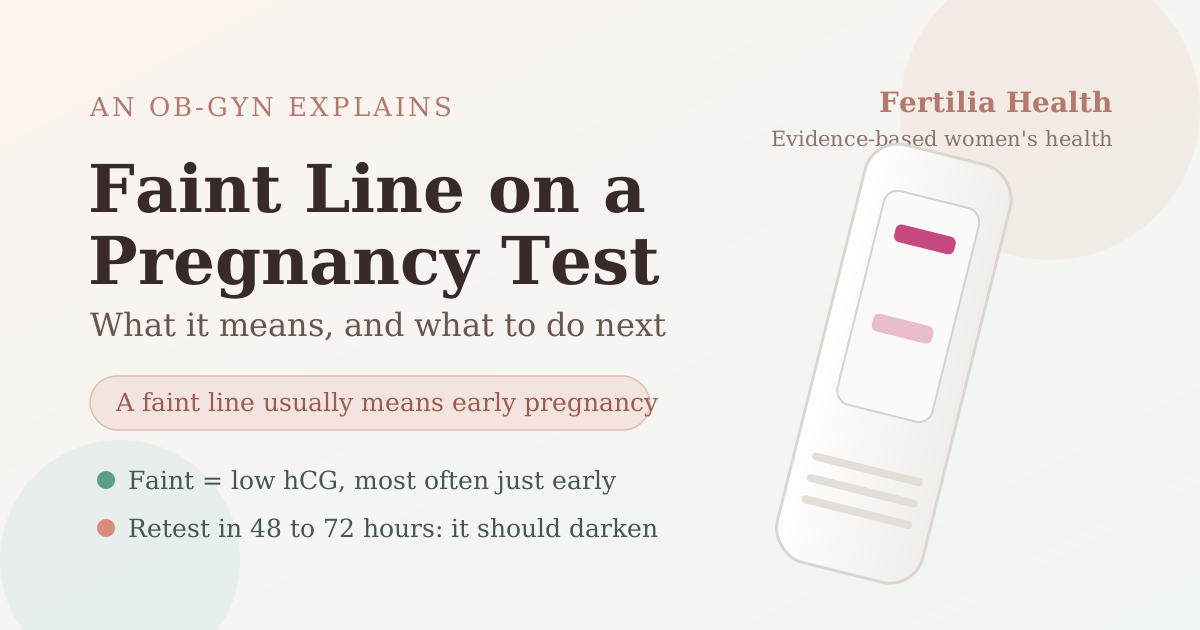
In most cases, a faint line means one thing: there is a small amount of the pregnancy hormone hCG in your urine, and that usually means you are pregnant, just early.
Home pregnancy tests work by detecting hCG (human chorionic gonadotropin), a hormone your body makes only when a pregnancy has implanted. The test line appears when there is enough hCG to trigger it. A faint line means the hCG is there but still at a low level, which is exactly what you would expect very early in a pregnancy. As one review of home pregnancy tests put it, the faintness of the line tracks with how much hCG is present, not with whether the result is real (Cole, 2011, Clinical Chemistry and Laboratory Medicine).
So a faint line is not a weak or uncertain pregnancy. It is usually just an early one.
Why is the line so faint?
There are three common, harmless reasons the line looks pale rather than bold:
- You tested early. hCG doubles roughly every two to three days in early pregnancy. If you test around the time of your missed period or a day or two before, the level is naturally low, so the line is faint. A few days later it is usually much clearer.
- Your urine was dilute. If you drank a lot of water or tested later in the day, the hCG in that sample is watered down. First morning urine, which is the most concentrated, gives the boldest line.
- The test is very sensitive. Some tests detect hCG at very low levels, which is a good thing, but it also means they can show a faint positive several days before your period is due, when the hormone is only just rising.
None of these means anything is wrong. They simply explain why the line is pale today.
Faint positive or evaporation line? How to tell
This is the question that causes the most worry, so here is the clear way to tell them apart.
A true faint positive appears within the reading time printed on the instructions, usually three to five minutes, and it has a hint of the test’s colour (pink or blue depending on the brand). It sits exactly where the test line should be, and it is still there when the test is fresh.
An evaporation line appears after the reading window, often after ten minutes or once the test has dried out. It is usually colourless, grey, or like a faint watermark rather than a coloured line, and it can look like a streak rather than a solid line.
The single most reliable rule: read your test within the time window on the packet, and trust what you saw then. A line that shows up an hour later on a dried test is not a result you should read into.
What to do next
If you have a faint line, the most useful next step is simple: test again in 48 to 72 hours, with first morning urine.
Here is why that works. In a healthy early pregnancy, hCG rises steadily, and the minimum expected rise over 48 hours is substantial (Barnhart et al., 2004, Obstetrics and Gynecology). That means a faint line today should become a clearer, darker line in two or three days as the hormone climbs. Watching the line get bolder over repeat tests is far more reassuring than any single result.
A few practical tips while you do this:
- Use first morning urine for the clearest line.
- Do not drink a lot of water right before testing, as it dilutes the sample.
- Use the same brand each time so you are comparing like with like.
- Try not to test every single day. Every two to three days shows a clearer trend and spares you a lot of anxiety.
💜 If you are staring at a faint line and the waiting feels hard, you do not have to sit with the uncertainty alone. You are welcome to send me a message, and I can help you understand what your test is showing and what the sensible next step is. Message Dr. Suganya on WhatsApp
Does the type of test matter?
A little, and it helps to know how, because it explains a lot of faint-line confusion.
Line tests (the familiar strips and cassettes like Prega News, i-can, and Clearblue, all widely available in India) show a control line and a test line. These are the ones that can give you a faint line, because the test line darkens gradually with the hormone level. Digital tests simply display “Pregnant” or “Not Pregnant,” so there is no faint line to squint at, but they often need a slightly higher hormone level to flip to “Pregnant,” which means a very early pregnancy can read positive on a sensitive line test and still say “Not Pregnant” on a digital one.
Sensitivity is the other factor. Tests are designed to detect hCG from different thresholds, and a more sensitive test picks up a pregnancy earlier, when the hormone is only just rising, so it is more likely to show a faint line in those first days (Cole, 2011). This is a strength, not a flaw. It simply means an early faint line is expected behaviour, not a faulty test.
The practical takeaway is the one from earlier: pick one reliable brand, use it consistently, test with first morning urine, and watch the trend across two or three days rather than reading too much into a single pale line.
When a faint line does not get darker
Most faint lines go on to darken, and for most women this is simply the start of a healthy pregnancy. Occasionally, though, a faint line stays the same or fades on a repeat test. I want to explain this gently, because it worries women and it should not carry any blame.
Sometimes a very early pregnancy implants but does not continue, which doctors call a chemical pregnancy or early pregnancy loss. It is far more common than most people realise. A large share of pregnancies end this early, often before a period is even missed, and many women who have one never knew unless they had tested very early (Wilcox et al., 1988, New England Journal of Medicine).
If this is what has happened, three things are true and worth holding onto: it is not caused by anything you did, it usually reflects a one-off issue with that particular embryo rather than a problem with you, and it does not mean you cannot have a healthy pregnancy. Most women who experience an early loss go on to conceive again. We cover this in more detail in our guide to chemical pregnancy.
When to see a doctor
A faint line is not usually a reason to rush anywhere, but it is a good reason to make a plan. It is worth checking in with a doctor if:
- Your line is not getting darker over repeat tests, or it has faded.
- You have taken a positive test and want to confirm it with a blood test. A blood beta-hCG gives an exact number, and two values 48 hours apart show whether the level is rising as it should. Our guide to beta hCG levels explains what the numbers mean.
- You have a faint positive along with bleeding, one-sided or severe pain, or dizziness, which should always be checked promptly to rule out an ectopic pregnancy.
- You have been trying for a while, or have a history of loss, and would simply feel steadier with a doctor walking through it with you.
Your gynaecologist confirms and monitors the pregnancy in person with blood tests and, a little later, a scan. What I add, alongside that, is help understanding what you are seeing and steadying the worry in between. If you are on a conception journey, Fertilia’s fertility program and conception guides are here for the whole road, not just this moment.
💬 Whatever your test shows, you deserve a clear answer rather than days of squinting and guessing. If you would like help reading your result or deciding whether a blood test is the right next step, a short message is enough. Message Dr. Suganya on WhatsApp
Frequently Asked Questions
Does a faint line mean I am pregnant?
Usually, yes. A faint line means the test has detected the pregnancy hormone hCG in your urine, which almost always means a pregnancy has implanted. The line is faint because the hormone level is still low, most often because it is very early. The clearest confirmation is a repeat test in two to three days, where a real pregnancy line becomes darker.
Can a faint line still mean I am not pregnant?
In most cases a genuine coloured line within the reading time is a positive. The main exception is an evaporation line, which appears after the time window, is usually colourless or grey, and is not a true result. Reading the test within the printed time, usually three to five minutes, avoids this confusion.
What is an evaporation line?
It is a faint mark that can appear where the test line sits, but only after the urine on the strip has started to dry, usually after the reading window has passed. It is caused by evaporation, not hCG, so it is typically colourless or grey rather than pink or blue. The rule that protects you from misreading it is simple: read the test within the time on the packet and trust that.
Should the line get darker each day?
Over two to three days, yes, a healthy early pregnancy line should get clearly darker as hCG rises. It may not look dramatically different from one day to the next, which is why testing every two to three days rather than every day shows the trend more reliably. Use first morning urine and the same brand each time for a fair comparison.
I had a faint line, then a negative test. What happened?
This can happen for a few reasons. The second test may have used more dilute urine, or a less sensitive brand, which can make a real early pregnancy read negative. Less often, it can mean a very early pregnancy did not continue, known as a chemical pregnancy. A blood beta-hCG test is the most reliable way to know what is happening, so this is a good point to check in with a doctor.
How many days after a missed period will the line be clear?
For most women, the line becomes clearly positive within a few days of a missed period, and often bolder by a week after. If you tested before your period was due and got a faint line, simply retesting a few days later usually gives a much clearer result as the hormone rises.
Should I get a blood test to be sure?
A blood beta-hCG test is helpful when you want certainty, when the line is not progressing, or when you have a history of loss or a reason to monitor closely. It gives an exact hCG number, and two values 48 hours apart show whether the pregnancy hormone is rising as expected. Your doctor can arrange this and interpret it with you.