You took the test. You read the instructions twice, used the first morning urine, waited the full three minutes, and the result is clear: negative. But your period has not arrived, and you cannot stop checking.
This is one of the more disorienting situations in women’s health, because neither story fits. You are not pregnant, at least according to the test, but your body is not doing what it normally does either. And without knowing why, it is hard to know what to do next.
This post is specifically about that scenario: you have already taken a pregnancy test, it came back negative, and your period is still missing. Here is what that combination can mean, and what a sensible next step looks like.
Is the Negative Test Reliable?
Before assuming the result is definitive, it helps to check the timing.
Home pregnancy tests detect hCG, a hormone the body produces only after a fertilised egg implants in the uterus. hCG levels start low and approximately double every 48 to 72 hours in the first weeks of pregnancy. If you test too early, there may not be enough hCG in your urine to register as positive, even if a pregnancy is present.
A test taken one week after your expected period date is highly reliable. A test taken on the day your period was due, or a day or two before, can miss an early pregnancy. The earlier you test, the higher the chance of a false negative.
So the first question to ask is: when did you test relative to your expected period date?
- Tested on or before the day your period was due: Retest in 48 to 72 hours, especially if your period still has not arrived.
- Tested 5 to 7 days after your expected period date: A negative result at this point is much more conclusive. Pregnancy becomes unlikely.
- Tested a week or more after your expected date: A negative test here reliably rules out pregnancy in most women.
The home pregnancy test guide covers the testing mechanics in more detail if you want to understand timing and what each result means.
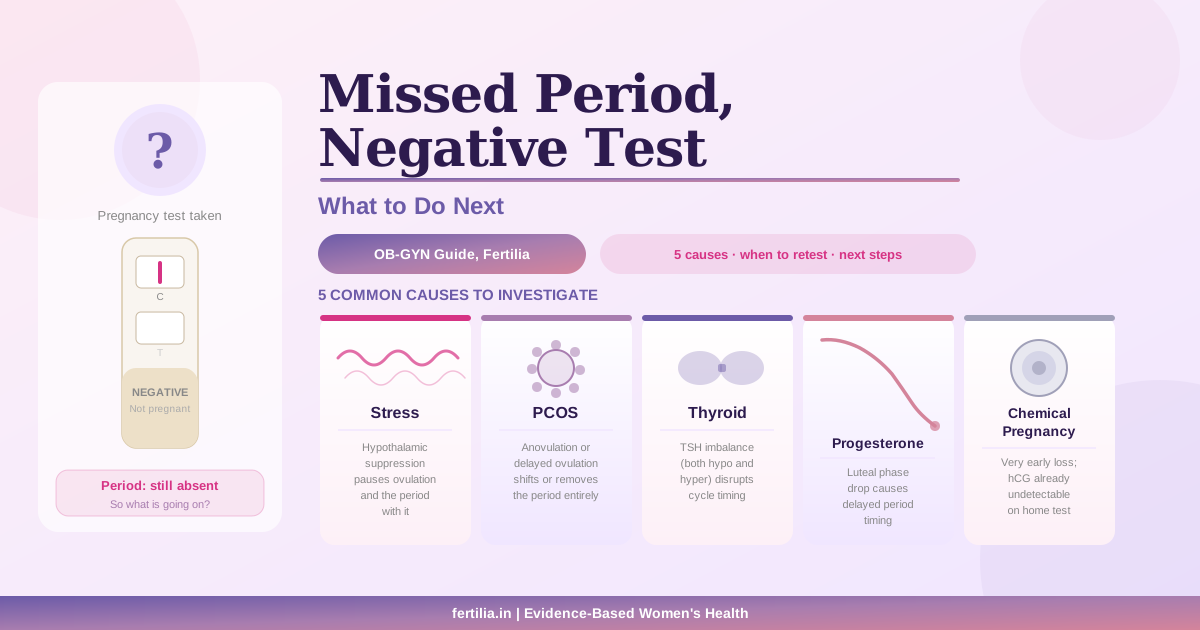
Five Reasons Your Period Is Late With a Negative Test
Once you have confirmed the test was taken at the right time and the negative is reliable, the next question is: what is delaying your period?
Here are the five most common causes.
1. Stress and Hypothalamic Suppression
The hypothalamus is the part of the brain that sends the hormonal signals needed to trigger ovulation. It is also sensitive to stress, whether physical or psychological.
When the body is under significant stress, including exam pressure, a difficult family situation, sleep deprivation, rapid weight loss, or over-exercising without enough food, the hypothalamus can reduce or pause the signals that lead to ovulation. No ovulation means no progesterone surge, which means no period.
This is called hypothalamic suppression. It is one of the most common and underappreciated reasons for a missed period in otherwise healthy women. The test is negative because there is no pregnancy. The period is absent because ovulation never happened.
Research in reproductive endocrinology consistently shows that changes in energy availability, even short-term, can alter the pulsatile secretion of GnRH (gonadotropin-releasing hormone), which in turn disrupts LH pulsatility and delays or prevents ovulation (Loucks AB, Thuma JR. J Clin Endocrinol Metab. 2003;88(1):297-311).
The body is doing exactly what it was designed to do: protecting itself from the metabolic demands of pregnancy when resources are insufficient or stress is high. It is frustrating when you are waiting for your cycle, but the biology behind it is purposeful.
2. PCOS (Delayed or Absent Ovulation)
PCOS, or Polyendocrine Metabolic Ovarian Syndrome (PMOS, as it is now officially called following the 2026 Lancet renaming), is one of the most common hormonal conditions in Indian women. One of its defining features is irregular or absent ovulation.
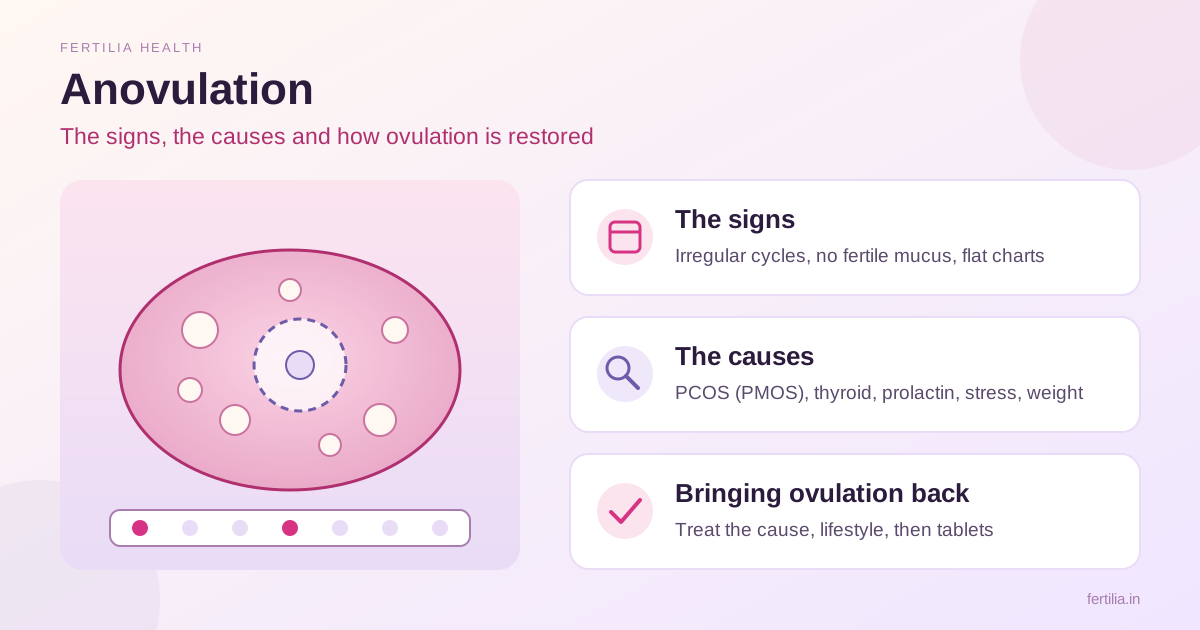
In a typical cycle, ovulation happens around day 14. In a cycle where PCOS is the underlying driver, ovulation may happen on day 20, day 25, or not at all in a given month. Because the timing of ovulation determines when the period follows, a delayed ovulation produces a long cycle, and an absent ovulation produces no period.
The test is negative because there is no pregnancy. The period is absent because ovulation did not happen on schedule, or did not happen at all this cycle.
If your cycles have been irregular over multiple months, heavier or lighter than usual, or if you have noticed other signs like scalp hair thinning, facial hair, or acne along the chin and jaw, PCOS deserves attention. The PCOS and missed periods guide goes into detail about how anovulation works and what helps restore cycle regularity.
Diagnostic criteria for PCOS require two of three features: oligo-ovulation or anovulation, clinical or biochemical androgen excess, and polycystic ovary morphology on ultrasound (Rotterdam criteria, Hum Reprod. 2004;19(1):41-47. PMID 15321452).
3. Thyroid Dysfunction
Both hypothyroidism (underactive thyroid) and hyperthyroidism (overactive thyroid) can disrupt the menstrual cycle. Thyroid hormones play a role in regulating the hormonal axis that controls ovulation and cycle length.
With hypothyroidism, cycles can become long, irregular, or absent altogether. Hyperthyroidism tends to produce shorter, lighter, or skipped cycles. Either way, the result can be a missed period with no pregnancy.
In Indian women, autoimmune hypothyroidism is particularly common and often goes undetected for years. The symptoms, fatigue, weight gain, feeling cold, dry skin, constipation, low mood, can be subtle and easy to attribute to other things. A delayed or absent period is sometimes the first noticeable signal.
A TSH blood test, inexpensive and available at any diagnostic lab in India, is the right starting point if thyroid dysfunction is a possibility. The thyroid and fertility guide explains the TSH levels to aim for and what treatment looks like.
4. Luteal Phase Inadequacy
After ovulation, the follicle that released the egg transforms into the corpus luteum, which produces progesterone. Progesterone supports the uterine lining and, if conception does not occur, eventually falls, triggering the period.
If the corpus luteum does not produce enough progesterone, or if progesterone falls earlier than usual, the period can arrive late or at an unpredictable time. In some cycles, ovulation is confirmed on an ultrasound but the post-ovulatory phase is not supported adequately, and the period timing shifts.
This is different from anovulation. Ovulation did occur, but the luteal phase was not well-sustained. A day-21 progesterone blood test (timed to days 17 to 21 of your cycle) can help assess this.
5. Chemical Pregnancy
A chemical pregnancy is a very early pregnancy loss, one that happens before the pregnancy would be visible on an ultrasound, typically before five weeks of pregnancy.
In these cases, hCG rises briefly and then falls. If the loss happens early enough and you test a few days after it began, the hCG may already be below the detection threshold of a home test. The test reads as negative. The period, when it arrives, may be a few days late and sometimes heavier or more crampy than usual, but many women have no way of knowing what happened.
Research using highly sensitive hCG monitoring found that approximately 22% of pregnancies ended as chemical losses, most of them before women even recognised that a pregnancy had occurred (Wilcox AJ et al. N Engl J Med. 1988;319(4):189-194. PMID 3393170). A single negative test taken a week after a missed period does not confirm a chemical pregnancy occurred, but it is worth knowing this exists as a possibility if you had some very early spotting or a briefly faint positive that then disappeared.
If You Are Waiting and Worried Right Now
Uncertainty about your cycle, especially when you are also wondering about pregnancy, is genuinely stressful. A 30-minute video consultation (₹399) gives you a chance to walk through your cycle history, symptoms, and test results with an OB-GYN and get a clear picture of what might be going on.
Chat with Dr. Suganya on WhatsApp →
What to Do Next: A Step-by-Step Plan
Step 1: Retest if your timing was early
If you tested before or on the expected date of your period, test again now. Use a sensitive brand (Prega News, Clearblue, or any CDSCO-cleared kit) with your first morning urine. If this retest is negative and your period is 7 or more days late, you can be reasonably confident that pregnancy is not the cause of the delay.
Step 2: Track when the period eventually arrives
Note the exact date. This gives you and your doctor a precise cycle length to work from, which matters when investigating causes like PCOS or thyroid dysfunction.
Step 3: Decide whether to investigate now or wait one cycle
If this is the first time your period has been significantly late, and a stressful month, a new exercise routine, or a major life change is the obvious trigger, observation for one cycle is reasonable. Many cycles resolve on their own once the stressor passes.
If this is a recurring pattern, two or more cycles per year that are significantly delayed, or if your period does not arrive within six weeks of your last one, a blood panel is the right next step.
Step 4: Get the right blood tests
The standard starting panel for a late period investigation includes:
- TSH: rules out thyroid dysfunction
- Prolactin: elevated prolactin (hyperprolactinaemia) can suppress ovulation
- Day 2 or 3 LH and FSH: gives information about the hypothalamic-pituitary-ovarian axis
- Fasting insulin and fasting glucose: helps assess insulin resistance, a common driver of PCOS
- Total or free testosterone: for androgen excess
- Day-21 progesterone (timed to days 17 to 21 of your cycle): assesses whether ovulation occurred and how well the luteal phase was supported
This panel is available at most diagnostic labs in India, including SRL, Metropolis, Thyrocare, and Dr Lal PathLabs, as well as government hospitals at lower cost. The complete fertility workup guide covers what each result tells you and how to interpret the numbers.
Step 5: Go to your doctor if no period by six weeks
If your last period was more than six weeks ago and you still have not had one, see a doctor. A pelvic ultrasound alongside the blood panel gives more information and rules out structural causes. Your doctor may also check for other less common causes like hyperprolactinaemia or Asherman’s syndrome depending on your history.
When to See a Doctor Sooner
Some situations call for an earlier appointment, not a six-week wait:
- Any pelvic or abdominal pain alongside a late period. Ectopic pregnancy, though rare, needs to be ruled out quickly if there is any possibility of pregnancy. Pain is the key warning sign.
- A period absent for 90 or more days. This meets the clinical definition of amenorrhea and needs medical evaluation.
- Trying to conceive for 6 to 12 months with irregular cycles. This calls for a fertility workup, not watchful waiting.
- Heavy or unusual bleeding when the period does eventually arrive. Worth a review.
You can also read the free period health guide for a broader overview of what cycle irregularities mean and when investigation is needed.
FAQs
Can I have a negative pregnancy test and still be pregnant?
Yes, but only if you tested too early. A test taken on the day your period was due, or before, can miss an early pregnancy if hCG has not risen enough yet. A test taken a full week after your expected period date is highly reliable. At that point, a negative result makes pregnancy unlikely in most cases. If you are unsure of your timing, retest with first morning urine.
My period is 10 days late and the test is negative. What is most likely going on?
At 10 days past the expected date with a negative test, pregnancy is unlikely (though not impossible if you tested very early). The most common causes at this point are stress-induced hypothalamic suppression, PCOS-related anovulation, or a thyroid issue. A TSH test and a standard hormonal panel covering LH, FSH, prolactin, and fasting insulin is the most useful next step.
What is a chemical pregnancy and how do I know if I had one?
A chemical pregnancy is a very early loss, typically before five weeks, where hCG rose briefly and then fell before it could be detected reliably on a home test. You may have noticed a very faint positive line on an early test, followed by a negative a few days later. The period, when it arrives, may be a little late and heavier than usual. Most women who experience a chemical pregnancy do not know it happened without daily sensitive testing.
How long should I wait before seeing a doctor for a late period?
If your period has been absent for six weeks or more from your last period, see a doctor. If you have recurring irregular cycles across two or more months, do not wait for the six-week threshold. Get the blood panel now. And if you have any pelvic pain or unusual bleeding, see someone sooner.
Can stress delay a period by 10 to 14 days?
Yes. Significant stress, whether emotional (exams, family pressure, major life changes) or physical (illness, rapid weight loss, intense exercise without adequate nutrition), can disrupt hypothalamic signalling and delay or prevent ovulation. Because the period follows ovulation by roughly 14 days, a delayed ovulation produces a delayed period. Removing the stressor, and giving the body time, often restores the cycle within one or two cycles.
Do I need an ultrasound for a missed period?
Not immediately. A blood panel is usually the better first step. An ultrasound is added when the blood work raises questions, when PCOS is being evaluated (to assess follicle count and ovarian volume), or when a period has been absent for several months. Your doctor will guide you on whether an ultrasound is needed based on your specific situation.
A negative test with a missing period is a signal worth investigating. In most cases the cause is identifiable and, with the right approach, addressable. The most common ones, hypothalamic suppression, PCOS, thyroid dysfunction, and progesterone issues, all respond well to targeted care.
If you have been waiting and would like a proper assessment, I am available online for a consultation.