A patient joined a video consultation last week holding a printout from her lab up to the camera. Her Day-21 progesterone result was 2.1 ng/mL. She had done exactly what her previous doctor told her: gone on Day 21 of her cycle, had the test done, and waited for the result.
The number was circled in red. No interpretation was written on the report.
She asked me: “Does this mean I didn’t ovulate? Or is 2.1 too low for something else?”
The answer to her question was not as simple as reading the number. It required knowing when in her cycle she was actually tested, what her cycle length was, and what we were really measuring. And as it turned out, her cycle was 32 days long. She should have been tested on Day 25. Tested on Day 21, she had measured progesterone before her corpus luteum had even had time to form properly.
That conversation is what this guide is built around.
Here is what I will cover: what the Day-21 progesterone test actually measures, why the “Day 21” name is one of the most misleading shortcuts in fertility testing, how to read your result, and what to do if yours has come back low.
What Day-21 Progesterone Actually Measures
When an egg is released from the ovary during ovulation, it leaves behind a temporary gland called the corpus luteum. The corpus luteum has one primary job: produce progesterone. This progesterone surge is the body’s own signal that ovulation has occurred. It prepares the uterine lining for potential implantation and supports the early luteal phase.
The Day-21 progesterone test measures the level of progesterone in your blood during what should be the peak of this luteal phase, approximately 7 days after ovulation. A meaningful rise in progesterone at that point is the most reliable blood-test confirmation that ovulation actually occurred that cycle.
This is why the test is sometimes called the mid-luteal progesterone test, which is a more accurate name than “Day-21.” The number 21 is a shorthand that works for one specific cycle length and misleads everyone else.
For how progesterone continues to play a role after conception, our separate guide covers Progesterone in Pregnancy: Levels Guide.
Why “Day 21” Is a Misleading Name
Most women assume the test must be done on the 21st day of their cycle, regardless of how long their cycle actually is. This assumption is incorrect, and it is the single most common reason I see for an uninterpretable progesterone result.
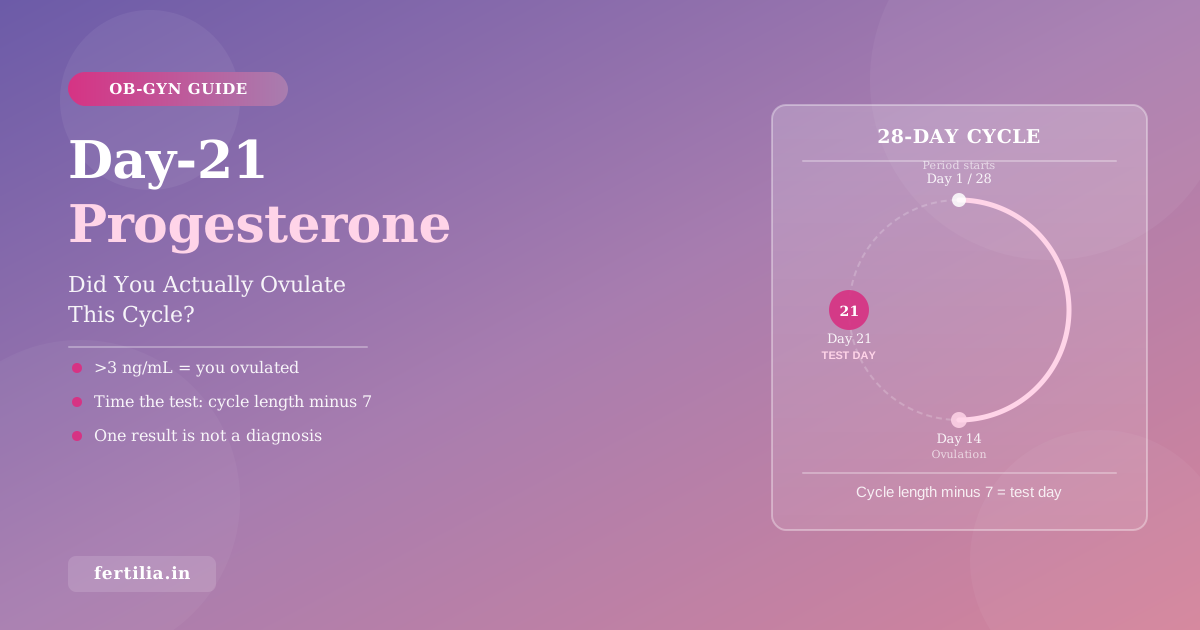
“Day 21” is shorthand for mid-luteal, which really means approximately 7 days before your next expected period. For a regular 28-day cycle, Day 21 is the right day. For most other cycle lengths, it is not.
The correct formula is:
Correct test day = Your total cycle length minus 7
Here is how that works for different cycle lengths:
| Cycle length (days) | Correct progesterone test day |
|---|---|
| 24 | Day 17 |
| 26 | Day 19 |
| 28 | Day 21 |
| 30 | Day 23 |
| 32 | Day 25 |
| 35 | Day 28 |
A woman with a 35-day cycle who tests on Day 21 is testing 14 days before her next period, not 7. At that point, ovulation may not have happened yet and the corpus luteum has barely started forming. Her progesterone will be low simply because she tested too early, not because she failed to ovulate.
This is why knowing your cycle length matters before you get the test done. If your cycles are irregular and vary by more than 5 days each month, calculating the right day from Day 1 alone is unreliable. In those cases, using ovulation predictor kits to detect your LH surge and then testing 7 days after a confirmed positive is more accurate than counting forward from the first day of your period.
Our Ovulation Tracking Guide for Indian Women walks through the different methods for identifying ovulation: basal body temperature, ovulation kits, cervical mucus changes, and ultrasound tracking. You can also read our Cervical Mucus Guide for TTC for a practical approach to recognising your fertile window.
How to Read Your Progesterone Result
Once you have confirmed the timing was correct, here is how to interpret the number:
| Progesterone level | What it means |
|---|---|
| Under 3 ng/mL | Did not ovulate this cycle (anovulatory cycle) |
| 3 to 10 ng/mL | Ovulated, but luteal phase output may be marginal |
| 10 ng/mL or above | Well-formed corpus luteum and healthy luteal phase |
These thresholds come from well-established research. The cutoff of 3 ng/mL as confirmation of ovulation is referenced in the Practice Committee of ASRM 2015 guidelines on female infertility evaluation. The 10 ng/mL threshold for a well-formed corpus luteum is supported by Wathen et al. (1984), whose work on mid-luteal progesterone remains a foundational reference for luteal phase assessment.
A few important caveats:
These are serum (blood) values. Salivary and urine progesterone tests use different reference ranges and should not be read against these numbers.
Progesterone fluctuates across the day because it is released in pulses, not at a steady level. A single draw is one snapshot. Two readings from the same morning in the same cycle can differ by 15 to 20 percent.
In medicated cycles (IUI or IVF with progesterone support), your doctor will use different reference points because added progesterone changes what the numbers represent.
Why One Cycle Is Not Enough
Ovulation is not the same every month. A woman can ovulate in most cycles and have an anovulatory cycle occasionally, particularly during periods of illness, stress, travel, or significant weight change. The same woman can have a mid-luteal progesterone of 14 ng/mL in one cycle and 7 ng/mL the next, depending on how that follicle developed and how well the corpus luteum performed.
This variability matters clinically. The Practice Committee of ASRM recommends that a consistent pattern across two or three cycles is needed before drawing conclusions about anovulation or luteal phase defect. A single low reading, even with correct timing, does not establish a diagnosis.
For more on this, read our guide on Luteal Phase Defect. What I tell patients is this: one progesterone result is a data point. Two or three results, each timed correctly in separate cycles, give us a pattern. Clinical decisions are based on patterns, not on single numbers.
This is also why I am cautious about starting luteal phase support (progesterone supplements) after just one low reading. That decision belongs in a conversation with your doctor after reviewing several cycles of data, not as a reflex response to one result.
Common Reasons for a Low Day-21 Progesterone
If your result has come back under 3 ng/mL, or in the lower part of the 3 to 10 range, here are the most common explanations.
Wrong timing. This is the most frequent cause by far. A woman with a 32-day cycle tested on Day 21 is being tested 11 days before her next period, not 7. The corpus luteum has not yet peaked. Confirm your cycle length, check the table above, and repeat the test on the correct day before concluding anything.
An anovulatory cycle. Ovulation did not happen that particular cycle. A single anovulatory cycle in a woman who normally ovulates is common and does not indicate a chronic problem. Recurring anovulation, meaning multiple cycles in a row with confirmed low progesterone at the right timing, is different and deserves investigation.
PCOS. Polycystic ovary syndrome is one of the most common causes of irregular or absent ovulation in Indian women. If your Day-21 progesterone is consistently low and you also have irregular cycles, excess hair growth, acne, or weight gain around the abdomen, PCOS is worth exploring as part of a full workup. The complete picture of how PCOS fits alongside other fertility tests is in The Honest Fertility Workup: An OB-GYN’s Indian Guide.
Hypothalamic suppression. When the brain’s signalling to the ovaries is suppressed, by severe or prolonged stress, very low body weight, or intensive training, ovulation can become irregular or stop entirely. The hypothalamic-pituitary-ovarian axis is sensitive to the body’s overall state. This is a different clinical situation from PCOS and requires a different approach.
Perimenopause. In women in their late thirties and forties, anovulatory cycles become more common as the ovarian reserve declines. A consistently low Day-21 progesterone in this age group is worth understanding alongside AMH, antral follicle count, and Day-2 FSH. For how these tests relate to each other, see Antral Follicle Count: How to Read Your Ultrasound. If you think perimenopause may be starting, this guide covers the full symptom list.
Luteal phase defect. In some women who do ovulate, the corpus luteum does not produce enough progesterone to maintain a robust luteal phase. The result is a progesterone above 3 ng/mL (confirming ovulation) but in the lower part of the range. Whether this needs treatment is a genuinely contested area in reproductive medicine. Current guidelines recommend confirming the pattern across multiple cycles before considering any intervention.
💜 Trying to make sense of a low progesterone result? Message Dr. Suganya’s team on WhatsApp and we will help you work through what it means for your cycle.
What to Do If Your Day-21 Progesterone Is Low
Confirm the timing first. Before anything else, go back to your calendar. What day of your cycle was the blood drawn? What is your average cycle length? Use the table above to verify that Day 21 was actually the correct day for you. If the timing was off, repeat the test in your next cycle on the right day.
Repeat across two or three cycles. If the timing was correct and the result is still under 3 ng/mL, repeat in your next one or two cycles. A consistent pattern of low progesterone with correct timing is what justifies further investigation.
Investigate the underlying cause if the pattern persists. Consistently low progesterone with correct timing points to either anovulation or a luteal phase issue. The next step is to understand why. The full fertility workup, including thyroid, prolactin, a Day-2 hormonal panel, and an ovarian reserve assessment, helps identify what is driving the pattern. See The Honest Fertility Workup for the complete approach.
Do not start progesterone supplements on your own. Luteal phase support is an evidence-based intervention in specific clinical situations. It should follow a confirmed pattern and be prescribed and monitored by your doctor, not started in response to a single low reading.
Look at the full fertility picture. Ovulation confirmation does not rest on progesterone alone. Our guide to Conceiving Naturally: A Couple’s Complete Guide covers timing, lifestyle factors, and how to structure your approach to trying to conceive alongside your workup. For context on how ovulation relates to other fertility markers, Low AMH and Pregnancy: Can You Still Conceive Naturally? addresses a scenario many women encounter.
The Indian Lab Context
Cost: A serum progesterone test in India typically costs between Rs 300 and Rs 800, depending on the lab and city. Home collection is available through most major labs at a small additional charge.
For more on this, read our guide on IUI Cost India 2026. Which labs: Thyrocare, Dr. Lal PathLabs, Metropolis, and Redcliffe all offer serum progesterone testing at their collection centres and via home visits. Results are typically available within 24 hours.
How to request it correctly: When you visit or book the test, ask specifically for “serum progesterone” and mention the day of your cycle. You do not need a doctor’s prescription at most labs in India for this test, though having a requisition from your gynec helps if you want the result reviewed at the same consultation.
When to collect the sample: Morning collection before 11 AM is generally preferred. Progesterone follows a mild diurnal pattern and evening values can be slightly lower. Fasting is not required.
Units to watch: Most Indian labs report in ng/mL. Some report in nmol/L. To convert nmol/L to ng/mL, divide by 3.18. Check the units on your report before comparing against the thresholds above.
Consistency across cycles: For meaningful cycle-to-cycle comparisons, using the same lab each time reduces the variability introduced by different assay platforms. A reading of 9.8 ng/mL at one lab and 10.2 ng/mL at another does not necessarily mean your progesterone changed between cycles.
If your progesterone result came back low, that is useful information, not a crisis. The test tells us one specific thing: whether this particular cycle included ovulation and a well-functioning corpus luteum. What happens next depends on the full picture.
You can download Dr. Suganya’s free Ovulation Tracking Resource for a practical guide to confirming ovulation across your cycle using multiple methods.
If you would like to understand how your progesterone fits into the complete fertility workup alongside AMH, AFC, and your other tests, the Fertilia Fertility Program walks through each layer with you over 90 days.
💜 Ready to understand what your progesterone result means for your cycle? Message Dr. Suganya’s team on WhatsApp and we will walk through the next steps together.
Frequently Asked Questions
What does a low Day-21 progesterone actually mean? A result under 3 ng/mL, tested at the right time in your cycle, suggests that ovulation did not occur that cycle. This is one cycle’s data and is not a permanent diagnosis. The first step is always to confirm the timing was correct, then repeat the test in the next cycle on the right day before drawing any conclusions.
My cycles are irregular. When should I get the progesterone test? For irregular cycles, counting forward from Day 1 is unreliable. A better approach is to use an ovulation predictor kit to track your LH surge and then get the progesterone test 7 days after a confirmed positive. This method works regardless of cycle length and removes the guesswork from the timing.
How accurate is the Day-21 progesterone test for confirming ovulation? When timed correctly, serum progesterone is one of the most reliable blood-test confirmations of ovulation. A level above 3 ng/mL is widely accepted as evidence of ovulation in the preceding week (ASRM 2015). The main source of inaccuracy is incorrect timing, not the test itself. An uninterpretable result almost always comes down to testing on the wrong day.
Can I have a normal Day-21 progesterone but still have trouble conceiving? Yes. A result above 3 ng/mL confirms ovulation occurred, but it does not tell you whether egg quality was healthy, whether fertilisation took place, or whether the implantation environment is optimal. Ovulation is one step in a multi-step process. A normal progesterone is reassuring but is not the only piece of the fertility picture.
Do I need progesterone supplements if my result is between 3 and 10 ng/mL? Not necessarily, and not based on a single reading. A result in the 3 to 10 range means ovulation occurred but the corpus luteum output was not at its strongest. Whether this needs treatment depends on whether the pattern repeats across multiple cycles, your clinical history, and your fertility timeline. This is a decision to make with your doctor after reviewing several cycles, not a reflex action after one number.
Can stress or illness affect my Day-21 progesterone? Yes. Acute illness, a particularly stressful period, significant changes in sleep, or intense physical training can disrupt the ovarian cycle and result in delayed ovulation or no ovulation at all that month. A low progesterone in the context of a difficult few weeks is often explained by the disruption, not a structural problem with your cycle.
What other methods confirm ovulation alongside progesterone? Urinary LH testing detects the surge that immediately precedes ovulation. Basal body temperature charting shows the temperature rise that follows ovulation. Transvaginal ultrasound can confirm follicle rupture directly. Cervical mucus changes provide a physical sign across the fertile window. Our Ovulation Tracking Guide covers each method and how to use them together for a more complete picture.