One of the most common situations I see in a week: a woman gets an ultrasound done for mild pelvic discomfort or a routine pre-marital check, and the report comes back with the words “ovarian cyst.” The next few hours are spent online reading increasingly alarming results. By the time she reaches me, she is convinced something serious is happening.
For more on this, read our guide on Ruptured Ovarian Cyst.
For more on this, read our guide on Ovarian Cyst on Ultrasound. Most of the time, nothing serious is happening.
Ovarian cysts are a routine finding in women of reproductive age. Many women have them at some point without ever knowing. The vast majority are benign, cause no symptoms, and disappear on their own within one to three menstrual cycles. But there are exceptions, and knowing which type of cyst needs monitoring versus which one needs nothing is genuinely useful.
This post covers what ovarian cysts are, how the main types differ, why many women confuse them with PCOS (and why they are not the same condition), and the specific signs that mean a cyst warrants prompt attention.
What an ovarian cyst is
An ovarian cyst is a fluid-filled sac that develops on or inside an ovary. “Cyst” simply describes the structure: a closed pocket containing fluid. It does not tell you where the fluid came from, what type it is, or whether it matters clinically. That context comes from the cyst’s size, its appearance on ultrasound, and whether it is causing symptoms.
The ovaries are continuously active organs. Each month they mature follicles, release eggs, form temporary hormone-producing structures, and repeat the cycle. Small cysts form naturally as part of this process and resolve without any intervention. A cyst on a scan report does not, on its own, mean something has gone wrong.
The main types of ovarian cysts
The type of cyst is the most important piece of information for deciding what to do next.
Functional cysts
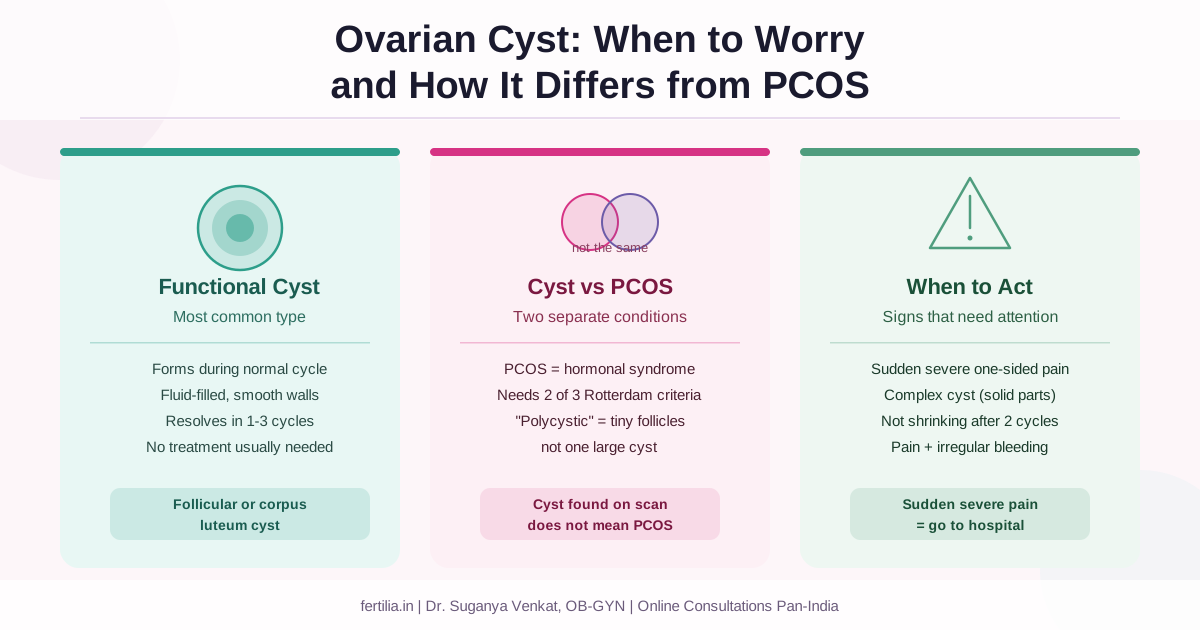
Functional cysts form as a direct result of the normal menstrual cycle. They are the most common type, by a wide margin, and the most likely to resolve on their own.
Follicular cysts develop when a follicle does not rupture to release its egg as it normally would. Instead of shrinking back, it continues to fill with fluid. These cysts are typically smooth, thin-walled, and fluid-filled. Most measure between 2 and 5 cm but can occasionally grow larger.
Corpus luteum cysts form after a follicle has released its egg. Normally the empty follicle shrinks and dissolves. Occasionally it seals off and collects fluid instead, becoming a corpus luteum cyst. These can sometimes bleed internally, making them appear slightly complex on an ultrasound, though they are almost always benign.
Both types typically resolve within one to three menstrual cycles without treatment (Grimes DA et al., Cochrane Database Syst Rev. 2014, PMID 24782304). No medication is needed for most of them.
Structural (non-functional) cysts
These arise from ovarian tissue itself, rather than from the cycling process. They do not resolve on their own the way functional cysts do.
Dermoid cysts, also called mature teratomas, are the most common structural cysts in women under 30. They form from germ cells and can contain hair, skin tissue, and occasionally cartilage. Most are benign. They can grow slowly over years and are usually managed surgically once they reach a size that creates a risk of complications.
Cystadenomas form from the surface tissue of the ovary. They can be serous (filled with watery fluid) or mucinous (thicker fluid). They tend to grow large over time. They are benign in the overwhelming majority of cases but are removed when they cause symptoms or grow beyond a threshold size.
Endometriomas are cysts filled with old blood from endometrial tissue that is growing outside the uterus. They have a distinctive dark, thick appearance on ultrasound and are sometimes called chocolate cysts. They are associated with endometriosis and can cause significant pain, particularly around menstruation. They also have implications for fertility, which is covered below.
Ovarian cysts and PCOS: not the same thing
This is the point of confusion I address most often in consultations.
PCOS (polycystic ovary syndrome, also called PMOS following the May 2026 international consensus rename) is a hormonal and metabolic syndrome. Diagnosing it requires meeting two out of three criteria established by the Rotterdam Consensus (Rotterdam ESHRE/ASRM Consensus Workshop Group, Fertil Steril. 2004, PMID 14711538):
- Irregular or absent ovulation, which shows up as irregular or missing periods
- Clinical or biochemical signs of excess androgens, presenting as unusual acne, excess facial or body hair, or an elevated testosterone on a blood test
- Polycystic ovarian morphology on ultrasound
That third criterion is where the confusion originates. On ultrasound, polycystic ovarian morphology means the ovaries contain multiple small follicles (typically 20 or more per ovary), each measuring 2 to 9 mm, arranged around the periphery of the ovary. These are small, immature follicles that did not fully develop. They look like a string of pearls on the scan image.
This is entirely different from what most people mean when they say they have a cyst. A typical ovarian cyst on a report is a single, larger fluid-filled structure, often 3 to 5 cm or bigger. The tiny follicles in PCOS are not individually what is meant by a cyst.
There are three important points that follow from this:
You can have PCOS without having a conventional ovarian cyst. You can have an ovarian cyst without having PCOS. And you can have the polycystic ovarian pattern on ultrasound without meeting PCOS criteria, because that scan finding alone is only one of three diagnostic features.
If your ultrasound report mentions “multiple follicles,” “PCOD,” or “polycystic pattern,” but your periods are regular and your androgen markers are normal, you likely do not meet PCOS criteria. That finding is worth discussing with a gynaecologist who can look at the full picture, including your cycle history and blood tests, not just the scan. For a detailed explanation of how PCOS is diagnosed and what drives it, see PCOS: Symptoms, Root Causes & Treatment.
Symptoms a cyst may cause
Many ovarian cysts cause no symptoms at all and are found incidentally on a routine scan. When symptoms do appear, they typically include:
- Mild pressure or a sense of fullness in one side of the lower abdomen
- Bloating or heaviness in the pelvis, especially in the second half of the cycle
- Pain with menstruation or in the days leading up to a period
- A delayed or slightly irregular period if the cyst has temporarily affected ovulation
- Pain during intercourse, particularly with deep penetration
None of these symptoms are specific to ovarian cysts, which is part of why cysts are usually found on imaging rather than from symptoms alone.
When a cyst warrants prompt attention
Most functional cysts need nothing more than time. There are specific situations, though, that need a faster response.
Sudden, severe one-sided pain in the lower abdomen. This is the most important symptom to act on immediately. A large cyst can cause the ovary to twist around its supporting ligaments, a condition called ovarian torsion. Torsion cuts off blood supply to the ovary and is a surgical emergency. The pain is typically sudden and severe, often accompanied by nausea or vomiting. If this happens, go to a hospital without waiting. Torsion is uncommon but the window for saving the ovary is short.
A cyst that is large, not shrinking, or complex on ultrasound. A simple cyst (smooth-walled, thin, filled with clear fluid) that has been confirmed to be shrinking on follow-up is reassuring. A complex cyst with solid components, thick internal walls, or irregular borders warrants a closer look. This does not mean it is cancer. It means the picture is less clear and needs evaluation.
Pain plus irregular bleeding plus a cyst. This combination can point toward endometriosis or an endometrioma. Endometriomas do not resolve on their own and can affect fertility over time if left unmanaged. This combination is worth a dedicated gynaecology review rather than watchful waiting.
Any cyst found after menopause. Postmenopausal ovaries are no longer cycling, so a cyst in that context is always evaluated with greater care.
If you have received a scan report showing a cyst and are unsure what it means for your situation, an online consultation can go through the findings with you.
Consultations are via video call, pan-India. ₹399 for a 20 to 30-minute session.
Ovarian cysts and fertility
For women trying to conceive, or planning to, the question that comes up most often is whether a cyst affects fertility.
Functional cysts do not generally affect fertility. A follicular cyst means a follicle was developing, which is the first step in ovulation. These cysts typically resolve within one to three cycles without any effect on conception.
Endometriomas are a more significant consideration. They are associated with endometriosis, a condition that can affect egg quality, ovarian reserve, and implantation. Management decisions require particular care: when surgical excision is needed, it can also affect the follicle pool (Raffi F et al., J Clin Endocrinol Metab. 2012, PMID 22723324). If you have an endometrioma and are trying to conceive, the timing and approach to management is worth discussing with a gynaecologist before you start trying. For more on endometriosis and fertility specifically, the Endometriosis and Fertility guide covers this in detail.
Dermoid cysts and cystadenomas do not typically impair fertility when they are small and well-monitored. A very large one may warrant removal before attempting to conceive, primarily to reduce the risk of torsion during pregnancy, when the uterus expands and can shift the ovary’s position.
PCOS is managed through addressing the underlying hormonal picture. The follicles seen on ultrasound in PCOS are not individual lesions that need to be removed. If PCOS is what is affecting your cycle and fertility, the approach is different from treating a conventional cyst.
What typically happens after a cyst is found
Watchful waiting. For a simple functional cyst under 5 cm found incidentally, the standard approach is a repeat ultrasound after one to three menstrual cycles. Most will have resolved completely. No medication and no procedure are needed.
Monitoring at 6 to 8 weeks. For simple cysts in the 5 to 7 cm range, a repeat scan in six to eight weeks is the usual recommendation. If the cyst is unchanged or has grown by then, the next steps depend on its characteristics.
Surgical removal. Complex cysts with solid components, dermoid cysts above a threshold size, cysts that are symptomatic, or cysts that have not resolved after adequate monitoring are managed surgically. Laparoscopic cystectomy (removing the cyst while preserving the ovary) is the standard approach in reproductive-age women when possible.
Oral contraceptive pills. The evidence for OCP in accelerating the resolution of existing functional cysts is limited (Grimes DA et al., PMID 24782304). They are sometimes prescribed to prevent new functional cysts from forming in women who have them recurrently, but they do not reliably dissolve a cyst that is already there.
If PCOS is what has been identified and you want to work on managing it through lifestyle rather than relying solely on the pill, the PCOS Symptom Reversal program is the 90-day approach used at Fertilia. The PCOS Reversal Guide is a free download to get started.
What ovarian cysts are called in Tamil and Hindi
Women searching for information about cysts in their native language often use these terms:
| Language | Common term | Transliteration |
|---|---|---|
| Tamil | murattai neer katthi | (moo-rat-tai neer kat-thi) |
| Hindi | anḍāshay mein cyst | (common informal usage) |
If your scan report uses the Tamil phrase “murattai neer katthi” or the Hindi phrase “andashay mein cyst,” those describe the same finding discussed in this post.
FAQ
What is the difference between an ovarian cyst and PCOS?
An ovarian cyst is a single fluid-filled sac on the ovary. PCOS is a hormonal and metabolic syndrome diagnosed when two of three criteria are met: irregular ovulation (irregular periods), signs of excess androgens, and a polycystic ovarian pattern on ultrasound. That pattern means multiple small follicles, not one large cyst. You can have a cyst without having PCOS, PCOS without a conventional cyst, and the polycystic pattern on ultrasound without meeting PCOS criteria. They are different conditions.
My scan says “simple ovarian cyst, 4 cm.” Should I be concerned?
A simple, thin-walled, fluid-filled cyst under 5 cm in a reproductive-age woman is almost always a functional cyst. The standard recommendation is a repeat scan after one to two menstrual cycles to confirm it has resolved. Most do. There is no indication for surgery or urgent treatment unless you are having significant symptoms or the cyst changes on the follow-up scan.
Can an ovarian cyst cause irregular periods?
A functional cyst can occasionally disrupt ovulation for one or two cycles, resulting in a delayed or missed period. If irregular periods are a persistent pattern rather than a one-off, the likely cause is something hormonal rather than a single cyst. PCOS, thyroid imbalance, and other factors are more common drivers of ongoing cycle irregularity. See Irregular Periods: Causes, Natural Solutions for a fuller picture.
What size ovarian cyst needs surgery?
There is no single cutoff size that automatically triggers surgery. The decision depends on the cyst’s type, its ultrasound appearance, whether it is growing, whether it is causing symptoms, and the woman’s age and fertility plans. Simple cysts under 7 cm in reproductive-age women are typically monitored. Complex cysts, cysts above 7 to 10 cm, and cysts that have not resolved after adequate monitoring are evaluated for surgical removal. Dermoid cysts are often removed around the 5 to 7 cm mark because they do not resolve on their own and carry an increasing torsion risk as they grow.
I have an ovarian cyst and I am trying to conceive. What should I do?
It depends on the type. A simple functional cyst is unlikely to interfere and will probably resolve on its own before it becomes relevant. An endometrioma needs evaluation before you start trying, because it is associated with endometriosis and can affect ovarian reserve. A large dermoid or cystadenoma may warrant removal first, to reduce the risk of complications during pregnancy. The right path involves reviewing the scan findings alongside your history and conception plans with a gynaecologist.
Is a chocolate cyst the same as a regular ovarian cyst?
A chocolate cyst (endometrioma) is technically a type of ovarian cyst, but it is categorically different from a functional cyst. It is filled with old menstrual blood from endometrial tissue growing outside the uterus. Unlike functional cysts, endometriomas do not resolve on their own. They are associated with endometriosis and can affect fertility over time.
My scan says “PCOD” but I have regular periods. Do I have PCOS?
“PCOD” is an older term still used in Indian radiology for the polycystic ovarian pattern on ultrasound. This scan finding alone does not diagnose PCOS. Rotterdam criteria require two out of three features. If your periods are regular and you have no signs of androgen excess (no unusual acne or hair growth), you may not meet diagnostic criteria at all. Discuss the full picture with a gynaecologist, including your cycle history and a basic hormonal blood panel, before concluding that you have PCOS based on the scan alone.
An ovarian cyst on a scan report is a starting point for a conversation, not an answer in itself. Most are benign, most resolve, and most need nothing more than a follow-up scan. If your report has raised questions, WhatsApp Dr. Suganya and we can go through the findings together.
Consultations are online, via video call, pan-India. ₹399 for a 20 to 30-minute session with Dr. Suganya Venkat, OB-GYN · 15+ years experience.