You were mid-afternoon, maybe doing something ordinary, when a sharp pain hit your lower right (or left) side. Not a dull ache that built up over hours. An abrupt, stabbing pain that stopped you in your tracks. This is often how a ruptured ovarian cyst announces itself.
Most women who experience this have no idea what is happening in the moment. They wonder if it is appendicitis, or a period problem, or something more serious. This post explains what a ruptured cyst actually is, how to tell whether the pain requires a hospital visit or can be managed at home, and what to expect if you do go to the emergency department.
For more on this, read our guide on Period Cramps Home Remedies. For background on what ovarian cysts are and how they are found on scans, see the guide to ovarian cysts: when to worry and how they differ from PCOS and the guide to reading your ovarian cyst scan report. This post covers the specific situation of rupture.
What Happens When an Ovarian Cyst Ruptures
An ovarian cyst is a fluid-filled sac on or within the ovary. Functional cysts, which form as a normal part of the menstrual cycle, are the most common type. A follicular cyst develops when the dominant follicle (the one preparing to release an egg) does not rupture at ovulation as expected. A corpus luteum cyst forms after the egg has been released, from the tissue the follicle leaves behind.
When either of these cysts bursts, the fluid inside spills into the pelvic cavity. This is what causes the pain. The peritoneum, the membrane lining the inside of your abdomen, is sensitive to fluid that does not belong there. Its irritation produces the sharp, one-sided pain that characterises a ruptured cyst.
Whether the cyst contains clear fluid or blood makes a significant difference to how serious the rupture is, and this is the distinction the rest of this post is built around.
What a Ruptured Cyst Feels Like
The pain follows a recognisable pattern, though it varies between women.
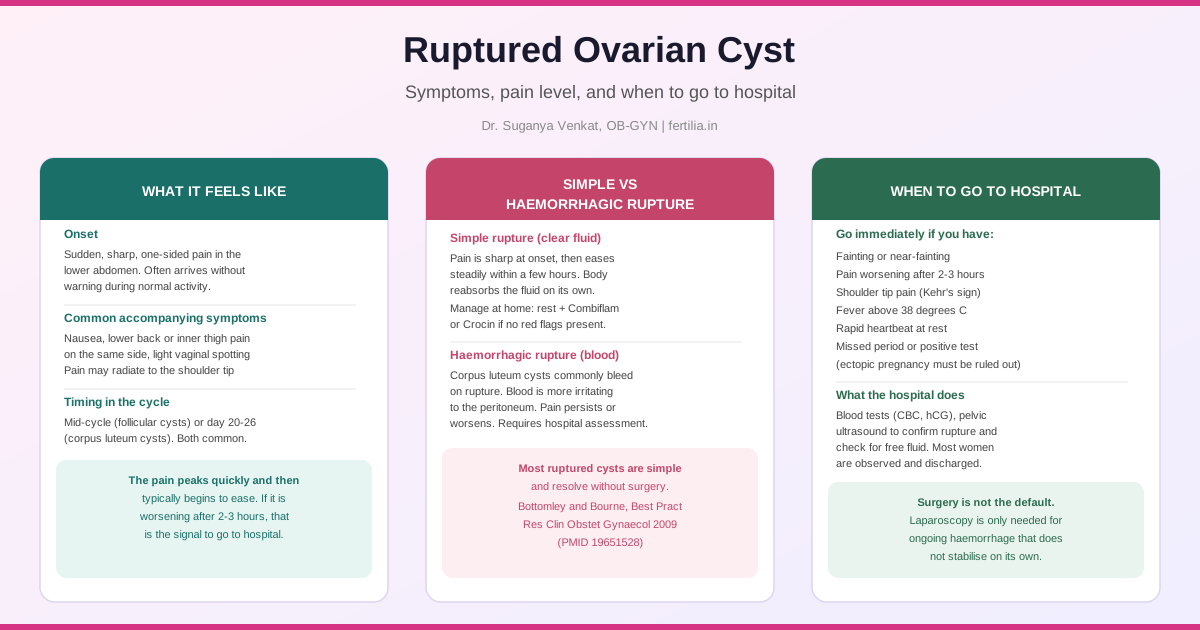
Onset is sudden. Most women describe it as a sharp pain that appeared without warning, sometimes with a brief sensation of pressure or “popping” before it. It typically starts on one side of the lower abdomen, corresponding to whichever ovary the cyst was on.
Location is one-sided. Functional cysts can form on either ovary. The pain starts on whichever side the cyst was on, right or left. It may radiate into the lower back or inner thigh on the same side.
Nausea is common. The sudden pain often triggers a wave of nausea, and some women vomit. This is a reflex response to peritoneal irritation and does not, by itself, indicate a serious complication.
Vaginal spotting may occur. Some women notice a small amount of vaginal bleeding at the time of rupture. A functional cyst rupture can coincide with a break in the cycle or trigger light spotting. This does not mean the bleeding is internal; it is separate from the pelvic fluid.
Timing relative to the cycle. Follicular cysts tend to rupture around mid-cycle, near when ovulation would normally happen. Corpus luteum cysts rupture more often in the second half of the cycle, typically between day 20 and day 26. Pain that arrives at these points and is sudden and one-sided is a common presentation for cyst rupture.
Simple Rupture vs Haemorrhagic Rupture: The Key Distinction
This is the most important section to understand, because it determines whether you need to go to hospital.
Simple (non-haemorrhagic) rupture means the cyst contained clear or serous fluid. When it bursts, the fluid is released into the pelvis. This is mildly irritating to the peritoneum, causes a sharp pain, and then typically resolves on its own. The body absorbs the fluid over hours. Pain that is severe at onset but improves steadily over the next few hours is usually a simple rupture. It can generally be managed at home with rest and pain relief (ibuprofen, such as Combiflam, or paracetamol, such as Crocin or Dolo) as long as no red flags are present (see below).
Haemorrhagic rupture means the cyst contained blood, or the cyst bled when it burst. Corpus luteum cysts are the most prone to this because the corpus luteum is richly vascularised. When a corpus luteum cyst ruptures with bleeding, blood enters the peritoneal cavity. Blood is far more irritating to the peritoneum than serous fluid. The pain tends to be more severe and does not improve in the same way over a few hours. Significant blood loss can lead to dizziness, fainting, and a drop in blood pressure.
Haemorrhagic rupture does not happen to most women with a ruptured cyst, but it is the category that requires emergency assessment. The red flags below identify it.
Bottomley and Bourne, reviewing management of ovarian cyst accidents (Best Pract Res Clin Obstet Gynaecol 2009, PMID 19299205), note that the majority of ruptured functional cysts settle conservatively without surgery. The cases requiring intervention are typically haemorrhagic, particularly in women on anticoagulants (aspirin, warfarin, or low-molecular-weight heparin) who are at higher risk of significant bleeding.
When to Go to Hospital Immediately
Go to the emergency department without waiting if you have any of the following:
Dizziness or fainting. If you feel faint, pass out, or feel lightheaded even when lying down, this suggests significant blood loss into the abdomen. Do not drive yourself; call someone or call 102/108.
Pain that worsens rather than improves. A simple rupture hurts acutely and then gets better. If the pain is escalating or remains at the same severe level after two to three hours, go in.
Shoulder tip pain. This is an important sign that is often missed. Blood pooling under the diaphragm irritates the phrenic nerve, which refers pain to the shoulder, most often the left shoulder. This phenomenon is called Kehr’s sign. If you have significant pelvic pain AND a dull ache in the shoulder, tell the doctor at triage immediately.
Fever above 38°C. A ruptured cyst by itself does not cause a fever. If you have a temperature, it suggests infection, either a ruptured abscess (pyovarium or tubo-ovarian abscess) or a secondary infection of pelvic fluid. This needs urgent treatment with antibiotics and sometimes surgery.
A missed period or a positive pregnancy test. A missed period combined with sudden one-sided pelvic pain is an ectopic pregnancy until proven otherwise. An ectopic pregnancy has a similar pain presentation to a ruptured cyst, but it is a medical emergency. Do not wait to see whether the pain improves. See also: ectopic pregnancy signs and what to expect.
Unable to keep water down. If vomiting is persistent and you cannot stay hydrated, you need assessment regardless of other symptoms.
Rapid heartbeat at rest. A heart rate consistently above 100 beats per minute at rest is a sign the body is compensating for something, often fluid or blood loss.
If none of these red flags are present, the pain started suddenly, is one-sided, and is now easing within two to three hours, it is reasonable to manage at home initially with rest, a hot water bag on the lower abdomen, and Combiflam or Crocin. But if you are uncertain, going to hospital is never the wrong call.
If you are not sure whether what you experienced was a cyst rupture or something else, or you have had this kind of pain more than once, that is worth understanding properly.
Message Dr. Suganya on WhatsApp to discuss what happened and what, if anything, needs to be investigated.
What the Hospital Does
Knowing what to expect reduces anxiety about going in. The assessment for a suspected ruptured cyst is straightforward.
History. The doctor will ask when the pain started, how severe it is, where it is located, whether there is any fever, whether your last period was on time, and whether there is any possibility of pregnancy. Answer these as accurately as you can, particularly the pregnancy question.
Examination. An abdominal examination checks for tenderness, guarding (muscles tightening to protect the underlying area), and signs of peritoneal irritation. A vaginal examination is often done to assess the cervix and adnexa.
Blood tests. A full blood count checks haemoglobin levels (a significant drop suggests internal bleeding). A CRP or ESR checks for infection. A beta-hCG blood test is done to rule out pregnancy, including ectopic pregnancy. Blood group and cross-match may be done if there is any concern about possible surgery.
Pelvic ultrasound. This is the key investigation. The sonographer looks for free fluid in the pelvis and abdomen (fluid that is not inside an organ), confirms whether a cyst is still visible or has resolved, and checks both ovaries for signs of torsion (twisting, which is a different emergency requiring surgery). A collapsed or resolving cyst alongside free fluid is the typical ultrasound picture of a ruptured cyst. For more on what cyst ultrasound reports show, see the ovarian cyst scan report guide.
Observation. If investigations show a simple rupture with minimal free fluid and stable vital signs, most women are observed for a few hours, given pain relief, and discharged with instructions on what symptoms would require them to return.
Surgery is reserved for ongoing or worsening haemorrhage that does not stabilise with observation, or for situations where the diagnosis is uncertain and ectopic pregnancy or other emergency cannot be excluded. The procedure is laparoscopy, done through small incisions in the abdomen, not open surgery. Most women with a ruptured cyst do not need an operation.
How a Ruptured Cyst Differs from Other Causes of Sudden Pelvic Pain
The symptom of sudden, severe, one-sided lower abdominal pain is shared by several conditions. Telling them apart matters because they are managed differently.
Appendicitis is classically right-sided and starts around the navel before settling in the right iliac fossa. Unlike a cyst rupture, appendicitis pain tends to build gradually over several hours rather than appearing all at once. Fever and nausea are more prominent, and the pain does not ease.
Ovarian torsion is when the ovary twists on its ligament, cutting off its blood supply. The pain is severe, persistent, and does not improve. Nausea and vomiting are often significant. Torsion does not resolve on its own and requires surgery promptly. Unlike a ruptured cyst, torsion pain does not ease within a few hours.
Ectopic pregnancy presents like a ruptured cyst, which is why the pregnancy question is always asked first. The difference is outcome: an untreated ectopic pregnancy can rupture and cause life-threatening haemorrhage. If there is any chance of pregnancy, a beta-hCG is done before any other conclusion is drawn.
Period pain (dysmenorrhoea) tends to start with or just before the period and is central or bilateral rather than sharply one-sided. For cases where period pain is severe and possibly related to endometriosis, see period pain and dysmenorrhoea: when it is endometriosis.
Endometrioma rupture is less common but follows the same principles. An endometrioma (a cyst filled with old blood from endometriosis) can rupture and cause significant peritoneal irritation because the thick, dark fluid is particularly irritating. If you have known endometriosis and experience this type of pain, go to hospital for assessment. For more on endometriosis and its effect on fertility, see the endometriosis and fertility guide.
After a Ruptured Cyst: What Comes Next
If a cyst rupture has been confirmed and you were discharged from hospital, a follow-up pelvic ultrasound 4 to 6 weeks later confirms the cyst has resolved completely and no new cyst has formed.
For women with PCOS (PMOS), functional cysts form more frequently because the follicles often fail to complete ovulation. If you have had a ruptured cyst and also have irregular periods or other PCOS signs, it is worth investigating the underlying cycle pattern rather than waiting for the next rupture. See PCOS symptoms, root causes and natural treatment for more.
A single episode of cyst rupture does not require ongoing treatment in most women. If ruptures recur, or if there is a known underlying cause such as endometriosis, a longer-term management conversation with your OB-GYN is worthwhile.
What it is Called in Tamil and Hindi
In spoken Tamil, a ruptured ovarian cyst is often described as “karpappai kattumoolai vettuppadu” (cyst burst in the ovary) or simply “ovary kattukkolai vettuppadu.” These are Roman transliterations; Tamil script sign-off is pending.
In Hindi, the common description is “ovary mein ganth ka phoot jaana” (the cyst in the ovary bursting). Another phrase used is “andkosh ki ganth ka phoot jana.” These Roman transliterations reflect how the condition is typically described in patient conversations; Devanagari sign-off pending.
FAQ
1. Is a ruptured ovarian cyst serious?
Most ruptured ovarian cysts are not serious. The majority are simple ruptures that resolve on their own with rest and pain relief. A smaller number are haemorrhagic (involving significant bleeding into the abdomen), and these require hospital assessment and sometimes surgery. The red flags section above lists the signs that distinguish the two.
2. How long does the pain last after a cyst ruptures?
For a simple rupture, the sharpest pain typically eases within a few hours. A dull ache or soreness in the lower abdomen may persist for 24 to 48 hours. If pain is not improving within 2 to 3 hours, or is worsening, that is the time to go to hospital.
3. Can a ruptured ovarian cyst heal on its own?
Yes, in most cases. When the cyst is simple (containing clear fluid rather than blood), the fluid is reabsorbed by the body over a few days and the pain resolves without any medical intervention. Follow-up ultrasound in 4 to 6 weeks confirms complete resolution.
4. Does a ruptured cyst show up on ultrasound?
Yes, though the picture changes depending on how quickly after the rupture the ultrasound is done. A collapsed cyst may still be visible as a partial structure, and free fluid (the released cyst fluid) is typically seen in the pelvis or lower abdomen. The radiologist looks for these findings alongside any active blood collection. See the ovarian cyst scan guide for more on how these reports are read.
5. What is the difference between a ruptured cyst and ovarian torsion?
A ruptured cyst releases fluid and the pain often starts sharply then eases as the fluid disperses. Ovarian torsion involves the ovary twisting on itself, which cuts off blood supply. Torsion pain is persistent and worsening, does not ease, and is a surgical emergency requiring prompt laparoscopy to untwist the ovary. If in doubt, hospital assessment is the right step for either.
6. Ovary mein ganth phoot jaaye toh kya karna chahiye? (What should I do if the cyst in my ovary bursts?)
Agar dard achanak aaya ho, ek taraf ho, aur 2-3 ghante mein sudharne lage, to aap ghar par rest kar sakti hain: hot water bottle (nicha pet par), Combiflam ya Crocin for pain relief, aur khub paani piyein. Agar dard badh raha ho, chakkar aa rahe hon, bukhaar ho, ya pregnancy ki sambhavna ho, to turant hospital jayein ya 102/108 call karein. Shoulder mein dard bhi ek important sign hai, isko nazar-andaaz mat karein.
7. Will I need surgery after a ruptured ovarian cyst?
Most women do not. Surgery is considered only when there is significant ongoing bleeding that does not stabilise on its own, or when the diagnosis is uncertain and a more serious condition such as ectopic pregnancy cannot be excluded. The large majority of ruptured cysts resolve without any procedure beyond observation and pain relief.
A sudden sharp pain in your lower abdomen is frightening, but a ruptured ovarian cyst, as common a cause as it is, most often resolves on its own. Knowing what to watch for and what the red flags mean lets you make a calm, informed decision about whether to go to hospital or rest at home.
If you have had this kind of pain and want a proper evaluation of what may have caused it, including whether an underlying cycle disorder might be contributing, a consultation helps clarify that.
Message Dr. Suganya on WhatsApp to get clarity on your situation. Consultation is online, pan-India, at Rs. 399.