Somewhere in the third trimester, many families pick up a sheet of paper from the hospital billing desk. It says “Normal Delivery Package” with a number on it, perhaps Rs 60,000, perhaps Rs 90,000, and below that a column of room types and a few lines of small print. A few months later the discharge bill arrives, and it does not quite match the sheet.
Often nothing has gone wrong when that happens. The package covered what it said it covered, and a few things sat outside it: the epidural, the baby’s charges, an extra night, medicines above a cap. The surprise comes from not knowing where those lines were drawn.
I’m Dr. Suganya Venkat, an OB-GYN with over fifteen years of experience. In pregnancy consultations at Fertilia, the question of what the delivery will cost often comes up alongside the question of how the baby will be born. This post answers the first one: what a normal delivery costs in India in 2026, and what you are paying for in each line of the bill.
Here is what it covers:
- What a normal delivery costs in government, trust and private hospitals, using prices the hospitals publish themselves
- Why the room you choose changes the whole price
- What a delivery package usually includes, and what is usually billed separately
- What happens to the bill if labour ends in an assisted delivery or a caesarean
- What government schemes, Ayushman Bharat and private health insurance pay for
- The questions to ask before you book
Normal delivery cost in India: the quick answer
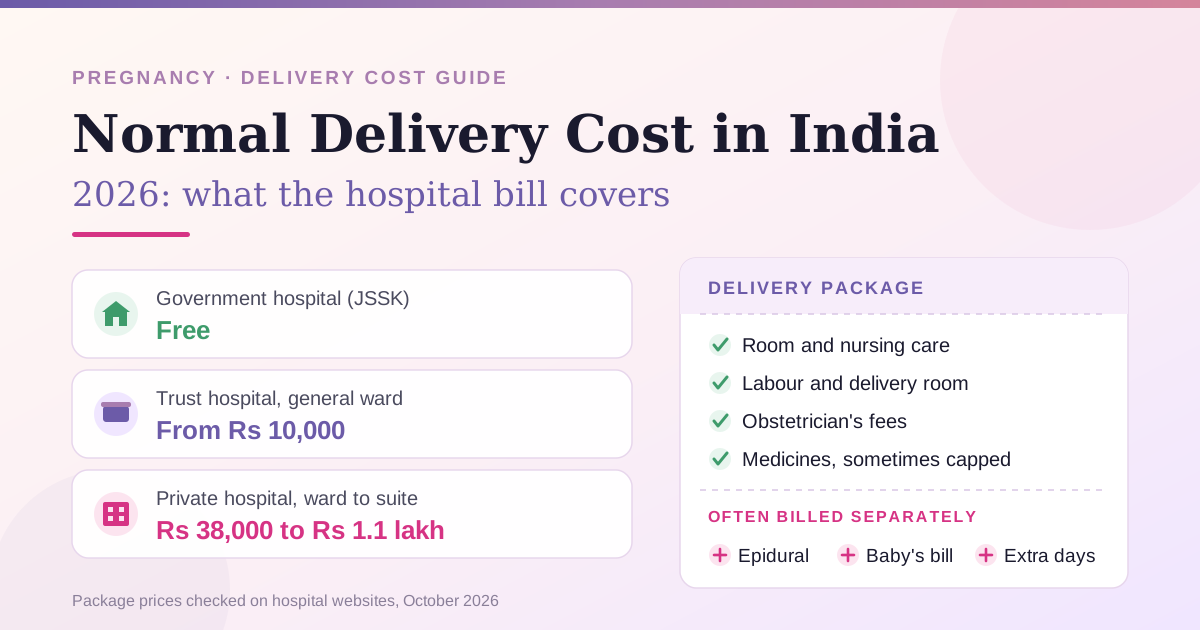
These are package prices published by the hospitals themselves, all checked on 19 October 2026. They are planning figures, not quotes. Your own hospital’s written estimate is the number that counts.
| Where you deliver | Example and source | Normal delivery package | Billed separately (per the hospital’s own list) |
|---|---|---|---|
| Government hospital | Any public health facility, under JSSK (nhm.tn.gov.in) | Free | Nothing should be charged |
| Trust hospital, general ward | PSG Hospitals, Coimbatore, Anbudan Amma package (psghospitals.com) | Rs 10,000 | Food, pharmacy, epidural, extra days, baby’s NICU care |
| Mid-range private | Vivekananda Hospital, Hyderabad (vivekanandahospital.in) | Rs 38,000 (general ward) to Rs 75,000 (single AC room) | Baby’s charges of Rs 10,000 to 13,000, epidural, NICU |
| Metro private | Ovum Hospitals, Bengaluru (ovumhospitals.com) | Rs 75,000 to 85,000 | Ask for the written list |
| Metro private | Prashanth Hospitals, Chennai (prashanthhospitals.org) | Rs 90,000 (private room) to Rs 1,10,000 (suite) | Days beyond the package, ICU, baby’s bill, twins |
For a broader benchmark, the insurer ManipalCigna puts the indicative cost of a normal delivery hospitalisation at about Rs 60,000 nationally, about Rs 50,000 in Tier 2 cities and about Rs 1,10,000 in Tier 1 cities such as Chennai, Bengaluru and Hyderabad (manipalcigna.com, checked 19 October 2026).
National survey data shows the same public-private gap. In NFHS-5 (2019-21), families who delivered in a public facility reported an average out-of-pocket spend of Rs 2,916 per delivery (NFHS-5 India fact sheet). An analysis of the same survey, covering 145,386 women, found a median out-of-pocket spend of Rs 25,600 for a delivery in a private hospital against Rs 2,067 in a public one (Manna S et al., BMC Public Health, 2023, PMID 37532981). Those figures include caesareans and are several years old, so read them as the pattern, not today’s price.
Why the same normal delivery can cost Rs 38,000 or Rs 75,000
Look closely at a hospital price sheet and you will usually find one list of inclusions and several prices beside it. At Vivekananda Hospital the normal delivery package is Rs 38,000 in the general ward, Rs 55,000 in a single non-AC room and Rs 75,000 in a single AC room. At Prashanth Hospitals it is Rs 90,000, Rs 1,00,000 or Rs 1,10,000 for a private room, a deluxe room or a suite. On both sheets a single list of inclusions sits above the prices, so the step-up from one column to the next is the room.
That makes the room category the biggest lever you control. On these sheets the care listed does not change with the room; what a costlier room adds is privacy and comfort for you and the family member who stays with you.
The other things that move the price:
- The city and the type of hospital. The insurer benchmark above roughly doubles from a Tier 2 city to a Tier 1 metro, and a trust hospital’s general-ward package (Rs 10,000 at PSG) can sit far below the private average for a city of the same tier.
- How many days the package includes. Prashanth’s package includes 3 days for a normal delivery, Vivekananda’s 2 to 3 days and PSG’s up to 5 days. The WHO recommends at least 24 hours of care in the facility after an uncomplicated vaginal birth (WHO postnatal care guideline, 2022). All three hospitals above bill days beyond the package separately.
- Whether the epidural and the baby’s care sit inside the price. This is where most of the difference between the sheet and the final bill comes from, and it is covered in the next two sections.
What a normal delivery package usually includes
Read the three published inclusion lists side by side and the core of a package looks like this:
- Room and nursing care for a fixed number of days.
- Labour and delivery room charges, including monitoring of your baby’s heart rate during labour. PSG and Prashanth list NST monitoring; Vivekananda lists continuous electronic fetal monitoring.
- Your obstetrician’s fees during the admission. Vivekananda includes the obstetrician’s visits through admission, delivery and the post-delivery review. Prashanth includes the gynaecologist, anaesthetist and neonatologist charges for the admission.
- Medicines and consumables, sometimes with a ceiling. Prashanth covers pharmacy and consumables up to Rs 20,000, and anything above that is billed. PSG’s general-ward package covers consumables used during the delivery but bills food and pharmacy separately.
- Food for you during the stay. Prashanth and Vivekananda include meals; PSG does not.
- Some first care for your baby. Prashanth lists baby resuscitation and the vaccines due at birth (BCG, oral polio and the first hepatitis B dose). Those are the three birth doses in India’s Universal Immunisation Programme, which provides them free of cost at government health facilities (PIB, March 2026).
Some packages also bundle counselling sessions, a lactation consultation or a review visit after discharge. These are useful, but they are not the lines that change the bill.
What is usually billed separately
The exclusion lists are where the final bill is decided, so read them as carefully as the price.
Days beyond the package. If you stay longer than the package allows, for any reason, the extra days are charged. If you are booked for an induction of labour, which can begin with several hours of cervical ripening before contractions start, ask whether the package days count from admission or from delivery. Prashanth’s, for example, count from admission.
The epidural. Vivekananda and PSG bill painless delivery separately; Prashanth includes epidural analgesia in its package. If you are still deciding about pain relief, my guide to epidural, Entonox and natural pain relief options in Indian hospitals covers each one, including why you should check whether an anaesthetist is available round the clock.
The baby’s bill. This is the line most often split. Some newborn items sit inside your package and the rest go on a separate account in the baby’s name. Vivekananda lists newborn charges of Rs 10,000 to 13,000 as additional and NICU care at actual cost; Prashanth says the baby bill is charged extra; PSG excludes the baby’s NICU care. If your baby needs care beyond routine newborn checks, such as phototherapy for newborn jaundice, expect it on that separate bill.
Extra care for you. PSG excludes ICU and high-risk care for the mother and blood transfusion; Prashanth excludes ICU charges and additional tests needed for a complication.
Twins. Prashanth lists multiple births as outside the standard package. If you are carrying twins, ask for a separate estimate.
Optional add-ons offered at booking. Some hospitals offer extras alongside the package; Prashanth, for example, advertises a discount on stem cell banking for early bookings. These are choices, not medical needs. If cord blood banking is on your list, read who it genuinely helps before you pay for it.
If labour changes course: assisted delivery or caesarean
A labour that starts as a planned normal delivery does not always end that way, and the bill follows what happens. Knowing this in advance means that, if the plan changes, the only thing you need to think about in that moment is you and your baby.
- Assisted delivery with vacuum or forceps. PSG prices “Normal / Assisted Delivery” as one package. Other hospitals may charge more, so ask.
- Caesarean. The bill moves to the caesarean package. At the hospitals above, the difference in the same room category was Rs 12,000 at PSG (Rs 22,000 against Rs 10,000), Rs 12,000 to 25,000 at Vivekananda, and Rs 40,000 to 60,000 at Prashanth. What the operation and recovery involve is explained in what to expect from a C-section delivery.
Whether your baby is born vaginally or by caesarean is a medical decision, made with your obstetrician as labour unfolds. The package price has no place in it. My normal delivery vs C-section decision guide explains what that decision rests on, so you can walk into labour understanding it.
If you would like help preparing for birth, from the questions for your hospital to your birth plan, you can talk it through with Dr. Suganya alongside your own obstetrician’s care:
WhatsApp Dr. Suganya: wa.me/919940270499 (₹399 video consultation, pan-India, online only)
Government hospitals: what is free, and the cash support you can claim
In a government hospital, a normal delivery should cost you nothing. Under the Janani Shishu Suraksha Karyakram (JSSK), a woman who delivers in a public health facility is entitled to a free and cashless delivery, a free caesarean if she needs one, free medicines and consumables, free tests, free food during the stay (up to 3 days after a normal delivery and up to 7 days after a caesarean), free blood if required, exemption from user charges, and free transport from home, between hospitals if she is referred, and back home after 48 hours. Sick newborns have matching entitlements (nhm.tn.gov.in, checked 19 October 2026).
Separately from the bill, three schemes pay cash support to eligible mothers:
- Janani Suraksha Yojana (JSY). In Tamil Nadu and the other high-performing states, women from BPL, SC and ST families who deliver in a government facility receive Rs 700 in rural areas or Rs 600 in urban areas. In the ten low-performing states named by the National Health Mission, every woman delivering in a government facility receives Rs 1,400 (rural) or Rs 1,000 (urban). BPL, SC and ST women delivering in an accredited private hospital are also eligible (nhm.gov.in, checked 19 October 2026).
- Pradhan Mantri Matru Vandana Yojana (PMMVY). Rs 5,000 for the first child, paid in instalments, and Rs 6,000 for a second child if she is a girl, paid directly into the mother’s account (wcd.gov.in, checked 19 October 2026).
- Dr. Muthulakshmi Reddy Maternity Benefit Scheme (Tamil Nadu). Financial assistance of Rs 18,000, which includes the Amma Maternal Nutrition Kit, for eligible women (nhm.tn.gov.in, checked 19 October 2026).
Eligibility rules apply to each of these, and registering early in pregnancy makes the paperwork simpler. Your nearest primary health centre can tell you which ones you qualify for.
Ayushman Bharat (PM-JAY) and delivery
PM-JAY covers hospital care for eligible families, and its package list does include deliveries. In the 2022 package master published by Kerala’s state health agency, the obstetric packages include caesarean delivery, high-risk delivery and operative vaginal delivery with vacuum or forceps (HBP 2022, sachis.in).
These packages are steered towards government hospitals. The National Health Authority’s Health Benefit Package 2.0 user guidelines state that caesarean and high-risk delivery packages are primarily for government facilities and are open to private hospitals on referral from a government hospital or doctor, and they advise states to keep all delivery-related packages reserved for public hospitals, with each state making the final call (HBP 2.0 user guidelines).
In NFHS-5, which was collected in the scheme’s early years, enrolment in PM-JAY or another government insurance scheme was not linked to lower out-of-pocket spending on either caesarean or non-caesarean deliveries (Garg S et al., BMC Res Notes, 2023, PMID 37217964). If you plan to use an Ayushman card for a delivery in a private hospital, confirm with that hospital’s PM-JAY desk, well before your due date, whether your delivery will be covered and on what referral.
Private health insurance: when it pays for a delivery
A health policy can be active and still pay little or nothing towards a delivery. ManipalCigna’s guide to maternity cover (manipalcigna.com, checked 19 October 2026) sets out the conditions that decide it:
- Maternity cover is not included in every policy. Some plans include it and others need a maternity add-on.
- There is a waiting period, ranging from 9 months to 4 years depending on the policy, and pregnancy claims within it are not paid. Most insurers do not offer maternity cover to a woman who is already pregnant when she buys the policy.
- There is usually a sub-limit. For a normal delivery, many insurers set limits between Rs 25,000 and Rs 75,000. In some policies that limit covers only the delivery; in others it covers the whole hospitalisation, including room rent and medicines.
- Newborn cover often starts from the first day of life, up to specified limits.
- Employer group policies sometimes include maternity cover without the long waiting periods of individual plans.
One more clause is worth checking: the room rent limit. If your policy caps room rent and you choose a costlier room, the insurer may reduce what it pays for other charges in proportion, not just the room (manipalcigna.com, checked 19 October 2026). Choosing a room within your limit can protect much more of the claim than the room rent alone.
Even with insurance, expect to pay part of a private delivery yourself. In the NFHS-5 analysis cited above, health insurance was not enough to bring down out-of-pocket spending in private hospitals (Manna S et al., BMC Public Health, 2023, PMID 37532981).
If you are using cashless insurance, most insurers need pre-authorisation documents before or at admission. The paperwork section of my hospital bag checklist lists what to keep in your document folder.
Questions to ask before you book your delivery
These questions turn a price sheet into a bill you can predict. Ask them at the billing desk around the seventh month, and ask for the answers in writing.
- What is the package price for the room I want, and how many days does it include? Do the days count from admission or from delivery?
- Is my obstetrician’s fee included, for the delivery and the review visit?
- Is the epidural included? If not, what does it cost, and is an anaesthetist available at all hours?
- What is included for my baby: the paediatrician at birth, the birth vaccines, hearing screening? What does a day in the NICU cost?
- Is there a cap on medicines and consumables? Are my meals included?
- Is the repair of a tear or an episiotomy part of the package? (What those stitches after a normal delivery involve, and how they heal, is a separate read.)
- What happens to the bill if I need an assisted delivery or a caesarean?
- Is there a booking advance, and is it adjusted against the final bill?
- Do you accept my insurance or government scheme cashless, and what documents do you need from me before admission?
- Will I get an itemised final bill?
Keep the written answers with your antenatal file. At discharge, compare the itemised bill with the package: anything outside it should match an exclusion you were told about.
Frequently Asked Questions
How much does a normal delivery cost in India in 2026?
A normal delivery is free in government hospitals under JSSK. In private hospitals, packages published in October 2026 ranged from Rs 10,000 in a trust hospital general ward to Rs 1,10,000 for a suite in a Chennai private hospital, and the insurer ManipalCigna’s indicative national average is about Rs 60,000. The baby’s charges, the epidural and extra days can add to the package price.
Is normal delivery free in government hospitals?
Yes. Under the Janani Shishu Suraksha Karyakram, a woman who delivers in a public health facility is entitled to a free and cashless delivery, free medicines, tests, food and blood, and free transport, with no user charges. Families in NFHS-5 (2019-21) still reported spending an average of Rs 2,916 per delivery in public facilities, so carry some money for incidentals, but the delivery itself should not be billed.
Does health insurance cover normal delivery? Can I buy cover after I am pregnant?
Only if your policy includes maternity cover and its waiting period, typically 9 months to 4 years, is over. Most insurers do not offer maternity cover to a woman who is already pregnant at purchase. Even when covered, a sub-limit, commonly Rs 25,000 to 75,000 for a normal delivery, caps what the insurer pays. Employer group policies sometimes cover maternity without a long wait, so check yours first.
Is the epidural included in the normal delivery package?
It depends on the hospital. Of the hospitals in this post, Prashanth Hospitals in Chennai includes epidural analgesia in its package, while Vivekananda Hospital and PSG Hospitals bill it separately. Ask before you book, and also ask whether an anaesthetist is available at all hours to place one.
What happens to the bill if my normal delivery becomes a C-section?
The bill moves to the caesarean package. At the hospitals in this post, that meant Rs 12,000 more at PSG Hospitals, Rs 12,000 to 25,000 more at Vivekananda Hospital and Rs 40,000 to 60,000 more at Prashanth Hospitals, depending on the room. Ask your hospital for both prices when you book, so a change of plan in labour is a medical decision only.
Are the baby’s charges included in the delivery package?
Often only partly. Some packages include resuscitation at birth, a first examination and the birth vaccines, while the rest of the newborn’s care goes on a separate bill. Vivekananda Hospital, for example, lists newborn charges of Rs 10,000 to 13,000 as additional, and NICU care is billed separately at all three hospitals in this post.
How much does a suga prasavam (normal delivery) cost in Tamil Nadu?
A suga prasavam (சுகப்பிரசவம்), as a normal delivery is called in Tamil, is free in Tamil Nadu government hospitals under JSSK, and eligible women can also claim the Rs 18,000 Dr. Muthulakshmi Reddy Maternity Benefit. In private and trust hospitals the range is wide: the general-ward package at PSG Hospitals, Coimbatore, was Rs 10,000, while Prashanth Hospitals in Chennai charged Rs 90,000 to Rs 1,10,000 depending on the room, as checked in October 2026.
Preparing for your delivery
The delivery bill is one part of getting ready for birth. Fertilia’s Pregnancy Care program offers trimester-wise guidance and birth preparation over video consultations, alongside the obstetrician who will deliver your baby, and the free normal delivery and postpartum care guide covers the weeks after you come home.
WhatsApp Dr. Suganya: wa.me/919940270499 (₹399 video consultation, pan-India, online only)