One of the most common questions I hear in the third trimester is some version of this: “Doctor, will I have a normal delivery or a C-section?”
Women ask it with real anxiety behind it. Some have already formed a strong preference. Some have been told by someone (a relative, another doctor, a neighbour) that they will “definitely” need a C-section based on their height or their pelvis or a scar from a prior surgery. Others are going in with no idea what to expect.
The honest starting point is this: in most pregnancies, delivery mode is not decided once, in advance. It is a clinical assessment that happens in stages, across the third trimester and into labour itself. There are situations where a C-section is planned well ahead of time because there is a clear medical reason. But for most women with a healthy pregnancy, the mode of delivery depends on how things unfold during the stages of labour themselves.
Here is what I want to cover: how the decision is made, what factors support a vaginal birth, what the medical indications for a C-section are, what the evidence says about outcomes, and what questions you can bring to your own obstetrician.
How delivery mode is assessed (it is not decided once)
Your obstetrician does not make a final delivery-mode decision at 20 weeks and file it away. The assessment is ongoing.
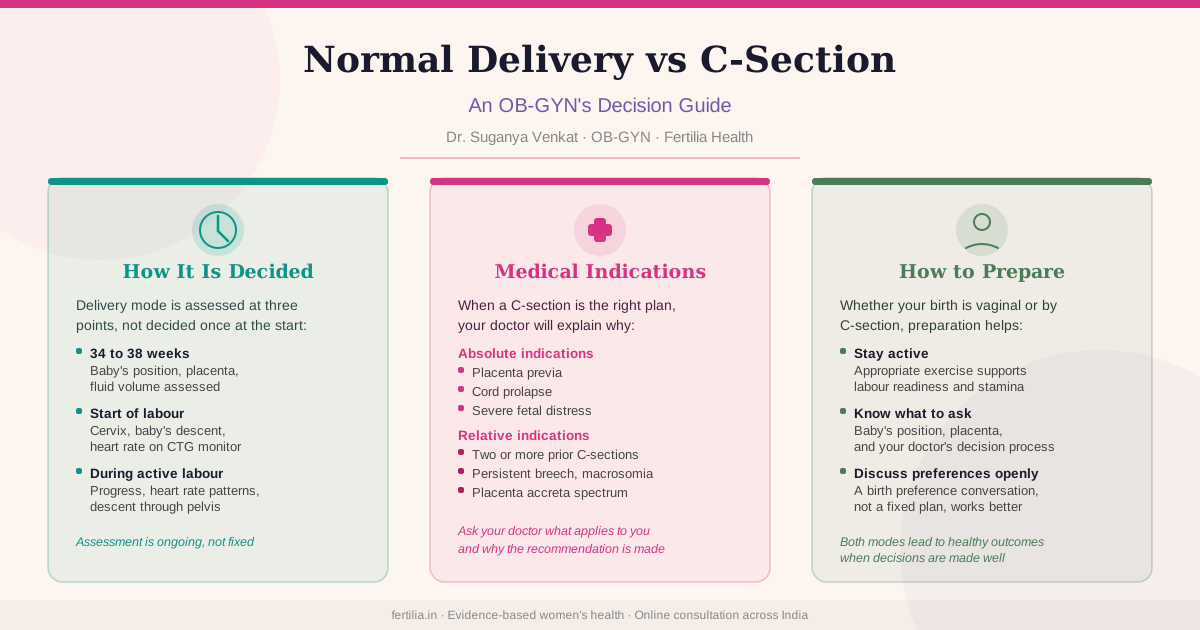
There are three broad points where delivery mode is actively evaluated:
During pregnancy (typically 34 to 38 weeks): Your doctor will check the baby’s position (ideally head-down, or vertex), the location of the placenta, amniotic fluid volume, and whether any maternal or fetal conditions change the picture. These findings are reviewed at each antenatal visit.
At the start of labour: If you are aiming for a vaginal birth, your obstetrician will assess your cervix (how effaced and dilated it is), the baby’s position in the pelvis, and the fetal heart rate on the CTG monitor. Labour can begin spontaneously, be induced, or lead directly to a planned C-section, depending on what these assessments show.
During active labour: Progress is monitored continuously. If the baby’s heart rate shows concerning changes, if labour stops progressing despite adequate contractions, or if the baby is not descending, a C-section at that point becomes the safest option.
This matters because it means that neither you nor your doctor can always predict with certainty what will happen six months in advance. Many women who deliver vaginally had a moment in labour where a C-section was seriously considered. Women who planned for a vaginal birth sometimes need a C-section for reasons that only became clear during labour. That is not a failure of planning. It is how clinical care works.
What supports a vaginal birth
For women with a healthy pregnancy, a vaginal birth is the standard expected course. The factors that support it include:
Baby’s position: The ideal scenario is a baby in the vertex (head-down) position by 36 to 37 weeks. If the baby remains in a breech position (feet or bottom first), your obstetrician will discuss options: external cephalic version (ECV, a gentle manual procedure to turn the baby, usually offered from around 36 to 37 weeks), a planned C-section, or in selected centres with appropriate expertise, a vaginal breech birth.
Placenta location: The placenta should not be covering or lying close to the cervical opening. Your 20-week anomaly scan flags this. A low-lying placenta at 20 weeks will often shift upward as the uterus grows; a repeat scan at 32 to 34 weeks confirms the final position.
No significant obstetric contraindication: This includes placenta previa, certain fibroid positions, active genital herpes near term, and prior uterine surgeries that increase rupture risk.
The three Ps during labour: A vaginal birth depends on powers (contraction strength), passenger (baby size and position), and pelvis (dimensions and configuration). All three need to work together. When one of them becomes a limiting factor during active labour, that is typically when a C-section decision is made.
A word about the verdicts women bring into my consultations. By the third trimester, many have already been told at home how this will end: she is short, so it will be a caesarean. She has a small build. She had her appendix out years ago, so normal delivery is risky. In my experience, most of these predictions are simply irrelevant. Height alone does not decide labour, build alone does not decide labour, and an appendix scar has nothing to do with the uterus. The one item on that list I do take seriously is previous surgery on the uterus itself: if you have had fibroids removed (a myomectomy), find your operative notes, because a myomectomy that entered the uterine cavity genuinely changes the delivery plan. Bring those records to your obstetrician, and let the height predictions stay at home.
When a planned C-section is the right call
There are situations where a C-section is the appropriate plan from the start, and your obstetrician will explain this during pregnancy if it applies to you.
Absolute indications (a C-section is the only safe option):
- Placenta previa (placenta covering the cervix)
- Cord prolapse (the umbilical cord descends before the baby)
- Severe fetal distress requiring immediate delivery
- A prior classical uterine incision (a vertical midline cut on the uterus, distinct from the more common transverse bikini-line cut)
Relative or situational indications (C-section is the safer or more appropriate choice in that specific context):
- Two or more prior C-sections (which increases the risk of uterine rupture during labour)
- Persistent breech presentation that cannot be turned
- Estimated fetal macrosomia (a very large baby) with a small pelvis
- Certain maternal conditions, such as severe cardiac disease or specific neurological situations
- Placenta accreta spectrum (placenta that has grown into the uterine wall)
A note on C-section rates in India: The NFHS-5 (2019 to 2021) data shows India’s national C-section rate at 21.5%, with 47.4% of births in private health facilities happening by caesarean, against 14.3% in public facilities. For context, the WHO’s 2015 statement on caesarean section rates concluded that at population level, caesarean rates higher than 10% are not associated with reductions in maternal and newborn mortality, and it deliberately declined to set a target rate: rather than striving for a specific number, its position is that efforts should focus on providing a caesarean to every woman who needs one.
This does not mean every individual C-section above that threshold is unnecessary. Population statistics and individual clinical decisions are different things. What it does mean is that the recommendation should be based on a clear medical reason, communicated transparently to you. If your doctor recommends a C-section and you are not sure of the reason, ask directly: “What is the clinical indication, and what would the risks be of attempting a vaginal birth in my situation?”
One more India-specific driver deserves an honest word: the auspicious date. Families ask for a caesarean scheduled to a muhurtham more often than any textbook admits, and I understand why. A birth is the biggest event in a family’s year, and choosing a good day can feel like the one thing still within their control. My request is simple: choose the date from within the medically safe window, never instead of it. A caesarean scheduled before 39 completed weeks without a medical reason exposes the baby to avoidable breathing difficulty: in a large study of elective repeat caesareans in the New England Journal of Medicine, babies delivered at 37 or 38 weeks had higher rates of respiratory complications and NICU admission than babies delivered at 39 weeks (Tita et al., 2009, PMID 19129525). Bring your family’s preferred dates to your obstetrician, and let them be fitted inside the safe window rather than the other way around.
What the evidence says about outcomes
Ye et al. (2016), published in BJOG, analysed caesarean rates against maternal and neonatal mortality across 159 countries, using longitudinal data adjusted for each country’s level of development (PMID 26331389). They found that above a caesarean rate of roughly 10 percent at population level, more C-sections were not associated with any further fall in maternal or neonatal mortality. Separately, repeat caesareans carry rising risks in later pregnancies: Silver et al., in a large multicentre study in Obstetrics and Gynecology (2006), showed that the risks of placenta accreta, surgical injury and hysterectomy at delivery all rise progressively with each additional caesarean (PMID 16738145).
For individual women, here is what is broadly true about each mode:
Recovery: A vaginal birth typically allows for faster physical recovery. Most women are mobile within hours. A C-section is major abdominal surgery. Full recovery takes 6 to 8 weeks, with activity restrictions during that period.
Future pregnancies: After one C-section with a transverse (horizontal) uterine incision, vaginal birth after caesarean (VBAC) is possible for many women. The uterine rupture risk in a well-monitored VBAC trial is approximately 0.5 to 0.9%. After two or more C-sections, that risk rises, and placenta-related complications in future pregnancies also increase.
Baby outcomes: When appropriately managed, both modes support safe neonatal outcomes. Babies born by elective C-section before labour have slightly higher rates of transient tachypnoea of the newborn (TTN), a breathing adjustment that typically resolves within hours, because the passage through the birth canal helps clear fluid from the lungs. This is generally mild and self-limiting.
A C-section is not a lesser outcome. When it is the right call, it is the right call. The point is that the decision should be grounded in clinical assessment, not in convenience, scheduling, or assumption.
What about the cost?
Cost is part of this decision for almost every family, so let me address it plainly. A normal delivery is usually the less expensive route; a caesarean is an operation, with theatre charges, anaesthesia and a longer hospital stay behind the bill. Beyond that, prices vary so widely between government, trust and private hospitals, and between cities, that any specific figure I print here would be wrong for most readers. Ask your hospital for its delivery package rates in writing, and confirm with your insurer what is covered, well before your due date. What cost should never do is answer the medical question: a caesarean that is genuinely indicated should not be refused over the bill, and one that is not indicated should not be accepted because the package is convenient.
Questions to ask your obstetrician
Going into the third trimester with a clear set of questions helps you participate actively in your own care. These are worth bringing to your next appointment:
1. What is my baby’s position right now, and when should I know if it has not changed?
This sets the timeline for monitoring and tells you whether an ECV discussion might be coming.
2. Has my placenta position been confirmed? Is there anything on my ultrasound that affects the delivery plan?
A direct answer here tells you whether a re-scan is needed and whether anything is being watched. If your report mentions an anterior placenta, that is a normal position on its own, not a reason for a C-section.
3. Is there any medical reason right now that makes a C-section more likely for me?
This invites your doctor to share their current assessment, which may change as pregnancy progresses.
4. If I go into labour, under what circumstances would you recommend a C-section during labour itself?
Understanding this in advance means that if it happens, it will not feel like a sudden left turn. You will recognise the conversation.
5. What can I do in the coming weeks to support a vaginal birth?
Your obstetrician’s answer will be specific to your situation. In many cases it involves staying physically active, attending antenatal preparation classes, and maintaining check-ins as the due date approaches.
Not sure which of these apply to you, or what your scan reports are actually saying? WhatsApp Dr. Suganya: wa.me/919940270499 (₹399 video consultation, pan-India, online only)
What you can do to prepare
Delivery mode is not fully within your control, and framing it as something you can “achieve” through the right mindset or exercise routine does a disservice to the reality of labour. What I mean by preparation is different: it is about supporting your body’s readiness and going into labour with the best possible foundation.
Stay active through pregnancy: In an uncomplicated pregnancy, staying physically active is safe and builds the stamina labour asks of you. The key word is appropriate: adapted to your trimester and your individual situation. What the research actually supports, and what it does not, is laid out in the evidence-based guide to exercise for normal delivery.
Understand the stages of labour: Women who go into labour with a clear sense of what to expect tend to feel less overwhelmed by decisions in the moment. Antenatal classes, whether hospital-run or independent, give you this frame. The normal delivery preparation guide covers the practical side in more detail.
Have a birth preference conversation, not a rigid birth plan: A birth preference discussion with your obstetrician (what matters to you, what you want explained if decisions need to be made quickly, who you want in the room) is more realistic and more useful than a fixed plan. Labour rarely follows a script.
Understand C-section recovery in advance: If there is any possibility of a C-section, reading about what recovery involves helps you go in without shock. The complete C-section recovery guide covers the week-by-week physical timeline. Knowing what to expect in advance reduces a great deal of the anxiety around the outcome.
When to call your doctor now
Almost everything in this guide plays out over weeks, with time to think and ask questions. A few things do not wait for the next appointment. Call your obstetrician the same day if:
- Your baby’s movements have reduced or changed noticeably from their usual pattern
- You have any vaginal bleeding
- You are leaking fluid, whether a gush or a steady trickle
- You have a severe headache with visual changes, or pain in the upper abdomen
- You are having regular, painful contractions before 37 weeks
None of these automatically changes your delivery plan. They are simply the situations where your doctor wants to hear from you today, not at the next scheduled visit.
FAQ: Normal delivery vs C-section
What factors most often lead to a C-section during labour?
The most common reasons a C-section is decided during labour are: failure of labour to progress (the cervix stops dilating despite adequate contractions, or the baby stops descending), and non-reassuring fetal heart rate patterns on the CTG monitor that indicate the baby is not coping well with the contractions. Both are situations where a C-section becomes the safest next step for the baby.
My first delivery was a C-section. Will my second be too?
Not necessarily. VBAC (vaginal birth after caesarean) is an option for many women after one C-section with a transverse incision. The eligibility depends on the reason for the first C-section, the type of uterine incision, the current pregnancy, and whether continuous monitoring is available during labour. Your obstetrician will assess this with you based on your specific record.
Can I request a C-section if I am anxious about labour?
Anxiety about labour is real and should be taken seriously. The first step is discussing it with your obstetrician or a mental health professional, because in many cases, preparation and information significantly reduce that anxiety. If your concerns about labour persist after that conversation, an honest discussion with your doctor about elective C-section, including its specific risks in your situation, is appropriate.
Will my baby be safer with a C-section?
In a healthy pregnancy without medical indications, the evidence does not support a C-section as safer for the baby. Both modes, when appropriately managed, result in good neonatal outcomes. When there is a specific medical reason (such as severe fetal distress, cord prolapse, or abnormal presentation), a C-section is absolutely the safer option for the baby.
My doctor says my pelvis is “small.” Does that mean I will need a C-section?
Not automatically. Pelvic dimensions alone are rarely the deciding factor in labour outcomes, because the pelvis is flexible and the baby’s head moulds as it descends. Cephalopelvic disproportion (when the baby cannot fit through the pelvis) is a real condition, but it is confirmed during labour through progress monitoring, not predicted by pelvis measurement alone in early pregnancy.
Does a normal delivery hurt less recovery-wise than a C-section?
Most women experience faster physical recovery after a vaginal birth than after a C-section. That said, a vaginal birth with a tear or episiotomy involves perineal healing over two to four weeks. A C-section involves abdominal incision healing and restrictions on activity for six to eight weeks. Both involve real recovery. For specific guidance on perineal healing after a vaginal birth, see the stitches and episiotomy care guide.
My baby has been breech at 28 weeks. Does that mean I will need a C-section?
No. The majority of breech babies at 28 weeks turn on their own before 36 weeks. If the baby remains breech at 36 weeks, your obstetrician will discuss ECV (a gentle external procedure to turn the baby), a planned C-section, or (depending on their training and your situation) a monitored vaginal breech birth. There is no reason to assume a C-section is fixed at 28 weeks.
Ready to discuss your pregnancy and birth preparation with Dr. Suganya? WhatsApp Dr. Suganya: wa.me/919940270499 (₹399 video consultation, pan-India, online only)
For pregnancy preparation resources, see the Normal Delivery & Postpartum Care Guide or explore the Fertilia Pregnancy Program.