Is this morning sickness or hyperemesis gravidarum? (Quick answer)
Ordinary morning sickness makes you queasy and may make you vomit, but you can still keep some food and water down and get through most of your day. Hyperemesis gravidarum (HG) is the severe form: the nausea and vomiting are so strong that you cannot eat or drink normally, and they stop you from carrying on with daily life. An international consensus, the Windsor definition, describes HG as symptoms that start before 16 weeks, nausea and vomiting with at least one of them severe, an inability to eat and/or drink normally, and a strong limit on daily activities, with signs of dehydration supporting the diagnosis (Jansen LAW et al., Eur J Obstet Gynecol Reprod Biol, 2021, PMID 34555550).
HG is treatable. Fluids, vitamins and anti-sickness medicines that are used in pregnancy can help you feel steadier.
Perhaps you are reading this lying down, phone close to your face, because sitting up brings the next wave. Perhaps someone at home has told you that every woman vomits in pregnancy and you just need to bear it. If you have reached the point where even a sip of water comes back up, you deserve proper medical care, not more advice to eat a biscuit.
I’m Dr. Suganya Venkat, an OB-GYN, and over fifteen years I have looked after many women through this phase. The women who recover fastest are usually the ones who asked for help early. This guide explains what HG is, how it is treated, and the exact signs that mean you should see a doctor today.
How HG differs from ordinary morning sickness
Nausea and vomiting affect as many as 70% of pregnant women. HG is reported in a much smaller group, between 0.3% and 10.8% of pregnancies depending on how it is defined, because there was no single agreed definition for many years (Fejzo MS et al., Nat Rev Dis Primers, 2019, PMID 31515515).
| Ordinary morning sickness | Hyperemesis gravidarum | |
|---|---|---|
| Eating and drinking | You can keep some food and fluids down | You struggle to keep food or fluids down |
| Daily life | Uncomfortable, but you manage work and home | You may be unable to work, cook or look after yourself |
| Weight | Usually stable or small changes | Often weight loss |
| Urine | Normal amounts | Small amounts of dark urine |
| How you feel | Tired and queasy | Weak, dizzy, sometimes faint |
If you are somewhere in between, that still counts. Moderate symptoms that are wearing you down are worth treating too. Our guide to ordinary morning sickness and safe home remedies covers the milder end; this post is about the point where home measures are no longer enough.
Why does HG happen?
Research increasingly points to the placenta. Genetic studies have linked nausea and vomiting of pregnancy, and HG in particular, to genes for placental proteins, especially a hormone called GDF15, and to the receptor that GDF15 acts on (Fejzo MS et al., Nat Rev Dis Primers, 2019, PMID 31515515). GDF15 acts on the part of the brainstem that controls nausea, and a 2024 study in Nature explored how a mother’s own GDF15 levels before and during pregnancy relate to her risk of severe sickness (Fejzo M et al., Nature, 2024, PMID 38092039).
What this means for you is simple: HG has a biological cause. It is not caused by stress, by being “too sensitive”, or by anything you ate or did. You did not bring this on yourself.
HG is more common in some situations, such as a twin pregnancy or a previous pregnancy with HG. Your doctor will usually arrange an early scan, which also checks for twins and, rarely, a molar pregnancy, both of which can bring stronger nausea.
Vomiting more than you can manage? Dr. Suganya Venkat consults online across India over a video call and can help you plan treatment alongside your local doctor. Send a message and the team will help you book (₹399 in India, US $20 from outside India). Chat on WhatsAppWhen to seek medical care today
Go to your nearest hospital emergency department straight away if you notice confusion, double vision or unsteady walking. Do not wait for a clinic appointment or an online consultation; these signs need urgent assessment and treatment.
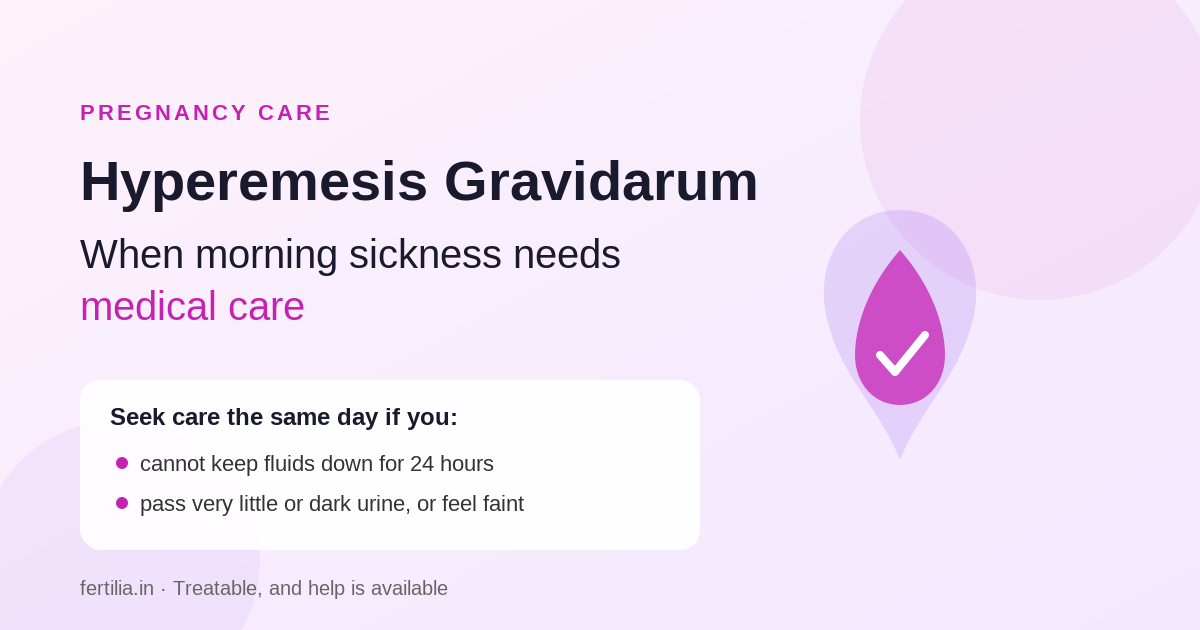
Please contact your doctor or go to your nearest hospital the same day if any of these apply:
- You cannot keep any fluids down for 24 hours, or everything you drink comes back up
- You are passing very little urine, or it is dark yellow or brown
- You feel dizzy, faint or very weak, especially when you stand up
- You are vomiting blood or material that looks like coffee grounds
- You have severe abdominal pain, fever, or pain when passing urine
- You are losing weight quickly, or your clothes have become loose within a week or two
These signs mean your body needs fluids and support that tablets at home cannot give. Going to hospital is not an overreaction. In my experience, women often wait too long because they do not want to “make a fuss”. A few hours of IV fluids can change how you feel completely.
Those emergency signs, confusion, eye problems and unsteadiness, matter because long periods of vomiting can use up vitamin B1 (thiamine). A review of 49 cases of Wernicke encephalopathy in pregnancy (a rare complication of severe HG caused by thiamine deficiency) emphasised giving thiamine to women with prolonged vomiting, especially before intravenous or parenteral nutrition, and stressed replacing vitamin B1 promptly when neurological symptoms or signs develop (Chiossi G et al., Obstet Gynecol Surv, 2006, PMID 16551377). This is rare, and thiamine replacement is a routine part of HG care for exactly this reason.
How hyperemesis gravidarum is treated
Treatment is built in steps, and your doctor moves up only as far as you need. Many women can be treated with clinic or day-care visits rather than a long hospital stay.
1. Rehydration
If you are dehydrated, IV fluids are usually the first and fastest relief. Many women feel noticeably better once the dehydration is corrected. Your doctor may also check your urine for ketones and your blood for salts (sodium, potassium) and kidney function.
2. Vitamins
Thiamine (vitamin B1) is given to women with prolonged vomiting to prevent complications, and a standard review recommends introducing it following protocols before refeeding (Fejzo MS et al., Nat Rev Dis Primers, 2019, PMID 31515515). If your iron tablets seem to make the nausea worse, tell your doctor rather than stopping them on your own; our guide to managing iron tablet side effects explains practical ways to make them easier to take.
3. Anti-sickness medicines
Several medicines are used in pregnancy, and your doctor chooses based on how severe your symptoms are:
- Doxylamine with pyridoxine (vitamin B6) is a common first choice. In a randomised trial of 256 women, the delayed-release combination improved nausea and vomiting scores and quality of life more than placebo (Koren G et al., Am J Obstet Gynecol, 2010, PMID 20843504). The combination is not teratogenic (Fejzo MS et al., Nat Rev Dis Primers, 2019, PMID 31515515).
- Other anti-sickness medicines may be added or swapped in if the first one is not enough. Ondansetron is commonly used for HG (Fejzo MS et al., Nat Rev Dis Primers, 2019, PMID 31515515), and your doctor will talk you through the choice for your stage of pregnancy.
- Acid-reducing medicines help when heartburn and acid reflux add to the sickness.
Please do not buy anti-sickness tablets on your own from a pharmacy. The right medicine and dose depend on your stage of pregnancy and your other health conditions, and your treating doctor should decide this with you.
4. Hospital care, when needed
A small number of women need admission for a few days for continuous fluids, injectable medicines and close monitoring. Very rarely, when a woman cannot eat for a long time, nutrition support through a tube or a vein is used. For many women, those few days in hospital are when they finally start to feel better.
Will HG harm my baby?
This is usually the first worry I hear. For most women who are treated, the baby grows well. HG can be associated with poor outcomes for mother and baby (Fejzo MS et al., Nat Rev Dis Primers, 2019, PMID 31515515), which is one more reason to get proper treatment and monitoring rather than push through. Your doctor will follow your weight, your fluids and your baby’s growth on scans. Our guide to pregnancy weight gain explains what is typical in each trimester, including weight loss from early sickness.
Practical steps that help alongside treatment
These do not replace medical care for HG, but they make the days more bearable:
- Sip, do not gulp. Small sips every few minutes are easier to keep down than a full glass. Try cool water, tender coconut water, thin buttermilk or rice kanji.
- Eat whatever stays down. In the worst weeks, plain idli, a little curd rice, dry toast or a spoon of rice is a win. Balanced meals can wait until you are steadier.
- Separate food and drink. Some women do better drinking 20 to 30 minutes before or after eating, not with the meal.
- Avoid trigger smells. Ask someone else to do the tadka for now, keep a window open, and stay away from the kitchen while cooking oil heats.
- Rest without guilt. If you work, a medical certificate for a few days or weeks is reasonable. HG is a medical condition.
- Keep a simple log. Note how many times you vomited, how much you drank and how often you passed urine. This helps your doctor decide what you need.
- Ask for help at home. Partners, mothers and mothers-in-law often want to help but do not know how. A short list (bring water, take over cooking, let me sleep) goes a long way.
Looking after your emotional health
HG is exhausting, and many women feel low, isolated or anxious while it lasts. Some feel guilty for not “enjoying” the pregnancy. These feelings are common and they deserve attention just as much as the vomiting does. Tell your doctor if you feel persistently low or hopeless, so that support can be arranged early.
How long does hyperemesis gravidarum last?
For most women, HG eases gradually during the second trimester. A smaller number continue to have symptoms for longer, sometimes until delivery. The first trimester guide explains the tests and scans you can expect during these weeks.
If you have had HG before, it can return in another pregnancy. That is worth telling your doctor early in your next pregnancy, so that a treatment plan is ready from the first signs.
What it is called in Tamil and Hindi
Many women search for this in their own language. In Tamil it is often described as “karpa kaala vaanthi” (pregnancy vomiting), and in Hindi as “pregnancy mein zyada ulti” (excessive vomiting in pregnancy). Whatever words you use, if you cannot keep food or water down, the advice in this guide applies to you.
Frequently asked questions
What is hyperemesis gravidarum?
Hyperemesis gravidarum is the severe form of nausea and vomiting in pregnancy. It usually starts before 16 weeks, makes it hard or impossible to eat and drink normally, and strongly limits daily activities. It is a recognised medical condition and it is treatable.
How do I know if my vomiting is serious enough to go to hospital?
Go the same day if you cannot keep fluids down for 24 hours, pass very little or dark urine, feel faint or dizzy, vomit blood, or have severe abdominal pain or fever. These are signs that you need fluids and medical support. If you notice confusion, double vision or unsteady walking, go to a hospital emergency department straight away.
Is hyperemesis gravidarum dangerous for my baby?
When HG is treated, most babies grow well. Severe HG has been linked with poorer outcomes, so treatment and monitoring matter. Your doctor will follow your hydration, weight and your baby’s growth on scans.
Which medicines are safe for severe vomiting in pregnancy?
Doxylamine with pyridoxine (vitamin B6) is a common first-line option and is not teratogenic. Other anti-sickness medicines, such as ondansetron, are used when needed. Your treating doctor should choose the medicine and dose for your stage of pregnancy, so please do not self-medicate.
When does hyperemesis gravidarum stop?
For most women it eases during the second trimester. Some women have symptoms for longer. Treatment helps you stay hydrated and nourished while it lasts.
Can I prevent hyperemesis gravidarum?
There is no proven way to prevent it, and nothing you did caused it. If you had HG in a previous pregnancy, tell your doctor early next time so treatment can start at the first signs.
Pregnancy mein bahut zyada ulti ho rahi hai, kya karein?
If you are vomiting so much in pregnancy that you cannot keep food or water down, please see a doctor the same day. Severe vomiting is treatable with fluids, vitamins and safe medicines, and it is better to ask for help early.
You do not have to push through this alone
HG can make early pregnancy feel very long. With the right treatment and support, the worst weeks do pass. If you would like help planning your care alongside your local doctor, WhatsApp Dr. Suganya to book an online video consultation, ₹399 in India and US $20 from outside India. You can also download our free pregnancy guide.
If you are vomiting blood, feel confused, have double vision or unsteady walking, or cannot keep any fluids down, please go to your nearest hospital now rather than waiting for an online consultation.