Your obstetrician has just said the words: “your baby is still breech, and I’d like to try turning her.” Before you can ask a single question, the appointment moves on to scheduling. You go home with a date on the calendar and almost nothing about what will actually happen in that room, whether it will hurt, or what you’re supposed to do if it doesn’t work.
I’m Dr. Suganya Venkat, an OB-GYN with more than 15 years of clinical experience in obstetrics, and I’ve walked many women at Fertilia through exactly this appointment, both the ones ahead of an ECV and the ones counting the hours after one. This post is not about whether your baby might turn on her own or why she settled breech in the first place. It’s about the one procedure that can actually change her position before labour: what happens on the day, what it feels like, who it works best for, and what your options are afterward either way.
What this post covers:
- What actually happens during an ECV, step by step
- Whether it hurts, and what hospitals do to manage that
- Who ECV works best for, and who it doesn’t suit
- What determines success versus failure
- What happens in the rare event of a complication
- What comes next if the ECV succeeds, or if it doesn’t
- Practical questions to ask before you go in
What ECV Is
External Cephalic Version, ECV, is a procedure where your obstetrician uses both hands on the outside of your abdomen to guide your baby from a bottom-down or feet-down position into a head-down one. Nothing enters your body. It’s manual pressure and manipulation from outside, done in a hospital, with ultrasound and continuous fetal heart-rate monitoring before, during, and after.
If you want the background on why babies end up breech and how likely a spontaneous turn is at each stage of pregnancy, our guide to breech presentation covers that in depth. This post assumes you already know your baby is breech close to term and picks up exactly where that decision point begins: the procedure itself.
The Day of Your ECV: What Happens
Most women are told almost nothing about the mechanics of the appointment itself, which is part of why it feels intimidating. Here is the typical sequence at a hospital that runs ECV properly.
Before you’re called in. Some hospitals ask you to fast for a few hours beforehand, in case the rare event of an emergency caesarean becomes necessary, but this policy varies, so follow the instructions your own unit gives you. An ultrasound confirms your baby’s exact position, the amniotic fluid level, and where the placenta sits. Your baby’s heart rate is monitored on a cardiotocograph (CTG) strip for a baseline reading before anything begins.
The tocolytic. Many hospitals give you an injection of a tocolytic, a medication that relaxes your uterine muscle, a few minutes before the attempt. A relaxed uterus gives your baby more room to move and improves the odds of success. A 2015 Cochrane review of interventions used alongside ECV found that tocolytic use increased the chance of a successful version (Cluver C et al., Cochrane Database of Systematic Reviews, 2015, PMID 25674710). Some hospitals also offer regional anaesthesia (a light spinal or epidural), and a 2011 systematic review and meta-analysis found this too raises the success rate, likely by reducing your own abdominal guarding against the pressure (Goetzinger KR et al., Obstetrics & Gynecology, 2011, PMID 22015882). Ask your hospital which of these they offer; not every centre in India routinely uses either.
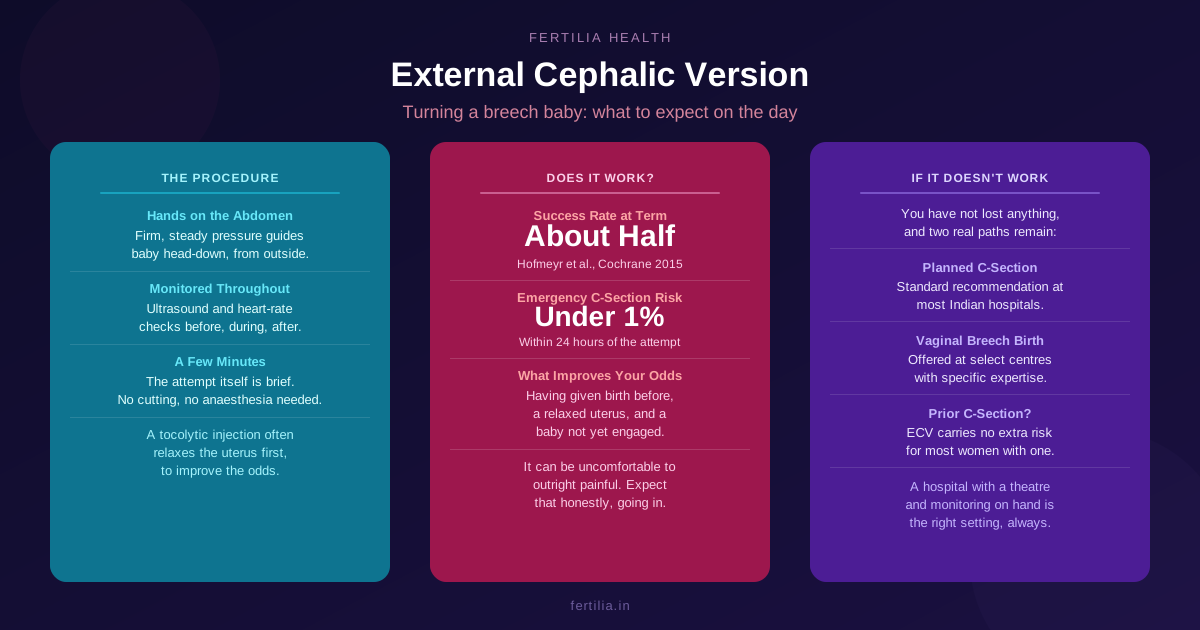
The attempt itself. Your obstetrician places one hand on your baby’s head and the other on the bottom, and applies firm, steady, sustained pressure to lift the bottom up and out of your pelvis while guiding the head down toward it, in either a forward or backward roll. Ultrasound is used throughout to track your baby’s position and confirm the heart rate stays reassuring. It typically takes a few minutes, though it can feel longer while it’s happening.
Immediately after. Whether it succeeds or not, your baby’s heart rate is monitored again for a period afterward, and a further ultrasound confirms the final position. If you are Rhesus D negative, you will usually be tested for any fetomaternal bleeding and offered an anti-D injection, since the manipulation can occasionally cause a small amount of your baby’s blood to cross into your circulation. Most hospitals keep you for observation for an hour or two before you go home the same day.
That’s the whole procedure. There is no cutting, no needle near your baby, and no general anaesthesia required for the version itself. The intensity is in the pressure applied to your abdomen, not in any instrumentation.
Does It Hurt?
Most women are more anxious about this question than any other, and it deserves a direct answer rather than a reassuring dodge. ECV can be uncomfortable to outright painful, and it is fair for you to expect that going in rather than be surprised by it. Reported experience varies widely. Some women describe firm, tolerable pressure; others describe it as one of the more intense parts of their pregnancy care.
What helps: the tocolytic that relaxes your uterus also tends to ease how much force is needed. Regional anaesthesia, where offered, reduces pain for many women and improves the chance of success, though it does not remove discomfort for everyone and carries its own risks, such as a drop in your blood pressure. It is also not universally available or used. The attempt itself is also short. If it isn’t working after a reasonable number of tries, most obstetricians will stop rather than push through, both for your comfort and because repeated forceful attempts do not meaningfully improve the odds.
Tell your doctor during the procedure if the pain feels different from firm pressure, sharper, or localized. That distinction matters, and a good team will pause and reassess rather than continue on the assumption that all discomfort is expected.
Who ECV Works Best For (and Who It Doesn’t Suit)
ECV isn’t a coin flip that applies equally to everyone. Certain factors genuinely change your odds, and knowing yours helps you have a realistic conversation with your obstetrician rather than an abstract one.
A 2015 systematic review of prediction models for ECV success identified several consistent factors: having given birth before (multiparity), a presenting part that hasn’t yet descended and engaged into your pelvis, a posterior or side-lying placenta rather than an anterior one, and a normal amount of amniotic fluid, all improve the likelihood of a successful turn (Velzel J et al., European Journal of Obstetrics & Gynecology and Reproductive Biology, 2015, PMID 26546757). A relaxed, non-tense abdominal wall also helps, which is part of why the tocolytic and regional anaesthesia options above matter.
Timing matters too. Turning tends to be easier a little earlier in the window your hospital offers it, before your baby has settled more firmly into position and before your amniotic fluid volume naturally starts to reduce as you approach your due date. This is a separate consideration from your due date itself: your doctor is weighing “easier to turn now” against “closer to a settled decision if we wait.”
On the other side, some situations make ECV unsuitable altogether, regardless of how it’s performed: an abnormal fetal heart-rate trace, current or very recent vaginal bleeding, ruptured membranes, severe pre-eclampsia, placenta praevia, or a multiple pregnancy in most circumstances. Your obstetrician screens for these before ever bringing you into the room, which is exactly why the pre-procedure ultrasound and CTG happen first, not as a formality but as the actual eligibility check.
Wondering if ECV is right for your pregnancy? Dr. Suganya Venkat consults online, pan-India, over a video consultation, and can talk through whether you're a good candidate, what to expect on the day, and your options either way. Chat on WhatsApp
What Success Looks Like
Across trials, roughly half of ECV attempts at term succeed in turning the baby head-down, and a Cochrane review of eight trials involving 1,308 women found that ECV at term reduced the chance of a non-cephalic baby at birth and reduced the caesarean section rate compared with no attempt (Hofmeyr GJ et al., Cochrane Database of Systematic Reviews, 2015, PMID 25828903). A roughly one-in-two chance is worth having the conversation about, especially since the factors above can shift your individual odds meaningfully higher or lower than that average.
A successful turn is not always permanent. Your baby can revert to breech afterward, though this is uncommon. If it happens close to your due date, whether a repeat attempt can be offered depends on your baby’s position and wellbeing, your amniotic fluid volume, whether the presenting part has engaged, whether labour has started, and your hospital’s protocol. Your obstetrician will talk that through alongside your delivery options for a breech baby.
Safety: What’s Common and What’s Rare
Common and expected: a brief slowing of your baby’s heart rate during or right after the attempt, usually resolving within a few minutes on its own once you’re positioned on your left side and monitored. This is anticipated, not alarming, and it’s precisely why continuous monitoring runs through the whole procedure.
Genuinely rare: the reported risk of needing an emergency caesarean within 24 hours of an ECV attempt is under 1%, and when it happens, the trigger is almost always vaginal bleeding or a heart-rate trace that doesn’t recover as expected, both of which the monitoring is designed to catch immediately. Placental abruption and a significant fetal-to-maternal bleed are described in the literature but rare. This is the entire reason ECV is performed in a hospital with an operating theatre, ultrasound, and monitoring immediately available rather than in a clinic. If anyone offers to attempt this outside that setting, that is the wrong setting, full stop.
The Cochrane review referenced above found no significant difference in low Apgar scores, neonatal admission, or perinatal death between babies whose mothers had an attempted ECV and those who did not (Hofmeyr et al., 2015, PMID 25828903), which is the reassurance worth holding onto walking in.
If ECV Doesn’t Work
A failed attempt is not a failure on your part, and it doesn’t close every door. Your obstetrician has two conversations left to have with you: whether a repeat attempt makes sense (sometimes it does, particularly if the first try was stopped early for comfort rather than fully exhausted), and what your delivery options look like if your baby stays breech. In most Indian hospitals, that means a planned caesarean, on the basis of better documented neonatal outcomes; a small number of specialised centres with the right protocols, staffing, and theatre access do offer vaginal breech birth under specific criteria. Our guide to breech delivery options walks through that decision in full, including the honest trade-offs of both paths, and our C-section guide covers exactly what to expect if that’s the route you take.
If you’ve had a caesarean before and are now facing a breech baby this pregnancy, it’s worth knowing that RCOG guidance supports considering ECV after one previous caesarean, though the evidence in this group is limited and not enough to establish that the risk of rare complications is the same as in a uterus that hasn’t been operated on before. That it can be considered at all surprises many women who assume a prior section rules it out automatically. If a vaginal delivery this time is something you’re weighing more broadly, our VBAC guide covers who is generally a good candidate for a trial of labour after a caesarean.
Questions Worth Asking Before Your ECV
“How many ECVs does this hospital perform, and who will be doing mine?” This should be a trained obstetrician or someone directly supervised by one, and a unit with regular experience will be more confident guiding you through discomfort without over- or under-reacting to it.
“Will I be offered a tocolytic, or regional anaesthesia?” Both improve the odds, and not every hospital in India offers the second routinely. It’s worth asking rather than assuming.
“What happens immediately if there’s a concern during the procedure?” You want to hear “ultrasound and theatre are both available right here,” not “we’d need to move you.”
“If it doesn’t work today, is a second attempt an option?” The answer depends on your specific circumstances, but it’s worth knowing before you go in rather than after.
“I’m Rhesus D negative. Will I be tested and offered anti-D afterward?” This is standard practice and easy to overlook in a busy day unit.
FAQ: External Cephalic Version
How long does an ECV take?
The attempt itself usually takes only a few minutes, though the full hospital visit, including the pre-procedure ultrasound, monitoring, the attempt, and post-procedure observation, typically takes a couple of hours from arrival to discharge.
When is ECV usually done?
Most hospitals offer it from around 36 to 37 weeks onward, once your baby is unlikely to turn back to breech simply because there’s still room to do so, but before labour becomes imminent. Your own hospital’s protocol and your specific pregnancy determine the exact timing.
Can I eat before my ECV appointment?
Fasting policies before an ECV vary a lot between hospitals, so this is one to ask about directly rather than assume. Some units ask you to fast for a few hours beforehand, treating it like any procedure where an emergency caesarean, however unlikely, needs to remain an option, and others do not. Follow your hospital’s specific instructions.
Is ECV safe for my baby?
It is generally considered low risk when done in a hospital with the appropriate precautions in place, though no procedure is entirely without risk. A large Cochrane review did not find a significant difference in low Apgar scores, neonatal admission, or perinatal death between babies whose mothers underwent an attempted ECV and those who didn’t, though trials of this size cannot rule out a difference in the rarest outcomes (Hofmeyr et al., 2015, PMID 25828903). A brief, expected slowing of the heart rate during the attempt is common and resolves on its own; the risk of needing an emergency caesarean afterward is under 1%.
Does ECV increase my chance of needing a C-section?
No, the opposite. The same Cochrane review found ECV reduced the overall caesarean section rate compared with not attempting it, precisely because it gives a meaningful number of babies the chance to be born head-down instead (Hofmeyr et al., 2015, PMID 25828903).
What if the ECV works but my baby turns back to breech again?
This can happen, though it’s uncommon, particularly the closer you are to your due date when it’s attempted. If there’s little time left, your obstetrician will move straight into the delivery-planning conversation rather than attempting another version.
Can I have an ECV if I’ve had a C-section before?
Often yes. Guidance supports considering ECV after one prior caesarean, though the available evidence in this group is limited rather than reassuring about every rare outcome, so this remains an individual decision your obstetrician makes based on your surgical history and your hospital’s own protocol.
The Bottom Line
ECV is a short, monitored, outpatient procedure that gives roughly half of women with a breech baby at term the chance to deliver head-down instead. It can be significantly uncomfortable, and you deserve to be told that plainly rather than have it minimised. Multiparity, an unengaged presenting part, a posterior placenta, and a relaxed uterus, whether from a tocolytic or from regional anaesthesia, all improve your individual odds. The rare complications are exactly why it’s done in a hospital with a theatre and monitoring on hand, not despite that setting.
If it works, you move forward toward a head-down delivery. If it doesn’t, the attempt still carries the small risks described above, which is exactly why it’s done in a hospital where they can be managed, and you still have real, well-managed delivery options to plan through with your team.
Have questions about your own ECV or delivery plan? Dr. Suganya Venkat reviews your history over a video consultation, online and pan-India, and helps you understand your specific options before you go in. Chat on WhatsApp