Once a couple has been told the word azoospermia, the next question is almost always practical: how does anyone actually get sperm out, if none is showing up in the ejaculate? TESA and PESA are the two answers most couples hear first, usually in the same breath, and usually without much explanation of what separates one from the other.
I’m Dr. Suganya Venkat, and in the video consultations I run at Fertilia, I find couples are often handed these two abbreviations and a quote, with very little sense of which procedure applies to their specific diagnosis or why. This post covers what TESA and PESA actually involve, which one fits obstructive versus non-obstructive azoospermia, realistic retrieval rates, what recovery looks like, and an honest cost picture for India. If you have not yet worked through what azoospermia means and how it is diagnosed, my earlier guide on azoospermia: causes, diagnosis and treatment options covers that ground first, and this post picks up from there, at the procedure itself.
The Short Version
TESA and PESA are both needle-based procedures used to retrieve sperm directly from the male reproductive tract when none is present in the ejaculate. They are not interchangeable; which one is used, and how likely it is to succeed, depends almost entirely on whether the azoospermia is obstructive (a blockage, with normal sperm production) or non-obstructive (a production problem, with open tubes). Retrieved sperm is then used with ICSI, where a single sperm is injected directly into an egg, since the quantity recovered is almost never enough for conventional IVF or natural conception. On cost, the retrieval itself usually runs somewhere around Rs 15,000 to Rs 30,000 at Indian centres that price it separately, and that figure sits apart from the ICSI cycle, not inside it. The detail behind that range, and what it leaves out, is further down.
PESA: Percutaneous Epididymal Sperm Aspiration
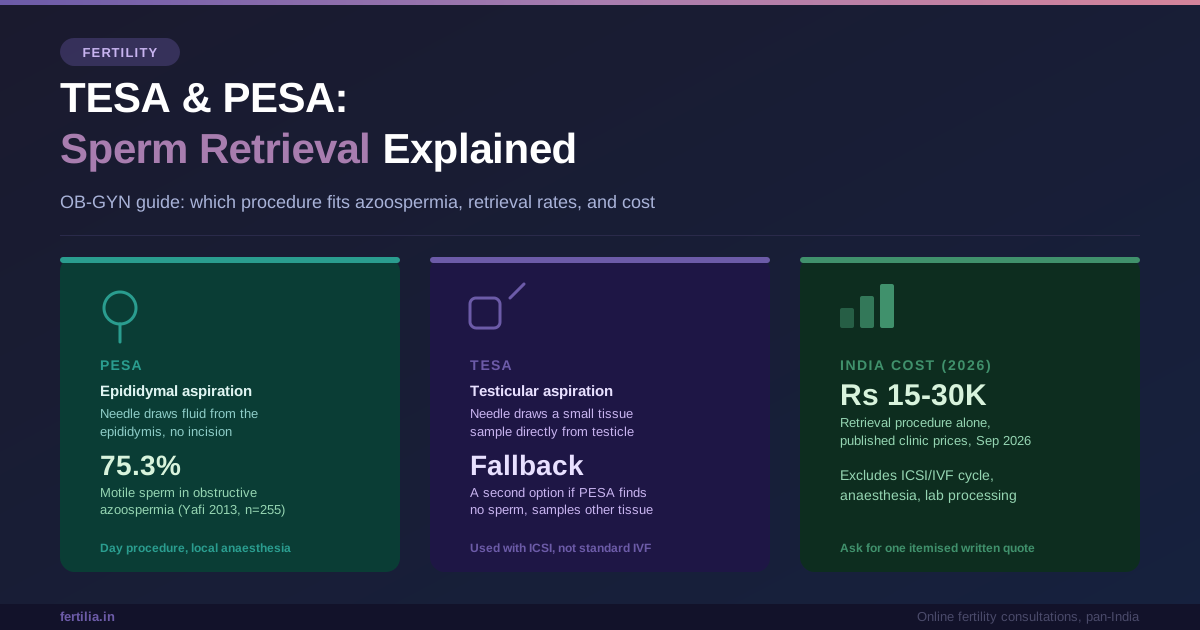
PESA uses a fine needle, passed through the skin of the scrotum, to draw fluid directly from the epididymis, the coiled tube that sits behind each testicle and stores mature sperm after production. Because it targets stored sperm rather than testicular tissue, PESA works well specifically when sperm production is normal and the problem is that sperm cannot travel onward, the definition of obstructive azoospermia.
The procedure is usually done under local anaesthesia or light sedation, usually takes under half an hour, and does not involve a surgical incision, since the needle passes through intact skin. Most men go home the same day.
TESA: Testicular Sperm Aspiration
TESA also uses a needle, but it is passed directly into the testicular tissue itself rather than the epididymis, drawing out a small sample that is examined for sperm. TESA can be used in obstructive azoospermia, often as a step after PESA if the epididymal aspirate does not yield enough sperm, and it is also used as an initial diagnostic or retrieval step in some non-obstructive cases, though it has largely been superseded by micro-TESE for that specific situation.
TESA is also typically done under local anaesthesia as a day procedure, similarly quick, with a slightly higher chance of minor testicular bruising than PESA since it draws from tissue rather than fluid.
PESA vs TESA: How They Differ in Practice
| PESA | TESA | |
|---|---|---|
| Where it retrieves from | Epididymis (stored, mature sperm) | Testicular tissue (sperm being produced) |
| Best suited for | Obstructive azoospermia with normal production | Obstructive azoospermia, or as a next step if PESA does not yield sperm |
| Method | Needle aspiration of fluid | Needle aspiration of tissue |
| Anaesthesia | Local or light sedation | Local or light sedation |
| Recovery time | Usually 1-2 days of rest | Usually 1-2 days of rest |
| Reported retrieval in OA | Motile sperm in 75.3% (Yafi & Zini, 2013); viable sperm in 97% of procedures in an earlier series (Levine, 2003) | Sperm obtained in 18 of 18 procedures in Levine 2003, a small series; too few cases to quote a reliable rate |
A retrospective study of 255 men with obstructive azoospermia undergoing PESA found motile sperm in 75.3%, with rare motile or non-motile sperm recoverable in a further 20%, meaning only about 5% had no sperm found in the aspirate at all (Yafi FA & Zini A, Urology, 2013, PMID 23768519). A single-centre series of 265 percutaneous aspirations, with ICSI outcomes pooled across six IVF centres, found viable sperm in 97% (91 of 94) of PESA and 100% (18 of 18) of TESA procedures done for obstructive azoospermia (Levine LA, Dimitriou RJ & Fakouri B, Urology, 2003, PMID 12893345). Where PESA does not yield usable sperm, moving to TESA in the same or a follow-up procedure gives a second chance at finding sperm, since the two approaches sample different tissue.
In non-obstructive azoospermia, these same numbers do not apply. When the testicles themselves are not producing sperm normally, needle aspiration through PESA or TESA is far less reliable, because it samples a small, random patch of tissue in an organ where sperm production, if present at all, is often patchy rather than uniform. This is why non-obstructive azoospermia is usually approached with micro-TESE instead, a more involved procedure using an operating microscope to identify the specific tubules most likely to contain sperm. I covered the evidence for micro-TESE retrieval rates in non-obstructive azoospermia, roughly 50% pooled across studies, in the azoospermia diagnosis and treatment guide. If your partner’s workup points toward non-obstructive azoospermia, that is the more relevant comparison to ask your urologist about, not PESA or TESA alone.
A 2019 systematic review and meta-analysis comparing TESA and PESA specifically in obstructive azoospermia, pooling 2,020 men across eight studies undergoing ICSI, found TESA gave a significantly higher implantation rate (OR 1.58, P=0.02) but no significant difference in pregnancy or miscarriage rates between the two approaches (Shih KW, Shen PY & Wu CC, Translational Andrology and Urology, 2019, PMID 32038959). That last part is the part worth holding on to: a higher implantation rate that did not carry through to a measurable difference in pregnancies is thin ground for insisting on one procedure over the other. Worth being precise here, though, since this is the sort of thing that gets repeated as settled: the pooled data showed no demonstrated difference in pregnancy rates, which is not the same as proving the two are equivalent. In practice, the choice for obstructive azoospermia comes down to which yields sperm on the day, your urologist’s usual approach, and whether an earlier attempt with one method fell short.
What Causes the Blockage Here, and Why It Matters for the Procedure
The causes of obstructive azoospermia listed in most international series are previous vasectomy, failed vasectomy reversal, and congenital bilateral absence of the vas deferens (CBAVD). Those are all real here too. But there is one cause that is comparatively prominent in India and nearly absent from the Western series quoted above: obstruction following genital tuberculosis. The epididymis is among the most commonly affected genital sites in tuberculous infection, and the resulting scarring can obstruct the ductal system and present as azoospermia years after the original infection was treated (Ravikanth R, Kamalasekar K & Patel N, J Hum Reprod Sci, 2019, PMID 31576086).
This matters for which procedure is likely to work. When the epididymis itself is scarred and fibrosed by old tuberculous disease, a needle drawing fluid from it has less to draw from, and PESA is more likely to come back empty even though sperm production in the testicle is perfectly normal. In a small series of 88 ICSI cycles in men with obstructive azoospermia, the seven men whose obstruction followed tuberculous epididymitis needed testicular rather than epididymal sperm considerably more often, and within that cohort the fertilisation, implantation, pregnancy and miscarriage rates were comparable to the non-tuberculous group (Moon SY, Kim SH & Jee BC, J Assist Reprod Genet, 1999, PMID 10478323). Two caveats on how far to take that. The cohort was Korean rather than Indian, so read it for the biology rather than as a local statistic; and seven men is far too few to conclude that a TB history has no bearing on outcomes generally. What it reasonably supports is the retrieval-route point: when the epididymis is scarred, expect the testicle to be the more productive place to look.
So if your partner has a history of treated genital or urinary tuberculosis, say so explicitly at the urology consultation, before the procedure is booked. It is the kind of detail that is easy to leave out years later, and it is directly relevant to whether TESA should be planned from the start rather than kept as a fallback after a disappointing PESA.
💜 Have a partner with a suspected or confirmed obstructive azoospermia diagnosis and want to understand which retrieval approach fits? Message Dr. Suganya’s team on WhatsApp and we will help you go through the semen report, hormone panel, and what your urologist has already told you.
What Happens to the Retrieved Sperm
Sperm recovered through TESA or PESA is almost never in the quantity needed for standard IVF, where many sperm are added to a dish of eggs and left to fertilise on their own. Instead, retrieved sperm, even a small number, is paired with ICSI (intracytoplasmic sperm injection), where an embryologist selects a single sperm and injects it directly into a single mature egg. This is why surgically retrieved sperm and ICSI are almost always mentioned in the same breath: retrieved sperm is only useful because ICSI exists to use it.
If more sperm is retrieved than is needed for the current cycle, the surplus can usually be frozen for a future attempt, sparing your partner a repeat procedure if the first ICSI cycle does not result in pregnancy or if you plan for more than one child. Ask your clinic directly whether freezing is included in your quoted retrieval fee or billed separately, since practice varies.
Recovery After TESA or PESA
Both procedures are day cases in the large majority of clinics, meaning your partner goes home the same day, usually within a few hours. What to expect afterward:
- Mild discomfort and swelling in the scrotal area for a few days, generally managed with an ice pack and a simple pain reliever your urologist recommends
- A supportive undergarment (scrotal support) is often advised for the first few days to reduce movement and swelling
- Avoiding heavy lifting, strenuous exercise, and sexual activity for roughly a week, though your urologist will give a specific timeline based on the procedure performed
- A small bruise or tenderness is common and expected, particularly after TESA, and typically resolves within one to two weeks
- Rare complications include infection, a larger haematoma (blood collection), or persistent pain, which is why any spreading redness, fever, or worsening pain after the procedure should be reported to your urologist promptly rather than waited out
Most men return to normal daily activity within two to three days and to unrestricted physical activity within a week to ten days.
TESA and PESA Cost in India
Cost varies meaningfully by city, clinic tier, and whether the procedure is billed as a standalone fee or bundled into an IVF-ICSI package. The figures below come from the published price pages of three Indian fertility centres, checked in September 2026:
- PESA: Rs 15,000 to Rs 28,000 quoted as a procedure fee at Javitri Hospital (Lucknow and Kanpur); Rs 25,000 at Wellspring IVF (Ahmedabad)
- TESA: Rs 15,000 to Rs 25,000 at Javitri; Rs 25,000 at Wellspring
- Surgical sperm retrieval quoted as a single band: Rs 28,000 to Rs 55,000 at One World Fertility (Saket, New Delhi), which groups TESA, PESA and micro-TESE together rather than pricing them separately
- Micro-TESE (used for non-obstructive azoospermia, a different and more involved procedure): quoted higher, for example Rs 30,000 to Rs 65,000 at Javitri, and not directly comparable to routine TESA or PESA pricing
The practical planning figure for a straightforward TESA or PESA is therefore about Rs 15,000 to Rs 30,000, and a quote well above that is often a bundled band that includes micro-TESE rather than an expensive needle aspiration. Ask which procedure the number actually refers to.
What the retrieval fee covers also varies by clinic, and this is where quotes stop being comparable. Wellspring states that its figure includes the retrieval, same-day lab processing and freezing of surplus sperm; Javitri lists its figure as the procedure fee alone, with ICSI and IVF quoted separately. So the same number can mean quite different things. The items to ask about specifically are the urologist’s pre-procedure consultation, anaesthesia or sedation charges, embryology lab processing of the retrieved sample, sperm freezing and storage, and the separate ICSI and IVF cycle costs that follow. A retrieval quote that looks unusually low is worth double-checking against what it actually includes; I have written about how to read a full IVF-ICSI quote in ICSI cost in India: what drives the price. Ask your clinic for a single itemised written estimate covering the retrieval procedure, anaesthesia, lab processing, and the ICSI cycle together, so you are budgeting against one real number rather than several partial ones.
What This Means for You as a Couple
TESA and PESA sound like a technical detour on the way to ICSI, but for a couple who has just processed an azoospermia diagnosis, they are often the first concrete sign that there is a specific, workable path forward rather than a dead end. For obstructive azoospermia in particular, the numbers are genuinely reassuring: the large majority of men will have usable sperm recovered, usually without an overnight hospital stay.
One more thing worth naming, because it goes unsaid in most consultations. Even when the diagnosis sits squarely with the male partner, it is usually the woman who fields the questions from both families, and often the woman who is assumed to be the reason a couple has not conceived. Deciding together, early, who gets told what spares a good deal of that, and it is a fair conversation to have before the appointments start stacking up.
At Fertilia, when a couple is moving from an azoospermia diagnosis into planning a retrieval procedure, my role and our Fertility and IVF Support programs sit alongside your urologist and IVF clinic, not instead of them. The surgical side stays with the urologist. What we look after is the rest of the picture: the female partner’s ovarian reserve and cycle readiness, the timing between the retrieval and the ICSI cycle, and the emotional weight of this particular stretch.
💜 Planning a TESA or PESA procedure, or trying to understand which one applies to your situation? Message Dr. Suganya’s team on WhatsApp A ₹399 online video consultation covers your full picture, alongside whatever your urologist or IVF clinic has already advised.
Frequently Asked Questions
What is the difference between TESA and PESA? PESA draws fluid from the epididymis, the tube that stores mature sperm after production, using a fine needle through the skin, without a surgical cut. TESA draws a small tissue sample directly from the testicle itself using a needle. Both are day procedures used mainly for obstructive azoospermia, where sperm production is normal but a blockage prevents sperm from reaching the ejaculate naturally.
Which is better, TESA or PESA? Neither is consistently better for obstructive azoospermia. A meta-analysis of 2,020 men found TESA gave a significantly higher implantation rate (OR 1.58, P=0.02), but that did not translate into higher pregnancy rates, and miscarriage rates were no different either. Since the outcome that matters to you is unchanged, there is no strong case for insisting on one over the other. In practice, many clinics try PESA first since it is less invasive, and move to TESA if PESA does not yield enough sperm.
Do TESA and PESA work for non-obstructive azoospermia? Not reliably. These needle-based techniques sample a small area of tissue, which works well in obstructive azoospermia because sperm production is normal throughout the testicle. In non-obstructive azoospermia, sperm production is often patchy or absent, so a random needle sample is much less likely to find sperm. Micro-TESE, which uses an operating microscope to target the specific areas most likely to contain sperm, is the standard approach for non-obstructive azoospermia instead.
How painful is the TESA or PESA procedure? Both are usually done under local anaesthesia or light sedation, which keeps the procedure itself largely comfortable for most men, though your partner will feel pressure or a pinch during the injection of anaesthetic, and some discomfort during the procedure is still possible. Mild soreness and swelling for a few days afterward is normal and is managed with an ice pack and a simple pain reliever. If he finds the sensation more than he expected at any point, he should say so during the procedure rather than waiting it out, since more local anaesthetic can usually be given.
What happens if no sperm is found during TESA or PESA? If a retrieval attempt does not find usable sperm, particularly in a case that was thought to be obstructive, your urologist may recommend trying the other technique (moving from PESA to TESA, for example) in the same or a follow-up procedure. If both are unsuccessful, or if the underlying picture turns out to be non-obstructive rather than obstructive, micro-TESE becomes the next step to discuss. Donor sperm is also a valid, well-established option if surgical retrieval genuinely does not succeed.
How much does TESA or PESA cost in India? On published price pages checked in September 2026, TESA and PESA are quoted at about Rs 15,000 to Rs 28,000 at Javitri Hospital (Lucknow and Kanpur) and Rs 25,000 at Wellspring IVF (Ahmedabad), while One World Fertility in Delhi quotes a single Rs 28,000 to Rs 55,000 band covering TESA, PESA and micro-TESE together. A reasonable planning figure for a straightforward retrieval is Rs 15,000 to Rs 30,000. These figures usually cover the procedure only, not the separate ICSI and IVF cycle costs, so ask for one itemised written estimate covering everything together.
Can retrieved sperm be frozen for future use? Yes, in most cases. If more sperm is retrieved than needed for the current ICSI cycle, the surplus can typically be frozen, saving your partner from a repeat procedure for a future attempt or an additional child. Confirm with your clinic whether freezing and storage are included in the retrieval fee or charged separately.
TESA PESA procedure kya hota hai aur iska India mein kharcha kitna hai? (What is the TESA/PESA procedure and what does it cost in India?) TESA aur PESA dono needle se sperm nikalne ke tareeke hain, jab ejaculate mein sperm na mile (azoospermia). PESA epididymis se fluid nikalta hai, TESA testicle se tissue nikalta hai. Yeh mostly obstructive azoospermia mein use hote hain, jahan sperm production normal hai lekin rasta band hai. India mein iska kharcha aam taur par Rs 15,000 se Rs 30,000 ke beech hota hai, lekin ICSI aur IVF cycle ka kharcha isme shamil nahi hota, alag se poochna zaroori hai.
(TESA and PESA are both needle-based ways to retrieve sperm when none is found in the ejaculate. PESA draws fluid from the epididymis, TESA draws tissue from the testicle. They are mostly used for obstructive azoospermia, where production is normal but the pathway is blocked. In India, a straightforward retrieval typically costs Rs 15,000 to Rs 30,000, but this usually does not include the separate ICSI and IVF cycle cost, so ask about that separately.)