A semen analysis report that reads “no sperm found” is one of the harder things a couple brings into a consultation. The word doctors use for it, azoospermia, sounds final in a way that the diagnosis itself usually is not. In my years working with couples at Fertilia, I have seen this word misunderstood more than almost any other fertility term, often read as the end of the road when it is, in most cases, the start of a specific and often treatable workup.
This post walks through what azoospermia actually means, the two fundamentally different categories it falls into, how a proper diagnosis is reached, and what the treatment paths genuinely look like for each type.
What Azoospermia Means
Azoospermia is the complete absence of sperm in the ejaculate, confirmed on a centrifuged semen sample examined under a microscope. It is a different finding from a very low sperm count (oligozoospermia), where sperm are present but few. A single semen analysis is never enough to diagnose it. The WHO laboratory manual for the examination and processing of human semen (6th edition, 2021) requires the finding to be confirmed on at least two separate semen analyses, spaced a few weeks apart, before azoospermia is called. If you have questions about reading your own report against these standards, my earlier guide on semen analysis and WHO reference ranges covers that ground in detail.
Azoospermia is found in roughly 1 percent of all men and in 10 to 15 percent of men being evaluated for infertility (Cocuzza et al., Clinics (Sao Paulo), 2013, PMID 23503951). It falls into two categories that matter enormously for what happens next, because they have almost nothing else in common.
Obstructive vs Non-Obstructive: The Distinction That Decides Everything
This is the single most important thing to understand about an azoospermia diagnosis. The two types share a symptom (zero sperm in the ejaculate) but almost never share a cause or a treatment path.
Obstructive Azoospermia (OA)
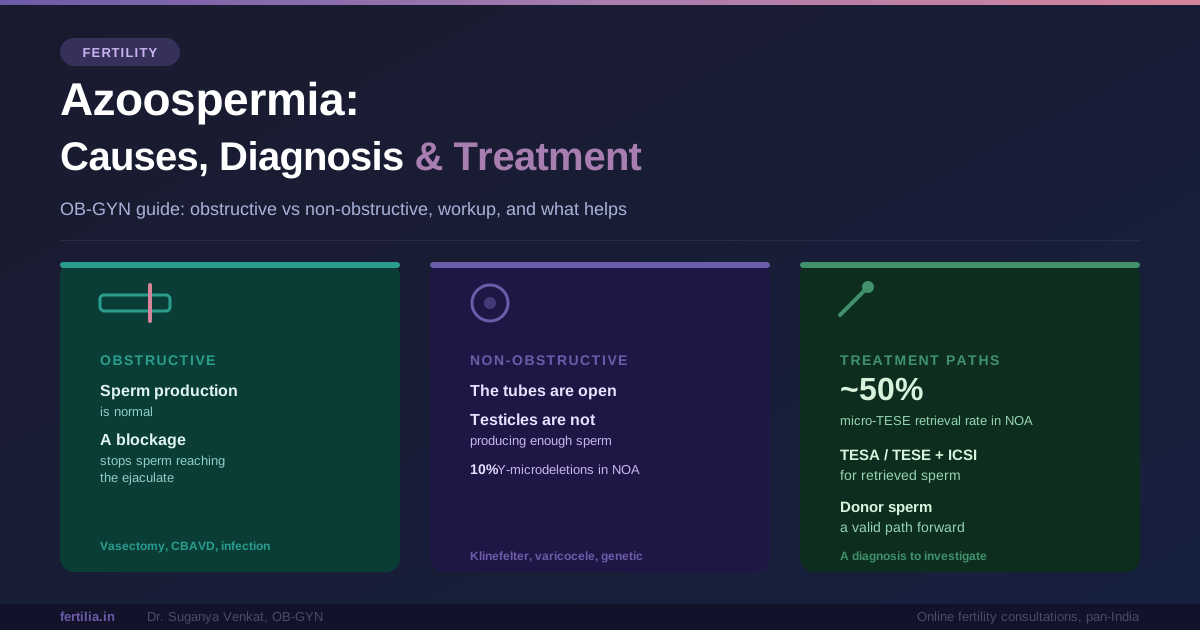
In obstructive azoospermia, sperm are being produced normally in the testicles, but a physical blockage somewhere in the reproductive tract prevents them from reaching the ejaculate. Testicular function is usually intact. Common causes include:
- Vasectomy, the most common cause worldwide in men who have previously undergone one
- Congenital bilateral absence of the vas deferens (CBAVD), a condition where the tubes that carry sperm are absent from birth, closely linked to CFTR gene mutations, the same gene involved in cystic fibrosis (Cioppi et al., Int J Mol Sci, 2021, PMID 33806855)
- Infection, particularly epididymitis, which can scar and block the epididymal tubes
- Prior surgery in the groin, scrotum, or pelvic area that inadvertently affected the reproductive tract
- Ejaculatory duct obstruction, a blockage closer to where the ducts empty into the urethra
Because sperm production itself is normal in obstructive azoospermia, the prognosis for retrieving usable sperm is generally good.
Non-Obstructive Azoospermia (NOA)
In non-obstructive azoospermia, the tubes are open, but the testicles are not producing sperm, or are producing so little that none reaches the ejaculate. This is a production problem, not a plumbing problem, and it is more complex to evaluate and treat. Causes include:
- Genetic conditions, most notably Klinefelter syndrome (an extra X chromosome, 47,XXY) and Y-chromosome microdeletions in the AZFa, AZFb, or AZFc regions, together accounting for a meaningful share of NOA cases (Cioppi et al., 2021)
- Varicocele, when longstanding or severe enough to significantly impair sperm production. My earlier post on varicocele and fertility covers when surgical repair is appropriate
- Hormonal causes, including low pituitary signalling to the testicles (hypogonadotropic hypogonadism)
- Undescended testicles (cryptorchidism) in childhood, even after correction
- Prior chemotherapy or radiation, which can damage sperm-producing tissue
- Idiopathic causes, where no specific reason is found despite a full workup, which does happen in a meaningful proportion of cases
How Azoospermia Is Diagnosed
A proper workup does not stop at a single semen report. It is a structured sequence designed to answer two questions: is this obstructive or non-obstructive, and is there a specific, addressable cause.
Repeat semen analysis. As above, confirmation on a second sample rules out a lab or collection error before anything else proceeds.
A focused history and physical exam. Prior surgeries, infections, mumps after puberty, chemotherapy, undescended testicles in childhood, and testicular size and consistency on exam all point the workup in different directions.
Hormone panel. FSH, LH, and testosterone are the core tests. A markedly elevated FSH with small, firm testicles usually points toward a non-obstructive, production-side problem. Normal FSH with normal-sized testicles is more suggestive of an obstruction, since the testicles are making sperm that simply cannot get out.
Genetic testing, generally including a karyotype (to look for Klinefelter syndrome) and Y-chromosome microdeletion testing, particularly when FSH is elevated or testicular volume is reduced. This step matters for two reasons: it can identify a cause, and in some cases (like a complete AZFa or AZFb deletion) it tells us in advance that sperm retrieval is very unlikely to succeed, which changes the conversation before an invasive procedure is attempted.
Scrotal ultrasound, to assess testicular structure, rule out a varicocele, and check for signs consistent with obstruction, such as dilated tubules.
Testicular biopsy, in some cases, to directly examine whether sperm production is occurring at the tissue level. This is sometimes combined with the retrieval procedure itself rather than done as a separate step.
If your partner’s report has come back with a zero count and you are trying to understand which direction the workup is pointing, a video consultation with Dr. Suganya Venkat at Fertilia can help you go through the findings together and plan the next steps. Message on WhatsApp at wa.me/919940200330.
Treatment Options by Type
For Obstructive Azoospermia
Surgical correction of the blockage is often possible and, when successful, can restore sperm to the ejaculate naturally, meaning conception without assisted reproduction becomes possible again. This depends heavily on where and why the obstruction occurred.
Surgical sperm retrieval (TESA or TESE) is the more commonly used path in practice, particularly when combined with IVF. Because sperm production is normal in obstructive azoospermia, retrieval success rates are high, sperm are usually found and used fresh or frozen for IVF with ICSI, where a single sperm is injected directly into an egg.
For Non-Obstructive Azoospermia
Microdissection TESE (micro-TESE) is the standard retrieval approach for NOA. A surgeon uses an operating microscope to identify the specific, larger seminiferous tubules more likely to contain sperm production, rather than sampling tissue blindly, which improves the odds of finding usable sperm while removing less tissue. A large systematic review and meta-analysis found a pooled sperm retrieval rate of roughly 50 percent with micro-TESE across men with non-obstructive azoospermia (Corona et al., Hum Reprod Update, 2019, PMID 31665451). This means retrieval succeeds in about half of attempts and does not succeed in the other half, a genuinely uncertain outcome that deserves to be discussed honestly before the procedure, not glossed over.
Addressing an underlying cause first, where one exists. A significant varicocele may be repaired before attempting retrieval, hormonal imbalances may be corrected, and in men with Klinefelter syndrome specifically, sperm retrieval rates with TESE have been reported around 40 to 45 percent in meta-analysis, meaningfully different from a blanket “no chance” (Corona et al., Hum Reprod Update, 2017, PMID 28379559).
When retrieval succeeds, any sperm found, even in very small numbers, is used with ICSI, since natural conception or standard IVF is not possible with the tiny quantities micro-TESE typically yields.
When retrieval does not succeed, donor sperm is a valid and dignified path to parenthood, worth naming plainly rather than treating as a last resort spoken about only when every other option has failed. Couples who reach this point after a full, honest workup are not choosing a lesser path. They are choosing a path.
What This Means for You as a Couple
I want to be direct about something I see often in consultations: the word “azoospermia” tends to land on the male partner as a verdict on his worth or his body, and it is neither. A zero count on a semen report is a diagnosis to investigate, with a defined workup and, for a meaningful proportion of men, a real treatment path forward. It is not the closing line of a couple’s fertility story.
At Fertilia, when a semen analysis comes back showing azoospermia, the next step is always the same: confirm it, classify it as obstructive or non-obstructive, and build the workup from there, together, as a couple. My comprehensive guide on getting pregnant covers the wider fertility journey if you are early in this process. If donor sperm becomes part of the conversation later, using a donor gamete with IVF is a well-travelled path, not a consolation prize; my guide on donor egg IVF walks through what that process looks like on the egg side, and much of the honest decision-making it describes carries over.
If your partner’s semen report has come back with a zero count and you would like help understanding what it means and what to do next, message me, Dr. Suganya Venkat, on WhatsApp at wa.me/919940200330. I work with couples across India over video consultation, and this is exactly the kind of report worth going through together before the anxiety gets ahead of the facts.
Frequently Asked Questions
Does azoospermia mean permanent infertility? No. Azoospermia means no sperm was found in the ejaculate on at least two tests, but that is the start of a workup, not a final verdict. Obstructive azoospermia often allows natural sperm to be retrieved surgically with high success, and even in non-obstructive azoospermia, sperm retrieval succeeds in roughly half of cases with micro-TESE. Many men with azoospermia go on to have biological children through IVF with ICSI.
What is the difference between obstructive and non-obstructive azoospermia? In obstructive azoospermia, sperm production is normal but a blockage prevents sperm from reaching the ejaculate. In non-obstructive azoospermia, the tubes are open, but the testicles are not producing sperm normally. The distinction matters because it determines both the cause and the treatment path, and it is established through hormone testing (particularly FSH), testicular exam, and sometimes genetic testing.
Can azoospermia be treated without surgery? Sometimes. If the cause is hormonal, such as low pituitary signalling to the testicles, medical treatment can occasionally restore sperm production. If a varicocele is contributing to non-obstructive azoospermia, surgical repair of the varicocele itself may improve sperm production over several months. Most cases, however, require either surgical correction of a blockage or surgical sperm retrieval for use with ICSI.
What tests are done to find the cause of azoospermia? A repeat semen analysis to confirm the finding, a hormone panel (FSH, LH, testosterone), a physical exam and history, genetic testing (karyotype and Y-chromosome microdeletion testing), and a scrotal ultrasound. A testicular biopsy is sometimes done, occasionally combined with the sperm retrieval procedure itself.
What is TESA and TESE, and how are they different from micro-TESE? TESA (testicular sperm aspiration) uses a needle to draw a small sample of testicular tissue, generally used when sperm production is expected to be normal, as in obstructive azoospermia. TESE (testicular sperm extraction) involves a small surgical excision of tissue. Micro-TESE uses an operating microscope to identify the specific tubules most likely to contain sperm, and is the preferred approach in non-obstructive azoospermia, where sperm production is patchy rather than uniform across the testicle.
Is Klinefelter syndrome always the cause of non-obstructive azoospermia? No, but it is one of the more common genetic causes, along with Y-chromosome microdeletions. Many men with non-obstructive azoospermia have a normal karyotype and no identified genetic cause after a full workup. Genetic testing is done specifically to identify the cases where a cause is found, since it changes what is discussed about retrieval odds and, in some situations, about genetic counselling before proceeding to IVF.
If sperm retrieval fails, what are our options? Donor sperm is a valid, well-established path to parenthood, and many couples build their family this way after a full and honest workup shows retrieval is not possible. It is worth discussing openly and early as one real option among others, not as a fallback raised only after every alternative is exhausted.
Zero sperm count report aaya hai, iska matlab kya hota hai? (My report shows zero sperm count, what does this mean?) Zero sperm count ka matlab hai azoospermia, lekin yeh permanent infertility nahi hai. Do prakar hote hain: obstructive (rasta band hai lekin sperm ban rahe hain) aur non-obstructive (testicles mein sperm production kam ya nahi ho raha). Sahi diagnosis ke liye hormone test (FSH, LH, testosterone), genetic test, aur ultrasound zaroori hai. Iske baad surgery ya TESA/TESE se sperm nikalne ka option ho sakta hai, jo IVF ke saath ICSI mein use hota hai.
If you or your partner have received an azoospermia diagnosis and want to understand the workup and what comes next, message me, Dr. Suganya Venkat, on WhatsApp at wa.me/919940200330. I consult with couples across India over video call, and going through the findings together is the clearest way to know what your specific path forward looks like.