If you have been through repeated IVF cycles, or you have been told that carrying a pregnancy is not medically possible for you, surrogacy can feel like a subject nobody explains properly before you need to understand it. Most of what circulates online is either outdated (built around the “rent a womb” commercial model that India banned years ago) or written for a different country’s law entirely. What you actually need is the current Indian legal picture, in plain terms.
I am Dr. Suganya Venkat, an OB-GYN with fifteen years of experience, and surrogacy comes up in my practice at Fertilia with a specific group of women: those with an absent or surgically removed uterus, a uterine abnormality that makes pregnancy unsafe, recurrent implantation failure across multiple well-run IVF cycles, or a medical condition where pregnancy itself carries serious risk. This guide covers who genuinely qualifies under the Surrogacy (Regulation) Act, 2021, what the process actually involves, a realistic 2026 cost picture, and where Fertilia’s role starts and stops.
What This Post Covers
- Who surrogacy is medically for, and who it is not for
- The legal framework: the 2021 Act, altruistic-only surrogacy, and what changed
- Eligibility criteria for intending parents and for the surrogate herself
- The certificate of essentiality and eligibility certificate process
- A realistic 2026 cost breakdown
- Where a lawyer becomes essential, not optional
Who Surrogacy Is For
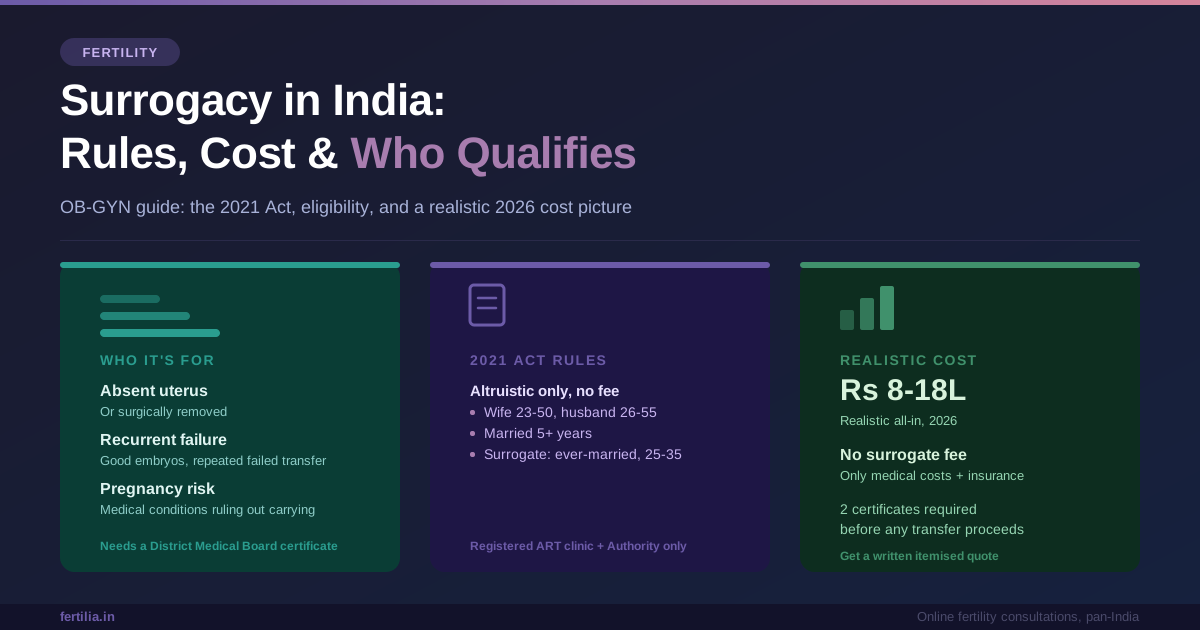
Surrogacy is not an alternative to IVF chosen for convenience. Under Indian law it requires a documented medical indication, certified by a District Medical Board, that gestational surrogacy is necessary. The situations where this conversation genuinely applies:
Absent or surgically removed uterus. Women born without a uterus (a MRKH-type condition) or who have had a hysterectomy, often after a complication like postpartum haemorrhage or fibroids, cannot carry a pregnancy regardless of egg quality or embryo health.
A uterine abnormality that makes pregnancy unsafe or unfeasible. Severe Asherman’s syndrome with extensive scarring, or a uterine malformation that has not responded to surgical correction, can rule out a safe pregnancy even when ovulation and egg quality are normal.
Recurrent implantation failure with good embryos. This is different from repeatedly poor embryo development, which can involve the eggs, sperm, parental genetics, stimulation, or the lab, not the uterus alone. When good-quality embryos repeatedly fail to implant despite a competent lab and protocol, and the workup has ruled out treatable causes, surrogacy becomes part of the conversation. Recurrent Implantation Failure: Causes and the ERA Test covers how we tell these two pictures apart.
A medical condition where pregnancy carries serious risk. Certain cardiac conditions, a history of life-threatening pregnancy complications, or other conditions your treating specialist has flagged as making pregnancy itself dangerous.
This is not a decision to make from a single difficult IVF cycle. If you are earlier in that conversation, Do You Need IVF? An OB-GYN’s Honest Decision Framework and IVF Success Rates India 2026: Age-Wise Data Explained are worth reading first, and if egg quality rather than the uterus is the limiting factor, Donor Egg IVF in India: What to Know, Cost & Success Rates may be the more relevant path.
The Legal Framework: The Surrogacy (Regulation) Act, 2021
Surrogacy in India is governed by the Surrogacy (Regulation) Act, 2021, which came into force on 25 January 2022, along with the Surrogacy (Regulation) Rules, 2022. Two things about this law matter more than anything else:
Only altruistic surrogacy is legal. Commercial surrogacy, where a surrogate is paid a fee or compensation for carrying the pregnancy, is banned outright. Intending parents may cover the surrogate’s genuine medical expenses and the insurance the law requires, but there is no lawful “surrogate fee,” “carrier remuneration,” or agency commission for arranging a surrogate. If a clinic or agency quotes a package that includes a payment to the surrogate beyond medical costs and insurance, that is a compliance red flag, not a normal line item.
Only gestational surrogacy is permitted. The surrogate does not contribute her own egg, so she has no genetic link to the child. Ordinarily the embryo is created from the intending couple’s own gametes, with one narrow donor-gamete exception covered below.
Who Qualifies as an Intending Couple or Intending Woman
This is where most of the confusion online comes from, because the eligibility rules are specific and the age test is applied at a particular moment, not whenever treatment happens to start.
| Requirement | Statutory position |
|---|---|
| Intending wife’s age | 23 to 50 years, on the day the eligibility certificate is issued |
| Intending husband’s age | 26 to 55 years, on the day the eligibility certificate is issued |
| Marital status | Legally married (the enacted Act does not require a minimum duration of marriage; a five-year rule appeared in earlier Bills and was dropped) |
| Citizenship | Indian citizens |
| Existing children | Generally must not have a surviving biological, adopted, or previous surrogacy-born child (exception: if the existing child is physically or mentally challenged, or has a life-threatening disorder) |
| Medical basis | A District Medical Board certificate confirming gestational surrogacy is medically necessary |
A single, unmarried woman cannot access surrogacy in India. The Act separately defines an “intending woman” as an Indian widow or divorcee aged 35 to 45 who intends to use surrogacy, using her own egg with donor sperm (Surrogacy (Regulation) Act, 2021, s.2(1)(s); India Code, verified 2026-09-20). This is a narrow category, not a general option for single women. Legal position as verified on 20 September 2026 against the Act text; confirm any later amendment with a lawyer before relying on it.
One detail that catches people off guard: the age window is fixed to the eligibility certificate date, not to when IVF started, when embryos were frozen, or when you first approached a clinic. If your embryos were created within the age window but the certificate is issued after your 51st birthday (for the intending wife) or your husband’s 56th, the statutory window has closed. Do not assume having frozen embryos ready preserves your eligibility. This is exactly the kind of detail a lawyer experienced in ART/surrogacy matters should confirm for your specific timeline before you proceed.
Who Qualifies as a Surrogate Mother
The surrogate herself must meet her own set of statutory conditions:
- Willing, and ever-married (married at least once)
- Has a child of her own
- Aged 25 to 35 on the day of embryo implantation
- Certified medically and psychologically fit
- Gives written informed consent, in a language she understands
- May act as a surrogate only once in her lifetime
- Does not contribute her own egg; she has no genetic link to the child
It is not mandatory for the surrogate to be a relative of the intending couple, though families sometimes prefer this arrangement. Up to three embryo transfer attempts are permitted with a given surrogate under the rules, though ordinarily a single embryo is transferred per cycle. The surrogate also retains the right to withdraw her consent at any point before embryo implantation.
Whose Gametes Are Used
Ordinarily, the embryo is created from the intending couple’s own egg and sperm (with one narrow donor-gamete exception, covered below); the surrogate never contributes her own egg, so the arrangement is gestational, not traditional. A 2024 amendment to the Rules allows one donor gamete (donor egg or donor sperm) when a District Medical Board certifies that one partner has a medical condition that necessitates it, provided the child still carries genetic material from at least one member of the intending couple. This is not a matter of personal preference or a clinic’s suggestion; it requires that specific medical certification. For the widow or divorcee pathway, the woman must use her own egg with donor sperm.
Because this exact rule has changed more than once since 2022, confirm the current position directly with a registered ART clinic and a lawyer before assuming which gamete arrangement applies to you.
The Certificate Process
Before any surrogacy arrangement can proceed, the intending couple (or intending woman) needs two separate approvals from the state’s Appropriate Authority:
- Certificate of essentiality, which establishes medical and legal necessity. It requires a District Medical Board certificate of proven infertility or the qualifying medical condition, a Magistrate’s court order on the parentage and custody of the child to be born, and proof of insurance coverage for the surrogate for 36 months covering pregnancy, delivery, and postpartum complications.
- Eligibility certificate, which confirms the intending couple or woman meets the personal statutory criteria: age, marital status, citizenship, and the existing-children condition.
Only after both certificates are issued can the embryo transfer to the surrogate proceed through a registered ART clinic. This sequence, and the paperwork behind it, is exactly where a reproductive-law advocate earns their fee. Fertilia’s role in a surrogacy journey is medical orientation, not legal representation, and I say that directly to every woman I see for this: engage a lawyer experienced in ART and surrogacy law early, not after a clinic has already asked you for certificates you do not yet have.
Message Dr. Suganya on WhatsApp about surrogacy
Surrogacy Cost in India, 2026
This is the number search engines send people looking for, and it is also the number most likely to be quoted misleadingly, because a lawful altruistic arrangement has no “surrogate fee” line item, while some non-compliant quotes still include one.
| Cost head | Typical 2026 range | What it covers |
|---|---|---|
| Initial investigations and eligibility workup | ₹50,000–₹1.5 lakh | Fertility evaluation, infectious-disease testing, surrogate screening |
| IVF cycle and embryo creation | ₹2–5 lakh per cycle | Stimulation, retrieval, ICSI/IVF lab work, embryo culture |
| Embryo freezing, storage, frozen transfer | ₹40,000–₹1.5 lakh+ | Cryopreservation, annual storage, subsequent transfers |
| Surrogate’s antenatal care | ₹2–5 lakh | Obstetric consultations, scans, routine investigations, monitoring |
| Delivery and hospitalisation | ₹1–4 lakh+ | Normal delivery or caesarean, anaesthesia, admission |
| Mandatory 36-month insurance | ₹50,000–₹2 lakh+ | Policy meeting the statutory pregnancy/postpartum cover requirement |
| Legal fees, documentation, certification | ₹75,000–₹3 lakh+ | Lawyer’s fees, affidavits, medical board and court paperwork |
| Travel, incidentals | ₹50,000–₹2 lakh+ | Genuine, documented pregnancy-related costs |
| Realistic total, straightforward case | ₹8–12 lakh | One retrieval, few transfers, uncomplicated pregnancy |
| Realistic total, with buffer | ₹12–18 lakh | Full medicines, routine care, some allowance for a failed transfer or a caesarean |
Ranges reflect wide variation by city, clinic, and complexity, and are planning figures, not a fixed tariff. Costs can rise to ₹18–30 lakh or more with repeat IVF cycles, donor-gamete certification, maternal complications, or a NICU admission. Always request a written, itemised quote before paying anything, and treat any quote that includes a payment to the surrogate herself, beyond her medical expenses and insurance, as something to raise with your lawyer before proceeding.
The Emotional and Ethical Side
This is not a lesser way to become a parent. The most reassuring evidence here comes from long-term follow-up, not opinion. A UK study following surrogacy families found that children born through surrogacy showed no differences in socio-emotional or cognitive development compared with naturally conceived children at age two (Golombok S et al., J Child Psychol Psychiatry, 2006, PMID 16423152). The pregnancy was carried by someone else; the parenting, and everything that follows it, is entirely yours.
Confidentiality is built into the process, and many families find that genuinely relieving. The certificate process, the court order on parentage, and the ART clinic’s records exist specifically to establish your legal parentage clearly from birth, so you are not navigating an uncertain legal status with your own child.
What you eventually tell your child is a personal decision, and Indian data on this specific question is limited. In my experience, the emotional climate around the topic, whether or when it is discussed, matters more than any single script. This is worth raising with a counsellor or your treating doctor well before you need an answer for a child, not under pressure.
This is a decision made with your fertility team and your lawyer together, not with either one alone. The medical side (confirming surrogacy is genuinely indicated, coordinating the embryo transfer) and the legal side (the certificates, the court order, the surrogate’s rights) run in parallel, and both need to be right.
FAQs
Is surrogacy legal in India? Yes, but only altruistic, gestational surrogacy through a registered ART clinic and Appropriate Authority process under the Surrogacy (Regulation) Act, 2021. Commercial surrogacy, where the surrogate is paid a fee, is banned.
How much does surrogacy cost in India? A realistic budget for a straightforward, legally compliant case in 2026 is ₹8 lakh to ₹12 lakh, and ₹12 lakh to ₹18 lakh with a sensible buffer for repeat cycles or complications. This covers the IVF cycle, the surrogate’s antenatal care and delivery, mandatory 36-month insurance, and legal and documentation costs. There is no lawful separate fee paid to the surrogate for carrying the pregnancy.
Who qualifies for surrogacy in India? A legally married Indian couple where the intending wife is 23 to 50 and the intending husband is 26 to 55 on the date the eligibility certificate is issued (Surrogacy (Regulation) Act, 2021, s.4(iii)(c); no minimum marriage duration in the enacted Act), generally without an existing child, and with a District Medical Board certificate confirming surrogacy is medically necessary. A widow or divorcee aged 35 to 45 can also qualify, using her own egg with donor sperm (Act s.2(1)(s), verified 2026-09-20).
Can a single woman have a baby through surrogacy in India? Only if she is an Indian widow or divorcee aged 35 to 45. An unmarried single woman does not qualify under the current law (Surrogacy (Regulation) Act, 2021, s.2(1)(s)).
Can the surrogate be a family member? It is not mandatory. The rules do not require the surrogate to be a relative of the intending couple, though some families do choose this arrangement.
What is the certificate of essentiality? It is one of two approvals (alongside the eligibility certificate) required before a surrogacy arrangement can proceed. It establishes medical necessity through a District Medical Board certificate, a Magistrate’s court order on the child’s parentage and custody, and proof of 36-month surrogate insurance.
Surrogacy ki cost India mein kitni hoti hai? India mein ek legally compliant altruistic surrogacy ka realistic budget, IVF cycle, surrogate ki antenatal care aur delivery, 36-month insurance, aur legal fees milaake, typically ₹8 lakh se ₹18 lakh ke beech hota hai, complexity aur clinic ke hisaab se. Surrogate ko seedhe fees dena kanoonan allowed nahi hai.
Surrogacy involves layers most people never need to learn until they are living through the decision: medical necessity, statutory eligibility, and a legal process that has changed more than once in recent years. If this is where your journey has led you, an unhurried conversation is the right next step, one that looks honestly at whether surrogacy is medically indicated for you and what your realistic options are. Dr. Suganya offers online video consultations pan-India at ₹399, and where IVF or a fertility workup is the more appropriate next step, the 90-day IVF Support program is built around that.
Message Dr. Suganya on WhatsApp for a ₹399 Online Consultation
Consultation is online, pan-India, via video call or phone. For the legal certification and documentation process, engage a lawyer experienced in ART/surrogacy law; this guide is medical and educational orientation, not legal advice.