One of the most common questions I hear from women in their third trimester is this: what exactly is happening during labour? They have watched films, listened to relatives, done their research, and still feel like nobody has explained the mechanics clearly.
Labour has a structure. It follows a sequence. And understanding that sequence does not make the process easier in a physical sense, but it does make it less frightening. When you know what each phase is working toward, you are not just waiting for the pain to stop. You understand what your body is accomplishing.
I’m Dr. Suganya Venkat, an OB-GYN with fifteen years of experience, and this is what I walk through with every woman in the final weeks of her pregnancy at Fertilia. Here is the same explanation, in full.
How Labour Progress Is Measured
Before we go phase by phase, it helps to know what doctors and nurses are tracking during labour.
Contractions. The key measurements are frequency (how many minutes apart), duration (how many seconds each one lasts), and quality (how strong they feel). In early labour, contractions may be 10-15 minutes apart and last 30 seconds. By active labour, they are typically 3-5 minutes apart and last 45-60 seconds.
Cervical dilation. This is measured in centimetres, from 0 to 10. Full dilation (10 cm) means the cervix is open wide enough for the baby to pass through. Your midwife or doctor checks this internally; the numbers they give you are not abstract, they are milestones.
Descent of the baby. The baby’s head moves through the pelvis in a series of positions and engages progressively lower. This is described by a scale called the station (from -3 to +3, where 0 means the head is at the level of the sitting bones).
These three things together, contractions plus dilation plus descent, tell your care team how labour is progressing.
The First Stage: Three Phases
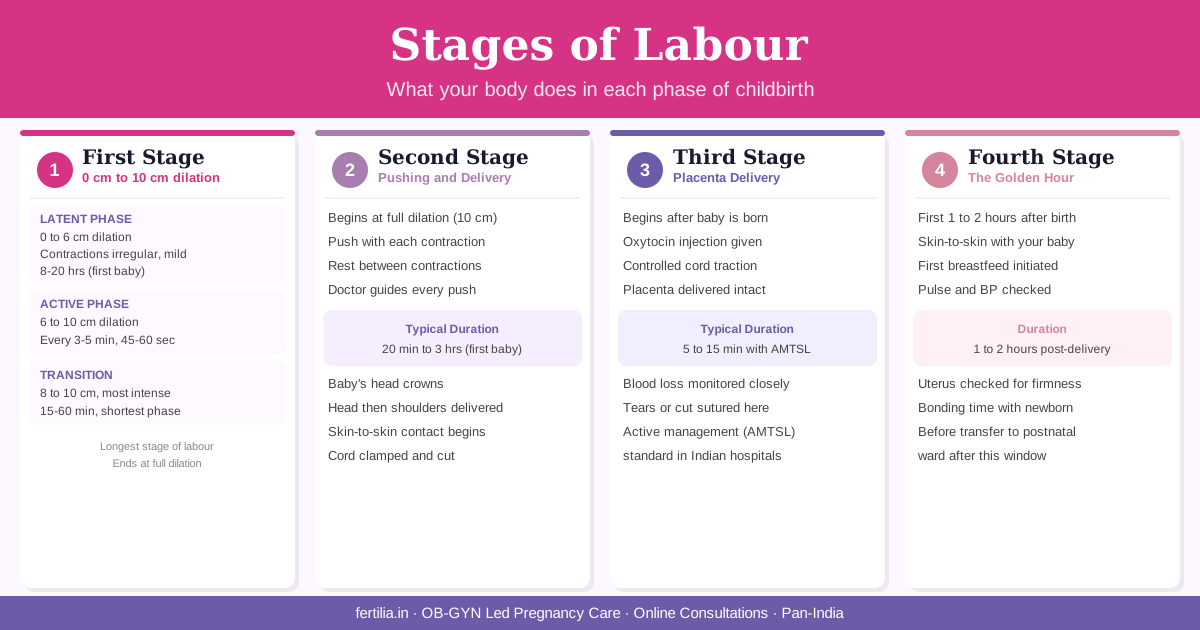
The first stage of labour is the longest. It begins when contractions become regular and progressive, and it ends when the cervix is fully dilated to 10 cm.
Latent Phase (Early Labour): 0 to 6 cm
This is where most of the time in labour is spent.
Contractions in the latent phase are real but irregular. They may be 8 to 15 minutes apart, lasting 30 to 45 seconds. The cervix is softening, thinning, and beginning to dilate. For a first-time mother, this phase can last anywhere from 8 to 20 hours. For women who have delivered before, it is usually shorter.
Updated guidance from a landmark 2010 study by Zhang et al., published in the New England Journal of Medicine, showed that cervical dilation in the latent phase is slower than previously assumed. Active labour, by current ACOG (American College of Obstetricians and Gynecologists) standards, is now defined as beginning at 6 cm, not 4 cm as older textbooks stated. Some Indian hospitals and doctors still use the older Friedman curve, which placed the transition to active labour at 4 cm. Both frameworks are in use, and your doctor will tell you which they follow.
During the latent phase, most women can still talk through contractions. Many manage at home with rest, walking, warm water, and breathing techniques. There is no need to rush to hospital during this phase unless your waters have broken, you notice reduced fetal movement, or something feels wrong.
What helps: walking gently, changing positions, a warm shower, light food if you feel hungry, resting between contractions.
Active Phase: 6 to 10 cm
Once the cervix reaches approximately 6 cm, the pace changes.
Contractions become regular, arriving every 3 to 5 minutes, each lasting 45 to 60 seconds. They are stronger and require full attention to breathe through. Dilation in the active phase typically progresses at around 1 cm per hour in first-time mothers, though there is natural variation. The ACOG 2014 Safe Prevention of Primary Cesarean Delivery consensus statement confirmed that slower progress in active labour is common and does not automatically indicate a problem, as long as the baby is tolerating contractions well.
This is the phase where most women arrive at hospital if they have not already done so.
Pain management options (if desired) are discussed during this phase: breathing techniques, positioning, epidural anaesthesia, nitrous oxide, or injections. There is no correct choice. What matters is that you know what is available and have discussed your preferences with your doctor in advance.
Transition: 8 to 10 cm
Transition is the end of the first stage and is almost always the most intense part of labour.
Contractions arrive every 2 to 3 minutes, sometimes overlapping, and can last 60 to 90 seconds each. Many women feel shaking, pressure in the back and pelvis, nausea, and an overwhelming urge to bear down before the cervix is fully open. This feeling is normal. Your nurse will ask you to breathe and hold the pushing urge a little longer until you reach full dilation.
The most important thing to know about transition is this: it is the hardest phase, and it is the shortest. It typically lasts 15 to 60 minutes. Women who know this often describe transition as bearable precisely because they know it signals the end is near.
If you are in your third trimester and want to talk through a birth plan, what your hospital options are, or how to prepare for labour, a video consultation with me at Fertilia can help. Reach out on WhatsApp at wa.me/919940200330.
For more on this, read our guide on Headache in Pregnancy.
The Second Stage: Pushing and Delivery
The second stage begins at 10 cm (full dilation) and ends with the birth of your baby.
Once the cervix is completely open, you will feel a strong urge to push, often described as similar to the pressure of needing to have a bowel movement. With each contraction, you push. Between contractions, you rest.
How long it takes depends on whether this is your first delivery and whether you have had an epidural.
- First-time mothers without an epidural: typically 20 minutes to 1.5 hours.
- First-time mothers with an epidural: up to 3 hours is within the normal range, because the pushing sensation is reduced.
- Women who have delivered before: often 5 to 30 minutes, sometimes less.
Your doctor or midwife will guide your pushing and may ask you to wait for a contraction before pushing, to push for 10 seconds at a time, or to slow down as the baby’s head is crowning. This guidance is to protect the perineum and reduce tearing.
The baby is delivered head first in most cases. After the head is out, the shoulders rotate, and the rest of the body follows quickly.
The cord is clamped and cut (your partner can do this in many hospitals if they wish). The baby is placed on your chest for skin-to-skin contact unless there is a medical reason to delay this.
The Third Stage: Delivering the Placenta
After your baby is born, the placenta is still inside. The third stage is its delivery.
In most Indian hospitals, doctors use active management of the third stage of labour (AMTSL). This involves an injection of oxytocin (given as the baby’s anterior shoulder is born, or immediately after), controlled cord traction, and uterine massage. A Cochrane review (Prendiville et al., 2000, PMID: 10908457) confirmed that AMTSL reduces blood loss and the risk of postpartum haemorrhage significantly compared to expectant management.
With active management, the placenta is usually delivered within 5 to 15 minutes of the baby’s birth.
If you have had any tears or an episiotomy (a small cut to enlarge the vaginal opening if needed), these are sutured after the placenta is delivered. The anaesthetic for suturing is given locally, and most women feel pressure rather than pain. Read more on stitches after normal delivery and episiotomy care.
Blood loss is monitored carefully in this phase. Any significant bleeding is addressed immediately. The most common serious complication of childbirth is postpartum haemorrhage, which is why the third stage is managed actively in nearly all hospital settings.
The Fourth Stage: Recovery and the Golden Hour
The fourth stage is not always named in textbooks, but it is one of the most important.
It refers to the first 1 to 2 hours after birth. You are still in the labour room or delivery suite. Your pulse, blood pressure, and bleeding are checked regularly. The uterus is felt to confirm it is contracting and firm.
This period is called the golden hour because of what else happens here. Skin-to-skin contact between you and your baby stabilises the baby’s temperature, breathing, and blood sugar. The first breastfeed, if you choose to breastfeed, typically happens during this window. Colostrum (the first milk) is produced from this point onward, even if the larger milk supply takes 2 to 3 days to come in.
Many women describe the golden hour as emotionally overwhelming, a combination of exhaustion, relief, and a feeling that is hard to name. That is normal. There is no right way to feel in those first minutes.
Labour in Indian Hospitals: What to Expect
A few things are specific to the Indian hospital context.
The partograph. Most hospitals, government and private, use a partograph: a chart that plots cervical dilation, contractions, and fetal heart rate over time. If progress falls outside expected parameters, your doctor will discuss augmentation (an oxytocin drip to strengthen contractions) or the possibility of a caesarean section.
Shared vs private labour rooms. Government hospitals typically have shared labour rooms where multiple women labour together. Private hospitals often offer individual labour-delivery-recovery (LDR) rooms. Both settings provide the same clinical monitoring.
Fetal heart rate monitoring. Intermittent auscultation (listening to the fetal heartbeat with a Doppler) is standard. In high-risk pregnancies or if concerns arise, continuous cardiotocography (CTG) monitoring is used.
C-section. A caesarean is recommended if the baby shows signs of distress, if labour does not progress despite augmentation, or if a complication arises. It is not a failure. Read more in our guide on normal delivery vs C-section.
What Labour Is Called in Tamil and Hindi
Many women search for this topic in their own language. Here is the terminology:
| Language | Term | Meaning |
|---|---|---|
| Tamil | prasava vedanai (பிரசவ வேதனை) | labour pains |
| Tamil | prasavam (பிரசவம்) | childbirth / delivery |
| Tamil | prasava nilaigal | stages of delivery |
| Hindi | prasav peedha (प्रसव पीड़ा) | labour pains |
| Hindi | prasav (प्रसव) | delivery / childbirth |
| Hindi | prasav ke charan | stages of labour |
If you are searching for “prasava vedanai stages” or “prasav ke charan kya hote hain,” this post covers exactly that.
What You Can Do to Prepare
Knowing the stages helps. A few other things that help:
Discuss a birth plan with your doctor. This does not need to be a rigid document. It is a conversation about your preferences for pain relief, cord clamping, skin-to-skin contact, and what happens if a caesarean is needed. Your doctor should know your preferences before labour begins.
Practice breathing techniques. Simple slow breathing (in through the nose, out through the mouth, counting to 4 or 6 each way) is not just a coping tool. It keeps your oxygen levels steady during contractions and helps you stay focused.
Know when to go to hospital. The general guide is the 5-1-1 rule: contractions every 5 minutes, lasting 1 minute, for at least 1 hour. Go sooner if your waters break, if there is bleeding, if fetal movement decreases, or if you have any medical concern.
Read about exercise for normal delivery in the third trimester to understand which movements help prepare the pelvis in the final weeks.
If you felt Braxton Hicks contractions and were unsure whether they were real labour, our guide to Braxton Hicks contractions explains the difference in detail.
And if your pregnancy is flagged as high-risk, read our guide on high-risk pregnancy to understand how monitoring and care differ.
If you have questions about what to expect during labour, or you want to prepare a birth plan with a doctor who will look at your full history and pregnancy, I am available for online consultations, pan-India, via video call. Message me directly on WhatsApp at wa.me/919940200330.
Frequently Asked Questions
How long does labour last for a first-time mother? Total labour duration varies widely. The latent phase alone can take 8 to 20 hours. The active phase typically adds 4 to 8 hours. The second stage (pushing) can be 20 minutes to 3 hours. Total labour for a first-time mother commonly falls between 12 and 24 hours, though shorter and longer labours are both within normal range.
At what cervical dilation does active labour begin? Current ACOG guidance (based on Zhang et al., 2010) places the start of active labour at 6 cm. Some Indian hospitals and obstetricians still use the older threshold of 4 cm from the Friedman curve. It is worth asking your doctor which standard they follow, so you are not confused when they describe your progress.
What does the transition phase feel like? Transition (8 to 10 cm) is the most intense part of labour. Contractions are very close together and can feel like they are overlapping. Pressure in the pelvis, back pain, shaking, and nausea are all common. Many women feel an urge to push before they are fully dilated. Transition is intense but short, usually 15 to 60 minutes.
Is pushing painful? The sensation during the second stage is often described as pressure and an overwhelming urge to bear down rather than the sharp pain of contractions. Many women describe pushing as a relief from the transition phase because there is something to do with the sensation. It is physically demanding, and exhaustion is normal.
How long does it take to deliver the placenta? With active management (oxytocin injection plus controlled cord traction, which is standard in Indian hospitals), the placenta is typically delivered within 5 to 15 minutes of the baby’s birth.
What is the golden hour after birth? The golden hour refers to the first 60 to 90 minutes after delivery. Skin-to-skin contact between mother and baby during this time stabilises the newborn’s temperature, breathing, and blood sugar, and supports the first breastfeed. It is a period of monitoring and bonding before you are moved to a postnatal ward.
What happens if labour slows down during the active phase? If dilation stops or slows significantly in active labour, your doctor will assess the situation: checking the baby’s position, reviewing contraction patterns, and deciding whether augmentation with an oxytocin drip is appropriate. Labour arrest is not uncommon, and augmentation resolves it in many cases. If the baby shows distress or augmentation does not work, a caesarean section may be recommended. Your doctor will explain the decision clearly before proceeding.