You had a C-section for your first baby. Now you are pregnant again and wondering: do I have to go through another caesarean, or is a normal delivery still possible?
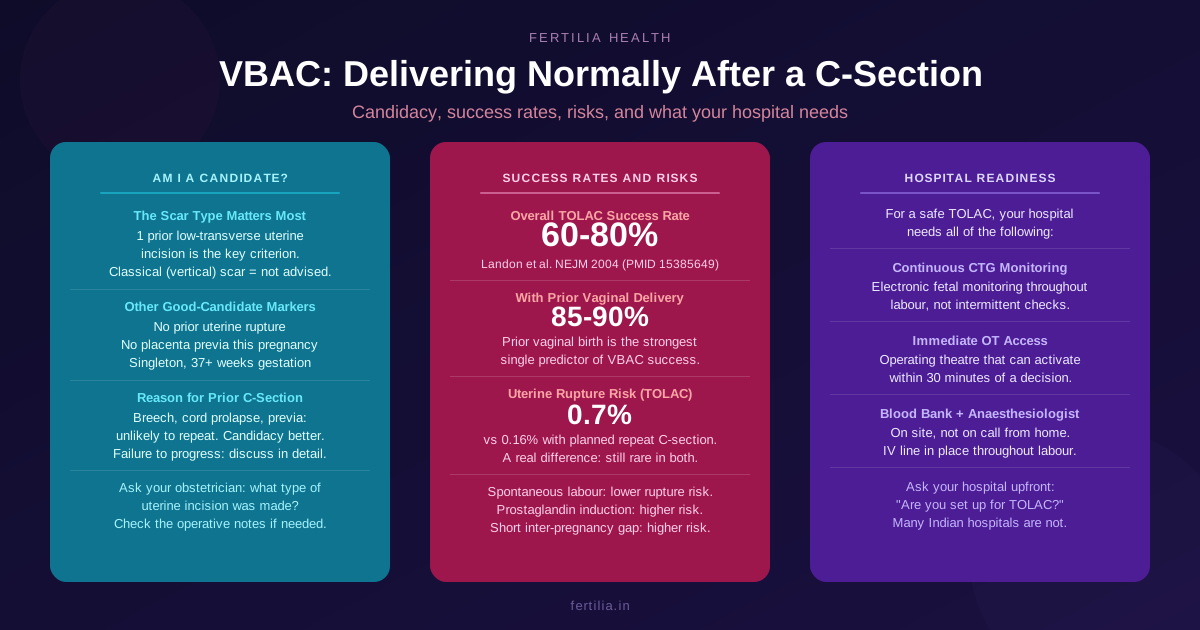
This is one of the most common questions I hear from women in their second pregnancy. And the answer is not automatic. For some women, a vaginal birth after a prior caesarean, called VBAC, is absolutely achievable with a success rate of 60 to 80 per cent. For others, a repeat caesarean is the safer path. The difference depends on the type of scar you have, your hospital’s resources, the reason for your first C-section, and how this pregnancy is going.
I am Dr. Suganya Venkat, an OB-GYN. In fifteen years of practice, I have supported women through both paths, and I want to give you the clear, evidence-based picture so you can have an informed conversation with your own obstetrician.
What VBAC and TOLAC Mean
Two terms come up in every VBAC discussion. It helps to know both from the start.
TOLAC stands for Trial of Labour After Caesarean. It means choosing to go into labour and see whether you can deliver vaginally, rather than scheduling a repeat C-section upfront.
VBAC stands for Vaginal Birth After Caesarean. It is the successful outcome of a TOLAC: a vaginal delivery actually happening.
Doctors use both terms, often interchangeably. When your obstetrician says “I am comfortable offering you a TOLAC,” they mean they are willing to support you through a trial of labour. When you succeed, that is your VBAC.
Who Is a Good Candidate for VBAC?
The strongest international evidence on VBAC safety comes from a landmark 2004 study by Landon et al., published in the New England Journal of Medicine (PMID 15598960). It followed nearly 18,000 women and is the basis for most of the guidance that follows.
ACOG (the American College of Obstetricians and Gynecologists) set out clear candidacy criteria in their 2019 Practice Bulletin (No. 205). A woman is generally a good candidate when:
She has one prior low-transverse uterine incision. This is the key criterion. A “low-transverse” cut is made horizontally across the lower segment of the uterus, the thinner, less muscular part. This scar is the most likely to hold during subsequent labour. A vertical or “classical” incision on the upper part of the uterus carries a much higher rupture risk and usually means a repeat caesarean is recommended.
The reason for her first C-section is not recurring. If your first caesarean was for a breech baby and your current baby is head-down, the reason that triggered the first surgery is simply not there this time. If the first was for failure to progress but your cervix is now favourable, the picture is different from before. If the first was for placenta previa and you have a normally placed placenta now, you are no longer in that category.
She has no new reason that would prevent vaginal delivery. Placenta previa, a transverse-lying baby, or conditions that require a planned early delivery are examples of situations that make a TOLAC inadvisable regardless of your history.
She is giving birth at a hospital that can respond immediately if needed. This is not a minor point. VBAC requires a hospital with continuous electronic fetal monitoring (CTG), intravenous access, blood bank availability, an operating theatre that can be activated within minutes, and an anaesthesiologist on standby. More on this below.
Her uterus has had no prior rupture. A uterus that has ruptured once carries a significantly elevated risk of rupturing again, and a repeat caesarean is strongly recommended in that situation.
Women considering VBAC who have had two prior low-transverse caesareans are a separate category. ACOG does not categorically prohibit a TOLAC in this group, but the risks are higher and the decision requires very careful individual counselling. In practice, most Indian hospitals do not offer TOLAC to women with two prior scars. This is something to discuss directly with your obstetrician.
What Is the Risk of Uterine Rupture?
This is the question that concerns most women, and it deserves a straightforward answer.
In the Landon 2004 study, symptomatic uterine rupture occurred in 0.7% of the 17,898 women who attempted TOLAC (124 women, about 7 in 1,000). In the 15,801 women who had a planned repeat caesarean without labour, symptomatic uterine rupture was not a reported outcome. The difference is real, and the absolute risk with TOLAC remains small.
A uterine rupture, if it occurs, is a serious emergency. The risk to mother and baby rises sharply if the hospital cannot respond in under 30 minutes. This is exactly why hospital readiness is as important as individual candidacy.
Rupture risk also varies depending on how labour starts. Spontaneous labour (starting on its own) carries a lower rupture risk than induced labour. Induction with prostaglandins, specifically the agents used to ripen the cervix, increases rupture risk to roughly 2 times that of spontaneous labour. Your obstetrician will factor this into their advice if induction is being considered. For more on what induction involves, read our guide on induction of labour methods and what to expect.
What Improves Your Chances of a Successful VBAC?
Success rates across different studies range from 60 to 80 per cent overall, but this number is not fixed. Certain factors move it in your favour.
A previous vaginal delivery. If you have had at least one vaginal birth before or after your C-section, your success rate with TOLAC rises to 85 to 90 per cent. The uterus has already laboured and delivered before.
Spontaneous onset of labour. Labour beginning on its own is associated with both higher success rates and lower rupture risk compared with induced or augmented labour.
A favourable Bishop score. The Bishop score is a clinical assessment your obstetrician makes near term, looking at cervical dilation, effacement, consistency, position, and how far the baby’s head has descended. A higher score (8 or above) means the cervix is ready, and success rates improve accordingly.
The reason for your prior C-section is not likely to recur. Breech presentation, cord prolapse, placenta previa: these do not come back automatically. Failure to progress in a long and complicated first labour is more likely to repeat than these one-off situations, and your obstetrician will weigh that.
No very short interval between pregnancies. A gap of less than 18 months between your C-section and the next conception is associated with higher rupture risk. The uterine scar needs time to heal fully. If your pregnancies are close together, your obstetrician will discuss this with you as part of the TOLAC decision.
Wondering whether to plan for a normal delivery or C-section from the start? Our guide to normal delivery versus C-section: an OB-GYN’s decision framework covers the broader picture.
What Labour and Delivery Look Like with VBAC
If you proceed with a TOLAC, your labour will be monitored more closely than a standard first labour. Continuous CTG (cardiotocograph) monitoring runs throughout, both to track the baby and to watch for the early signs of uterine stress. An intravenous line stays in place, partly for access if medication is needed and partly for rapid response capability.
An epidural is entirely compatible with VBAC. There is no clinical reason to avoid it, and the concern that it might mask pain from a rupture is not supported by evidence. If you would like to understand the full range of pain relief options, read our guide to labour pain management: epidural, Entonox and natural options.
The labour itself proceeds as any other labour would. The obstetrician monitors progress and the baby’s wellbeing. If things are moving well and the CTG is reassuring, you continue. If the pattern suggests the labour is not progressing safely, the team moves to a C-section. This is the “trial” aspect of TOLAC: it is genuinely assessed in real time.
If VBAC succeeds, recovery is usually faster than from a C-section. You may still have stitches if there is a perineal tear, but the abdominal wound and the healing that comes with it is not part of your recovery.
What Indian Hospitals Need to Offer VBAC Safely
This is where the India context matters most.
In India, the overall caesarean rate has climbed significantly, particularly in private hospitals in urban areas. The infrastructure for managing obstetric emergencies varies widely between hospitals. A government district hospital, a small private nursing home, and a tertiary-level private hospital do not all have the same resources.
A safe VBAC requires every one of the following:
Continuous electronic fetal monitoring. CTG machines that run throughout labour, not just intermittently.
An operating theatre that can be activated immediately. Not in 45 minutes, not in the next hour. A team that can perform an emergency caesarean within 30 minutes of a decision is the accepted benchmark.
A blood bank on site. Not a nearby arrangement. On site.
Intravenous access throughout labour. Standard for most hospitals but worth confirming.
An anaesthesiologist available throughout. Many smaller hospitals have anaesthetists available during scheduled hours or on call from home, not stationed in the hospital. This matters.
Ask your hospital upfront. The question is direct: “Is your hospital equipped to handle a TOLAC, and what is your emergency caesarean response time?” A hospital that cannot answer this clearly, or that says yes but cannot describe the setup, may not be the right place for a VBAC attempt.
In Fertilia’s online consultations, one thing I help women prepare for is exactly this conversation. Knowing what to ask your obstetrician and your hospital, and how to weigh what you hear, is a skill. You can book a video consultation with me to work through your specific situation: if you would like to discuss your options before your next antenatal appointment, WhatsApp me here.
The Conversation to Have with Your Obstetrician
VBAC is not a decision you make alone, and it is not a decision your obstetrician makes for you. It is a shared decision between you, your obstetrician, and, in many cases, the hospital where you are planning to deliver.
Bring these questions to your next appointment:
- What type of uterine incision did I have in my first caesarean? (You want “low-transverse” confirmed; sometimes the operative notes need to be checked.)
- Was there any extension or complication of that scar during surgery?
- Given my pregnancy now and how it is going, am I a good TOLAC candidate in your view?
- What is this hospital’s setup for VBAC, including emergency response time?
- If we attempt TOLAC and it does not progress, what is the plan?
Your obstetrician is not the obstacle in this conversation. They have the clinical information you need, and a good working relationship with them makes the whole decision clearer. Fertilia’s role is to add the preparation layer: helping you arrive at that appointment informed, with the right questions, and with a realistic sense of what the evidence says.
For a full picture of how a caesarean itself is managed and what recovery looks like if it does become the path, you may find these useful: C-section delivery: what to expect before, during and after and C-section recovery week by week.
What VBAC Is Called in Hindi and Tamil
Women searching for information about this topic in Indian languages often use these terms:
| Language | Common term |
|---|---|
| Hindi | pichhale operation ke baad normal delivery (पिछले ऑपरेशन के बाद नॉर्मल डिलीवरी) |
| Tamil (Roman) | murai C-section pichagana normal delivery (previous C-section after normal delivery) |
| English (medical) | TOLAC / VBAC / trial of labour after caesarean |
If you have been searching “pichhale operation ke baad normal delivery ho sakti hai,” the answer is: for the right candidate, at the right hospital, it absolutely can.
Frequently Asked Questions
If my first C-section was because my baby was too big, does that mean I cannot try VBAC next time? Not necessarily. “Baby too big” can mean different things. If the concern was a very large baby at a specific gestational age and your current baby’s growth is tracking differently, your obstetrician may assess you as a TOLAC candidate. If there is a genuine structural mismatch between your pelvis and even a normal-sized baby (a condition called cephalopelvic disproportion), a repeat C-section is more likely to be advised. This is worth discussing with your obstetrician along with the previous birth’s operative notes.
Can I have an epidural during VBAC labour? Yes, fully. An epidural does not interfere with a TOLAC and does not hide the warning signs of uterine rupture reliably enough to change clinical management. The continuous CTG monitoring is the primary early-warning system during VBAC, not the mother’s pain reports. Pain relief choice remains the same as in any other labour.
My first C-section was a vertical cut. Can I still try VBAC? A classical or vertical uterine incision (not the same as the skin cut, which is often vertical but the uterus may still have been cut horizontally) carries a rupture risk of 2 to 9 per cent with TOLAC, which is substantially higher. ACOG and most guidelines advise against TOLAC in this situation. Your operative report will clarify what type of uterine incision was made; this is worth retrieving if you do not already have it.
I am planning a home birth for my second baby. Can I do VBAC at home? TOLAC at home is not recommended by any major obstetric guideline. The reason is the emergency response requirement: if uterine rupture occurs, a surgical team needs to be available within minutes. Home birth, by definition, does not offer this. A hospital with VBAC capability is the appropriate setting.
Does choosing VBAC mean more risk for my baby as well as me? The Landon 2004 study found no significant difference in neonatal death rates between TOLAC and planned repeat C-section overall, though the TOLAC group did have a small number of hypoxic-ischemic encephalopathy (brain injury from oxygen deprivation) cases: 12 infants born at term, of which 7 followed uterine rupture, an absolute risk of about 0.46 per 1,000 women attempting TOLAC at term. There were none in the elective repeat caesarean group. The study did not analyse emergency response times, but the reason guidelines insist on TOLAC happening where a caesarean can be started immediately is precisely this: the events are rare, and what makes them survivable is speed.
How soon after my C-section can I get pregnant if I want to try VBAC next time? A gap of at least 18 months from delivery to the next conception is generally recommended to give the uterine scar adequate time to heal. Conception before 12 months post-caesarean is associated with higher rupture risk. This applies regardless of whether you plan TOLAC or a repeat caesarean, because the scar’s integrity matters for the uterus throughout pregnancy, not only in labour.
I have had two C-sections. Is VBAC possible? TOLAC after two prior C-sections is considered a higher-risk situation. ACOG does not categorically prohibit it but requires careful individual counselling and a hospital with the highest level of preparedness. In most Indian hospitals, TOLAC after two caesareans is not routinely offered. If this is your situation, a detailed conversation with your obstetrician, ideally at a tertiary-level hospital, is the right place to start.
Thinking about your second pregnancy and what delivery might look like? If you would like to talk through your specific history and options with an OB-GYN before your next appointment, Fertilia offers online consultations for women across India at Rs 399. WhatsApp to book a video call with Dr. Suganya Venkat.
For more on what happens during each phase of labour, our guide to the stages of labour has the full walk-through. If your pregnancy has any complicating factor, our guide to high-risk pregnancy care explains how that changes your management. And if this is your first pregnancy and you are still in the planning phase, the week-by-week pregnancy guide covers what to expect from each trimester.
This post covers general clinical information for educational purposes. Decisions about your specific delivery plan should be made with your own obstetrician, who has access to your complete pregnancy history and operative records.