You’re at a routine scan, and the sonographer says it almost in passing: “there’s a loop of cord around the baby’s neck.” Then she moves on to measure something else, but you don’t move on. That one sentence stays with you for the rest of the appointment, and probably for the rest of the day.
I’m Dr. Suganya Venkat, an OB-GYN with over 15 years of clinical experience, and a nuchal cord is one of the findings I explain most often precisely because the name sounds alarming and the reality, in almost every case, is not. I want to walk you through exactly what this finding means, how common it actually is, when it genuinely needs closer attention, and what changes (and what doesn’t) in how your delivery is managed if one is present.
In this post:
- What a nuchal cord is, and why it happens
- How common it is at scans and at delivery
- What the evidence actually shows about risk
- When it becomes a genuine monitoring point
- Why a nuchal cord alone does not mean a caesarean
- How it’s managed during labour and delivery
- Answers to the most common questions
What a Nuchal Cord Is
A nuchal cord is simply the umbilical cord looped around the baby’s neck, once or more than once. “Nuchal” refers to the neck, and that’s the entire definition. It is not a knot, it is not a tangle in the sense that word suggests, and it is not the same as a true knot of the cord, which is a separate and much rarer finding where the cord ties an actual knot in itself, usually formed by fetal movement earlier in pregnancy.
Babies move a great deal inside the uterus, especially in the second trimester when there is more room relative to their size: rolling, somersaulting, kicking, changing position several times a day. The umbilical cord is long enough and flexible enough that a loop around the neck happens simply as a byproduct of this normal movement. Because babies keep moving throughout pregnancy, a loop noted at a 24-week scan can slip off entirely by the next scan, or a baby with no loop at 28 weeks can have one by 36 weeks. This is one reason a nuchal cord finding early in pregnancy is rarely something to fix your attention on: it is a snapshot, not a fixed condition.
How Common It Is
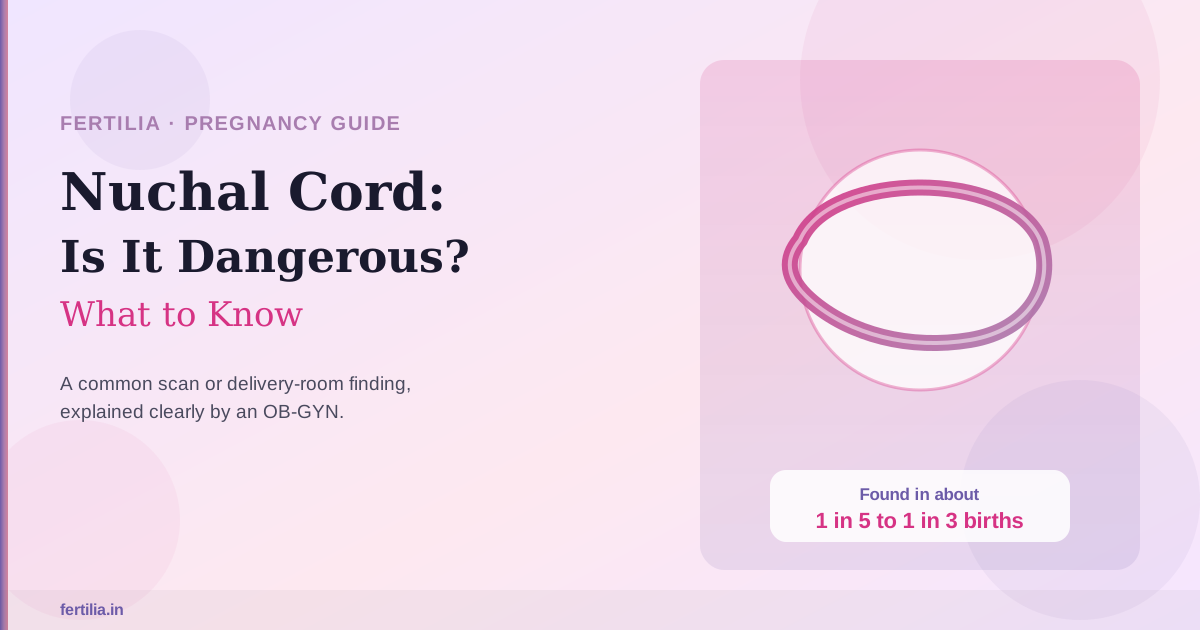
This is the detail that reframes the whole conversation for most women I see: a nuchal cord is not a rare complication. It is one of the most common findings at delivery. A single nuchal cord is reported in roughly 20% to 35% of all singleton deliveries at term, and multiple loops occur less often, with each additional loop becoming progressively rarer (Sherer DM et al., International Journal of Women’s Health, 2020, PMID 32982473).
Put plainly: somewhere between 1 in 5 and 1 in 3 babies are born with a loop of cord around the neck, and the overwhelming majority of them are perfectly healthy at birth. If you have just been told your baby has one, you are not in an unusual situation. You are in the situation a very large share of pregnant women are in by the time they deliver.
What the Evidence Shows
It’s worth being specific about what the research says, rather than reasoning from how the finding sounds.
A prospective cohort study compared 218 pregnancies with a nuchal cord against 190 pregnancies without one, looking specifically at umbilical cord blood gas values, Apgar scores, and caesarean section rates. It found no statistically significant difference in cord pH or in one-minute and five-minute Apgar scores between the two groups, and concluded that a nuchal cord on its own is not associated with the kind of adverse outcomes, like low oxygen levels or low Apgar scores, that would justify treating it as a standalone risk factor. At the same time, the same study found that the number of loops was significantly related to fetal distress, and that fetal distress was the leading reason for a caesarean within the nuchal cord group, even though the overall caesarean rate was no higher than in the comparison group (Akkaya H et al., Journal of Maternal-Fetal & Neonatal Medicine, 2017, PMID 27585242).
A larger meta-analysis pooling twenty studies and more than 267,000 pregnant women (just over 50,000 with cord entanglement and around 217,000 without) did find higher relative risks in the entanglement group (Pergialiotis V et al., European Journal of Obstetrics & Gynecology and Reproductive Biology, 2019, PMID 31704532). A low one-minute Apgar score was more common (risk ratio 1.75, 95% CI 1.46 to 2.11), as were fetal distress (risk ratio 1.50, 95% CI 1.33 to 1.69) and a cord pH below 7.1 (risk ratio 1.73, 95% CI 1.48 to 2.03).
This is worth sitting with honestly rather than smoothing over. The relative increases were real. The reason they still do not mean most babies with a nuchal cord are at meaningful individual risk is that these are relative increases applied to a low baseline event rate: a higher relative risk on an uncommon outcome still leaves the absolute chance for any one baby small. How common the finding is does not dilute the relative risk; only the low baseline rate does. When fetal distress does occur in labour, it is picked up on monitoring the same way it would be from any cause, and managed the same way: close monitoring, and delivery expedited if the pattern does not settle.
The way I explain this to my own patients is that a nuchal cord shifts your baby into a group that is watched a little more closely for the specific pattern that would matter, not a group that is assumed to be in danger.
If your scan report mentioned a nuchal cord and you want to talk through what it means for your specific pregnancy and delivery plan, message Dr. Suganya on WhatsApp and we can go through your scan findings together over a video consultation.
When It Becomes a Genuine Monitoring Point
Most of the time, a nuchal cord stays exactly what it sounds like: an incidental finding. There are two situations where it earns closer attention from your care team.
Multiple loops. A single loop is by far the most common pattern, and a double loop is still common and generally reassuring. The literature notes that emerging evidence associates three or more loops of nuchal cord, particularly alongside a coexisting true knot of the cord, with a somewhat higher risk of stillbirth or a compromised baby at delivery, compared with a single or double loop (Sherer DM et al., PMID 32982473). This is why, if your scan notes multiple loops, your obstetrician may suggest more frequent growth scans or fetal wellbeing checks in the later weeks, not because something is currently wrong, but because this specific pattern is the one worth keeping an eye on. This is an individualised judgement rather than a fixed protocol, since the evidence here comes from observational studies.
A tight loop causing repeated heart rate changes in labour. During labour, contractions naturally put some tension on the cord. If a loop is loose, this usually makes no difference at all to the baby’s heart rate pattern. If a loop is tight, it can occasionally cause brief, repeated dips in the baby’s heart rate on the monitor, particularly during contractions. This is picked up in real time on the fetal heart rate monitor, which is precisely why labour with a known nuchal cord is watched carefully. Your team does not judge this on any single feature. They look at the whole picture: the depth and timing of any dips, how the baby’s heart rate recovers, the baseline rate, and the trend over time. Some patterns settle and are reassuring; others, even when the heart rate returns to normal between contractions, are the ones that prompt your team to consider expediting delivery. That judgement is exactly what monitoring in labour is for.
Neither of these situations means something has gone wrong. They mean your care team has identified the specific detail that, in a small minority of cases, is worth acting on, and they are watching for exactly that.
Why a Nuchal Cord Alone Does Not Mean a Caesarean
This is one of the most common questions I get asked, and the answer is straightforward: a nuchal cord noted on a scan, or even a nuchal cord confirmed at the start of labour, is not on its own an indication for a planned caesarean section. Given how common the finding is at term, routinely scheduling a caesarean for every nuchal cord would mean operating on somewhere between a fifth and a third of all pregnant women for a finding that, in the large majority of cases, causes no problem at all.
What actually happens is that labour proceeds normally, with your baby’s heart rate monitored the way it is in any labour, and often a little more closely when a nuchal cord is known. If the monitoring shows a reassuring pattern throughout, as it does for most babies with a nuchal cord, delivery continues vaginally. A caesarean becomes the right decision only if labour itself shows a specific pattern of concern, whether related to the cord or to any other cause, the same threshold that applies to every labour regardless of whether a nuchal cord is present.
If you’ve been told your baby has a nuchal cord and you’re worried this changes your birth plan entirely, in the great majority of cases it doesn’t. It changes how closely certain things are watched, not the plan itself.
How It’s Managed During Delivery
Once the baby’s head is delivered, your doctor or midwife checks for a cord around the neck as a routine part of every single delivery, whether or not one was suspected beforehand. What happens next depends on how tight the loop is.
A loose loop is simply slipped gently over the baby’s head, or over the shoulder, in the moments after the head is born. This takes seconds and most parents in the room don’t even register it happening.
A tight loop that cannot be slipped off easily is managed with one of two well-established approaches. It can be clamped in two places and cut before the shoulders are delivered, a technique that has been part of standard vaginal delivery practice for a long time. Alternatively, many teams now use the somersault manoeuvre: instead of cutting the cord, it is left in place around the neck while the baby’s head is guided toward the mother’s thigh as the body is born, which minimises the distance from the cord to the placenta and keeps the loop from being pulled tight, so it does not need to be clamped and cut (Dresang LT, Yonke N, American Family Physician, 2015, PMID 26280140). Both are standard, well-practised parts of delivery training rather than emergency improvisation. Where it is possible, many teams now prefer the somersault approach precisely because it avoids cutting the cord and keeps the baby’s blood flow through it intact, reserving clamping and cutting for a very tight cord that cannot be managed any other way.
This is a good example of something I remind women of often at Fertilia: your delivery team has almost certainly managed a nuchal cord many times before, because they manage one in roughly a fifth to a third of all their deliveries. It is a familiar, well-rehearsed part of a normal delivery, not a crisis moment.
When to Check In Sooner
A nuchal cord is not something you need to monitor at home, and it is not a reason to worry day to day. What matters far more in the later weeks is your baby’s usual movement pattern. If you notice your baby moving less than usual, or the pattern changing noticeably, contact your obstetrician or the labour ward straight away, the same day, and ask to be checked. Reduced movement is the one thing not to wait on: do not put it off to the next day or your next scheduled scan, and do not let a known nuchal cord make you second-guess whether it is worth calling. It always is. The same applies to any vaginal bleeding, a gush or trickle of fluid, or regular painful tightenings before 37 weeks. These are general pregnancy safety points rather than nuchal cord ones specifically, but they are the things genuinely worth acting on quickly.
Practical Takeaways
- A nuchal cord is common, not a complication in itself. It is present in roughly 1 in 5 to 1 in 3 births at term.
- A single or double loop, on its own, carries a low absolute risk to the baby. The studies that looked at cord pH and Apgar scores directly found individual risk small, even where a larger meta-analysis found modest relative increases.
- Three or more loops, or a true knot alongside the loop, is the pattern that may earn closer monitoring, sometimes with more frequent scans in the final weeks, decided case by case rather than by a fixed protocol.
- In labour, your baby’s heart rate is watched closely, which is how a tight loop causing real distress would actually be identified, not by the presence of the loop itself.
- A nuchal cord alone does not justify a planned caesarean. Most babies with one are born vaginally, without incident, using techniques your delivery team already knows well.
For the fuller picture of what’s tracked through the rest of pregnancy, our Pregnancy Guide walks through the full schedule of scans and monitoring by trimester. If you’re also keeping an eye on your baby’s movement pattern day to day, our guide on fetal movement and kick counts covers what a healthy pattern looks like as you get closer to your due date. A nuchal cord noted around 12 weeks is an entirely different finding from a raised nuchal translucency measurement on the same scan; our NT scan guide explains the translucency measurement in detail if that’s what you’re trying to understand instead.
A nuchal cord is one of those pregnancy findings that sounds far more frightening in the sentence than it turns out to be in practice for the vast majority of women. If you’ve just found out your baby has one and want to talk through what it means for your specific pregnancy, or you’re approaching your due date and want a clear sense of what to expect at delivery, message Dr. Suganya Venkat on WhatsApp and we’ll go through it together, over a video consultation, at whatever stage of pregnancy you’re at.
Frequently Asked Questions
Is a nuchal cord dangerous for my baby? In the large majority of cases, no. For a single loop, and usually a double loop, the absolute risk to the baby is low: studies measuring cord pH and Apgar scores directly found individual risk small, even though a larger meta-analysis found modest relative increases in fetal distress and low Apgar scores. What you can expect at your next appointment is normal, routine monitoring, unless your scan shows three or more loops or a coexisting true knot, which is the specific pattern your care team tracks more closely.
How common is a nuchal cord? Very common. A single nuchal cord is reported in roughly 20% to 35% of all singleton deliveries at term, making it one of the most frequently seen findings at delivery, not an unusual complication.
Will I need a C-section if my baby has a nuchal cord? Not on its own. A nuchal cord noted on a scan or confirmed at the start of labour is not, by itself, an indication for a planned caesarean. Labour proceeds with your baby’s heart rate monitored as it would be in any labour, often a little more closely when a nuchal cord is known, and a caesarean is considered only if that monitoring shows a genuine pattern of concern, the same threshold that applies regardless of whether a cord loop is present.
Can a nuchal cord disappear before delivery? Yes. Babies move frequently throughout pregnancy, especially in the second trimester, and a loop seen at one scan can slip off entirely before the next one, or appear later in pregnancy when it wasn’t there before. A nuchal cord finding earlier in pregnancy is a snapshot of that moment, not a fixed condition that stays the same until delivery.
What’s the difference between a nuchal cord and a true knot in the cord? A nuchal cord is a loop of cord around the baby’s neck. A true knot is a separate finding where the cord forms an actual knot in itself, usually from fetal movement, and is much less common. The two can occur together, and current evidence suggests this combination, along with three or more nuchal loops, is the pattern most worth closer monitoring.
Is a nuchal cord the same as a raised nuchal translucency on my scan? No, and this is a common point of confusion because both terms use the word “nuchal,” referring to the neck. Nuchal translucency is a first-trimester ultrasound measurement of fluid at the back of the baby’s neck, used as part of Down syndrome screening. A nuchal cord is the umbilical cord physically looping around the neck, usually noted later in pregnancy or at delivery. They are unrelated findings. Our NT scan guide explains the translucency measurement specifically.
What happens during delivery if my baby has a nuchal cord? Your doctor or midwife checks for a cord around the neck as a routine step in every delivery, whether or not one was expected. A loose loop is simply slipped over the baby’s head or shoulder in seconds. A tight loop is managed either by clamping and cutting it before the shoulders are delivered, or with the somersault manoeuvre, where the baby’s head is guided toward the mother’s thigh to keep the loop loose without cutting it. Both are standard, well-practised techniques.
Should I ask for extra scans if I’ve been told about a nuchal cord? If your scan shows a single or double loop, routine antenatal care is generally sufficient, since the absolute risk with this pattern is low. If your scan shows three or more loops, or a true knot alongside a loop, it’s reasonable to ask your obstetrician whether more frequent growth or wellbeing scans in the final weeks make sense for your specific situation.