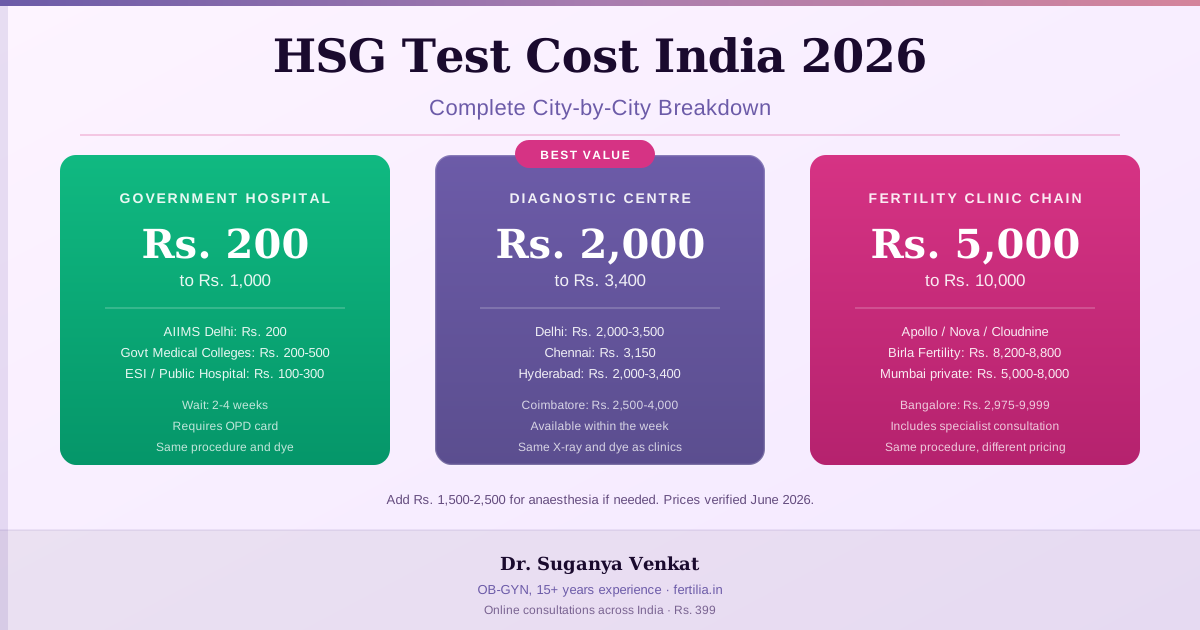
HSG test cost in India ranges from about Rs. 200 at a government hospital to Rs. 10,000 at a private fertility chain (2026). Most women pay Rs. 2,000–3,400 at a diagnostic centre. The dye, the X-ray machine, and the procedure are identical at every price point. What you pay more for is the setting and the built-in consultation, not better accuracy.
The HSG test (hysterosalpingography) is one of the most common investigations in a fertility workup, and also one of the most price-variable. This guide explains what drives that price difference, gives you verified city-by-city numbers for 2026, and tells you what is and is not included in the quoted fee.
If you have already had your HSG done and are trying to understand your results, read my companion guide: How to Read Your HSG Report: An OB-GYN’s Walkthrough. If you want the bigger picture, The Honest Fertility Workup Guide and the full fertility workup cost breakdown show where the HSG fits, and Can You Get Pregnant With One Ovary or One Fallopian Tube? covers tubal-patency questions after surgery.
Quick Answer: What Does HSG Cost in India? (2026)
| Setting | Price Range |
|---|---|
| Government hospital / Medical college | Rs. 200–1,000 |
| Diagnostic centre / radiology lab | Rs. 2,000–3,400 |
| Private hospital (non-fertility chain) | Rs. 3,000–5,000 |
| Fertility clinic chain (Apollo, Nova, Cloudnine, Birla) | Rs. 5,000–10,000 |
| With anaesthesia/sedation (add-on) | +Rs. 1,500–2,500 |
Prices verified from primary sources: AIIMS published fee schedule (Rs. 200), 1mg / BookmeriLab diagnostic rates, CGHS reference rates (Rs. 2,040–2,400 metro), and fertility clinic websites. Re-verified July 2026.
On this page: City-by-city prices · What’s included · Government vs private · After your HSG · 5 ways to cut the cost · FAQ
The fertility chain prices are not higher because the procedure is more accurate. The dye and the X-ray protocol are standardised. You are often paying for the consultation fee built in, the branded environment, and the fertility brand itself.
City-by-City HSG Price Breakdown (2026)
Chennai
Diagnostic centres: Rs. 2,800–3,150 With anaesthesia: Rs. 4,500–5,100
Chennai has a well-developed private radiology network. MFine aggregator lists the procedure at Rs. 3,150 at partnered centres (verified June 2026). Fever Hospital, Government Kilpauk Medical College, and Rajiv Gandhi Government General Hospital offer the test at government rates (Rs. 200–500) for women with outpatient registration.
Coimbatore
Diagnostic centres: Rs. 2,500–4,000 Government Medical College Hospital: Rs. 200–500
Coimbatore’s private diagnostic market is competitive given the city’s concentration of maternity hospitals. Government Medical College Coimbatore offers the test at government OPD rates. For women in Coimbatore and surrounding areas (Erode, Salem, Tirupur), a call to the radiology department of your nearest government medical college is always worth doing before booking privately.
Bangalore
Diagnostic centres: Rs. 2,975–5,000 Fertility clinics: Rs. 6,000–10,000
Bangalore shows the widest price band of any major city in this review. Arva Health, which aggregates Bangalore fertility service pricing, reports a range of Rs. 2,975–9,999 depending on facility type and whether sedation is included (verified via their June 2025 guide). Mid-range private hospitals (Manipal, Fortis) typically charge Rs. 3,500–5,000 including radiologist review.
Delhi/NCR
Diagnostic centres: Rs. 2,000–3,500 AIIMS Delhi: Rs. 200 (OPD patients) Gurgaon diagnostic centres: Rs. 3,150
AIIMS Delhi’s fee schedule lists HSG at Rs. 200 for OPD patients (verified from the published AIIMS hospital charges document). This is for women who have an AIIMS OPD card. Government Medical College Delhi, Safdarjung, and GTB Hospital all offer the test at nominal government rates. For private diagnostic centres in Delhi, bookmerilab.com data for 2026 shows a range of Rs. 2,000–3,500. Gurgaon centres are priced at approximately Rs. 3,150.
For more on this, read our guide on Day 3 FSH, LH & Estradiol.
Mumbai
Diagnostic centres: Rs. 3,500–8,000 Fertility clinics: Rs. 7,000–10,000
Mumbai is the most expensive city for HSG in India. H.R. Diagnostic (Mumbai) reports a range of Rs. 5,000–8,000 at private Mumbai facilities. KEM Hospital, Lokmanya Tilak Municipal Medical College (Sion), and Wadia Hospital offer the test at government rates for eligible patients. If cost is a concern, a referral letter from your gynaecologist to the nearest government women’s hospital is worth pursuing.
For more on this, read our guide on IUI Cost India 2026.
Hyderabad
Diagnostic centres: Rs. 2,000–3,400 Fertility clinics: Rs. 6,000–8,500
Hyderabad’s government sector includes Osmania General Hospital and Gandhi Hospital, both of which offer HSG in the government radiology department. Bookmerilab.com lists Hyderabad diagnostic centre prices at Rs. 2,000–3,400. Fertility chain pricing (Nova IVF Hyderabad, Oasis) runs Rs. 6,000–8,500.
Kolkata
Diagnostic centres: Rs. 2,000–3,000 Government hospitals: Rs. 200–500
Kolkata has a strong government hospital network. NRS Medical College, Medical College Kolkata, and SSKM Hospital all perform HSG at government rates. Private diagnostic centres are priced at the lower end of the national range, Rs. 2,000–3,000.
A word about online aggregator pricing: platforms like BookmeriLab, MFine, and 1mg show “offer prices” that may be 30–40% below the walk-in rate at the same lab. Booking through the aggregator is often cheaper than booking directly with the lab. This is worth checking before you call.
What the HSG Cost Includes (and What It Does Not)
When a lab quotes you “HSG test at Rs. 3,000”, here is typically what that covers:
Included in most HSG quotes:
- The procedure itself (catheter, dye, fluoroscopy time)
- Basic radiologist’s written report
- Hard copies of selected X-ray images
Usually NOT included and billed separately:
- Gynaecologist consultation before and after the test (Rs. 300–1,500 depending on clinic)
- Anaesthesia or conscious sedation if requested (Rs. 1,500–2,500 extra)
- Antibiotics prescribed after the procedure (Rs. 200–600 at a pharmacy)
- Any medications given before the procedure (misoprostol for cervical priming, NSAIDs)
- A re-read by a radiologist if the report is unclear
The most common surprise bill comes from anaesthesia. Most women do not need sedation for HSG, but some clinics offer or strongly recommend it. If the procedure is being done at a non-fertility private hospital, ask explicitly: “Is the quoted price only for the HSG, or does it include anaesthesia and the consultation fee?”
Government vs Private: What You Are Actually Trading Off
The difference between a Rs. 200 government HSG and a Rs. 8,000 fertility clinic HSG is worth understanding clearly.
What is identical: The contrast dye (Omnipaque is the standard in both settings), the X-ray principle, the basic diagnostic output.
What is different:
-
Waiting time. Government OPD registration often takes two to four weeks. Diagnostic centres will book you for the same week. Fertility clinics often book you for next week.
-
Environment and privacy. Government radiology departments are high-volume and offer minimal private space. Diagnostic centres and fertility clinics offer individual procedure rooms.
-
Radiologist availability for discussion. A government radiologist may not be available for a consultation after the procedure. A fertility clinic radiologist or reproductive medicine specialist is typically available the same day.
-
Built-in follow-up. When you have the HSG done at a fertility clinic, the referring reproductive medicine specialist can discuss results on the same visit. At an independent diagnostic centre, you carry the report back to your gynaecologist.
There is no medical advantage to the higher-priced option in terms of what the test shows. The clinical interpretation still happens at your doctor’s consultation, not at the time of the procedure. For women who are managing costs, the diagnostic centre is the practical middle ground: shorter wait than government, much lower cost than fertility chains.
What Happens After Your HSG: The Clinical Next Step
Your HSG result will fall into one of four categories, and the next step depends on which one you are in.
Normal (bilateral spillage): Both tubes are open. The uterine cavity is regular. This is the result in roughly 60–70% of women who have the test. A normal HSG does not mean conception is guaranteed, but it confirms the anatomical pathway for natural conception or intrauterine procedures is intact.
Unilateral block: One tube appears blocked. About 15–20% of results. The interpretation depends on where the block is. A proximal (near-uterus) block in an otherwise normal cycle is often tubal spasm during the procedure rather than true obstruction. Repeating the test, or proceeding directly to a diagnostic laparoscopy if clinical suspicion is high, is the standard approach.
Bilateral block: Both tubes show blockage. Requires further evaluation. IVF (which bypasses the tubes entirely) is typically the recommended path, but repeat testing and a clinical review of the full picture matter before making that decision.
Uterine cavity abnormality: A filling defect suggesting a polyp, fibroid, or septum. These are typically investigated with saline sonogram (SIS) or hysteroscopy.
For the full clinical context of what your specific HSG result means and what happens next, read: How to Read Your HSG Report: An OB-GYN’s Walkthrough. That post covers bilateral spillage, cornual block, hydrosalpinx, and uterine anomalies with clinical context that goes beyond the radiologist’s terminology.
HSG in the Context of Your Full Fertility Workup
The HSG is one part of a broader fertility investigation, not a standalone test. A complete fertility workup for a couple typically costs Rs. 8,000–18,000 and includes blood tests (AMH, Day 2/3 hormones, thyroid, HbA1c), the HSG for the fallopian tubes, and a semen analysis for the male partner.
If you are building your workup systematically, The Honest Fertility Workup Guide gives the complete list of tests, their sequencing, and approximate costs so you are not ordering redundant or low-yield investigations. The AMH test cost guide covers the ovarian reserve component specifically.
The HSG is typically done after Day 6 blood tests have been run and before any treatment decision is made. It answers one specific question: are the tubes patent? That question is worth answering before spending Rs. 1.5–3 lakhs on IVF, because if the tubes are open, natural conception or IUI may still be the right path. Read about whether IVF is actually what you need before making that call.
5 Ways to Reduce Your HSG Cost Without Compromising Care
-
Book through an aggregator. Platforms like MFine, BookmeriLab, and 1mg negotiate discounted rates with the same labs that charge full walk-in prices. The test and the radiologist are identical. The price can be 30–40% lower.
-
Avoid fertility chain markup when you just need the test. If you already have a gynaecologist who will interpret the results, you do not need to have the HSG done at the fertility clinic. Any accredited radiology centre with fluoroscopy can do the test. Your gynaecologist can read the report.
-
Check government eligibility. If you have a Below Poverty Line (BPL) card, Ayushman Bharat card, or State Health Insurance eligibility, HSG may be available at government hospitals at nominal or no cost. This is worth a phone call before paying full private rates.
For more on this, read our guide on Egg Freezing Cost in India 2026. 4. Do not pay for anaesthesia unless you need it. Mild cramping during HSG is common but manageable for most women without sedation. If you have a very low pain threshold or are anxious, sedation is a valid choice, but it is not medically necessary in the majority of cases.
- Ask what is bundled. Before booking, confirm: “Does this price include the procedure, the report, and images? Is the radiologist consultation separate? Is the referring doctor visit charged additionally?” A transparent facility will answer all three clearly.
Frequently Asked Questions
What is the HSG test cost in Chennai? At diagnostic centres in Chennai, HSG is typically priced at Rs. 2,800–3,150 (verified via MFine June 2026). HSG with anaesthesia runs Rs. 4,500–5,100. Government hospitals including Rajiv Gandhi Government General Hospital and Kilpauk Medical College offer the test at Rs. 200–500 for OPD patients.
Is HSG covered by health insurance in India? It depends on your policy. Diagnostic investigations like HSG are covered under some corporate group health plans when there is a documented medical indication (infertility investigation after 12 months of trying, or after pelvic surgery). Star Health’s family health optima, HDFC Ergo, and Max Bupa include diagnostic investigations in most comprehensive plans. Pre-authorisation is typically needed. Individual or maternity-only plans are less likely to include it. Call your insurer’s helpline and ask specifically whether “hysterosalpingography for infertility investigation” is covered under your policy.
Does the HSG test hurt? Is anaesthesia necessary? Most women describe HSG as similar to period cramps, ranging from mild to moderately uncomfortable. The discomfort peaks during the 30–60 seconds when contrast is injected and subsides quickly. Taking an NSAID (like ibuprofen 400 mg) 45–60 minutes before the procedure helps significantly. Anaesthesia is not medically required for routine HSG. If you have a history of severe period pain, prior pelvic surgery, or high procedure anxiety, conscious sedation is a reasonable option to discuss with your gynaecologist. It adds Rs. 1,500–2,500 to the cost.
What is the best time of the month to schedule an HSG? Between Day 6 and Day 12 of your menstrual cycle, counting Day 1 as the first day of full flow. This window is after your period has completely stopped (so the uterine lining is thin and clear for X-ray visualisation) and before ovulation (so there is no possibility of disrupting a conception in progress). Call the radiology centre a week before your period ends to book a slot in this window.
Can a normal HSG guarantee that I will conceive naturally? No. A normal HSG confirms that the fallopian tubes are open and the uterine cavity appears regular. It does not assess egg quality, ovarian reserve, ovulation timing, sperm quality, or the implantation environment. It is one piece of the fertility puzzle. Women with completely normal HSG results can still face difficulty conceiving due to other factors, which is why a complete workup matters.
Why did the HSG show a block, but my doctor said not to worry yet? Proximal tubal spasm is a well-documented phenomenon. During HSG, the catheter or the contrast injection can cause the muscle at the uterine end of the tube to contract involuntarily, giving the appearance of a blockage. This happens in a small but meaningful percentage of normal tubes and resolves when the test is over. If your block is at the proximal end (where the tube meets the uterus), your doctor may want to either repeat the HSG or proceed to a selective salpingography or laparoscopy before concluding the tube is truly blocked. A single “block” finding on HSG is not a final verdict.
Is the HSG result different at a Rs. 3,000 diagnostic centre vs a Rs. 8,000 fertility clinic? The procedure and dye are the same. The diagnostic output depends on the quality of the X-ray machine and the radiologist’s experience, not on the facility’s pricing tier. A diagnostic centre with good fluoroscopy equipment and an experienced radiologist will produce the same quality report as a fertility clinic. What the fertility clinic adds is on-site interpretation by a reproductive medicine specialist immediately after the procedure. If your gynaecologist is already familiar with HSG interpretation, the additional cost of doing it at a fertility clinic is for convenience, not clinical superiority.
If you have had an HSG and are unsure what the results mean for your next step, or if you are in the middle of a fertility workup and want to talk through the full picture, a ₹399 video consultation will give you a clear, personalised plan, and the 90-day Fertility program is there if you want ongoing support through the next steps.