One of the most common messages I receive from women in the middle of a fertility or PCOS journey is some version of this: “I’ve been seeing my doctor for over a year and nothing is changing. Is it wrong to want to see someone else?”
It is not wrong. Seeking a second opinion in fertility care is normal, it happens often, and in some situations it is the most practical thing you can do. The question worth asking is not whether it’s appropriate, but how to know when it will genuinely help.
This post covers six situations where a second opinion makes sense, what to bring when you go, what you might learn, and how to access one in India without the usual logistics.
Getting a Second Opinion Is Medicine, Not Disloyalty
Many women worry that consulting a different doctor is somehow a betrayal of their current one. It is not. Second opinions are a routine part of medicine. Surgeons seek them before major procedures. Oncologists routinely present complex cases to multidisciplinary panels. Fertility medicine, with its mix of hormonal, structural, and male-factor variables, is exactly the kind of field where a fresh pair of eyes can make a material difference.
The doctor-patient relationship in fertility care can be long, emotionally loaded, and built on accumulated trust. That is worth protecting. But it is not a reason to stay in a plan that isn’t working when there may be options you haven’t heard about yet.
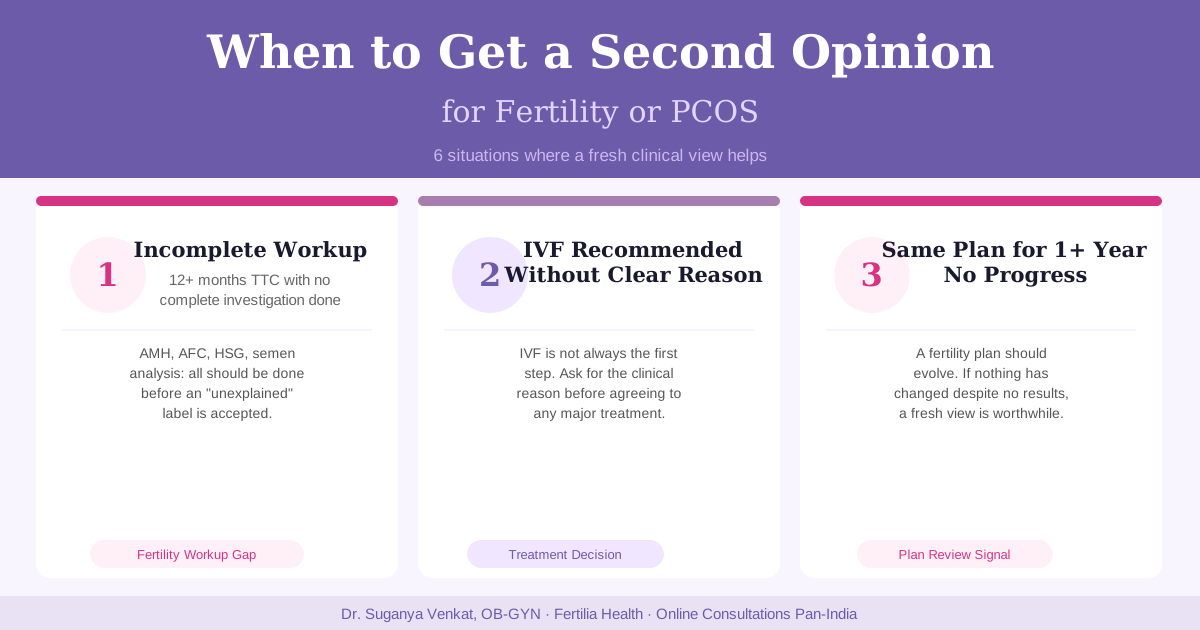
6 Situations Where a Second Opinion Makes Sense
1. You have reached the investigation threshold and have not had a complete workup
The American Society for Reproductive Medicine defines infertility as 12 months of regular unprotected intercourse without conception for women under 35, and 6 months for women 35 and older. At those thresholds, a structured investigation of both partners is clinically indicated.
A complete workup includes: ovarian reserve testing (AMH, antral follicle count), hormonal panel (FSH, LH, prolactin, TSH, androgens), uterine and tubal assessment, and a full semen analysis for the male partner covering count, motility, and morphology.
If you have reached the investigation threshold and not all of these have been checked, or if the diagnosis you have received is “unexplained infertility” without having had all of the above, the second opinion is often less about finding a different doctor and more about finding one who will complete the picture. Unexplained infertility applies to approximately 10 to 15% of couples investigated for infertility (Hull et al., 1985, British Medical Journal). Before accepting that label, it is worth confirming that the full workup has been done.
Our complete fertility workup guide covers everything both partners should have assessed before an unexplained diagnosis is final.
2. You have been advised to go straight to IVF without a clear clinical reason
IVF is the right treatment for some couples and the wrong first step for others. For a woman under 35 with open fallopian tubes, normal ovarian reserve, and a partner with a normal semen analysis, timed intercourse and IUI are typically the appropriate starting points. Skipping to IVF without a clear clinical reason for it (severe male factor, blocked tubes, multiple failed IUIs, diminished ovarian reserve, or age-related urgency) is worth questioning.
If you have been recommended IVF and you are not sure why that specific step is necessary at this stage, a second opinion can clarify whether the clinical picture justifies it. This is not about avoiding IVF if it is the right call. It is about making sure the reasoning has been explained and the intermediate steps have been properly considered.
For a structured way to think through this decision, see our IVF decision framework.
3. Your PCOS management has been the pill for years with no other plan
The oral contraceptive pill has a clear and legitimate role in PCOS: regulating cycles, reducing androgen-driven symptoms, and protecting the endometrium when periods are absent. These are real clinical benefits.
What the pill does not do is treat the metabolic drivers of PCOS. When you come off it to try to conceive, the insulin resistance, inflammation, and hormonal imbalance that were present before you started are still there.
The 2023 International Evidence-Based PCOS Guideline (Teede et al., PMID 37580861) recommends lifestyle intervention as the primary treatment for PCOS, with medication as an add-on for specific indications. If your current PCOS plan is the pill alone, with no discussion of nutrition, weight, insulin resistance, or what happens when you want to conceive, a second opinion can open that broader conversation.
The pill was likely the right decision at the time. The question is whether the plan has expanded to address what comes next.
4. You have been on the same plan for over a year with no visible progress
A fertility treatment plan should respond to new information. Follow-up investigations, cycle monitoring, and treatment response all shape what the next step should be. If the plan has not changed in over a year despite no results, it is worth asking why.
For couples who have had multiple IUI cycles with no success, most guidelines suggest revisiting the approach after three to four attempts. This might mean investigating whether the tube on the dominant follicle side is open, checking the uterine cavity, or moving toward IVF. If you are on a fifth or sixth IUI without a clinical conversation about what is being learned from each cycle, a second opinion is reasonable.
5. You are about to have surgery
Any woman who has been advised to have a myomectomy, a laparoscopy for suspected endometriosis, a hysteroscopy for a suspected polyp or fibroid, or any other fertility-related procedure has every reason to get a second surgical opinion before proceeding.
Surgery carries risk, recovery time, and cost. It is also irreversible in many cases. A second opinion before a planned procedure is standard medical practice. Most women find it confirms what their surgeon has said. Some find that the procedure is not yet indicated, or that a less invasive option is available. Either way, the information is worth having.
This is particularly relevant when the surgical recommendation is based on ultrasound alone. Endometriosis, for example, cannot be definitively diagnosed without laparoscopy. If surgery is being recommended to both diagnose and treat a condition, that reasoning deserves careful scrutiny.
6. You feel consistently unheard
This is less clinical than the others, and no less valid.
If you leave appointments feeling like your questions were brushed aside, your concern about your cycle was minimised, or your symptoms were attributed to anxiety, a different doctor may give your situation the attention it deserves. Fertility care is a long process. You need a doctor who listens carefully enough to understand your specific situation, not one who moves through the consultation at speed.
Your instinct that something is being missed is data. It is not always right, but it is worth taking seriously.
Book a ₹399 video consultation with Dr. Suganya if any of the above applies to your situation. The consultation is online, pan-India, and reviews your existing reports and history in detail.
What a Good Second Opinion Gives You
A second opinion is not just a chance to hear “you should leave your current doctor.” Most of the time it gives you one of three things:
Confirmation that your current plan is sound. This is the most common outcome, and it is genuinely valuable. Knowing that two independent clinicians agree on a plan gives you the confidence to stay on it.
Identification of a gap. A missing test, a follow-up that wasn’t ordered, a male factor that wasn’t fully investigated. This is actionable and can shift the plan.
A different clinical interpretation of the same data. Not every AMH or semen analysis report reads the same way to every specialist. A second opinion may give you a more detailed explanation of what your results mean for your specific situation.
All three of these are useful. None of them require your current doctor to have been wrong.
What to Bring to a Second Opinion Consultation
The more complete the picture you bring, the more useful the consultation will be. Here is what to prioritise:
For her: AMH and antral follicle count. FSH, LH, prolactin, TSH, and androgens (testosterone or DHEA-S). Any pelvic ultrasound or HSG/sonosalpingography report. A note of your cycle length pattern over the past six months.
For him: Full semen analysis with count, motility (total and progressive), and morphology. If a repeat has been done, bring both reports.
Both: A note of any medications you are currently taking or have recently stopped. Any prior treatment history (IUI cycles, previous surgeries, clomiphene or letrozole use).
You do not need to have everything. Bring what you have. A skilled second-opinion consultation will also tell you what is still missing.
Getting One Without the Usual Logistics
The practical barriers to a second opinion in India are real. Specialist clinics in larger cities have long waiting lists. Travelling to Mumbai or Chennai for an appointment is not always possible for women in smaller cities or abroad.
An online video consultation is a practical alternative. A 60-90 minute video call with a different OB-GYN covers the history, report review, and clinical impression that an in-person second opinion provides. It does not require travel, and it fits around work schedules in a way that an in-clinic appointment often doesn’t.
If you are an NRI woman seeking a second opinion on a diagnosis or treatment plan received in India, or on a plan recommended overseas that you want a different clinical view on, an online consultation works in both directions.
How the Fertilia Consultation Works as a Second Opinion
Many women come to Fertilia specifically for this purpose: not because they have given up on their current specialist, but because they want a different layer of perspective on their case before making a major decision.
The consultation covers your full history, your existing reports, and what a lifestyle and nutritional programme could add to your current treatment. We work alongside your treating gynaecologist or fertility specialist. If your current plan is well-constructed, we will say so. If there are gaps or options that haven’t been considered, we will outline them and explain why.
The consultation is ₹399, online, and available pan-India and to NRI women. Message Dr. Suganya on WhatsApp to ask about booking. Her Fertility program is there if you decide to take the next step together.
Frequently Asked Questions
When is a second opinion for fertility worth getting? If you have been trying to conceive for 12 months (or 6 months if you are 35 or older) without success, if you have received an unexplained infertility diagnosis without a complete workup, if you are about to start IVF without a clear clinical reason, or if you have been on the same plan for over a year with no progress. A second opinion is also appropriate before any planned surgery.
Do I need to inform my current doctor that I am getting a second opinion? No. Your medical records belong to you, and seeking another view is your right. If you have a good relationship with your current doctor, you may choose to mention it; this sometimes opens a more detailed clinical conversation. But there is no obligation to do so.
What should I bring to a second opinion consultation? Bring your AMH, FSH, LH, TSH, prolactin, and androgen results. Bring any imaging (pelvic ultrasound, HSG). Bring the full semen analysis for your partner. Bring a note of your cycle pattern over the past six months and any medications you are currently taking. If you have had any prior treatments, bring those details too.
Can an online consultation serve as a second opinion? Yes. A video consultation with a different OB-GYN covers the clinical history, report review, and diagnostic impression that an in-person second opinion provides. For women outside major cities, or NRI women who want a view from a specialist in India, an online consultation is a practical and complete option.
What if the second opinion contradicts my first doctor? Conflicting opinions are more common in fertility care than in many other specialties, because the evidence base for several decisions (how many IUI cycles to try, when to recommend IVF, how to manage borderline results) involves genuine clinical judgment. If the two views differ, ask each doctor to explain the reasoning behind their recommendation. One may be based on more complete information. Both may be valid approaches to an uncertain situation.
Is it reasonable to get a second opinion just for PCOS, even if I’m not trying to conceive? Yes. If your PCOS has been managed with the pill for an extended period and you have had no discussion of the metabolic picture (insulin resistance, weight, inflammation, what happens when you want to come off the pill), a second opinion can give you a fuller understanding of where you are and what the options are. The 2023 International PCOS Guideline recommends a broader plan than cycle regulation alone for most women with PCOS.
How is a second opinion different from switching doctors entirely? A second opinion is a single consultation to get a different view on your situation. It does not mean you have to change your primary doctor. Many women get a second opinion, share the findings with their current doctor, and continue their care with that same person. Others do choose to shift their care based on what they hear. The decision is yours, and it does not need to be made before the consultation.
For more background before your consultation, see the fertility workup guide, the IVF decision framework, and the guide to choosing the right doctor for PCOS.