A woman messaged our clinic last month, three weeks after stopping her pill: “I got a bleed almost right away, but now nothing. Is my body broken?” It’s one of the most common questions I hear when women come off the pill, and almost always, the answer is reassuring. Her body wasn’t broken. She had simply mistaken the withdrawal bleed for her first real period, and was now waiting for a cycle that hadn’t caught up yet.
This confusion is universal because nobody explains it clearly at the time the pill is prescribed. I’m Dr. Suganya Venkat, an OB-GYN with over 15 years of experience, and I want to walk you through exactly what happens to your cycle after you stop the pill, what counts as normal, and the specific point at which “still waiting” becomes “worth a call.” (If you’re still deciding whether to stop, or navigating side effects while you’re on it, our guide to birth control pill side effects covers that side of the picture.)
What this post covers
- Why the bleed right after your last pill isn’t a real period
- The realistic timeline: ovulation, then your first true period
- Post-pill amenorrhea: how common it is, and what usually causes it
- The “pill causes PCOS” myth, and what’s really going on
- Can you get pregnant in your very first cycle off the pill
- When to test, and when to see a doctor
The bleed after your last pill isn’t your first period
This is the single most useful thing to understand, because it resets the whole timeline in your head.
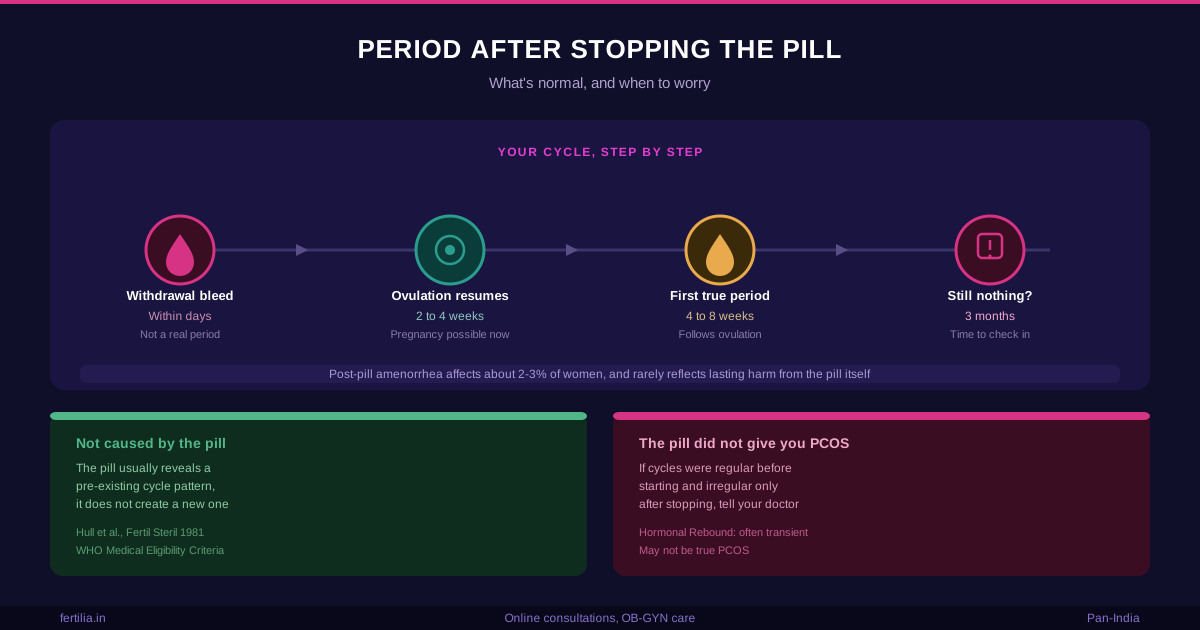
When you take combined oral contraceptives, the hormones in the pill suppress your own cycle and keep the uterine lining stable. During the placebo week, or when you stop the pack, both hormones drop, and the lining sheds. This is a withdrawal bleed, a predictable, pharmacological effect of hormone withdrawal. It is not the result of ovulation, and it doesn’t tell you anything about whether your own hormonal cycle has restarted.
Your first true period is different. It only happens after you ovulate, when your ovary releases an egg, progesterone rises for about two weeks, and then falls if you haven’t conceived, triggering a genuine period. That period is proof your own cycle is running again. The withdrawal bleed is not.
So if you stopped the pill, had a bleed within a few days, and then heard nothing from your body for weeks, you are not “missing” periods. You’re simply between the withdrawal bleed and your first real one, and that gap is expected.
The realistic timeline
Here’s the sequence most women go through, in order:
Days 1 to 7 after your last active pill: the withdrawal bleed. This usually starts within a few days of stopping, similar to your placebo-week bleed on the pill.
2 to 4 weeks after stopping: ovulation typically resumes. According to the UK Faculty of Sexual and Reproductive Healthcare’s 2023 guideline on combined hormonal contraception, most women who stop combined pills ovulate within about a month, whether they were on a standard cyclic pack or an extended regimen. One study following women in their first cycle off the pill found the average day of ovulation was around day 20 of that first cycle, a little later and slightly more variable than a typical unmedicated cycle, but well within a normal window (Kroll et al., European Journal of Contraception & Reproductive Health Care, 2015, PMID 25522805).
4 to 8 weeks after stopping (roughly 2 weeks after ovulation): your first true period. This arrives about two weeks after ovulation, the same interval as a normal luteal phase. Put together, most women see a genuine period within 4 to 8 weeks of stopping the pill.
After that: your pre-pill pattern gradually returns. The World Health Organization’s Medical Eligibility Criteria for Contraceptive Use (6th edition) and its Family Planning Global Handbook are both explicit on this point: combined pills do not cause infertility, there is prompt return of fertility after stopping, and your bleeding pattern generally returns to what it was before you started the pill, though it can take a few cycles to settle into that familiar rhythm.
If your cycles were regular before you started the pill, this is usually a smooth, unremarkable few months. If they were irregular before, the pill likely regulated that irregularity by force, and stopping it can reveal the same pattern you had before, which is a different situation from the pill “causing” a new problem. More on that below.
Post-pill amenorrhea: how common it is, and what it means
Some women have no period at all for an extended stretch after stopping the pill. This is often called post-pill amenorrhea, and it understandably worries people. Here’s what the evidence shows.
In a prospective study that followed women after stopping combined pills, 89% had a period within 60 days, and only 2.2% had gone six months with no bleeding at all (Evrard et al., American Journal of Obstetrics and Gynecology, 1976, PMID 1244751). Later reviews using slightly different definitions estimate the range at roughly 2% to 12% depending on how “delayed” is defined, but true prolonged amenorrhea beyond six months is uncommon.
The more important question is whether the pill itself causes this. A dedicated causal analysis of post-pill amenorrhea estimated that the pill’s own contribution to genuinely new, lasting anovulation was under 1 in 1,000 users (Hull et al., Fertility and Sterility, 1981, PMID 7286269). And in a separate study of women referred specifically for amenorrhea after stopping the pill, 63% had irregular or absent cycles even before they started it (Steele et al., British Medical Journal, 1973, PMID 4758428).
Put together, this is the honest picture: the pill is far more often unmasking a pre-existing pattern than causing a new one. If your cycles were already unpredictable before you started, going back to that same unpredictability after stopping isn’t a new problem the pill gave you. It’s the pattern the pill had been quietly managing.
That said, “usually not caused by the pill” doesn’t mean “never worth checking.” No period by 3 months deserves a conversation with your doctor, not because the pill damaged something, but because it’s a reasonable point to rule out other causes, including thyroid changes, prolactin elevation, or PCOS, which we cover next.
The “pill causes PCOS” myth
This is one of the most common things I hear, and it’s worth addressing directly rather than leaving it vague.
PCOS is not created by stopping the pill. What happens is closer to the opposite: the pill regulates cycles for anyone taking it, PCOS or not, by imposing a predictable hormonal pattern from outside. If you had PCOS before you ever started the pill, even without knowing it, the pill’s regular withdrawal bleeds may have looked like normal periods the whole time you were on it. Stop the pill, and the underlying pattern, irregular ovulation, is revealed again, because the external hormones that were masking it are gone.
This is what we call the Hormonal Rebound driver in PCOS: a pattern where periods become irregular specifically after stopping combined pills. ⚠️ It may not be true PCOS, and in many women it is transient, easing over a few months as the body’s own cycle re-establishes itself. If your periods were regular before you ever started the pill and only became irregular after stopping, mention that exact timeline to your doctor. It’s a meaningful clue that changes how the irregularity should be interpreted, rather than assumed.
If you want the fuller picture of how PCOS is diagnosed and what drives it, our guide on PCOS periods that go missing walks through the Rotterdam criteria and the different drivers behind irregular cycles.
Can you get pregnant in your very first cycle off the pill?
Yes, and this surprises a lot of women. Because ovulation typically comes before your first true period, not after it, you can conceive in that very first cycle, before you’ve had any bleeding to confirm your cycle has “restarted.” If you are trying to conceive, there is no medical need to wait for a withdrawal bleed, a spontaneous period, or any particular number of cycles before trying.
If you are not trying to conceive, the flip side matters just as much: use another method of contraception starting immediately after your last active pill, rather than assuming you’re protected during this transition. The same WHO Medical Eligibility Criteria (6th edition) cited above is direct on this: contraceptive protection ends when you stop taking the pill, and there’s no “safe” window built in.
The one nuance worth knowing about timing conception: a small number of studies suggest the very first cycle or two after stopping may have a marginally reduced conception rate compared with cycles further out, though 12-month conception rates after stopping the pill (72% to 94%) land in the same range as after stopping other reversible methods, with no evidence of a lasting fertility impairment (Barnhart and Schreiber, Fertility and Sterility, 2009, PMID 19268187). The World Health Organization’s Family Planning: A Global Handbook for Providers states the same directly: women stopping combined pills can become pregnant as quickly as women stopping non-hormonal methods, and their pre-pill bleeding pattern generally returns, though it can take a few cycles to settle (WHO, Family Planning: A Global Handbook for Providers, 2018 edition). If you’ve been off the pill for a few months and are actively trying, this is a good stage to start tracking ovulation directly. Our guide on understanding your fertile window covers the practical side of that.
If you’re not sure where you are in this process, or you’re trying to conceive and want a clearer sense of timing, you can talk to Dr. Suganya Venkat over WhatsApp at Fertilia, entirely online, across India.
Mini-pill (POP) vs the combination pill: a faster return
If you were on the progestin-only pill (POP, or mini-pill) rather than the combined pill, the return to your own cycle tends to be even quicker. The POP doesn’t suppress ovulation as consistently as the combined pill does in every user, so many women resume their own hormonal pattern within days to about two weeks of stopping, rather than the 4 to 8 week window typical for combined pills. If you switched between the two at some point, keep that difference in mind when you’re timing how long is “too long” to wait.
When to see a doctor
Most of what happens after stopping the pill is expected and doesn’t need intervention. Here’s specifically when it’s worth a conversation with your doctor rather than continuing to wait:
- No period at all by 3 months after stopping. This is the standard point to check in, not because something is wrong, but because it’s a reasonable window to rule out other causes.
- Periods that were regular before you started the pill but stay irregular for several months after stopping, well beyond the initial settling-in period.
- Symptoms alongside the missing period, such as new acne, excess hair growth, unexplained weight change, milky nipple discharge unrelated to breastfeeding, or hot flashes, since these point toward specific causes worth investigating directly (PCOS, thyroid disease, elevated prolactin, or low oestrogen, respectively).
- You’re trying to conceive and haven’t had a period at all, since this makes tracking your fertile window difficult and a hormone panel can clarify what’s happening.
- A positive or uncertain pregnancy test. Ovulation can precede your first period, so if you’ve had unprotected intercourse and you’re unsure, testing is the right first step regardless of how long it’s been.
A typical initial workup for a delayed period after stopping the pill includes a pregnancy test first, followed by targeted blood work: thyroid function, prolactin, and a hormone panel to evaluate for PCOS if there are supporting symptoms. This is a straightforward, low-anxiety process for most women, and the goal is simply to understand what’s happening, not to alarm you.
If it’s been three months or more and you’d like to talk through what to check first, you can reach out to Dr. Suganya Venkat and the Fertilia team over WhatsApp, online, wherever you are in India.
What you can do while you wait
- Track from the day you stop, not from your last withdrawal bleed. Counting the withdrawal bleed as “day one” of your first real cycle is the most common source of unnecessary worry.
- Expect some initial irregularity even if your true period does arrive on time. The first one or two cycles can run a little longer or shorter than what becomes your new normal.
- If you’re trying to conceive, you don’t need to wait for a “reset” cycle. Ovulation can happen in that first month, so there’s no benefit to delaying intercourse until after a confirmed period.
- If you’re not trying to conceive, use contraception immediately, not after your first bleed.
- Note your pre-pill cycle pattern if you can recall it. If your doctor does need to investigate, knowing whether your cycles were regular before you started the pill is one of the most useful pieces of history you can offer.
Frequently asked questions
How long after stopping the pill will I get my period? Most women have their first true period within 4 to 8 weeks of stopping, following ovulation that typically occurs 2 to 4 weeks after the last active pill. The bleed you may get within days of stopping is a withdrawal bleed, not this first true period.
Is it normal to have no period for 2 months after stopping the pill? Yes, this is within the normal range for many women, since ovulation can take up to about a month to resume and the first true period follows roughly two weeks after that. If you reach 3 months with no period, that’s the point to check in with your doctor.
Can stopping the pill cause PCOS? No. The pill does not create PCOS. If PCOS was present before you started the pill, its regular withdrawal bleeds may have masked the underlying pattern, and irregular cycles can reappear once you stop. This is sometimes called a hormonal rebound, and it may not represent true PCOS, and is often transient. Mention your pre-pill cycle history to your doctor if this applies to you.
Can I get pregnant in the first month after stopping the pill? Yes. Ovulation typically returns before your first period does, so pregnancy is possible in that very first cycle, even before you’ve had any bleeding to confirm your cycle has restarted. There is no medical reason to wait for a period before trying to conceive.
Does the pill delay fertility long-term? No. The WHO’s Medical Eligibility Criteria for Contraceptive Use (6th edition) states that combined pills do not cause infertility and that fertility returns promptly after stopping. Twelve-month conception rates after stopping the pill (72% to 94%) are comparable to those after stopping other reversible contraceptive methods (Barnhart and Schreiber, Fertility and Sterility, 2009, PMID 19268187).
What’s the difference between a withdrawal bleed and a real period after stopping the pill? A withdrawal bleed happens because hormone levels drop when you stop taking the pill, regardless of whether you’ve ovulated. A real period only follows ovulation, roughly two weeks after your body releases an egg. The withdrawal bleed usually comes first and doesn’t indicate your own cycle has restarted yet.
Should I take a pregnancy test if my period hasn’t come back after stopping the pill? If there’s any chance of pregnancy, meaning you’ve had unprotected intercourse since stopping, yes, test regardless of how long it’s been. Since ovulation can occur before a period returns, a missing period alone doesn’t rule pregnancy in or out reliably without a test.
A final word
Coming off the pill can feel like waiting for your body to send a signal that never quite arrives on schedule, and most of the time, that’s simply because the signal you’re waiting for, a real period, comes later than the withdrawal bleed most women mistake for it. Give your body 4 to 8 weeks before you start to worry, and use the 3-month mark as your genuine checkpoint, not day 30.
If you’re somewhere in this window and want a clearer sense of what’s normal for you specifically, or you’d like help understanding your cycle as you start trying to conceive, you can message Dr. Suganya Venkat and the Fertilia team over WhatsApp, entirely online, wherever you are in India.