You come home from a follicular study with a report in hand. It says “endometrial thickness: 9.4 mm.” Or 6.2 mm. Or 12.8 mm.
Good? Low? Should you be worried?
The number on its own tells you very little. The endometrium, the inner lining of the uterus, is one of the most dynamic tissues in the body. It grows, transforms, and sheds on a monthly cycle driven entirely by your hormones. A thickness that is perfectly normal on day 12 would be unusual on day 3, and vice versa.
This post gives you the reference values for each phase of the cycle, explains what clinics look for during IVF and IUI monitoring, and covers what endometrial thickness means after menopause.
Why the Number Keeps Changing
The endometrium responds directly to two hormones: oestrogen and progesterone.
In the first half of your cycle, the follicular or proliferative phase, oestrogen from your growing follicles drives the lining to build up. It grows in thickness and develops a characteristic three-layered appearance on ultrasound. The lining is preparing a receptive bed for an embryo.
After ovulation, progesterone takes over, in what is called the luteal or secretory phase. The lining stops growing in height and instead changes its texture and blood supply architecture. If no embryo implants, progesterone falls, the lining sheds as a period, and the cycle begins again.
Transvaginal ultrasound (TVUS) measures the lining as the total thickness of both the front and back walls of the uterine cavity combined. This is the bilayer measurement, and it is the standard used in all the reference values below.
Normal Endometrial Thickness at Each Cycle Stage
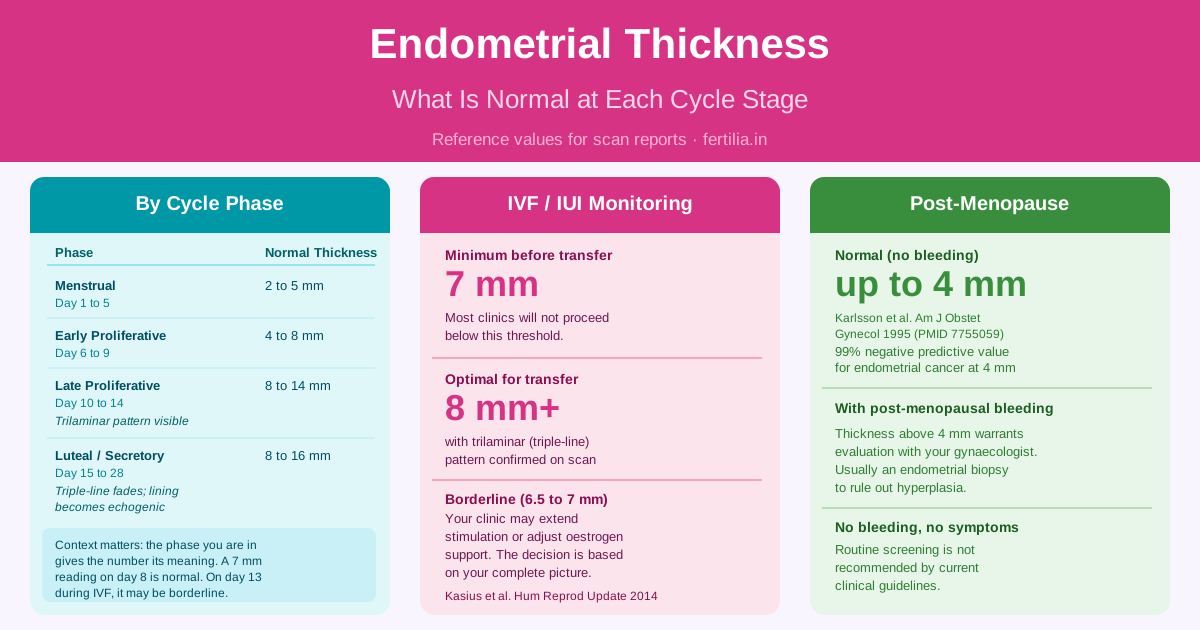
These are the reference ranges used in standard clinical practice:
| Cycle Phase | Approximate Days | Typical Thickness | Ultrasound Appearance |
|---|---|---|---|
| Menstrual | Day 1 to 5 | 2 to 5 mm | Echogenic (bright), fragmented, actively shedding |
| Early proliferative | Day 6 to 9 | 4 to 8 mm | Hypoechoic (dark), smooth, triple-line beginning to form |
| Late proliferative / periovulatory | Day 10 to 14 | 8 to 14 mm | Trilaminar (triple-line) pattern clearly visible |
| Luteal / secretory | Day 15 to 28 | 8 to 16 mm | Echogenic, triple-line fades, denser texture |
A few important notes on reading this table:
These are reference ranges, not absolute cutoffs. A variation of 1 to 2 mm between scans or between different sonographers is normal and expected. The trend matters more than any single reading.
Your cycle length sets the timeline. If you have a 35-day cycle, ovulation falls closer to day 21, not day 14. Day 10 of your cycle is still early proliferative, even if it would be “near ovulation” in a 24-day cycle. The phase you are in, not just the day number, gives the thickness its context.
What Is the Trilaminar Pattern?
If you have had a follicular study (folliculometry), your report may say your endometrium is “trilaminar” or shows a “triple-line pattern.”
This refers to three distinct layers visible on ultrasound in the late follicular phase:
- A bright outer line at the top of the uterine cavity
- A dark central zone, representing the functional layer thickening with oestrogen stimulation
- A bright inner line where the two inner surfaces of the uterus meet
This triple stripe indicates that the endometrium is responding to oestrogen as expected, building a lining suited for implantation. It typically appears around day 10 to 12 and is most pronounced just before ovulation.
After ovulation, progesterone transforms the lining into its secretory architecture. The triple-line fades and the entire lining becomes echogenic (bright and homogeneous) on ultrasound. This is normal and does not mean the lining has deteriorated.
In IVF monitoring, the trilaminar pattern is considered as important as the thickness number itself. Most clinics want to see both: a lining of 8 mm or more AND a clear triple-line pattern before proceeding with an embryo transfer. For the full detail on how follicular study scans track your lining and follicle progression, see our folliculometry guide.
Endometrial Thickness During IVF and IUI Monitoring
During ovarian stimulation, your clinic will track your endometrial thickness alongside follicle growth at each monitoring scan. This is a standard part of every follicular study.
What most clinics look for before a transfer or IUI:
A minimum thickness of 7 mm is the threshold most fertility clinics use before proceeding with a transfer. A systematic review and meta-analysis of 12 IVF studies (Kasius A et al., Hum Reprod Update, 2014; PMID 24664156) found that an endometrial thickness below 7 mm was consistently associated with lower clinical pregnancy rates compared to a lining of 8 mm or more.
The optimal is 8 mm with a trilaminar pattern. A lining above 8 mm and trilaminar is what most IVF teams would call ideal. Higher than this, up to 14 or 16 mm, is not necessarily better, but it is generally not a concern on its own.
What happens when thickness is borderline:
A reading of 6.5 to 7 mm during stimulation does not automatically mean the cycle will be cancelled. Some clinics will continue monitoring to see whether the lining improves over one to two additional days. Others may extend the stimulation phase or increase oestrogen support before the trigger injection. Your fertility specialist makes this call based on your full clinical picture, not the single number alone.
What triggers the transfer decision:
When the leading follicle reaches approximately 18 to 22 mm and the endometrium is 8 mm or more with a trilaminar pattern, this is the point at which most clinics give the trigger injection and plan the transfer or egg retrieval.
If you are going through IVF or IUI and want to understand what each monitoring scan is showing, Dr. Suganya can review your reports online. She consults via video call and WhatsApp at Rs. 399.
Send your scan report to Dr. Suganya
Post-Menopausal Endometrial Thickness
After menopause, the endometrium is no longer driven by monthly hormonal cycles. Without sustained oestrogen stimulation, the lining should be thin and inactive. Menolia’s guide to endometrial thickness after menopause explains what a post-menopausal scan report means in detail.
The reference threshold:
A post-menopausal endometrial thickness of 4 mm or less is considered within normal limits. This is based on a large Nordic multicentre study (Karlsson B et al., Am J Obstet Gynecol, 1995; PMID 7755059) that found a TVUS measurement at or below 4 mm in women with post-menopausal bleeding carried a 99% negative predictive value for endometrial cancer. In other words, a lining at or below 4 mm is extremely reassuring.
When the measurement becomes relevant:
If a post-menopausal woman has any vaginal bleeding and her endometrial thickness is more than 4 mm, further evaluation is recommended. This typically means an endometrial biopsy (pipelle sampling) to rule out hyperplasia or cancer. The bleeding is the trigger for evaluation, not the number alone.
For women on hormone replacement therapy (HRT), the endometrium may measure slightly thicker than 4 mm, and the interpretation depends on the type, dose, and duration of HRT. Your menopause specialist or gynaecologist is the right person to contextualise that reading.
Asymptomatic post-menopausal women:
If you have no bleeding and an endometrial measurement is mentioned incidentally on a scan done for another reason, a thickness up to 4 to 5 mm without bleeding is generally not a clinical concern. Routine endometrial screening in women without symptoms is not recommended by current guidelines, as it produces more false-positive investigations than meaningful findings.
In PCOS: When the Lining Does Not Follow the Expected Pattern
In women with PCOS, irregular or absent ovulation means the endometrium may not go through a normal monthly shedding cycle. Without ovulation, there is no progesterone to counterbalance the ongoing oestrogen stimulation. The lining can thicken beyond the expected range for the cycle phase, without developing the trilaminar pattern, and without a natural shed to clear it.
This is called unopposed oestrogen effect, and over months or years, it can lead to endometrial hyperplasia, an abnormal thickening of the lining that occasionally requires treatment.
If you have PCOS and your periods have been absent for several months, a scan showing an endometrial thickness above 8 to 10 mm (without a recent bleed) often prompts a conversation about inducing a withdrawal bleed with a short course of progesterone. This is not just about making you have a period. It is about protecting the lining from the long-term effects of oestrogen without progesterone to balance it.
This is one of the reasons why the goal of PCOS management is not just regular periods as a cosmetic outcome, but regular shedding of the lining as a health matter. For more on how a thin or inadequately prepared lining connects to fertility, see our thin endometrium guide.
You can also find practical guidance on building a healthy lining in our endometrium health resource.
How to Read Your Own Scan Report
If you are looking at an ultrasound report right now, here is a practical framework:
Step 1: Identify where you are in your cycle. Day 1 is the first day of your period. This tells you which phase applies and which reference range to use from the table above.
Step 2: Match the number to the phase. A 7 mm reading on day 8 is normal for early proliferative. The same reading on day 13 during an IVF stimulation cycle may be lower than your clinic would like. Context is everything.
Step 3: Look at the pattern, not just the measurement. If your report mentions trilaminar, homogeneous, or echogenic, these describe the appearance. Trilaminar in the late follicular phase is a positive finding. Echogenic in the luteal phase is normal. “Inhomogeneous” or “irregular” in any phase without clinical context is worth asking about.
Step 4: Ask your doctor about the trend. A single thickness reading rarely tells the full story. In a monitoring cycle, the direction of change from one scan to the next is often as important as the individual number.
If you have a specific report you are trying to make sense of, or if you are preparing for a cycle and want to understand what to watch for at each monitoring visit, a short consultation can save you a great deal of anxiety.
Ask Dr. Suganya about your endometrial thickness
Frequently Asked Questions
What is a normal endometrial thickness on day 10 of the cycle?
On day 10, most women are in the early-to-mid proliferative phase. A thickness of 6 to 9 mm is typical at this stage, with the lining continuing to grow toward its periovulatory peak. In a monitoring cycle, a day 10 scan is usually an interim check. Another scan 2 to 3 days later, when follicles and lining are closer to the transfer threshold, gives a clearer picture of readiness.
What endometrial thickness is needed for IVF embryo transfer?
Most IVF clinics require a minimum of 7 mm before proceeding with a transfer, with 8 mm and a trilaminar pattern considered optimal. A meta-analysis of 12 studies (Kasius et al., Hum Reprod Update, 2014; PMID 24664156) found consistently lower pregnancy rates when the lining was below 7 mm. That said, some women do conceive with a lining of 6.5 to 7 mm, and your fertility specialist makes the final call based on your complete clinical picture, not the number alone.
Is 5 mm endometrial thickness normal?
It depends entirely on where you are in your cycle and your reproductive status. A 5 mm endometrium on day 3 or 4 of a period, or just after menstruation, is completely normal. The same reading on day 12 during an IVF stimulation cycle would be considered suboptimal, and your clinic would likely continue monitoring or adjust your protocol. Post-menopause, a reading above 4 mm in a woman with bleeding warrants evaluation, while in an asymptomatic woman it is often watched without intervention.
What does a trilaminar endometrium mean?
A trilaminar or triple-line endometrium refers to three distinct layers visible on transvaginal ultrasound, typically in the late follicular phase of the cycle. It is a sign that the lining has responded well to oestrogen and is at its most receptive state. Having a trilaminar pattern is a favourable finding in fertility monitoring, and it is one of the markers IVF teams look for before embryo transfer alongside thickness.
Is 12 mm endometrial thickness too thick?
In the context of a normal menstrual cycle, 12 mm in the late follicular or early luteal phase is within the expected range. It would raise concern if it appeared alongside irregular or heavy bleeding, if it was present in the context of prolonged anovulation in someone with PCOS, or if it was found in a post-menopausal woman with bleeding. In an IVF cycle, a 12 mm endometrium with a trilaminar pattern is generally considered a very good finding.
What causes thin endometrium in women trying to conceive?
Common causes include previous uterine procedures such as a dilation and curettage (D&C), chronic endometritis (infection or inflammation of the lining), reduced blood supply to the uterus, and inadequate oestrogen stimulation. In some women, the lining simply does not build adequately despite normal hormone levels, which is why IVF monitoring tracks it carefully at each scan. For a full explanation of causes and treatment options, see our guide to thin endometrium. If you have questions about whether thin endometrium affects your specific fertility plan, see our post on whether you can conceive naturally with a thin lining.
Should I get my endometrial thickness checked routinely after menopause?
No. Routine endometrial thickness measurement in asymptomatic post-menopausal women is not recommended by current guidelines. The scan becomes relevant when there is post-menopausal bleeding, which should always be evaluated, or when a measurement is mentioned incidentally on a scan done for another reason. If you have any bleeding after 12 or more consecutive months without a period, that is worth discussing with your gynaecologist promptly, regardless of any thickness number.
Understanding your scan reports gives you a foundation for better conversations with your treating team. If you are preparing for IVF, monitoring a stimulation cycle, or simply trying to make sense of a follicular study report, Dr. Suganya is available for a Rs. 399 online consultation. She sees women across India and works online via video call and WhatsApp.