Cramps but no period: the quick answer
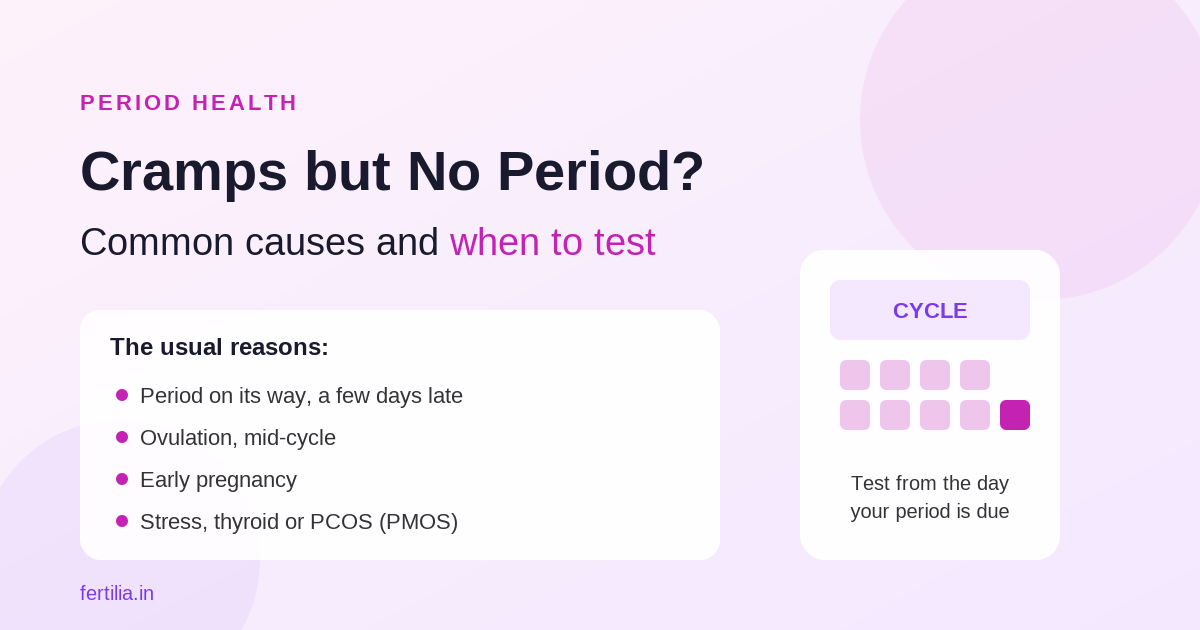
Cramps that feel like your period is about to start, but no bleeding comes, usually mean one of four ordinary things:
- Your period is simply on its way and is a few days later than you expected.
- You are ovulating (mid-cycle cramping, often on one side).
- You are in early pregnancy, when the uterus can cramp much like it does before a period.
- Your cycle has shifted because of stress, illness, travel, weight change, thyroid changes or PCOS.
If your period is late and pregnancy is possible, a home urine pregnancy test is the first step. If the cramping is severe, is on one side when your period is late or your test is positive, or comes with dizziness, fainting or shoulder-tip pain, go to the nearest emergency department straight away.
You may be reading this with a hot water bag on your tummy, checking the calendar for the third time today. The cramps feel exactly like the day before your period. You have pads ready. And nothing happens. That in-between feeling can be unsettling, especially if you are hoping to be pregnant, or hoping not to be.
I’m Dr. Suganya Venkat, an OB-GYN, and in fifteen years of practice this is one of the questions women send me most often on WhatsApp. Most of the time the answer is calm and simple. This guide walks you through the common causes, when a test gives a reliable answer, and which signs mean you should be seen.
If you mainly want relief from the pain itself, our period cramps home remedies guide covers heat, painkillers and gentle movement. This post is about the puzzle of cramping when the bleed has not come.
First, where are you in your cycle?
The single most useful thing you can do is to work out roughly which day of your cycle you are on. Day 1 is the first day of your last period.
- Around the middle of your cycle (about day 12 to 16 in a 28-day cycle): cramping is most often ovulation.
- In the last few days before your period is due: cramping is most often your period getting ready, sometimes a day or two before any bleeding shows.
- After your period was due: think about pregnancy first if it is possible, and then about a delayed cycle.
If you do not track your cycle, start today. A simple note in your phone of the first day of each period and any cramping days will make the next conversation with your doctor much easier.
Cause 1: your period is coming, just later than you thought
Pre-period cramping can start one or two days before the bleed. The uterus begins to contract as the lining prepares to shed, and some women feel this as a dull ache in the lower tummy or back well before any spotting.
A cycle does not always run to the same length. A period that comes a few days earlier or later than last month is common, and cycle length naturally varies from month to month. If you counted from a guessed date, you may simply be a little ahead of your body. For the full list of reasons a period can run late, see our guide on why your period may be late.
Cause 2: ovulation pain (mittelschmerz)
Some women feel a twinge or a dull cramp when an egg is released, usually about two weeks before the next period. It is often on one side of the lower tummy, can last a few hours to a day or two, and may come with a little clear, stretchy discharge. Because it feels like a mild period cramp, it is easy to mistake for a period that never arrived.
The timing is the clue. If the cramping is in the middle of your cycle and your period is not yet due, ovulation is the likely reason. Our ovulation pain guide explains what is normal and how to use it as a fertile-window signal if you are trying to conceive.
Cause 3: early pregnancy
Early pregnancy can cause light cramping that feels very like a period on its way. This is the reason so many women search for “cramps but no period” in the first place.
A pregnancy cannot show on a test until the embryo has implanted in the lining of the uterus. In a study that collected daily urine samples from women trying to conceive, most successful pregnancies implanted 8 to 10 days after ovulation (Wilcox AJ et al., N Engl J Med, 1999, PMID 10362823). That is why cramping in the days before your period is due cannot tell you on its own whether you are pregnant. Our guide to implantation cramps explains what women describe at this stage.
Other early signs you may notice alongside the cramps include breast tenderness, tiredness, needing to pass urine more often, and mild nausea. None of these is a reliable test by itself, because many of them also happen before a period.
If you are already pregnant and cramping, our guide to cramps in early pregnancy covers what is usually normal and when to call.
Not sure what your cramps mean? Share your cycle dates and symptoms with Dr. Suganya and she will help you work out the next step.
WhatsApp Dr. SuganyaWhen to take a pregnancy test
This is where timing matters most.
- Before your period is due: a negative result does not rule out pregnancy, because implantation may not have happened yet or the hormone level is still too low to detect.
- From the day your period was due: a test becomes much more useful. Even so, the same research group found that around 10% of pregnancies had not yet implanted by the first day of the missed period, using a far more sensitive laboratory method than home kits (Wilcox AJ et al., JAMA, 2001, PMID 11594902).
- One week after your missed period: the same study estimated the highest possible detection at 97%. If your first test was negative and your period still has not come, repeating the test a week later gives a clearer answer.
Use your first morning urine if you can, because it is the most concentrated. Our step-by-step guide to taking and reading a home pregnancy test covers brands available in India and how to read faint lines.
If the test stays negative and your period is still missing, our guide on a missed period with a negative pregnancy test sets out a calm plan for what to do next.
Cause 4: a delayed cycle from stress, illness or weight change
Your cycle is controlled by signals from the brain to the ovaries. Things that put the body under strain can delay ovulation, and when ovulation is late, the period that follows it is late too. The cramping you feel may be your uterus getting ready, while the bleed itself is still a few days away.
Common triggers include:
- A stressful few weeks: exams, a family function, a move, a new job
- A recent illness, fever or course of medicines
- Travel and broken sleep, including night shifts
- Sudden weight loss, weight gain, or a big jump in exercise
- Stopping hormonal contraception, after which cycles can take a little time to settle
One late period after a stressful month is usually nothing to worry about. If your cycles stay irregular for several months, it is worth having them checked.
Cause 5: PCOS (PMOS) and thyroid changes
PCOS, now formally renamed PMOS (Polyendocrine Metabolic Ovarian Syndrome), is one of the most common reasons for periods that come late or skip months. When ovulation does not happen regularly, the lining of the uterus can build up without the usual signal to shed, so the period comes late. Cramping itself is not a typical sign of PCOS, so cramps during a long gap may have another cause and are worth mentioning to your doctor. Other clues include acne, extra facial hair, weight that is hard to shift, and cycles longer than about five weeks. Our PCOS symptoms and root causes guide explains how it is diagnosed.
Thyroid changes, both an underactive and an overactive thyroid, can also change the length and flow of your cycle. A simple blood test (TSH) checks this.
If your periods are often late, this is very treatable. Working on the drivers behind PCOS, such as insulin resistance, sleep and steady meals, helps many women return to more regular cycles.
Less common causes
A few less common reasons are worth knowing about, without assuming you have any of them:
- Cervical stenosis: a narrowing of the opening of the cervix, sometimes after a procedure on the cervix. Menstrual blood may have trouble flowing out, which can cause cramping with very light or no bleeding. A doctor can usually see this on examination and ultrasound.
- Ovarian cysts: most are harmless and come and go with the cycle, but some cause a one-sided ache.
- Endometriosis: usually causes painful periods rather than cramps without a period, but some women have pelvic pain at other times of the month too.
- Cramps from the bowel or bladder: constipation, gas or a urine infection can feel like period cramps. Burning when you pass urine, or a change in your bowel habits, points this way.
When to get urgent help
Most cramping without a period settles on its own. Please go to your nearest emergency department straight away if you have:
- Severe pain, or pain mainly on one side when your period is late or your test is positive
- Feeling faint, dizzy, or very weak
- Pain in your shoulder tip along with tummy pain
- Heavy bleeding after a late period
These can point to an ectopic pregnancy or internal bleeding, which need emergency care. Please do not wait for an appointment or an online consultation.
If you have fever or foul-smelling discharge with the cramps, see a doctor in person the same day. This can point to an infection, which responds well to timely treatment.
Book a routine appointment if:
- Your period is more than a week late and your tests are negative
- You have missed three periods in a row, or your cycles are regularly longer than about five weeks
- You often get cramping without bleeding
- You are trying to conceive and your cycles are unpredictable
What your doctor may check
Your doctor will usually start with your cycle history and symptoms, then may suggest:
- A urine or blood pregnancy test (the blood test measures the hormone hCG and can pick up a pregnancy earlier)
- A pelvic ultrasound to look at the uterus, the lining and the ovaries
- Blood tests such as thyroid (TSH), prolactin, and hormones linked to PCOS
These tests work alongside whatever your local gynaecologist has already advised. They simply help put a name to what is happening so the next step is clear.
What you can do today
- Note the date. Write down the first day of your last period and the days you have had cramps.
- Test at the right time. If your period is late and pregnancy is possible, take a test with first morning urine, and repeat it in a week if your period still has not come.
- Ease the discomfort. A hot water bag, rest, warm fluids like jeera water or a light rasam, and gentle walking often help.
- Watch for the red flags above, and act on them straight away.
- Track for a few months if this keeps happening, so a doctor can see the pattern.
Frequently Asked Questions
Why do I have period cramps but no period?
The most common reasons are that your period is about to start, you are ovulating, you are in early pregnancy, or your cycle is running late because of stress, illness, weight change, thyroid changes or PCOS. Working out which day of your cycle you are on usually narrows it down.
Can I be pregnant if I have cramps but no period?
Yes, it is possible. Early pregnancy can cause mild cramping that feels like a period on its way. If your period is late and you have had unprotected sex, take a home pregnancy test from the day your period was due.
I have cramps, no period and a negative pregnancy test. What now?
If you tested before or on the day your period was due, the result may be too early. Repeat the test a week later. If it is still negative and your period has not come, see a doctor to check for causes such as stress, thyroid changes or PCOS.
How long can pre-period cramps last without bleeding?
Pre-period cramping often starts one or two days before the bleed. If you have had cramps for more than a few days, your period is a week late, or the pain is getting worse, it is worth getting checked.
Is cramping without a period a sign of PCOS?
Not on its own. PCOS often causes late or skipped periods, but cramping is not a typical PCOS symptom, and cramps during a long gap can have other causes. A diagnosis needs your cycle history, a physical check, blood tests and sometimes an ultrasound.
When is cramping without a period an emergency?
Go to the nearest emergency department straight away if the pain is severe, or on one side when your period is late or your test is positive, or if you feel faint or dizzy, have shoulder-tip pain, or have heavy bleeding after a late period. These can be signs of an ectopic pregnancy or internal bleeding. If you have fever or foul-smelling discharge with the cramps, see a doctor in person the same day.
Can stress cause cramps without a period?
Yes. Stress can delay ovulation, which pushes your period later. Your uterus may still cramp as it prepares, so you feel the ache before the bleed arrives.
You Do Not Have to Guess Alone
Waiting for a period that does not come, with cramps that keep teasing you, is tiring. Most of the time the answer turns out to be simple, and a clear plan takes the guesswork away. If you would like to talk it through, WhatsApp Dr. Suganya to book an online video consultation, ₹399 in India and US $20 from outside India. You can also download our free period health guide.