You spit after brushing and the foam is pink. Or you bite into an apple and see a red smear where your teeth went in. Your gums look a little puffier than usual, and they feel tender when you floss. It is easy to wonder whether something is wrong, and whether a visit to the dentist is even allowed now that you are pregnant.
I’m Dr. Suganya Venkat, and in more than fifteen years as an OB-GYN, sore and bleeding gums have been one of the most common small complaints I hear about at antenatal visits. For most women, gums bleed more in pregnancy because they react more strongly to the everyday plaque on the teeth, and gentle, thorough cleaning each day settles it down. Dental check-ups, cleaning, fillings and even dental X-rays can all be done while you are pregnant. A few signs mean you should see a dentist soon, and a couple need help the same day. This post walks you through all of it.
Here is what this post covers:
- Why gums swell and bleed more in pregnancy
- How to brush and clean between your teeth so the bleeding settles
- Looking after your teeth through morning sickness and cravings
- Which dental treatments, X-rays and injections are safe in pregnancy
- Gum health and your baby: what the research shows
- When to see a dentist, and when to get help straight away
How Common Bleeding Gums Are in Pregnancy
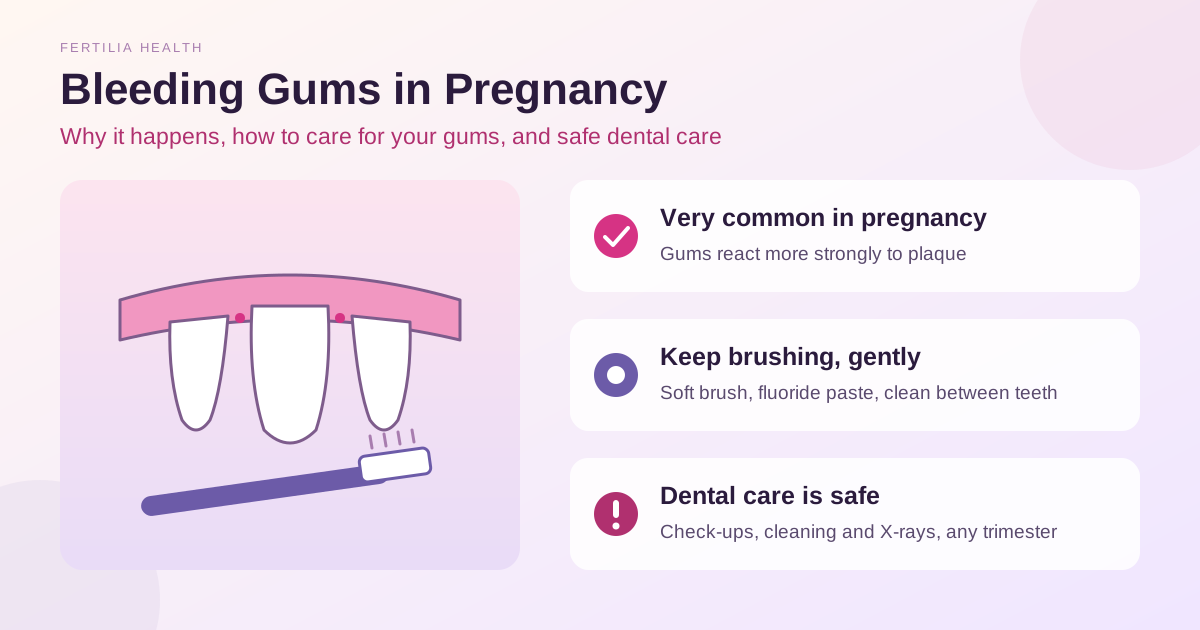
If your gums have started bleeding, you are in very large company. A review that pooled 20 studies of pregnant women found that about two in three (67%) had gums that bled when the dentist gently probed them during a check-up, and this bleeding became more common as pregnancy went on (Chen P et al., J Dent, 2022, PMID 35998741).
Doctors and dentists call this inflammation of the gums gingivitis. When it shows up or gets worse during pregnancy, you may hear it called pregnancy gingivitis. It is the mildest form of gum disease, and it does not damage the bone that holds your teeth in place.
Why Gums Bleed More When You Are Pregnant
The same plaque, a stronger reaction
Plaque is the soft, sticky film of bacteria that builds up on your teeth every day. The NHS explains that gum disease is caused by plaque that is not removed by brushing and cleaning between the teeth, and that it irritates the gums (nhs.uk, gum disease, reviewed April 2026).
What changes in pregnancy is how your gums respond to it. The American Dental Association notes that hormonal changes in pregnancy can exaggerate the gums’ response to bacteria (ada.org, oral health topics: pregnancy, checked October 2026). A systematic review of 33 studies found that gum inflammation rose through pregnancy, was higher in the second and third trimesters than in the first, and was lower after delivery, without a matching increase in plaque (Figuero E et al., J Clin Periodontol, 2013, PMID 23557432).
In other words, you may be cleaning your teeth exactly as well as you always have, and your gums are still more likely to bleed. It is not a sign that you have been careless.
The precise trigger is still being studied. In one study that followed 48 pregnant women through each trimester and after delivery, gum inflammation went up even though plaque stayed low, but the rise did not line up neatly with the hormone levels measured in saliva (Figuero E et al., J Clin Periodontol, 2010, PMID 20070862). What is clear is the practical part: less plaque means calmer gums.
Morning sickness, cravings and a busy routine
Pregnancy also changes daily habits in ways that affect the mouth. The ADA lists more snacking because of cravings, more acid in the mouth from vomiting, a dry mouth, and less brushing during bouts of nausea as reasons that tooth decay becomes more common in pregnancy (ada.org, oral health topics: pregnancy, checked October 2026). If the taste of toothpaste makes you gag in the first trimester, your brushing may get rushed, and plaque builds up along the gum line.
A lump on the gum: pregnancy granuloma
Some women notice a soft, red, rounded swelling on the gum that bleeds easily. This is a pregnancy granuloma (also called granuloma gravidarum or a pregnancy epulis). The ADA describes it as a round growth, usually attached to the gum by a thin stalk, that may develop because of the hormonal changes of pregnancy (ada.org, oral health topics: pregnancy, checked October 2026). It is not cancer.
In a Brazilian series of 41 cases, about half appeared in the third trimester, most (73%) were on the gums, and local irritants were involved in about three-quarters of them (Cardoso JA et al., J Appl Oral Sci, 2013, PMID 23857656). A granuloma that persists after the birth has been described as an unusual presentation (Purwar P et al., BMJ Case Rep, 2015, PMID 25576506). Show it to your dentist, who will check it and remove any tartar around it, and will decide whether anything more is needed.
What Pregnancy Gingivitis Usually Looks Like
The changes most women describe share a few features:
- Gums bleed when you brush, floss or bite into something hard, such as an apple or a guava
- The gums look redder and puffier, especially between the teeth
- They feel tender, but not severely painful
- It usually builds from the second trimester and eases after the baby is born
Brushing and Flossing When Your Gums Bleed
The instinct when gums bleed is to brush less, or to avoid the sore spot. That lets more plaque build up in exactly the place that is inflamed. Keep brushing, gently and thoroughly. For most women the bleeding starts to ease once plaque is removed every day.
A simple daily routine
The ADA’s advice for pregnant women is to brush twice a day for two minutes with a soft-bristled brush and a fluoride toothpaste, and to clean between the teeth once a day (ada.org, oral health topics: pregnancy, checked October 2026). The NHS adds a few useful details (nhs.uk, gum disease, reviewed April 2026):
- Brush twice a day with fluoride toothpaste, angling the soft bristles towards the gum line and using small, gentle movements.
- Spit after brushing, but do not rinse, so the fluoride stays on your teeth.
- Clean between your teeth every day with floss or small interdental brushes.
- Do not use mouthwash straight after brushing.
- Do not smoke. The same applies to chewing tobacco, gutka or paan with tobacco.
A little bleeding during the first few days of regular flossing is common. Keep going gently.
Interdental brushes are worth trying
Many women find small interdental brushes easier than floss, especially with puffy gums. In a multi-centre trial, 323 pregnant women who had not given birth before, all at risk of pre-eclampsia and none with deeper gum disease, were enrolled at 12 weeks of pregnancy. Half were given individual instructions and interdental brushes of the right size for daily use. In that group, gum bleeding on testing fell from 56% at the start to 12% by eight months of pregnancy, while the group receiving routine care stayed about the same, and most of the improvement came within the first week (Carrouel F et al., J Clin Periodontol, 2026, PMID 41558746). Ask your dentist or hygienist to show you which size fits between your teeth.
Looking after your teeth through morning sickness
If you vomit, do not brush straight away. The ADA advises rinsing instead with a cup of water mixed with a teaspoon of baking soda, because brushing immediately after vomiting rubs stomach acid into the teeth (ada.org, oral health topics: pregnancy, checked October 2026). Brush later, once your mouth has had time to settle.
If the taste of mint sets off nausea, try a milder or unflavoured fluoride toothpaste, a smaller brush head, and brushing at a time of day when the nausea is lighter. Our guide to morning sickness has more on eating and drinking through the first trimester, and on when vomiting needs a doctor.
Snacks that are kinder to teeth
Pregnancy hunger often means eating every two or three hours. If those snacks are biscuits, sweets or sweet tea, the teeth are bathed in sugar all day. Roasted chana, peanuts, a small bowl of dahi, fruit, a boiled egg, or a handful of makhana are easier on your teeth between meals. Finish with a glass of water. Our Indian pregnancy diet guide covers how to build the whole day’s meals.
💜 Gums bleeding and not sure if it needs a check? Message Dr. Suganya on WhatsApp to book a ₹399 video consultation. Share how many weeks pregnant you are, how long the bleeding has been going on, and any recent blood reports. For cleaning or treatment of the gums and teeth themselves, please see your dentist.
Is Dental Treatment Safe in Pregnancy?
Yes. This is the question I am asked most often about teeth in pregnancy, usually because a relative has said that dental work will harm the baby. That belief is widespread: a systematic review of studies on pregnant women and new mothers found “dental treatments are not safe and harm the fetus” among the beliefs reported most often, along with the idea that pregnant women lose their teeth because of pregnancy (Kamalabadi YM et al., BMC Oral Health, 2023, PMID 37840149).
The professional bodies are clear on this. ACOG’s committee opinion on oral health care during pregnancy (Committee Opinion No. 569, 2013, reaffirmed 2025, acog.org) asks that women be counselled about the safety and importance of oral health care in pregnancy. The ADA’s guidance (ada.org, oral health topics: pregnancy, checked October 2026) states that:
- Preventive, diagnostic and restorative dental treatment is safe throughout pregnancy. That includes check-ups, cleaning (scaling), and fillings.
- Urgent treatment such as extractions, root canal treatment or fillings can be done at any time in pregnancy, and delaying it may lead to more complex problems.
- Deep cleaning under the gums (scaling and root planing) is recognised as safe if gum disease develops in pregnancy.
Dental X-rays
The ADA states that dental X-rays are considered safe at any stage of pregnancy, and that a lead apron over the abdomen or a thyroid collar is no longer recommended (ada.org, oral health topics: pregnancy, checked October 2026). If your dentist needs an X-ray to see a problem tooth, it is fine to go ahead. Tell them you are pregnant so they can plan with that in mind.
Injections, antibiotics and pain relief
- Local anaesthetic. The ADA lists local anaesthetics, with or without adrenaline (epinephrine), such as lidocaine, as safe to use in pregnancy (ada.org, oral health topics: pregnancy, checked October 2026). Numbing the tooth properly is better for you than sitting through a painful procedure.
- Antibiotics. If you need one for a dental infection, the ADA lists penicillin, amoxicillin, cephalosporins, clindamycin and metronidazole among the options considered safe in pregnancy. Let your dentist choose, and tell them about any allergies.
- Pain relief. The ADA advises that pain medicines in pregnancy be decided together with your obstetrician. The NHS states that paracetamol is usually the best painkiller to use in pregnancy (nhs.uk, paracetamol for adults, reviewed March 2026). Our guide to fever and pain relief in pregnancy explains which medicines to leave on the shelf and why.
- “Laughing gas” (nitrous oxide). The ADA recommends that pregnant women avoid it.
When to book
Any trimester is fine for a check-up or urgent treatment. If a longer sitting can wait a few weeks, many women find the middle months the most comfortable, once nausea has settled and before lying back in the chair becomes awkward. In late pregnancy, ask for a short break to sit up or turn on your side if you feel light-headed lying back. Our post on dizziness in pregnancy explains why lying flat on your back can do this.
When you book, tell the dentist how many weeks pregnant you are, any medicines you take, and whether your obstetrician has called your pregnancy high-risk. The ADA encourages dentists to speak with your obstetrician if they have questions, so give them your doctor’s number if they ask.
Gum Health and Your Baby
You may read that gum disease is linked with early birth. Here is what the research shows, so you can put it in proportion.
The bleeding most pregnant women notice is gingivitis, which stays in the gums. Some women have periodontitis, a deeper gum infection that affects the tissues holding the teeth. An overview of systematic reviews found associations between periodontitis and preterm birth, low birth weight and pre-eclampsia, and the ADA notes that more research is needed to understand that relationship (ada.org, oral health topics: pregnancy, checked October 2026).
A link does not prove that the gums cause these problems. A Cochrane review of 15 randomised trials in 7,161 pregnant women, almost all of whom had periodontitis, found no clear difference in preterm birth between women whose gum disease was treated during pregnancy and those whose was not, and low-quality evidence that treatment may reduce low birth weight. No adverse effects of the gum treatment were reported in the trials that looked for them (Iheozor-Ejiofor Z et al., Cochrane Database Syst Rev, 2017, PMID 28605006).
So the practical message is a reassuring one. Looking after your gums makes your mouth more comfortable and keeps small problems small, and gum treatment during pregnancy is safe. Good oral care also helps once your baby arrives: ACOG notes that a mother’s good oral hygiene may lower the amount of decay-causing bacteria passed to a baby through everyday habits such as sharing spoons (Committee Opinion No. 569, acog.org).
When to See a Dentist
The NHS advises seeing a dentist if your gums bleed when you brush or eat hard foods, if your gums are painful and swollen, or if you have bad breath (nhs.uk, gum disease, reviewed April 2026). In pregnancy, I would add:
- A lump on the gum that bleeds easily or gets in the way when you eat
- A tooth that is sensitive, aching or has a visible hole or dark spot
- No dental check-up in the past year, even if you have no symptoms
Ask for an urgent dental appointment if
The NHS lists these as reasons to ask for an urgent appointment (nhs.uk, gum disease, reviewed April 2026; nhs.uk, dental abscess, reviewed March 2026):
- Very sore and swollen gums
- Teeth becoming loose
- Ulcers or red patches in your mouth, or a lump in your mouth or on your lip
- Intense toothache or gum pain, a swollen face or jaw, or a bad taste with swelling, which can be signs of a dental abscess
Go to hospital straight away if
- You have a swollen face or mouth and find it hard to breathe, speak, swallow or open your mouth, or the swelling reaches your eye. The NHS lists these as reasons to go to emergency care with a dental abscess (nhs.uk, dental abscess, reviewed March 2026). Do not drive yourself; ask someone to take you or call 108 or 112.
- You have, or recently had, a fever, and now your gums or nose are bleeding, especially during or after the monsoon. WHO lists bleeding gums or nose among the signs of severe dengue, which often appear after the fever has gone away, and advises seeking care immediately (who.int, dengue fact sheet, checked October 2026). Our guide to fever in pregnancy covers dengue and the other warning signs.
- Your gums keep bleeding and will not stop with pressure, or you also notice easy bruising, tiny red spots on the skin, nosebleeds or blood in your urine. These need a blood count the same day rather than a dental visit.
Call your obstetrician or prescribing doctor soon if
- You take low-dose aspirin or heparin injections and your gums bleed more than before. Let them know now rather than waiting for your next visit, and do not stop these medicines on your own. If the bleeding will not stop with pressure, go to hospital straight away.
Mention it at your next antenatal visit if
- You feel tired, breathless or look paler than usual, along with bleeding gums. A haemoglobin check is simple, and our guide to haemoglobin in pregnancy shows the normal ranges for each trimester.
What It Is Called in Tamil, Hindi and Telugu
Many women search for this in their own language, often typed in Roman letters:
| Language | Common words and search terms |
|---|---|
| Hindi | Masoodon se khoon aana (मसूड़ों से खून आना); pregnancy me masoodon se khoon aana |
| Tamil | Eeru (ஈறு) means gum; eerugalil ratham varuthal; pregnancy la eeru ratham |
| Telugu | Chigullu nundi raktam; pregnancy lo chigullu nundi raktam |
| English (search) | Bleeding gums in pregnancy; swollen gums in pregnancy; pregnancy gingivitis |
Practical Takeaways
- Bleeding gums are very common in pregnancy, because your gums react more strongly to plaque, not because you are brushing badly.
- Keep brushing twice a day with a soft brush and fluoride toothpaste, spit without rinsing, and clean between your teeth every day.
- Interdental brushes can calm bleeding gums quickly; ask your dentist which size fits.
- After vomiting, rinse with water and a little baking soda, and brush later.
- Dental check-ups, cleaning, fillings, X-rays and local anaesthetic are safe at any stage of pregnancy. Tell your dentist you are pregnant.
- See a dentist for bleeding that keeps up, a lump on the gum, or a painful tooth, and ask for an urgent appointment for very sore, swollen gums, loose teeth or a swollen face or jaw.
- Go to hospital if swelling makes it hard to breathe or swallow, or if your gums bleed during or after a fever.
For the wider picture of the nine months, see our pregnancy week-by-week guide.
Frequently Asked Questions
Is bleeding gums normal in pregnancy? (Pregnancy me masoodon se khoon aana normal hai?)
Yes, it is very common. In one review of 20 studies, about two in three pregnant women had gums that bled during a dental check. Pregnancy makes the gums react more strongly to the plaque on the teeth, so they swell and bleed more easily, often from the second trimester. Gentle daily brushing and cleaning between the teeth usually settles it. If it continues or your gums are painful, see a dentist.
Can I go to the dentist while pregnant?
Yes. Check-ups, cleaning, fillings and urgent treatment such as a root canal or an extraction can be done at any stage of pregnancy, according to the American Dental Association. Delaying needed treatment can turn a small problem into a bigger one. Tell your dentist how many weeks pregnant you are and which medicines you take.
Is a dental X-ray safe in pregnancy?
The American Dental Association considers dental X-rays safe at any stage of pregnancy. If your dentist needs one to diagnose a problem tooth, it is fine to go ahead. Let them know you are pregnant when you book.
Will bleeding gums harm my baby?
Ordinary pregnancy gingivitis stays in the gums and settles with good daily cleaning. Deeper gum infection (periodontitis) has been linked with early birth in some studies, but trials of treating it during pregnancy did not show a clear change in preterm birth, and the treatment itself was safe. The best step for you and your baby is simply to keep your gums clean and see a dentist if they stay sore or swollen.
Can I get my teeth cleaned (scaling) during pregnancy?
Yes. Professional cleaning removes the tartar that keeps gums inflamed, and the American Dental Association recognises scaling and deeper cleaning under the gums as safe in pregnancy. Many women find their gums bleed much less after a cleaning.
Will my gums go back to normal after delivery?
For most women, yes. Studies show gum inflammation is lower after delivery than in the second and third trimesters. A pregnancy granuloma on the gum also often settles after the birth. If your gums still bleed a few months after delivery, book a dental check, because ongoing bleeding usually means plaque or tartar that needs cleaning.
Is bleeding gums an early sign of pregnancy?
Bleeding gums can appear at any stage of pregnancy, and they are common in women who are not pregnant too, so they are not a reliable sign. If your period is late, a home pregnancy test is the way to find out.
Talking It Through
Bleeding gums in pregnancy are common, usually mild, and they respond well to gentle, daily cleaning and a dental check. When the bleeding comes with other signs, such as tiredness, bruising or a recent fever, it is worth looking at your blood reports too. In her video consultations at Fertilia, Dr. Suganya Venkat goes through your symptoms and reports with you, works alongside your dentist, and helps you plan any dental treatment around your pregnancy with confidence.
💜 Want a doctor to go through your symptoms with you? Message Dr. Suganya on WhatsApp to book a ₹399 video consultation, available online across India. You can also download our free pregnancy guide for week-by-week support through each trimester.