It usually shows up at the end of a long day. You have been carrying the baby on your hip, bending over the bucket, standing at the stove, and by evening there is a heavy, dragging feeling low down, as if something is about to slip out. Some women feel a soft bulge at the vaginal opening while bathing and quietly panic.
I’m Dr. Suganya Venkat, and with more than a thousand pregnancies in my care as an OB-GYN, I can tell you that this feeling is reported far less often than it happens. Women worry that their uterus is “coming out”, feel too shy to say it aloud, and wait. So let me start with what I want every new mother to know.
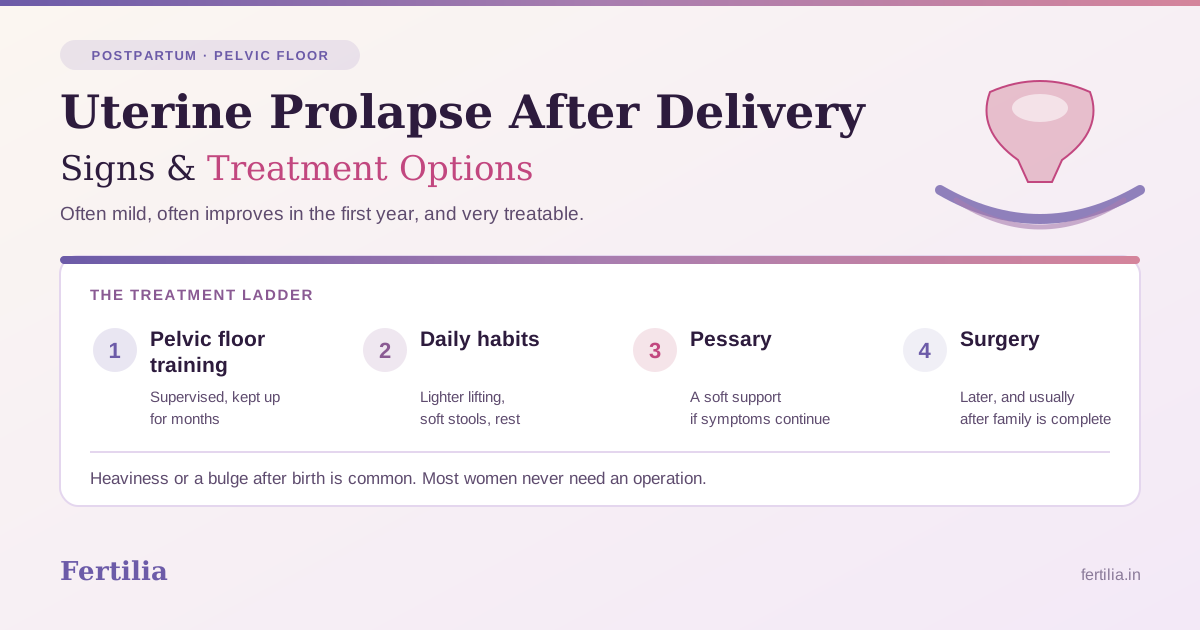
The short answer: a heavy or bulging feeling after delivery can be a sign of mild prolapse, which means one of the pelvic organs has dropped slightly because its supports were stretched during pregnancy and birth. Prolapse is one possible cause, not the only one, and an examination is what confirms the diagnosis and its stage. In the first year after a baby, these symptoms often become less noticeable as the tissues recover. When they do not, there is a clear ladder of treatment: pelvic floor physiotherapy first, a vaginal support device called a pessary if needed, and surgery only later, if at all, and usually after you have finished having children.
Here is what this post covers:
- What prolapse after delivery means, and which organ is usually involved
- The signs to look out for
- How common it is, and why many women improve
- The stages, in plain language
- The treatment options, step by step
- What it is called in Tamil and Hindi, and common questions
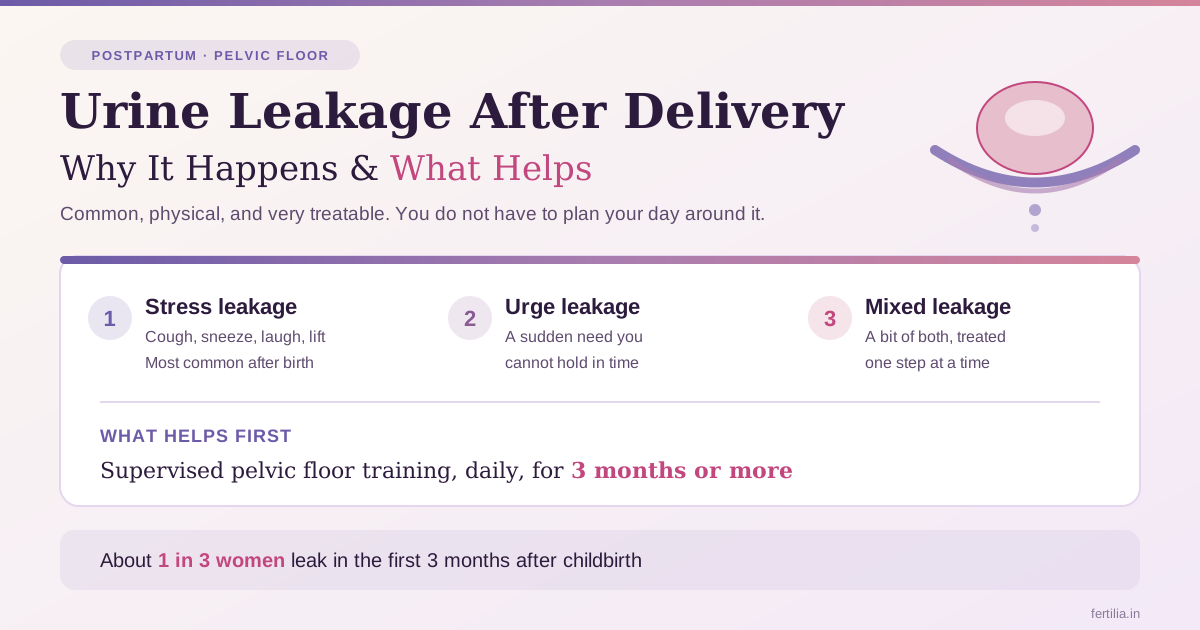
If your main symptom is leaking urine when you cough or sneeze, our separate guide on urine leakage after delivery covers that in detail. The two often travel together, but they are treated a little differently.
What Prolapse After Delivery Means
Inside the pelvis, the uterus, bladder and rectum are held in place by a sling of muscle (the pelvic floor) and by ligaments and connective tissue around the vagina. Prolapse happens when these supports weaken enough for one or more organs to sag down into the vagina.
“Uterine prolapse” is the phrase most women use, and most people search for, but after childbirth the organ that has dropped is not always the uterus. There are three main areas:
| Where it happens | What is dropping | Common name |
|---|---|---|
| Front wall of the vagina | The bladder | Cystocele (anterior wall prolapse) |
| Top of the vagina | The uterus and cervix | Uterine prolapse |
| Back wall of the vagina | The rectum | Rectocele (posterior wall prolapse) |
More than one area can be involved. An examination tells you which one it is, and that decides which symptoms you are likely to have and what will help most.
Why pregnancy and birth affect these supports
- The weight of pregnancy. For months, the growing baby, the uterus and the extra fluid press down on the pelvic floor.
- Hormonal softening. Pregnancy hormones loosen connective tissue so the pelvis can open for birth, and the supports around the vagina soften too.
- The birth itself. A vaginal birth stretches the pelvic floor muscles and the nerves that supply them. A long pushing stage, a large baby, and an assisted delivery with forceps or vacuum add to that strain.
A study that assessed 1,011 women 5 to 10 years after their first delivery found that, compared with a caesarean done before labour, a spontaneous vaginal birth was linked with about 5.6 times the odds of prolapse reaching the vaginal opening, and an assisted (forceps or vacuum) birth with about 7.5 times the odds. The authors estimated roughly one extra case of prolapse for every nine spontaneous vaginal births, compared with caesarean births (Handa VL et al., Obstet Gynecol, 2011, PMID 21897313).
I share this so you understand why it happened, not to make you regret how your baby was born. Most women who have a vaginal birth never develop troublesome prolapse, a caesarean carries its own risks, and nothing about this is a reason to feel you did something wrong.
The Signs to Look Out For
Prolapse after delivery is often mild and may cause no symptoms at all. When it does, women describe:
- A heavy, dragging or “something is falling out” feeling in the vagina, usually worse at the end of the day, after standing for long, or after lifting, and better when lying down
- A soft bulge you can feel or see at the vaginal opening, especially when bathing, squatting or straining
- Difficulty emptying the bladder fully, a slow stream, or needing to go again soon after
- Difficulty opening the bowels, or needing to press around the vagina or perineum to finish
- Urine leakage when coughing, sneezing or lifting, which often accompanies a bladder-wall prolapse
- Discomfort or a different sensation during sex. Our guide on painful sex after delivery covers the other common causes, which are worth ruling out too
When to see a doctor sooner
Most of these symptoms can be checked at a planned visit, including the 6-week postpartum checkup. Please contact a doctor promptly, rather than waiting, if:
- You cannot pass urine, or only pass small amounts with a full, uncomfortable bladder
- A bulge stays outside the opening and you cannot gently push it back
- A bulge becomes sore, raw or starts to bleed
- You have fever, foul-smelling discharge or worsening pelvic pain after the birth, which point to an infection rather than prolapse
Each of these is treatable. They simply need to be examined in person.
How Common Is It, and Will It Get Better?
Prolapse symptoms in the months after a first baby are more common than most women realise, and the trend over the first year is encouraging.
In a trial of 84 first-time mothers in Iceland, about four in ten reported some prolapse symptoms when they were assessed between 6 and 13 weeks after the birth. Far fewer were bothered by those symptoms (13% in one group and 21% in the other). Over the following year, the number of women with symptoms fell gradually in both groups (Sigurdardottir T et al., Int Urogynecol J, 2023, PMID 36995416).
That gradual improvement is what I see in practice too. The tissues stretched in pregnancy and birth continue to recover for months, so a mild heaviness at six weeks is often much less noticeable by six or twelve months. This is why most gynaecologists start with simple, low-risk steps and give them time.
The Stages, in Plain Language
Doctors describe prolapse using a measurement system called POP-Q, which grades how far the lowest part of the prolapse comes down compared with the hymen (the vaginal opening). In everyday terms:
| Stage | What it means |
|---|---|
| Stage 0 | No prolapse |
| Stage 1 | A slight drop, still well inside the vagina |
| Stage 2 | The bulge reaches close to the vaginal opening |
| Stage 3 | The bulge comes out beyond the opening |
| Stage 4 | The organ has come down completely |
In my experience, most prolapse found in the months after childbirth is stage 1 or stage 2. If you have been told your prolapse is “first degree” or “mild”, it falls in the group that responds best to the steps below.
💜 Feeling a heaviness or bulge since your delivery? Message Dr. Suganya on WhatsApp and talk it through privately over a ₹399 video consultation, from anywhere in India or abroad.
Treatment Options, Step by Step
The UK’s National Institute for Health and Care Excellence advises that treatment options for prolapse, including no treatment, non-surgical treatment and surgery, should be discussed with each woman, taking into account her symptoms, preferences, lifestyle and whether she wants more children (NICE guideline NG123, 2019, recommendation 1.7.1, nice.org.uk/guidance/ng123).
For most new mothers, that discussion leads to the first two steps below and nothing more.
Step 1: Pelvic floor muscle training
For women with symptomatic stage 1 or stage 2 prolapse, NICE recommends considering a supervised programme of pelvic floor muscle training for at least 16 weeks as a first option, and continuing the exercises afterwards if they help (NICE NG123, 2019, recommendation 1.7.5, nice.org.uk/guidance/ng123).
The best evidence for this comes from the POPPY trial, which included 447 women with newly diagnosed, symptomatic stage 1 to 3 prolapse. Women who had one-to-one pelvic floor training with a physiotherapist reported fewer prolapse symptoms at 12 months than women who received only a lifestyle advice leaflet (Hagen S et al., Lancet, 2014, PMID 24290404).
For women in the first months after birth, the picture is less clear-cut:
- In a trial of 175 first-time mothers, a 4-month supervised training programme starting 6 to 8 weeks after delivery showed no significant additional benefit for prolapse on examination or for symptoms of vaginal bulging, compared with a control group whose members also received thorough individual instruction and assessment in contracting the pelvic floor muscles correctly (Bø K et al., Am J Obstet Gynecol, 2015, PMID 24983687).
- In the Icelandic trial above, symptoms improved over the year in both the trained and untrained groups, with no significant difference between them (Sigurdardottir T et al., Int Urogynecol J, 2023, PMID 36995416).
How I put this together for my patients: in the early months, a lot of improvement happens through natural recovery, and exercises cannot be shown to speed that up much. But when heaviness persists, pelvic floor training is the first treatment with good evidence, and it also helps the urine leakage that often comes with prolapse. It works best when it is individually assessed and includes learning to relax the muscles as well as tighten them. If the exercises cause pain or make your symptoms worse, stop and get reassessed. So I encourage women to learn the exercises correctly early, and to take them seriously if symptoms are still there a few months on.
The technique is explained step by step in our guide to Kegel exercises for women. Two things matter most:
- Correct technique. Many women squeeze their buttocks or thighs, or push down instead of lifting up. A pelvic floor physiotherapist can correct this quickly. In Fertilia’s postpartum program, this part of the plan is guided over video calls by our pelvic floor physiotherapist, Dr. Maitri Daga. If an internal examination is needed, we suggest a gynaecologist or women’s health physiotherapist near you, alongside the online plan.
- Consistency over months. The trials that showed benefit ran their programmes for months, not days. A few minutes every day, kept up, is the goal.
- A physiotherapy assessment first for larger prolapse. If you have been told your prolapse is stage 3 or beyond, have a physiotherapist assess you before you start exercising on your own.
Step 2: Take pressure off the pelvic floor in daily life
NICE suggests giving women with prolapse advice on losing weight if their BMI is above 30, minimising heavy lifting, and preventing or treating constipation (NICE NG123, 2019, recommendation 1.7.2, nice.org.uk/guidance/ng123). In an Indian home, that translates into a few practical habits:
- Lift smarter. Carry water in smaller containers rather than a full bucket, ask for help with the gas cylinder and the heavy rice bag, and breathe out with a gentle pelvic floor squeeze as you lift the baby or an older child.
- Avoid long stretches of bearing down. Notice tasks that make you hold your breath and push down, such as squatting for a long time to wash clothes or vessels, and take breaks or sit on a low stool instead.
- Keep your stools soft. Daily straining on the toilet pushes down on the very supports you are trying to rest. Dal, vegetables, fruit, enough water and gentle walking help, and our guide on constipation after delivery has safe options if diet alone is not enough.
- Return to exercise in stages. Running, skipping and jumping place heavy loads on the pelvic floor. Our guide on postpartum exercise and when to start explains how to build up. A return of the heavy feeling during an activity is a sign to step back a level for a while.
- Rest lying down when the dragging builds up. A short rest during the day often eases the heaviness, and many women find it makes the evenings more comfortable.
Step 3: A vaginal pessary, if symptoms continue
A pessary is a soft, flexible device, usually made of silicone, that sits inside the vagina and holds the prolapsed organ back up. NICE recommends considering a pessary for women with symptomatic prolapse, alone or alongside supervised pelvic floor training (NICE NG123, 2019, recommendation 1.7.6, nice.org.uk/guidance/ng123).
A Cochrane review found that adding a pessary to pelvic floor training probably helps more women feel an improvement in their prolapse symptoms at 12 months than training alone (moderate-certainty evidence from one trial of 260 women). The same review noted that pessaries can cause side effects such as increased vaginal discharge and irritation of the vaginal walls (Bugge C et al., Cochrane Database Syst Rev, 2020, PMID 33207004).
What women find useful to know:
- Finding the right size and shape can take more than one fitting.
- Some types can stay in during sex, others are removed first.
- A pessary needs regular follow-up, and you can stop using it at any time.
- It does not close any doors. Many women use one for a period while they finish their family, then reassess.
Step 4: Surgery, as a later option
NICE advises offering surgery to women whose symptoms have not improved with non-surgical treatment, or who decide against it (NICE NG123, 2019, recommendation 1.8.1, nice.org.uk/guidance/ng123). There are several operations, including ones that preserve the uterus, and the right choice depends on which area has dropped, how far, and what you want for the future.
For a young mother, the timing matters as much as the operation. A later pregnancy and birth can stretch the repaired tissues again, so many gynaecologists, myself included, prefer to manage prolapse with physiotherapy and a pessary until a woman is sure her family is complete. Surgery is a decision you make with your gynaecologist when the time is right for you.
What It Is Called in Tamil and Hindi
Many women describe this at home in their own words, and those words often never reach the doctor.
| Language | Term | Meaning |
|---|---|---|
| Tamil | கர்ப்பப்பை இறக்கம் (karppappai irakkam) | The uterus coming down |
| Hindi | गर्भाशय का खिसकना (garbhashay ka khisakna) | The uterus slipping down |
| Hindi (common phrasing) | bachchedani neeche aana | The womb coming down |
Whichever words you use, the examination, the stages and the treatment ladder are the same.
Frequently Asked Questions
Is uterine prolapse after delivery common?
Yes. Some prolapse symptoms in the first months after a baby are common, especially after a first vaginal birth. In one study of first-time mothers, about four in ten had some symptoms at 6 to 13 weeks after the birth, far fewer were bothered by them, and the numbers fell steadily over the following year.
Bachchedani neeche aana after delivery: does it go back up on its own?
Often it improves. The stretched supports keep recovering for months after the birth, so a mild heaviness felt at six weeks is frequently much less noticeable by the end of the first year. If symptoms are still bothering you a few months after delivery, supervised pelvic floor exercises are the first treatment, and a pessary is an option if that is not enough.
How do I know if I have prolapse or just postpartum soreness?
Soreness from stitches or a tear is usually a stinging or tender pain around the perineum that eases steadily over the first weeks. Prolapse tends to feel like heaviness or dragging inside the vagina, worse after standing or lifting and better lying down, sometimes with a soft bulge you can feel. Our guide on normal delivery stitches and episiotomy care explains what usual healing looks like. If you are unsure, an examination settles it quickly.
Can I have another baby if I have prolapse?
Yes. Mild prolapse does not usually affect your ability to conceive or carry a pregnancy. It is a good reason to strengthen your pelvic floor before and during the next pregnancy, and to discuss your symptoms and delivery plan with your obstetrician early. Surgery is usually postponed until your family is complete.
Can prolapse happen after a C-section?
It is less likely, but possible. A caesarean avoids the stretch of a vaginal birth, yet the pregnancy itself still puts months of weight and hormonal softening on the pelvic supports. In long-term research, prolapse was most closely linked with vaginal and especially assisted births, but women who had caesareans were not completely free of it.
Is it safe to lift my baby if I have prolapse?
Usually, yes. Lifting your baby is part of daily life, and routine baby care is generally manageable with prolapse. What helps is how you lift: bend your knees, keep the baby close, breathe out and gently squeeze your pelvic floor as you rise. Try to avoid lifting much heavier things, such as full water buckets or the gas cylinder, in the early months. If lifting your baby increases the bulging, heaviness or pain, change how you lift and ask your doctor or physiotherapist for advice suited to you.
Will I need surgery for prolapse after delivery?
Most women do not. Mild prolapse after childbirth often improves over the first year, and physiotherapy and a pessary manage most of what remains. Surgery is considered when symptoms have not improved with these options, and for younger women it is usually planned after childbearing is complete.
You Can Recover From This
A heavy, dragging feeling after having a baby can make you anxious about every step and every lift. For most women it is a mild, temporary stretch of the supports, and the steps that help can start at home this week, while your body continues to heal.
If you would like support with your recovery, our free normal delivery postpartum care guide is a good place to start, and the Fertilia postpartum program brings pelvic floor rehabilitation, recovery and follow-up together in one plan.
💜 Ready to understand what your body needs? Message Dr. Suganya on WhatsApp to book a ₹399 video consultation. We will go over your symptoms, what stage they suggest, and the right next step for you.