
“We have two children. We are done. Should I get the operation?” Many women in India reach this question in their late twenties or early thirties, often while they are still recovering from a delivery, and often with family members already holding an opinion. It is a big decision made in a busy season of life.
I’m Dr. Suganya Venkat, an OB-GYN with more than fifteen years of practice, and this is a conversation I have often. Tubal ligation (the “family planning operation”, or tubectomy) is safe, quick and very effective. It is also meant to be permanent. That combination is exactly why the decision deserves a calm, unhurried look before the day of surgery.
This post covers what the operation involves, the different times and ways it can be done, what recovery feels like, and the questions worth settling first. If you have already had the operation and want to know about side effects afterwards, our guide to tubectomy side effects and what to watch for covers that in detail.
What tubal ligation does
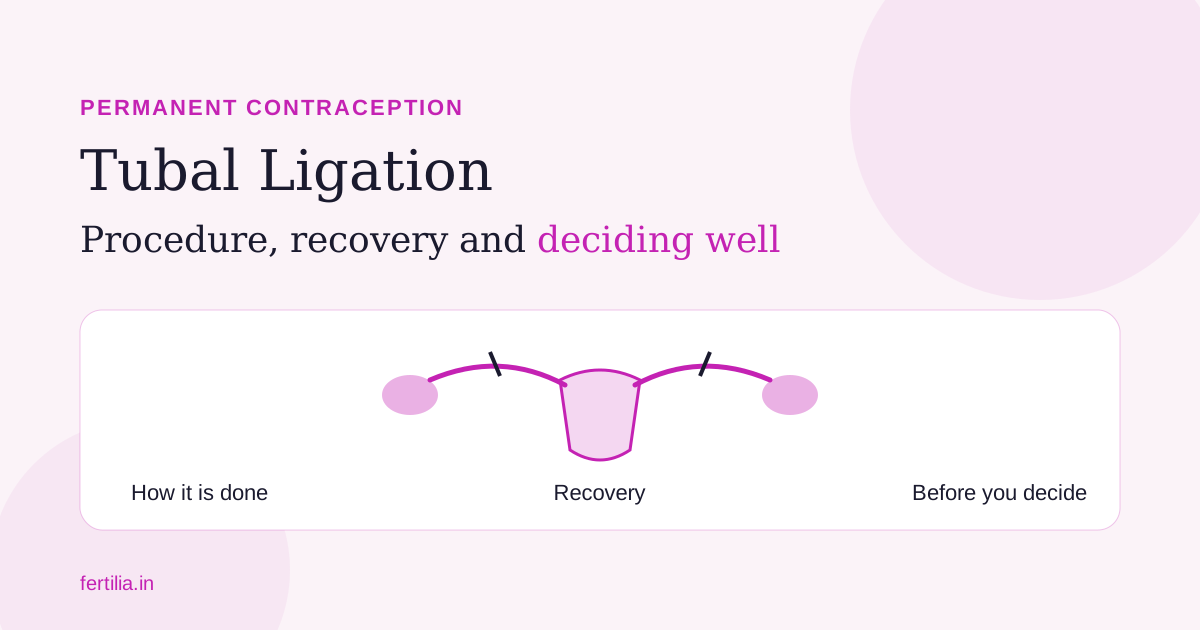
Each month, an egg leaves the ovary and travels down a fallopian tube, where it can meet sperm. Tubal ligation blocks, cuts or removes a section of both tubes, so egg and sperm can no longer meet.
What it does not do matters just as much to most women:
- Your ovaries stay. They continue to make oestrogen and progesterone as before.
- Your uterus stays. You will still have periods.
- It does not bring on menopause early.
- It does not protect against sexually transmitted infections. Condoms are still needed for that.
In Hindi it is usually called nasbandi or the “family planning operation”; in Tamil, women often simply say kudumba kattupaadu operation (family planning operation). Whatever the name, it refers to the same procedure on the tubes.
The three common timings
When the operation is done shapes how it is done.
1. After a normal delivery (postpartum sterilisation). Within the first day or two after birth, the uterus is still large and sits high in the abdomen, so the tubes lie just below the navel. A small cut of two to three centimetres near the navel is enough to reach them. This is called a minilaparotomy. The surgeon lifts each tube, ties a loop and removes a small segment (the Pomeroy or modified Pomeroy method).
2. During a caesarean section. If you are already having a C-section, the tubes can be tied or removed through the same incision, with no extra cut. Recovery is essentially the recovery of the caesarean itself, which our week-by-week C-section recovery guide walks through.
3. As a separate, planned procedure (interval sterilisation). This is done at a time unrelated to delivery, usually at least six weeks after birth. In India it is most often laparoscopic: a thin telescope goes in through a small cut at the navel, and the tubes are closed with a silicone band (the Falope ring), a clip or cautery. Some centres use a minilaparotomy cut just above the pubic hairline instead.
Tying the tubes versus removing them
A newer option you may hear about is salpingectomy, which means removing the tubes completely instead of tying or banding them.
The reason is ovarian cancer prevention. The American College of Obstetricians and Gynecologists’ Committee Opinion No. 774 (Obstet Gynecol, 2019, PMID 30913199) states that removing the tubes reduces the risk of ovarian cancer without eliminating it, that salpingectomy as a means of sterilisation appears safe without raising complication rates compared with tubal ligation, and that its risks and benefits should be discussed with women who want permanent sterilisation.
Even traditional tying is associated with a lower ovarian cancer risk: a meta-analysis found a 34% lower risk of epithelial ovarian cancer in women who had had a tubal ligation (Cibula D et al., Hum Reprod Update, 2011, PMID 20634209).
Removal does take slightly longer, and it closes the door on any later reversal, so it suits women who are completely certain. Not every hospital offers it routinely. It is a reasonable question to ask your surgeon.
What to expect on the day
For a planned laparoscopic procedure, a typical day looks like this:
- Before: a few blood tests, a urine pregnancy test on the day, and fasting for several hours. If you are not already using reliable contraception, your doctor will ask you to use it in the weeks before, because the operation does not end a pregnancy that has already begun.
- Anaesthesia: usually general anaesthesia for laparoscopy; spinal or local anaesthesia with sedation is common for a minilaparotomy, and for postpartum procedures many women already have a spinal from delivery.
- The operation itself: usually 20 to 30 minutes.
- Going home: most women go home the same day or the next morning after an interval procedure. After a delivery or caesarean, the hospital stay is set by the birth, not the sterilisation.
Serious complications are uncommon. In the US Collaborative Review of Sterilization (CREST), complications after interval laparoscopic sterilisation occurred in 0.9 to 1.6 per 100 procedures, depending on how strictly they were defined, among 9,475 women (Jamieson DJ et al., Obstet Gynecol, 2000, PMID 11084192). The same study found that diabetes, general anaesthesia, previous abdominal or pelvic surgery and obesity each raised the chance of a complication, so tell your surgeon about any of these beforehand.
💜 Weighing up the operation and want a second opinion on timing or method? Message Dr. Suganya on WhatsApp to book a ₹399 video consultation. Bring any delivery or surgery notes you have.
Recovery, step by step
Recovery from an interval laparoscopic or minilaparotomy procedure is usually quick.
Day 1 to 3
- Mild to moderate pain around the cuts and in the lower abdomen is normal. Paracetamol or the pain relief your doctor prescribes usually covers it.
- After laparoscopy, many women feel a dull ache in the shoulder. This comes from the gas used to lift the abdominal wall during surgery and settles within a day or two. Walking around gently helps it pass.
- Bloating, tiredness and a sore throat (from the breathing tube, if general anaesthesia was used) are common.
Day 3 to 7
- Most women are back to light housework and desk work within a few days.
- Keep the wound dry for the time your surgeon advises, usually 24 to 48 hours, then bathe normally and pat it dry.
- Eat normally: dal, rice, idli, vegetables and plenty of water help avoid constipation, which makes abdominal pain feel worse.
Week 1 to 2
- Avoid lifting heavy things (a full bucket of water, a gas cylinder, a heavy child on the hip for long) for about a week, or as long as your surgeon advises.
- Sex can usually resume once you are comfortable, often after about a week.
- Stitches are either dissolvable or removed at a follow-up visit around day 7.
After a postpartum or caesarean sterilisation, follow the advice for your birth recovery; the tubal part adds little.
When to call your doctor promptly:
- Fever, or chills
- Pain that is getting worse instead of better after the second day
- Redness, swelling or discharge from the wound
- Fainting or a racing heartbeat
- Vomiting that does not settle
These are uncommon, and calling early is what keeps them small.
How effective it is
Tubal ligation is among the most effective forms of contraception, though no method is perfect. CREST followed 10,685 women for 8 to 14 years and found that the 10-year chance of pregnancy varied with the method, from about 7.5 per 1,000 procedures for unipolar cautery and postpartum partial salpingectomy up to 36.5 per 1,000 for spring clips (Peterson HB et al., Am J Obstet Gynecol, 1996, PMID 8623843). The same study found the risk was highest in women sterilised at a young age.
If a pregnancy does occur, there is a higher chance than usual that it is outside the uterus. A companion CREST analysis found a 10-year probability of ectopic pregnancy of 7.3 per 1,000 procedures (Peterson HB et al., N Engl J Med, 1997, PMID 9052654). So the practical rule after any sterilisation is simple: a missed period or a positive test means an early scan, without waiting.
The questions to settle before you decide
This is the part I spend the most time on in consultations, because it is the part that cannot be undone.
Am I sure, for myself?
The single strongest predictor of later regret is age at the time of the operation. In CREST, the chance of a woman expressing regret within 14 years was 20.3% if she was sterilised at age 30 or younger, compared with 5.9% if she was older than 30 (Hillis SD et al., Obstet Gynecol, 1999, PMID 10362150). That does not mean young women should not have the operation. It means a younger woman benefits from thinking it through with extra care.
Ask yourself how you would feel in each of these situations:
- If, years from now, you were with a different partner.
- If, sadly, something happened to one of your children.
- If your financial situation became much easier.
If any of these makes you hesitate, that hesitation is worth listening to.
Is the timing mine, or the hospital’s?
Postpartum sterilisation is convenient: one hospital stay, one anaesthetic, and you go home “done”. But the hours after a delivery are also tiring and emotional. If you have not decided clearly before going into labour, it is entirely fine to wait and have an interval procedure six weeks or more later. A good decision made later is better than a rushed one made on the delivery table.
Is this my choice?
Sterilisation must be voluntary. Pressure from a husband, mother-in-law or anyone else, or a sense that “everyone in the family has done it after two children”, is not a reason. Your consent is yours alone to give, and a good doctor will want to hear it from you directly.
Would a long-acting reversible method suit me as well?
Many women choose sterilisation because they are tired of daily pills or worried about forgetting. Today, a copper-T or hormonal IUD, or an implant, offers protection in the same range as sterilisation, needs almost no daily effort, and can be removed whenever you choose. Our full comparison of contraception options in India sets them side by side. For women who have just delivered, our guide to birth control after delivery explains what can be started and when.
Has my husband considered vasectomy?
Vasectomy is a smaller procedure than tubal ligation, done under local anaesthesia, with a faster recovery. It is worth raising as a couple, even if the final choice is still tubal ligation.
What if I change my mind later?
Reversal surgery exists, but it is a larger operation, it is not always possible (especially after the tubes have been removed or heavily cauterised), and success depends strongly on age. We have written separately about tubal ligation reversal cost, success rates and who is a candidate. The plain summary: plan as though the operation is permanent.
Practical takeaways
- Tubal ligation blocks or removes the tubes. Your ovaries, hormones and periods carry on as before.
- It can be done after a normal delivery, during a caesarean, or as a planned procedure at least six weeks after birth.
- Ask whether full removal of the tubes (salpingectomy) is offered, especially if you are certain.
- Recovery from an interval procedure is usually a few days; avoid heavy lifting for about a week.
- After the operation, a missed period or positive pregnancy test means an early scan.
- Settle the decision before labour, make it your own, and compare it with IUDs, implants and vasectomy.
Frequently Asked Questions
How long does tubal ligation surgery take?
The operation itself usually takes 20 to 30 minutes. With preparation and recovery from anaesthesia, a planned laparoscopic procedure generally means a few hours in hospital, and most women go home the same day or the next morning.
How long is recovery after tubal ligation?
Most women return to light work within a few days and feel close to normal in about a week. Avoid heavy lifting for around a week or as your surgeon advises. After a caesarean, recovery follows the caesarean timeline.
Can tubal ligation be done during a C-section?
Yes. The tubes can be tied or removed through the same incision during a caesarean, with no extra cut. Decide and give consent well before the delivery date, not on the operating table.
Will I still have periods after tubal ligation?
Yes. The ovaries and uterus are untouched, so periods continue. If you were on hormonal contraception before, your natural cycle returns afterwards, which some women notice as a change in flow.
Nasbandi operation kaise hota hai? (How is the sterilisation operation done?)
Through a small cut near the navel or just above the pubic hairline, the surgeon reaches both fallopian tubes and ties and cuts a small section, applies a band or clip, or removes the tubes. It is done under general, spinal or local anaesthesia, and most women go home within a day.
Is tubal ligation 100% effective?
No method is 100% effective, but tubal ligation is among the most effective. In a large US study the 10-year chance of pregnancy ranged from about 7.5 to 36.5 per 1,000 procedures, depending on the method used.
Can I get pregnant again after tubal ligation if I change my mind?
Sometimes, through reversal surgery or IVF, but neither is guaranteed and both involve cost and effort. The operation should be chosen only if you are confident you do not want more children.
Talk it through before you decide
There is no right number of children and no deadline for this decision. If you would like to go over the method, the timing, or whether a reversible option might suit you better, I am happy to talk it through.
💜 Thinking about tubal ligation? Message Dr. Suganya on WhatsApp to book a ₹399 video consultation from anywhere in India. We can look at your history and plan a choice you will feel settled with.