“Ever since the family planning operation, my periods have changed.” “My back has hurt ever since.” “I’ve put on weight since the operation.” Women in India say these sentences to their doctors all the time, sometimes ten years after the surgery. Usually the operation is blamed, even when the cause lies somewhere else.
A tubectomy (tubal ligation, female sterilisation) is one of the most common operations in India. Yet many women are told very little about what to expect afterwards. This post sorts the side effects into three groups. The first is what is normal in the days after surgery. The second is what large, long-term studies found about periods, hormones, weight and sex. The third is the short list of signs that need a doctor, including the uncommon chance of pregnancy if the tubes reopen.
This is the explanation Dr. Suganya Venkat, an OB-GYN with more than 15 years of clinical practice, goes through with women who message Fertilia months or years after their operation, worried that something has gone wrong.
Here is what this post covers:
- What a tubectomy does to your body, and what it leaves alone
- Normal recovery in the first two weeks
- Periods after tubectomy: what the evidence shows (it is mixed, and we will say so)
- Weight, hormones, sex and back pain
- The rare but real possibility of pregnancy, and why it needs prompt attention
- Signs that need a doctor
What a Tubectomy Changes, and What It Leaves Alone
A tubectomy closes or removes a segment of both fallopian tubes so that the egg and sperm cannot meet. Depending on where and when it is done, the surgeon may cut and tie the tube, apply a ring or clip, seal it with cautery, or remove the tubes. In India it is done in two main settings: soon after a delivery or during a caesarean (often through a small cut below the navel, called a minilaparotomy), or at a separate time through a laparoscope.
What it does not touch is just as important:
- The ovaries stay in place. They keep releasing an egg each month and keep making oestrogen and progesterone.
- The uterus stays in place. You still have periods, because the lining still builds and sheds each month.
- You do not go into menopause early because of the operation. Menopause comes when the ovaries run out of eggs, on the same timeline it would have anyway.
The egg that is released each month is simply absorbed by the body. Most of the long-term myths about tubectomy come from the belief that it changes hormones. It does not: the operation works only on the tubes.
What it is called in Hindi, Tamil and Telugu
Many women search for this in their own language, so the names matter:
| Language | Common term | Notes |
|---|---|---|
| Hindi | Nasbandi (नसबंदी), mahila nasbandi | Used for both female and male sterilisation; “mahila” makes it specific to women |
| Tamil | Kudumba kattuppadu (குடும்பக் கட்டுப்பாடு) operation | Literally “family planning”; many women simply say “FP operation” |
| Telugu | Kutumba niyantrana (కుటుంబ నియంత్రణ) operation | Also literally “family planning” |
So “nasbandi ke baad side effects” and “FP operation side effects” are the same question this post answers.
Normal Recovery: The First Two Weeks
Most of what women feel in the first days is the ordinary aftermath of abdominal surgery and anaesthesia, not something specific to the tubes.
Common and expected:
- Soreness around the cut or cuts. A small incision near the navel (laparoscopy) or just below it (minilaparotomy) will be tender for several days.
- Cramping in the lower abdomen, a little like period cramps.
- Bloating, and pain in the shoulder tip, after laparoscopy. The abdomen is filled with gas during the procedure so the surgeon can see. Some of it stays for a day or two and can irritate the nerve that refers pain to the shoulder. Walking around helps it settle.
- A sore throat for a day if a breathing tube was used for general anaesthesia.
- Tiredness, especially if the operation was done after a delivery, when you are also recovering from the birth and feeding a newborn.
Roughly what to expect:
- Interval laparoscopic tubectomy: usually home the same day or the next morning, light activity within a few days, and back to most routines in about a week.
- Postpartum minilaparotomy or tubectomy at caesarean: recovery runs alongside your recovery from the delivery itself. If it was done during a caesarean, the caesarean is the bigger operation and sets the pace; our C-section recovery week-by-week guide covers that timeline in detail.
Your surgeon will tell you when to remove dressings, when to bathe normally, and when to resume lifting and intercourse. Follow their instructions over any general timeline, because they know which approach was used.
Serious complications are uncommon. In the US Collaborative Review of Sterilization (CREST), a large CDC-led study that followed women for years after their operation, complications after interval laparoscopic sterilisation occurred in 0.9 to 1.6 per 100 procedures depending on how strictly they were defined, with one life-threatening event and no deaths among 9,475 women (Jamieson DJ et al., Obstet Gynecol, 2000, PMID 11084192). Diabetes, general anaesthesia, previous abdominal or pelvic surgery, and obesity made a complication more likely, which is why your doctor asks about them beforehand.
Periods After Tubectomy: What the Evidence Shows
This is the side effect women ask about most. For decades, doctors debated whether there is a “post-tubal ligation syndrome” of heavier, more painful or irregular periods. The evidence does not give a single clean answer, so here is what it does show.
The largest study found no increase in menstrual problems overall. CREST followed 9,514 women who had a tubectomy and compared them with 573 women whose husbands had a vasectomy, asking both groups the same questions about their cycles for up to five years (Peterson HB et al., N Engl J Med, 2000, PMID 11106717). The findings:
- Women who had a tubectomy were no more likely to report lasting changes in bleeding between periods or in the length of their cycle.
- They were more likely to report fewer days of bleeding, less bleeding and less period pain.
- They were somewhat more likely to report cycles becoming more irregular.
- Among women who had very heavy periods before the operation, 45% of those who had a tubectomy reported lighter bleeding afterwards, compared with 33% in the vasectomy-partner group.
Earlier research was less consistent. A review of more than 200 studies found that many of the older reports of heavier, more painful periods had not accounted for age, weight, number of children, or the contraception women were using before (Gentile GP et al., Fertil Steril, 1998, PMID 9496325). Once those were controlled for, there was no consistent increase in menstrual problems for women sterilised after 30. The same review noted that the picture was less certain for women sterilised between 20 and 29, some of whom may be at higher risk of changes.
Why so many women still notice a change:
- Stopping hormonal contraception. If you were on the pill, an injection or a hormonal coil before the operation, your periods were probably lighter and more regular because of it. After a tubectomy those hormones stop, and your natural pattern returns. That can feel like “heavier periods since the operation” when it is your own cycle coming back.
- Age. Periods often change through the late 30s and 40s anyway, with fibroids, adenomyosis and the hormonal shifts of perimenopause becoming more common. A tubectomy done at 30 does not stop those changes from arriving at 40.
- A recent delivery. If the operation was done after a birth, periods may take months to settle, especially while breastfeeding.
What this means for you: if your periods have become heavy, painful or irregular after a tubectomy, do not assume it is “just the operation” and live with it. Look for the cause the same way you would if you had never had a tubectomy. Heavy bleeding in particular has treatable causes, and our guide to heavy periods and every treatment option walks through the tests and choices.
💜 Periods changed after your tubectomy and not sure why? Message Dr. Suganya on WhatsApp to book a ₹399 video consultation. Keep a note of your last three cycles and any recent ultrasound or blood reports, and we will work out the next step together.
Weight, Hormones, Sex and Back Pain
Weight gain
Many women gain weight in the years after a tubectomy, so it is natural to link the two. But the operation leaves the ovaries and their hormones untouched, so there is no hormonal pathway by which closing the tubes would cause weight gain. The more common reasons are the ones that arrive at the same stage of life: recovery after pregnancy, less sleep, less time to move, and the slower metabolism that comes with age. If weight is a concern, it can be worked on directly, and the operation is not a barrier to doing so.
Hormones and early menopause
Because the ovaries keep working, a tubectomy does not bring on menopause. If you notice hot flushes, night sweats or cycle changes in your 40s, they are worth discussing in their own right, but they are part of the normal transition rather than a delayed effect of the surgery.
Sex
Many women and couples worry that sterilisation will change their sex life. In CREST, more than 80% of 4,576 women reported no consistent change in sexual interest (80.0%) or pleasure (81.7%) after the operation, and among those who did notice a change, positive changes were reported 10 to 15 times more often than negative ones (Costello C et al., Obstet Gynecol, 2002, PMID 12220771). The one group more likely to report a decrease was women who regretted the operation. Women often feel more relaxed about sex once they are not worried about another pregnancy.
Back pain and long-term pelvic pain
“Ever since the operation my back hurts” is something many gynaecologists in India hear. Lower back pain is very common in women who have had children, and it has many causes, from posture while carrying and feeding a baby to weak core muscles, low vitamin D and disc problems. Pelvic pain that persists months or years after the operation also deserves a proper look, because conditions such as endometriosis, adenomyosis or ovarian cysts can cause it. The aim is to find and treat the cause rather than accept the pain as a permanent price of the surgery. Our guide to period pain and when it points to endometriosis is a useful starting point if the pain is worse around your period.
A possible long-term benefit
One effect of tubectomy is protective. A meta-analysis of 13 carefully selected studies found that women who had a tubal ligation had a 34% lower risk of epithelial ovarian cancer (Cibula D et al., Hum Reprod Update, 2011, PMID 20634209). This is not a reason to choose the operation on its own, but it is reassuring for women who already have.
Pregnancy After Tubectomy: Rare, but Worth Knowing
A tubectomy is one of the most effective forms of contraception, but no method is perfect. Occasionally the tube reconnects or a small channel forms, and a pregnancy can happen, sometimes years after the operation.
In CREST, which followed 10,685 women for 8 to 14 years, the 10-year chance of pregnancy ranged from about 7.5 per 1,000 procedures (after unipolar cautery or postpartum partial salpingectomy, the cut-and-tie method common after delivery) to 36.5 per 1,000 after clips (Peterson HB et al., Am J Obstet Gynecol, 1996, PMID 8623843). The risk was highest in women sterilised at a young age, and it did not disappear after the first few years.
Why this matters: if a pregnancy does happen, it may be outside the uterus. That paper counted 143 sterilisation failures in total, and a companion analysis of the same 10,685 women counted 47 ectopic pregnancies, a 10-year probability of 7.3 per 1,000 procedures, and the yearly rate of ectopic pregnancy in years 4 to 10 after sterilisation was no lower than in the first three years (Peterson HB et al., N Engl J Med, 1997, PMID 9052654). An ectopic pregnancy cannot continue normally and needs medical treatment, and it is very treatable when found early.
What you can do:
- If your period is late, take a home pregnancy test. A tubectomy history does not mean you can skip it.
- If the test is positive, see a doctor promptly for a blood test and an ultrasound to confirm where the pregnancy is.
- If you have one-sided lower abdominal pain, spotting, dizziness or shoulder-tip pain with a missed period or positive test, go to a hospital emergency department straight away. Do not wait to see if it settles. Call an ambulance if the pain is severe or getting worse, or if you faint or feel very weak, because these can be signs of internal bleeding from an ectopic pregnancy.
Our guide to ectopic pregnancy signs and future fertility explains the symptoms and the treatment options in more detail.
When to See a Doctor
In the first two weeks after surgery, contact your surgeon or go to a hospital if you have:
- Fever, or chills
- Pain that is getting worse rather than better, or is not helped by the pain relief you were given
- Redness, swelling, warmth, pus or a bad smell from a wound
- Heavy bleeding from a wound or from the vagina
- Repeated vomiting, fainting, or a swollen, tight abdomen
- Difficulty passing urine
- Breathlessness, chest pain, or a painful swollen calf
Months or years later, book a check-up if you have:
- A missed period or a positive pregnancy test (go to a hospital emergency department straight away if there is pain, bleeding, dizziness or shoulder-tip pain as well)
- Periods that have become heavier than your usual pattern, or that leave you feeling tired and drained. Do not wait for a check-up if you are soaking through a pad every hour for several hours in a row: get seen at a hospital the same day. If heavy bleeding comes with dizziness, fainting or severe breathlessness, go to emergency immediately
- Bleeding between periods or after sex
- Pelvic pain that keeps coming back
- A wish to have another child: talk to a doctor before anything else, because both reversal and IVF are options and the right one depends on how your tubectomy was done
If You Are Thinking About Having Another Child
Sometimes the question behind “side effects” is regret. Life circumstances change, and wanting another child after a tubectomy is more common than women think. In CREST, the chance of expressing regret within 14 years was 20.3% for women sterilised at 30 or younger and 5.9% for women sterilised after 30 (Hillis SD et al., Obstet Gynecol, 1999, PMID 10362150). Among the younger group, regret was higher when the operation was done at or within a year of a birth, and fell the longer the gap since the youngest child.
If this is where you are, there are two medical routes back to pregnancy: reopening the tubes surgically, or IVF, which bypasses them. Which one suits you depends on your age, how the original operation was done and how much healthy tube remains. Our detailed guide to tubal ligation reversal in India: cost, success rates and who is a good candidate covers that decision. Bring your original operation notes if you can find them; they make the conversation far more useful.
And if you are still deciding whether a tubectomy is right for you, it helps to compare it with long-acting reversible options such as a copper IUD or hormonal coil, and with vasectomy for your partner, which is a smaller operation. Our full comparison of contraception options in India sets them side by side.
Practical Takeaways
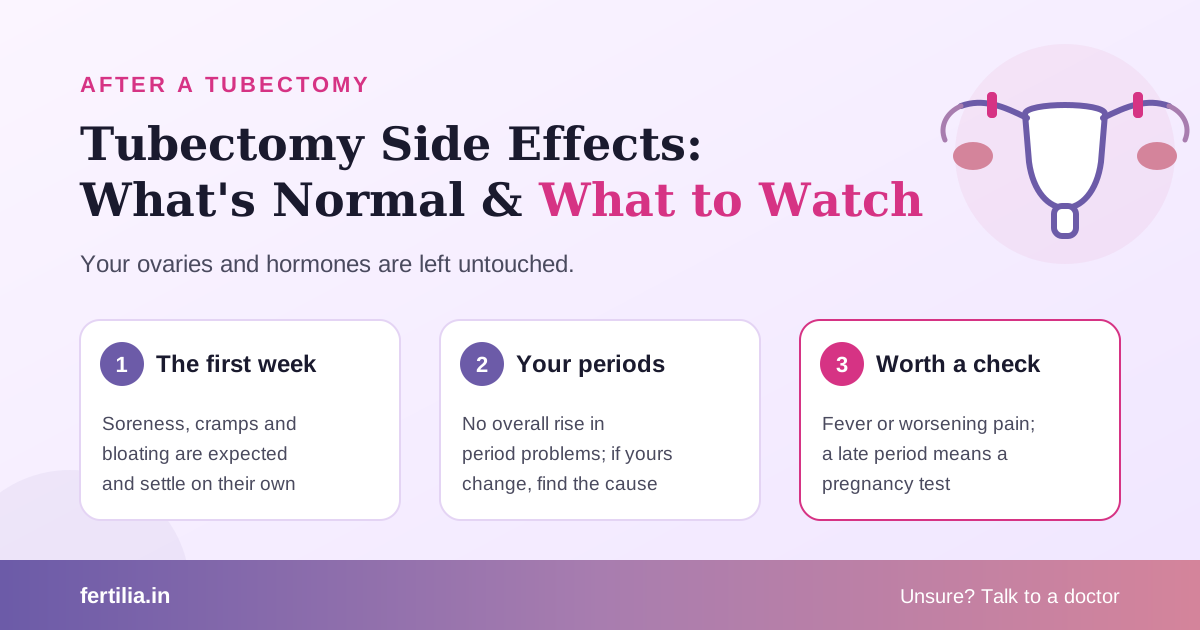
- The first week: soreness, cramping, bloating and shoulder-tip pain are normal and settle. Fever, worsening pain, a discharging wound or heavy bleeding are not.
- Your hormones are unchanged. The ovaries and uterus stay, so periods continue and menopause arrives on its usual timeline.
- Period changes are possible but not the rule. The largest study found no overall increase in menstrual problems, and women who had the operation were more likely than the comparison group to report lighter periods. If yours have changed, look for the cause.
- Pregnancy is rare but possible, even years later. A late period means a pregnancy test, and a positive test means prompt care to rule out an ectopic pregnancy.
- Weight gain and back pain have other causes, and those causes can be treated.
For a broader look at cycle changes worth tracking, Fertilia’s Period Health Guide is a useful companion.
Frequently Asked Questions
What are the common side effects of tubectomy?
In the first week or two: soreness at the incision, lower abdominal cramps, bloating, shoulder-tip pain after laparoscopy, and tiredness. These settle on their own. Serious complications are uncommon; in a large US study, complications after interval laparoscopic sterilisation occurred in 0.9 to 1.6 per 100 procedures, and serious problems were rare.
Do periods become heavy after tubectomy?
Not for most women. A study of more than 9,500 women found tubectomy did not increase menstrual problems overall, and women were more likely to report lighter bleeding and less period pain afterwards. A common reason periods seem heavier is stopping the pill, injection or hormonal coil that was keeping them light before. If your periods are heavy, get them checked rather than assuming the operation is the cause.
Can tubectomy cause irregular periods?
The large CREST study found a modest increase in reported cycle irregularity after tubectomy, without an increase in overall menstrual problems. Irregular periods also become common with age, after a delivery and while breastfeeding, so it is worth looking for those causes. Irregular cycles with a missed period should always prompt a pregnancy test.
Does tubectomy cause weight gain?
There is no hormonal reason for it to. The ovaries are left in place and keep making oestrogen and progesterone. Weight gain after the operation usually reflects the same life stage: recovery after pregnancy, less sleep, less time to exercise and age-related changes in metabolism.
Nasbandi ke baad side effects kya hote hain? (What are the side effects after nasbandi?)
Nasbandi is the Hindi term for sterilisation, so the answer is the same as for tubectomy: short-term soreness and cramping that settle within a week or two, no change in hormones, and a small but lasting chance of pregnancy, which may be ectopic. Most long-term complaints blamed on the operation, such as weight gain and back pain, have other causes that can be treated.
Can you get pregnant after tubectomy?
Rarely, yes. In the CREST study, the 10-year chance of pregnancy ranged from about 7.5 to 36.5 per 1,000 procedures depending on the method used, and the risk was higher in women sterilised young. Because a pregnancy after tubectomy is more likely to be ectopic, a late period means a pregnancy test, and a positive test means seeing a doctor promptly.
Does tubectomy affect sex life?
For most women, no. In a study of 4,576 women, more than 80% reported no consistent change in sexual interest or pleasure, and among those who noticed a change, it was far more often positive than negative.
Talk It Through With a Doctor
Many women live for years with heavy periods, pelvic pain or worry, believing it is simply the price of the family planning operation. Often there is a clearer cause and a treatment for it. In video consultations at Fertilia, Dr. Suganya Venkat reviews your symptoms, your operation details and any reports you already have with women from across India, and helps you plan the right tests or the right specialist locally.
💜 Worried about a symptom since your tubectomy? Message Dr. Suganya on WhatsApp to book a ₹399 video consultation.