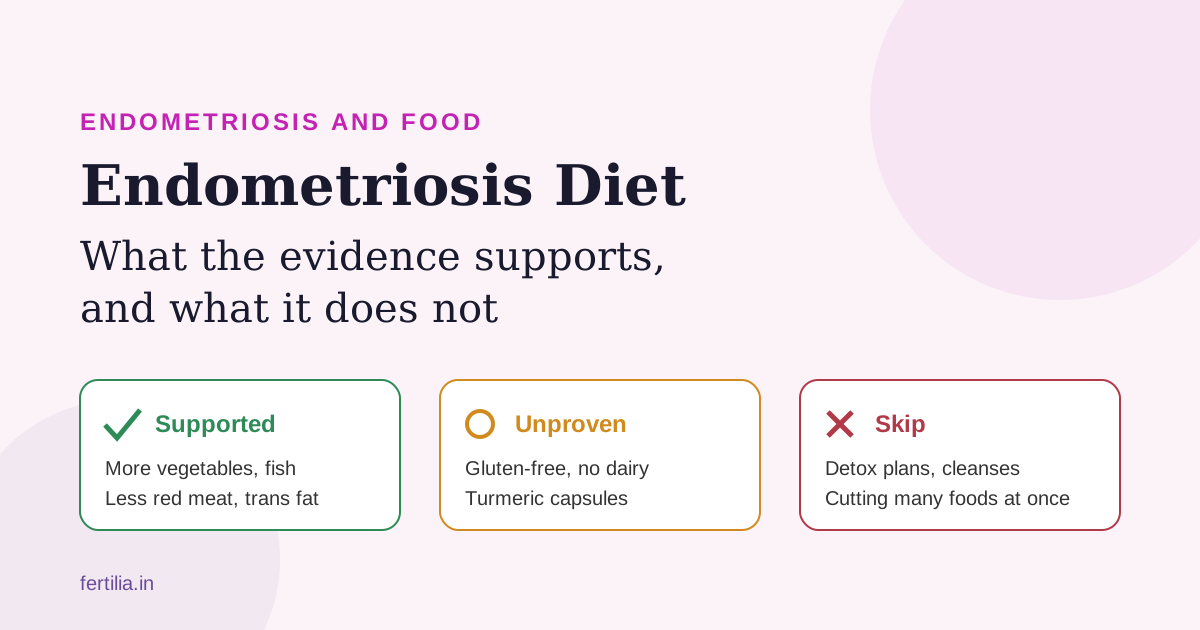
Almost every woman with endometriosis I see has already changed her diet before she reaches me. Some have stopped wheat. Some have cut out milk, curd and paneer. Some are drinking turmeric water every morning and avoiding tomatoes because a video told them to. Many of them are eating less, enjoying food less, and still having the same pain.
That effort deserves a straight answer. Food can help some women with endometriosis feel better, and the evidence for a few changes is reasonable. But no diet treats the disease itself, and some of the most popular rules have very little behind them.
This post sorts the research into three groups: what is reasonably supported, what is unproven, and what I would leave alone. It is written for women who already have a diagnosis, or a strong suspicion, and want to know where food fits alongside their medical care.
Where Diet Fits in Endometriosis Care
Endometriosis is a condition where tissue similar to the lining of the uterus grows outside it, usually on the ovaries, the pelvic lining and the bowel surface. It causes inflammation, pain and, for some women, difficulty conceiving. The main treatments are medical (hormonal treatment and pain relief) and, when needed, surgery. If you are still working out whether your pain is endometriosis, start with our guide on when period pain points to endometriosis.
Diet sits alongside that care. It does not replace it. In fifteen years as an OB-GYN, the pattern I see is that food changes help most with three things: bowel symptoms that flare around periods, general energy and weight, and the sense that you have some control over a condition that often feels out of your hands.
That last point matters. A Dutch survey of 157 women with endometriosis found that many had already changed their diet, and 71.3% of the specific changes they made were reported to reduce pain-related symptoms. Yet their diet quality was not linked to their measured quality of life (Krabbenborg I et al., Reprod Biomed Online, 2021, PMID 34493462). Women feel a benefit, and that feeling is real, but researchers have not yet been able to show which change produces it.
What the Research Can and Cannot Tell Us
Most diet research in endometriosis comes in two kinds, and it helps to know which one you are reading about.
Studies of risk. These follow large groups of women for years and ask whether what they ate was linked to being diagnosed with endometriosis later. They tell us about patterns, not about treatment. A food linked to lower risk is not proven to reduce pain in a woman who already has the condition.
Studies of treatment. These try a diet in women who already have endometriosis and measure symptoms. These are the ones that matter most to you, and they are few and small. A systematic review found only nine human studies of dietary interventions, of which two were randomised controlled trials. Most reported a benefit, but the studies carried moderate or high risk of bias, and each tested a different diet (Nirgianakis K et al., Reprod Sci, 2022, PMID 33761124).
So when you read that a food “cures” or “starves” endometriosis, you can be confident that claim has gone well beyond the evidence.
What Is Reasonably Supported
More vegetables and fruit
In an Italian case-control study of 504 women with laparoscopically confirmed endometriosis and 504 controls, women with the highest intake of green vegetables had a markedly lower risk (odds ratio 0.3), and those eating the most fresh fruit also had lower risk (odds ratio 0.6) (Parazzini F et al., Hum Reprod, 2004, PMID 15254009). This is a risk study, not a treatment trial. But vegetables and fruit help almost every other part of your health too, so there is no downside to building meals around them.
In an Indian kitchen this is easy: keerai (greens) in a poriyal or kootu, a vegetable sambar, a bowl of seasonal fruit such as guava, papaya or orange. Aim for vegetables at two meals a day rather than one.
Less red meat
In the Nurses’ Health Study II, women eating more than two servings of red meat a day had a 56% higher risk of endometriosis than women eating one serving a week or less. Poultry, fish, shellfish and eggs were not linked to risk (Yamamoto A et al., Am J Obstet Gynecol, 2018, PMID 29870739). The authors were careful to say that intervention studies are needed to confirm this.
For most Indian women this is a small change, since mutton is rarely a daily food. If you do eat it often, swapping some of those meals for fish, chicken, eggs, dal or chana is a sensible move.
Omega-3 fats in, trans fats out
The same cohort looked at dietary fat. Total fat was not linked to endometriosis. But women in the highest fifth of long-chain omega-3 intake were 22% less likely to be diagnosed, and women in the highest fifth of trans fat intake were 48% more likely (Missmer SA et al., Hum Reprod, 2010, PMID 20332166).
In practice:
- Add: fish such as mathi (sardine), ayala (mackerel) once or twice a week if you eat fish. Vegetarian sources like walnuts and flaxseed (alsi) offer a plant omega-3, though it is a different form from the fish oils studied.
- Reduce: vanaspati and reused frying oil, packaged bakery biscuits, puffs and namkeen made with hydrogenated fat. Check labels for “partially hydrogenated” oil.
A low FODMAP trial, if bowel symptoms are a big part of your pain
Many women with endometriosis also have bloating, cramps, diarrhoea or constipation, often worse around their period. In a specialist IBS clinic, 36% of women meeting criteria for IBS also had endometriosis, and 72% of them reported more than a 50% improvement in bowel symptoms after four weeks of a low FODMAP diet, compared with 49% of women with IBS alone (Moore JS et al., Aust N Z J Obstet Gynaecol, 2017, PMID 28303579).
That is a retrospective study, and it measured gut symptoms rather than pelvic pain. But it is the most practical evidence we have for a specific diet. Low FODMAP is a short, structured elimination (onion, garlic, wheat, some dals and some fruits are reduced), followed by reintroduction to find your own triggers. It is not meant to be followed forever, and it works best with guidance so you do not end up on a restricted diet you did not need.
What Is Unproven
Going gluten-free
Gluten-free diets are very popular in endometriosis communities, and in the Dutch survey removing gluten was among the changes women felt helped most. But there is no good-quality trial showing that a gluten-free diet reduces endometriosis pain in women who do not have coeliac disease. If you feel better without wheat, that may be a FODMAP effect (wheat is high in fructans) rather than gluten itself. If you suspect coeliac disease, get tested before cutting gluten, because the test becomes unreliable once you stop eating it.
Cutting out all dairy
This is the rule I most often ask women to reconsider. In the Nurses’ Health Study II, higher intake of total and low-fat dairy foods was associated with a lower risk of endometriosis, not a higher one (Harris HR et al., Am J Epidemiol, 2013, PMID 23380045). That does not prove dairy treats the condition. But it is the opposite of what many online diets claim, and removing curd, milk and paneer takes away an easy source of calcium and protein. If a particular dairy food clearly upsets your gut, adjust that one food rather than dropping the whole group.
Turmeric, ginger and “anti-inflammatory” supplements
Haldi and adrak are good foods and belong in your cooking. There is interesting laboratory research on curcumin, but no human trial shows that turmeric supplements treat endometriosis. Culinary amounts are fine. High-dose capsules are a different matter, and are worth discussing with your doctor first, especially if you are on other medicines or trying to conceive. For a broader look at eating this way, see our OB-GYN guide to an anti-inflammatory diet.
Soy
Soy appears on many “avoid” lists because it contains plant oestrogens. The evidence does not support strict avoidance at normal food amounts. If you already eat soya chunks or tofu occasionally, there is no reason to panic about them.
What I Would Leave Alone
- “Endometriosis detox” plans and juice cleanses. There is no evidence for them, and they can leave you underfed.
- Diets that remove several food groups at once without a plan. Cutting wheat, dairy, soy, sugar and nightshades together makes it impossible to know what helped, and it raises the risk of low iron, calcium and protein.
- Any claim that food can shrink endometriosis or replace treatment. Diet can support how you feel. It cannot remove endometriosis lesions or cysts.
A Practical Starting Plan
You do not need a special “endometriosis diet”. A simple, steady Indian plate covers most of what the evidence supports:
- Vegetables at two meals a day, with a mix of greens, gourds and seasonal produce.
- A protein at every meal: dal, chana, rajma, eggs, fish, chicken, curd or paneer.
- Fish once or twice a week if you eat it; walnuts or flaxseed if you do not.
- Red meat as an occasional food, not a daily one.
- Fewer packaged fried snacks and bakery items made with hydrogenated fat.
- Keep a symptom diary for six to eight weeks, noting pain, bowel symptoms and your cycle day. This is the most useful thing you can bring to a consultation.
- If bowel symptoms dominate, ask about a guided low FODMAP trial rather than cutting foods at random.
Change one or two things at a time. That way, if something helps, you will know what it was.
When Diet Is Not Enough
If your pain is stopping you from working or studying, if painkillers are not controlling it, or if you are trying to conceive, diet alone is not the right plan. Hormonal treatment, pain management and, for some women, surgery make a far bigger difference to pain. Our posts on endometriosis excision surgery and endometriosis and fertility walk through those options.
At Fertilia, Dr. Suganya Venkat, an OB-GYN with over 15 years of experience, reviews the full symptom picture with women over a video consultation and fits food changes around their medical plan, so the diet supports the treatment instead of standing in for it.
If you would like help working out what to change and what to leave alone, message Dr. Suganya on WhatsApp: wa.me/919940200330. The consultation is ₹399 and available online pan-India.
For a free overview of period pain, cycles and when to seek care, download our Period Health guide.
Frequently Asked Questions
Is there a best diet for endometriosis?
No single diet has been proven to treat endometriosis. The most reasonably supported pattern is plenty of vegetables and fruit, regular omega-3 sources such as fish, less red meat and fewer trans fats. A guided low FODMAP trial can help when bowel symptoms are a major problem.
Which foods should I avoid with endometriosis?
The clearest associations in research are with high red meat intake and high trans fat intake, so reducing daily mutton and packaged fried or bakery foods made with hydrogenated oil is sensible. Beyond that, avoid only the foods that clearly worsen your own symptoms, which a symptom diary helps you find.
Does a gluten-free diet help endometriosis pain?
There is no good-quality trial showing that it does in women without coeliac disease. Some women feel better without wheat, which may be because wheat is high in FODMAPs. If you suspect coeliac disease, get tested before stopping gluten.
Should I stop milk and curd if I have endometriosis?
Not routinely. A large cohort study found higher dairy intake was associated with a lower risk of endometriosis, not a higher one. Dairy is also an important source of calcium and protein. If one dairy food upsets your stomach, adjust that food rather than cutting all dairy.
Can diet cure endometriosis or shrink a chocolate cyst?
No. Diet can help with bowel symptoms, energy and overall wellbeing, but it cannot remove endometriosis lesions or endometriomas. Medical treatment and, when needed, surgery address the disease itself.
Does a low FODMAP diet work for endometriosis?
It can help bowel symptoms. In one clinic study, 72% of women with both endometriosis and IBS reported more than a 50% improvement in gut symptoms after four weeks. It is a short elimination followed by reintroduction, and works best with guidance.
Can I take turmeric capsules for endometriosis?
Turmeric in cooking is fine. There is no human trial showing turmeric supplements treat endometriosis, so discuss high-dose capsules with your doctor first, especially if you take other medicines or are trying to conceive.
Not sure where food fits in your endometriosis care? Talk it through with Dr. Suganya over a video consultation. Message on WhatsApp: wa.me/919940200330. ₹399, online pan-India.