You open the period tracker app, and it has given up on you. Last cycle was 34 days, the one before was 47, and this month you are on day 40 with no sign of anything. Every fertility article you read says “ovulation happens on day 14”, and you are left wondering whether you ovulate at all, and whether getting pregnant is even possible for you.
It is. Irregular periods make conception harder to time, and sometimes they point to a cause that needs treatment, but a large number of women with unpredictable cycles do conceive, many of them naturally. I’m Dr. Suganya Venkat, an OB-GYN, and in my practice irregular cycles are one of the most common reasons a woman first writes to me while trying for a baby. In most of these women, once we understand the pattern, there is a lot we can do.
This post covers:
- Why irregular cycles make conception harder to time, and why that is often solvable
- How to find your fertile window when your dates keep moving
- How long to try on your own before seeing a doctor
- Which tests to ask for, and what treatment can do
If you want to understand why your periods are irregular in the first place, that is covered separately in our guide to irregular periods: causes and what helps. This post stays focused on the conception question.
Can You Get Pregnant With Irregular Periods?
Yes. A period is the end of a cycle, but the part that matters for pregnancy is ovulation, the release of an egg. An irregular cycle can mean one of two things:
- You ovulate, but at a different time each month. The egg is released on day 18 one cycle and day 30 the next. Pregnancy is fully possible; you just cannot predict the window from the calendar.
- You ovulate only some months, or rarely. This is called oligo-ovulation (infrequent ovulation) or anovulation (no ovulation). Fewer ovulations mean fewer chances each year, which is why these women benefit from medical help sooner.
Most women cannot tell which of these applies to them from the period dates alone. That is exactly what the simple steps and tests below help you work out.
Why Timing Is the Real Challenge
The window for conception is short. In a landmark study of 221 healthy women trying to conceive, conception occurred only when intercourse took place during a six-day period that ended on the estimated day of ovulation (Wilcox AJ et al., N Engl J Med, 1995, PMID 7477165). Outside those six days, the chance was essentially zero.
The same research group later looked at when that window actually falls. Even in women whose cycles were usually regular, the fertile window occurred across a broad range of days, and only about 30% of women had their fertile window entirely within days 10 to 17 of the cycle (Wilcox AJ et al., BMJ, 2000, PMID 11082086). The authors advised that the timing of the fertile window can be highly unpredictable, even if cycles are usually regular.
If that is true for regular cycles, it applies even more to yours. So the “day 14” rule is not a useful tool for you, and the methods that work are the ones that read your body rather than your calendar.
How to Find Your Fertile Window When Your Cycles Vary
1. Watch your cervical mucus
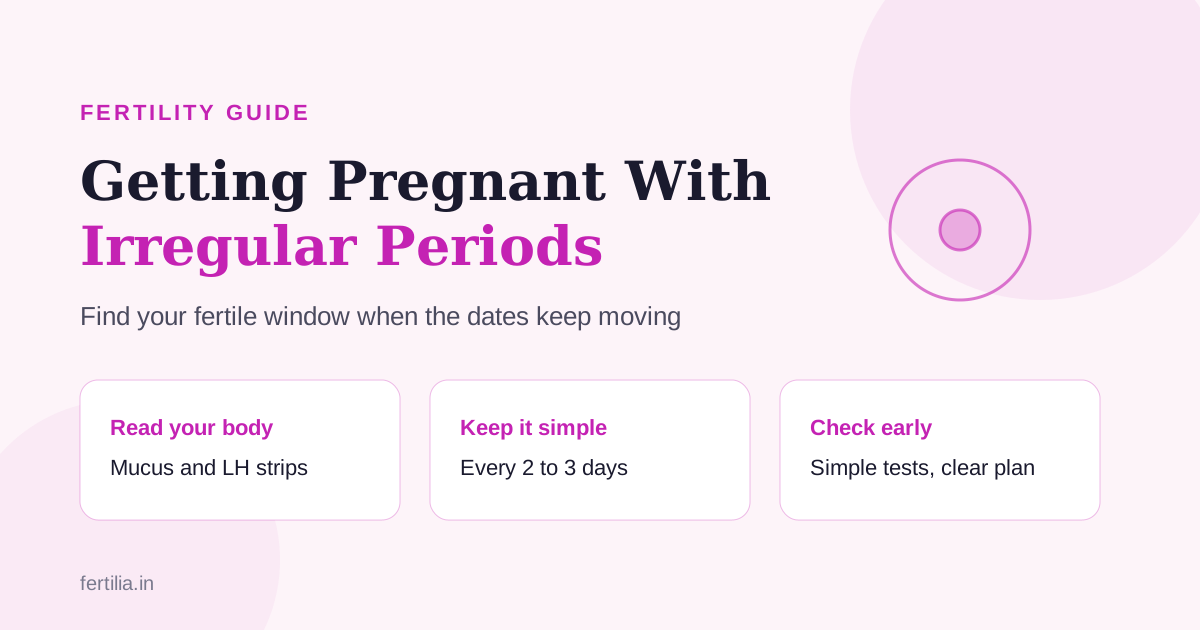
In the days before ovulation, rising oestrogen changes the discharge from your cervix. It goes from dry or sticky to creamy, and then to clear, slippery and stretchy, a bit like raw egg white. That stretchy phase marks your most fertile days, and it shows up whenever ovulation is approaching, whether that is day 16 or day 35.
This is the single most useful free tool for women with irregular cycles, because it moves with your body. Our cervical mucus guide shows what each type looks like and how to check.
2. Use LH strips, but start early and test longer
Ovulation strips detect the surge of luteinising hormone (LH) that comes a day or so before ovulation. With regular cycles, women test for a few days mid-cycle. With irregular cycles, that approach misses the surge. What works better:
- Start testing from around day 10 of your cycle.
- Test once a day (or twice a day if you have had a negative month despite testing), and keep going until you see a clear positive.
- Pair the strip with mucus checks. Egg-white mucus plus a positive strip is a strong signal.
One caution: if you have PCOS, your baseline LH can be high, so some strips may show faint or “almost positive” lines for days. In that case mucus and, if needed, a follicle scan give a clearer picture. Our guide on how to track ovulation compares the methods side by side.
3. Do not rely on the app’s prediction
Period apps predict ovulation from your past cycle lengths. When your cycle lengths vary by a week or more, the prediction is a guess. Use the app to log your periods, mucus and strip results, and ignore its “fertile days” colour bar.
4. Make the timing simpler: every two to three days
The most reliable approach of all needs no testing. Because sperm can wait in the reproductive tract for a few days, the six-day window described above can be covered without knowing the exact day. For a couple whose fertile window moves around, sex every two to three days through the whole cycle means a fertile day is very rarely missed, and it takes the pressure of a single “big day” off both of you.
5. Confirm that you ovulated
Mucus and strips tell you ovulation is coming. To know it actually happened, two tests help:
- A progesterone blood test about a week after you think you ovulated (often called the day 21 progesterone, though with irregular cycles the day is timed from your ovulation signs, not the calendar). Our post on day 21 progesterone explains how to time it.
- A follicle-tracking scan (folliculometry), a series of ultrasounds that watches a follicle grow and release. This is especially useful when strips are confusing. See what a follicular study tracks.
💜 Cycles all over the place and not sure whether you are ovulating? Message Dr. Suganya on WhatsApp to book a ₹399 video consultation. Bring your last few cycle dates and any reports you already have.
How Long Should You Try Before Seeing a Doctor?
The usual rule you will read is to try for 12 months before seeking help (6 months if you are 35 or older). That timeline is meant for couples with no known reason to expect a problem. Irregular or absent periods are a known reason, so in my practice I do not ask women with irregular cycles to wait a full year.
My practical advice:
- Cycles mostly 21 to 35 days, with some variation: track with mucus and strips for 3 to 6 months. If you are not pregnant by then, or if you never see a positive strip, see a doctor.
- Cycles often longer than 35 days, or fewer than about 8 periods a year: see a doctor now, before you start counting months. You may be ovulating rarely, and every month of waiting is a month with fewer chances than it seems.
- No periods for 3 months or more (and not pregnant): see a doctor now.
- 35 or older with irregular cycles: see a doctor at the start.
A few simple tests can save you a year of guessing about what is going on.
Which Tests to Ask For
Your doctor will tailor this, but a typical first workup for irregular cycles includes:
| Test | What it tells you |
|---|---|
| Pregnancy test | Rules out an early pregnancy as the reason for a late period |
| TSH (thyroid) | An underactive or overactive thyroid commonly disturbs cycles |
| Prolactin | A raised prolactin can stop ovulation; it is treatable |
| Day 2 to 3 FSH, LH, estradiol | Baseline hormone pattern; see our day 3 hormone test guide |
| AMH | A marker of egg reserve; often high in PCOS, low in reduced reserve |
| Pelvic ultrasound | Ovary appearance (including the PCOS pattern), uterus and lining |
| Progesterone after suspected ovulation | Confirms whether ovulation happened that cycle |
| Testosterone, fasting sugar or HbA1c | When PCOS is suspected, to understand its drivers |
| Partner’s semen analysis | Male factor is common and the test is simple; do it alongside yours |
Not everyone needs every test, and the semen analysis is worth doing early, because there is no point fixing ovulation perfectly if a sperm issue is the bigger factor.
What Helps: Treating the Cause and Supporting Ovulation
Once the cause is clear, the plan usually becomes much simpler.
PCOS. This is the most common reason for irregular cycles in women trying to conceive. It is diagnosed by the Rotterdam criteria, and the drivers behind it (insulin resistance, androgen excess, inflammation and others) differ from woman to woman. Lifestyle changes that improve insulin sensitivity can bring back ovulation in many women. When medicine is needed, letrozole is now widely used first: in a large trial of 750 women with PCOS, letrozole was associated with higher live-birth and ovulation rates than clomiphene (Legro RS et al., N Engl J Med, 2014, PMID 25006718). Our step-by-step guide on conceiving naturally with PCOS covers this route in full.
Thyroid or prolactin problems. These are among the most satisfying to find, because correcting the hormone often brings cycles back on its own. Your doctor will guide the treatment.
Weight and lifestyle. Both low body weight and higher body weight can disturb ovulation. Small, steady changes help: regular meals built around dal, vegetables and whole grains like ragi or millets, daily movement such as a brisk walk, and consistent sleep. A heavy crash diet or very intense exercise can make cycles more irregular, not less.
Stress and recovery after stopping the pill. Cycles can take a few months to settle after stopping hormonal contraception, and big life stress can delay ovulation. These are usually temporary, though they still deserve a check if cycles do not settle.
Ovulation induction and monitoring. If ovulation does not return with treatment of the cause, ovulation-inducing tablets or injections, timed with follicle scans, are effective and well established. For a few couples, IUI or IVF becomes the right next step, and arriving at that point well prepared is a good outcome in itself.
At Fertilia, our fertility program works alongside your gynaecologist: we help you understand your cycle pattern and reports, and build the nutrition, movement and sleep plan around whatever medical treatment you are on. You can read more on our fertility program page.
A Simple Plan for This Month
- Log every period start date, and note your mucus each day.
- Start LH strips from around day 10 and continue until a positive.
- Have sex every two to three days through the cycle, rather than aiming for one day.
- If your cycles are often longer than 35 days, book a consultation now rather than waiting.
- Ask your partner to get a semen analysis done in parallel.
Our free ovulation tracking guide has a printable chart to make the first two steps easier.
Frequently Asked Questions
Can I get pregnant if my periods are irregular?
Yes. Many women with irregular periods ovulate, just at different times each cycle, and conceive. If you ovulate only occasionally, your chances per year are lower, and medical treatment to support ovulation can help. A few basic tests can tell you which situation you are in.
Irregular periods me pregnant kaise hote hain? How do I know when I am ovulating?
With irregular periods, count on body signs rather than dates. Clear, stretchy, egg-white cervical mucus and a positive LH strip mean ovulation is close. Start strips from around day 10 and keep testing until you see a positive, and have sex every two to three days so the window is not missed.
Do ovulation kits work with irregular periods?
They do, but you need to start earlier and test for longer than the box suggests, sometimes for several weeks. In PCOS, LH can be raised at baseline, which may give confusing lines; checking mucus or having a follicle scan helps in that case.
How long should I try before seeing a doctor if my cycles are irregular?
If your cycles are mostly 21 to 35 days, try for 3 to 6 months with tracking. If cycles are often longer than 35 days, you have fewer than about eight periods a year, you have had no period for three months, or you are 35 or older, see a doctor at the start.
Does an irregular period mean I have PCOS?
Not necessarily. PCOS is a common cause, but thyroid problems, raised prolactin, weight changes, stress and stopping the pill can all cause irregular cycles. PCOS is diagnosed using the Rotterdam criteria, with blood tests and an ultrasound, not from cycle length alone.
Can irregular periods become regular again?
Often, yes. When the cause is treated, such as correcting thyroid levels, improving insulin sensitivity in PCOS, or steady changes in weight and sleep, many women see their cycles become more predictable. Even when they do not, ovulation can usually be supported with treatment.
Talking It Through
Irregular cycles can make trying to conceive feel like guesswork, and the guesswork is often the most tiring part. A clear plan, a few tests and a way to read your own body usually change that quickly.
💜 Trying to conceive with irregular cycles? Message Dr. Suganya on WhatsApp to book a ₹399 video consultation, available online across India. Share your cycle dates and any reports, and we will work out the next step together.