The question I hear most often from women with hypothyroidism is some version of this: “My thyroid is controlled now. Can I still have a baby?”
It is a reasonable question, and the answer, in most cases, is yes.
But there is a lot buried in the phrase “controlled thyroid.” Most women with hypothyroidism have been told their TSH is within the normal range. What they have not been told is that “normal for the general population” and “optimal for conception” are two different numbers. That gap is where a significant number of women lose months, sometimes over a year, before someone looks at the result more carefully.
This post is for women who already know they have hypothyroidism and are either planning to conceive or have been trying without success. It covers what hypothyroidism does to ovulation specifically, what TSH target to aim for before you start trying, how to track ovulation when your cycles are affected by thyroid dysfunction, and what to do if the thyroid is fixed and conception still has not happened.
Thyroid problems are among the most treatable causes of fertility disruption. That is genuinely good news, and the reason this diagnosis is worth taking seriously early.
How Hypothyroidism Disrupts Ovulation
Thyroid hormones reach into nearly every system in the body. The reproductive system is not an exception.
When thyroid hormone levels fall, the brain responds by releasing more thyrotropin-releasing hormone (TRH) to stimulate the thyroid gland. TRH also stimulates the pituitary to release prolactin, the hormone associated with milk production. In a woman who is not breastfeeding, elevated prolactin interferes with the normal pulsatile release of GnRH from the hypothalamus. Without adequate GnRH signalling, LH and FSH are not released in the right amounts or at the right times, and the ovulatory cascade falters. The result: ovulation becomes delayed, irregular, or absent (Krassas et al., 1999, PMID 10468932).
This is why hypothyroid women so often present with longer cycles, missed cycles, or what looks like irregular bleeding. The problem is not primarily with the uterus or the ovaries. It is a signalling problem, driven by the thyroid-TRH-prolactin-GnRH cascade. Treat the thyroid, and the signalling often corrects itself.
A second mechanism that matters for women who are actively trying to conceive: even subclinical hypothyroidism (a mildly elevated TSH with normal T4) can shorten the luteal phase. For implantation to occur, the luteal phase needs to be at least 12 to 14 days long and progesterone needs to hold throughout. A compressed luteal phase of 8 to 10 days, which hypothyroidism can contribute to, shortens the implantation window and is associated with early pregnancy loss. For a detailed look at this pattern, our post on luteal phase defect covers the signs and how to investigate it.
In Tamil: thyroid problems that disrupt cycles are referred to in the context of “thairaidu” (தைராய்டு) affecting “maadhavidaai” (மாதவிடாய்). In Hindi, this is often described as “thyroid ki wajah se period irregular ho jaana.” These are real search terms that bring many women to a thyroid-fertility conversation for the first time.
The TSH Target That Matters for Conception
Most labs report a TSH result as “normal” if it falls between 0.4 and 4.5 mIU/L. For general health purposes, that range is reasonable.
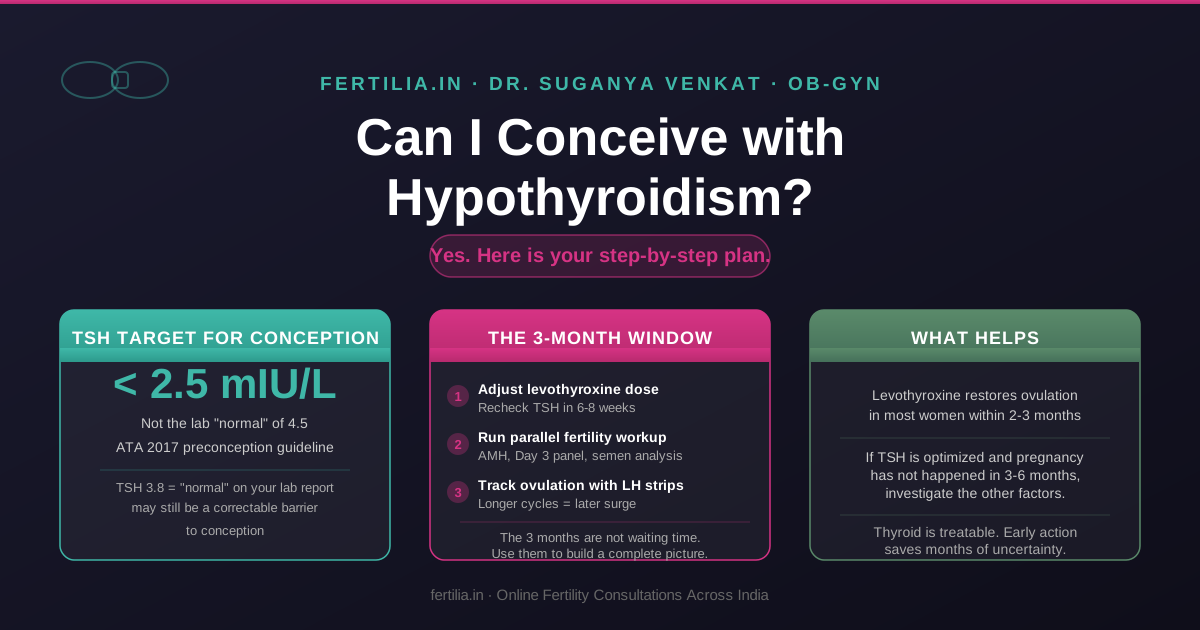
For women trying to conceive, the picture is different. The American Thyroid Association (ATA) 2017 guideline recommends that women with hypothyroidism who are already on levothyroxine and planning pregnancy have their dose adjusted to keep TSH below 2.5 mIU/L (PMID 28056690). The target reflects studies associating a TSH between 2.5 and 4.5, a range most labs still stamp as “normal,” with lower pregnancy rates and more early losses. Not every study has found that association, which is why the guideline treats 2.5 as a target for women already on treatment rather than a universal cut-off for starting it.
What this means practically: a woman with a TSH of 3.8 who has been told her thyroid is fine may have a correctable barrier to conception sitting in plain sight on her blood report. This is not an unusual scenario. It comes up regularly in women who have been trying for 6 to 12 months without a clear explanation.
The conversation with your treating doctor is worth having. If your TSH is above 2.5 and you are actively trying to conceive, a dose adjustment is supported by current evidence and by standard fertility guidelines.
A note on subclinical hypothyroidism specifically: if your T4 is normal, your TSH sits between 2.5 and 4.0 mIU/L, and you are not on any thyroid medication, the decision to start levothyroxine depends on your anti-TPO antibody status. The ATA 2017 guideline says treatment may be considered when antibodies are positive; when they are negative and TSH is inside the normal range, it advises monitoring rather than starting medication. Above the upper limit of the reference range (4.0 mIU/L where no pregnancy-specific range exists), treatment is recommended if antibodies are positive and worth discussing if they are negative, and above 10 mIU/L it is recommended regardless. If you are heading into IVF or ICSI, the guideline does recommend treating subclinical hypothyroidism to bring TSH under 2.5. Our post on subclinical hypothyroidism and TSH targets in pregnancy walks through this decision tree, and asking for an anti-TPO result alongside TSH makes the conversation with your doctor much more concrete.
For more on this, read our guide on Subclinical Hypothyroidism in Pregnancy. For an overview of how thyroid function affects the broader fertility picture (including nutrition, antibodies, and the PCOS connection), our earlier post on thyroid and fertility covers those angles in detail.
The 3-Month Optimization Window
Once you and your doctor have adjusted your levothyroxine dose to bring TSH below 2.5, allow roughly 6 to 8 weeks for the new dose to reach steady state. TSH should be rechecked 6 to 8 weeks after any dose change. Then allow one or two cycles to normalize before counting your conception attempts. In practice, this adds up to roughly 3 months from dose adjustment to being ready to try in a stable way.
Three months can feel like a long wait when you are already impatient to conceive. The thing to know is that this window is not passive waiting time. It is also when you should be running the rest of your fertility workup in parallel.
Hypothyroidism may not be your only factor. One of the most common patterns I see is this: a woman spends 3 to 6 months optimizing her thyroid, then discovers another issue, and loses another 3 to 6 months as a result. Running the basic fertility panel during the optimization period costs almost nothing in time and gives you a clearer picture.
Investigations worth running during the 3-month window:
For you:
- Day 3 FSH, LH, and estradiol (baseline ovarian function)
- AMH (ovarian reserve, particularly important if you are 30 or older)
- Prolactin (hypothyroidism can elevate it; if TSH normalizes and prolactin stays high, a separate investigation is needed)
- Anti-TPO antibodies, if not already tested (elevated antibodies raise miscarriage risk even when TSH is normal)
For more on this, read our guide on Hashimoto’s and Conception. For your partner:
- Semen analysis (accounts for roughly 40% of fertility factors and takes one test to assess)
Our guide to the fertility workup for Indian couples covers what each test costs at Indian labs, what the numbers mean, and what to do with borderline results.
Have a thyroid diagnosis and want clarity on the next steps?
Tracking Ovulation When Thyroid Has Affected Your Cycles
A common source of confusion: women with hypothyroidism may have longer or irregular cycles, which makes standard ovulation tracking unreliable when done by the calendar.
If your cycle is 28 days, standard LH strip instructions tell you to begin testing around day 10 or 11. But if hypothyroidism has lengthened your cycle to 35 or 40 days, ovulation may not occur until day 20 or later. Testing from day 10 in a 40-day cycle means you will very likely miss the LH surge entirely, then conclude that ovulation is not happening, when it is simply happening later than expected.
A more reliable approach when cycles are irregular:
- Begin LH testing around day 10 and continue daily until you detect the surge, regardless of how many days that requires.
- Pair LH strips with basal body temperature (BBT) tracking to confirm that ovulation actually occurred, not just that an LH surge was detected. Some hypothyroid women have LH surges without a dominant follicle rupturing.
- Once TSH is optimized and two or three cycles have regulated, ovulation timing often stabilizes and the testing window can be narrowed.
If ovulation signs are absent even after TSH has normalized, that is a signal worth raising with your doctor. Prolactin may still be elevated despite TSH normalization, or there may be a separate ovulatory factor. Our post on how to track ovulation covers the practical methods, including what each approach works best for.
When PCOS Is Also in the Picture
Hypothyroidism and PCOS are the two most common hormonal conditions in Indian women of reproductive age, and they frequently coexist. Studies from Indian centres put the overlap at 18% to 22%, meaning roughly one in five women with PCOS also has an underlying thyroid problem (Sinha et al.).
When both are present, each makes the other harder to manage. PCOS-driven insulin resistance raises TSH. Hypothyroidism worsens insulin resistance, makes weight harder to shift, and amplifies cycle irregularity. Treating only the thyroid often produces incomplete results; treating only the PCOS leaves a thyroid driver intact.
When both conditions are present, the sequence that tends to work best is to optimize the thyroid first, because levothyroxine is a simple single medication and the response is relatively fast. Once TSH is at target, reassess the PCOS picture. Thyroid treatment alone sometimes partially corrects the ovulatory pattern, which changes how aggressively the PCOS needs to be managed. A detailed post on the bidirectional relationship: PCOS and Thyroid: When They Come Together.
If TSH Is Optimized and You Are Still Not Conceiving
You have been on levothyroxine for three months or more. TSH is confirmed below 2.5 mIU/L. Ovulation appears regular. And pregnancy has not happened.
At this point, the thyroid has been addressed and other factors need to be investigated. This is not the time to continue waiting.
What to look at:
Prolactin, if not yet checked: If prolactin remains elevated even after TSH normalizes, it needs a separate investigation. A small pituitary adenoma is one cause; certain medications are another. Our post on high prolactin and fertility covers the causes and what an investigation looks like.
Cycle quality: Have cycles fully normalized? If cycles are still longer than 35 days or shorter than 24 days, there may be additional ovulatory factors. A mid-luteal progesterone check (drawn 7 days after confirmed ovulation) can assess whether progesterone is holding adequately through the luteal phase.
Tubal and uterine anatomy: A hysterosalpingogram (HSG) to assess tube patency takes one appointment and provides important structural information. This becomes particularly relevant at 30 or older, or if there is any history of pelvic infection or prior surgery.
Partner’s semen analysis: If this was not done during the optimization window, run it now. Male factor accounts for roughly 40% of fertility delays and takes a single test to assess.
Standard fertility guidance recommends a full workup after 12 months of trying (or 6 months if you are 35 or older). With hypothyroidism already in the picture, I typically recommend starting the workup earlier, because the optimization period is time that has already passed and should not be counted twice.
You can find the resource we put together for couples working through this: Guide to Getting Pregnant.
Once You Conceive: What Changes with Levothyroxine
If you are on levothyroxine and conceive, one step should happen immediately: contact your doctor to discuss increasing your dose.
The thyroid requirement increases by 30% to 50% in the first trimester, before the fetal thyroid is functional. An underactive thyroid in early pregnancy carries risk of early loss and, if left uncorrected, developmental consequences for the baby. The dose increase should happen as soon as you have a positive test, not at your first antenatal visit.
A practical protocol many doctors use: take two extra doses of levothyroxine per week immediately on a positive test, temporarily increasing from 7 doses per week to 9. Your doctor may have a specific instruction based on your starting dose. The key point is not to wait for the 8-week appointment.
TSH monitoring in the first trimester should be every 4 to 6 weeks. The target through the first trimester is below 2.5 mIU/L, with slightly more relaxed targets in the second and third trimesters. These targets are set out in the ATA 2017 guideline (PMID 28056690), which your obstetric team will follow.
Frequently Asked Questions
My TSH is 3.2 and my doctor says it is normal. Is it affecting my fertility?
Your TSH of 3.2 falls within the standard lab range (0.4 to 4.5 mIU/L). What happens next depends on whether you are already on treatment. If you take levothyroxine, the ATA 2017 guideline recommends adjusting the dose to bring TSH below 2.5 mIU/L before conception, and a value of 3.2 may be contributing to subtle ovulatory irregularity or a shortened luteal phase even if your periods appear regular; discussing a dose adjustment with your doctor, citing the preconceptional guideline, is reasonable. If you are not on any thyroid medication, ask for an anti-TPO antibody test: with positive antibodies, starting a low dose may be considered, and with negative antibodies the guideline advises monitoring rather than treatment. Most doctors treating women who are TTC are receptive to this conversation.
How long does it take to conceive after starting levothyroxine?
It depends on how much thyroid disruption was present and what else is contributing to your fertility picture. If hypothyroidism was the primary barrier and TSH normalizes by 6 to 8 weeks on medication, many women see cycles regulate within 2 to 3 months and conceive within 3 to 6 months of starting treatment. Some conceive faster; others have additional factors that need addressing. Levothyroxine treats the thyroid; it does not independently guarantee conception.
Do I need to wait for three normal cycles before trying to conceive after starting levothyroxine?
There is no strict rule requiring exactly three cycles. The reasoning for waiting is to confirm that TSH has stabilized at the target level and that cycle length has normalized so ovulation timing becomes predictable. If your TSH is below 2.5 at your 6 to 8 week recheck and your cycle has regulated, there is no medical reason to wait further. This is a conversation worth having with your own doctor, who knows your specific situation.
Can hypothyroidism cause early miscarriage?
Yes. Even subclinical hypothyroidism (mildly elevated TSH with normal T4) is associated with higher rates of early pregnancy loss. A 2016 meta-analysis found that subclinical hypothyroidism was associated with a significantly increased miscarriage risk (Maraka et al., PMID 26837268). This is one reason preconceptional TSH optimization matters, not just for achieving pregnancy but for maintaining it through the first trimester.
I have both PCOS and hypothyroidism. Where do I start?
Optimize the thyroid first. Levothyroxine is a simple, well-tolerated medication and the response on TSH is typically seen within 6 to 8 weeks. Once TSH is at target (below 2.5 mIU/L), reassess the PCOS picture: cycle regularity, weight, androgen levels. Thyroid correction alone sometimes partially improves the PCOS-driven ovulatory pattern, which changes the aggressiveness with which PCOS needs to be managed. Then build the PCOS strategy on what remains.
Can I take levothyroxine while breastfeeding?
Yes. Levothyroxine is bio-identical to your body’s own thyroid hormone and is considered safe during breastfeeding. Do not stop your thyroid medication after delivery. Also note that postpartum thyroiditis (a thyroid flare that typically occurs 1 to 6 months after delivery) is more common in women with elevated anti-TPO antibodies. TSH monitoring in the postpartum period is worthwhile even if your thyroid was well-controlled during pregnancy.
Does diet alone fix hypothyroidism if it is mild?
Nutritional support (adequate selenium from sunflower seeds or til, iodine from iodised salt rather than rock salt or pink salt, iron from ragi and drumstick leaves) supports thyroid function and can help reduce anti-TPO antibody levels. But diet does not correct clinical or subclinical hypothyroidism on its own. If TSH is elevated and you are trying to conceive, medication is the appropriate intervention. Nutrition works alongside it. Our post on thyroid and fertility has the detailed food list for thyroid support.
TSH is controlled but still not conceiving after 3 to 6 months?
Talk to Dr. Suganya Venkat on WhatsApp
The Fertilia Fertility Program brings thyroid management, ovulation tracking, and the full workup together in one coordinated 90-day plan.
Dr. Suganya Venkat is an OB-GYN with 15+ years of clinical experience. She consults online across India. Her practice, Fertilia, helps women with fertility, PCOS, pregnancy, and postpartum care.