When I tell a woman that the antidepressant I am suggesting for her premenstrual dysphoric disorder can be taken for only about two weeks a month, she usually looks at me as if she has misheard. Everything she has been told about these medicines says otherwise: that you take them every day, that they take a month to work, that once you start you cannot easily stop. For ordinary depression, all of that is broadly true. For PMDD, much of it is not.
For more on this, read our guide on PMDD or Depression? Why Timing Tells Them Apart.
For more on this, read our guide on PMDD & the Pill.
For more on this, read our guide on Which Doctor Should You See for PMDD?.
For more on this, read our guide on PMDD vs PMS.
For more on this, read our guide on PMDD Without Medication. I am a psychiatrist, and I contribute educational content to Fertilia’s blog on women’s mental and hormonal health. This post is about one of the most useful and least understood facts in PMDD treatment: that SSRIs can be dosed only during the luteal phase, the roughly two weeks before your period. If you are weighing up medication and the idea of daily tablets is what is holding you back, this is the option worth understanding first.
If you are still working out whether what you have is PMDD at all, start with our psychiatrist’s guide to PMS and PMDD, then come back here. This post assumes you and a doctor are considering an SSRI and you want to understand how the dosing actually works.
What “luteal-phase dosing” means
Your menstrual cycle has two halves. The follicular phase runs from the first day of your period until ovulation. The luteal phase runs from ovulation until your next period starts, usually about 14 days. In PMDD, symptoms belong almost entirely to that second half: they build after ovulation, peak in the days before bleeding, and lift once your period arrives.
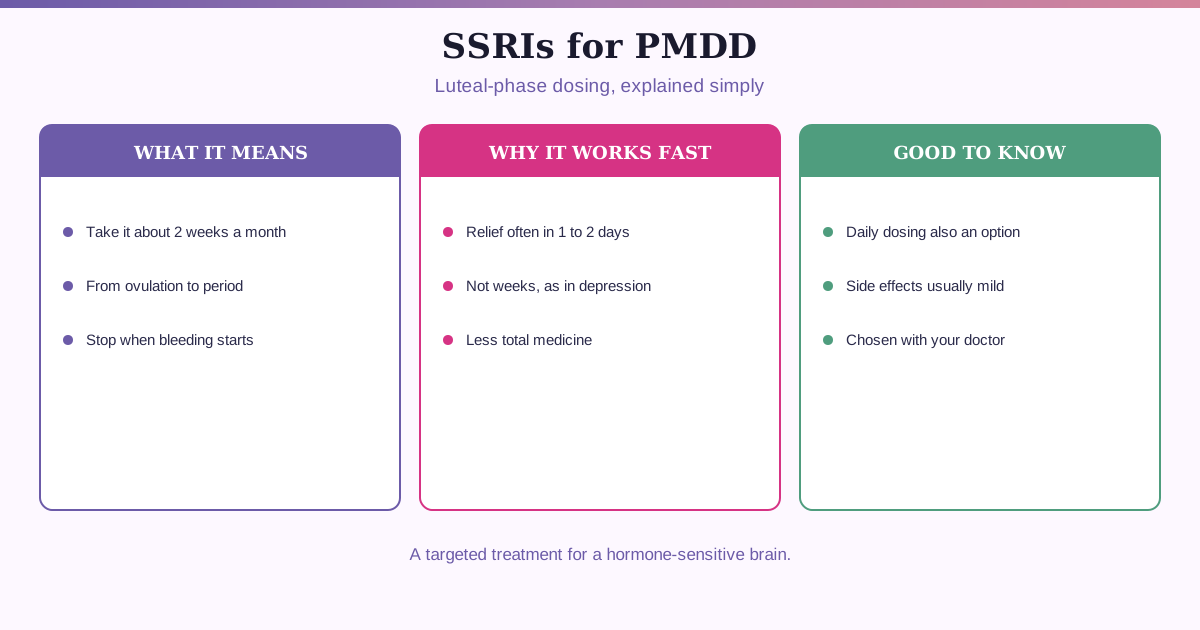
Luteal-phase dosing simply matches the medicine to that window. Instead of taking an SSRI every day of the month, you take it only during the luteal phase, then stop when your period comes. There are three recognised ways to prescribe SSRIs for PMDD (Steiner et al., 2013, CNS Drugs, PMID 23728922):
- Continuous dosing: every day, all month, the same as in depression.
- Luteal-phase dosing: starting around ovulation, roughly 14 days before your period is due, and stopping when bleeding begins.
- Symptom-onset dosing: starting each cycle only when your symptoms actually appear, and stopping a day or two into your period.
For a woman with predictable cycles, luteal dosing means taking medication for about half the month. That lower total exposure is exactly what makes this approach acceptable to many women who would otherwise refuse an antidepressant altogether.
Why it works when daily dosing for depression does not
Here is the part that genuinely surprises people, including some doctors. In depression, an SSRI takes two to four weeks to lift mood, because it works by slowly changing how nerve cells adapt to serotonin. If PMDD worked the same way, luteal dosing would be pointless, because the medicine would not have time to act before you stopped it.
But in PMDD, SSRIs work fast, often within a day or two. The current understanding is that in premenstrual disorders these drugs act through a second, quicker route: they rapidly influence a calming brain steroid made from progesterone, rather than waiting on the slow serotonin adaptation that antidepressant action in depression depends on (Hantsoo and Epperson, 2015, Current Psychiatry Reports, PMID 26377947). That rapid response is the whole reason luteal-only and symptom-onset dosing are even possible.
A 2024 Cochrane review confirmed the overall picture: SSRIs clearly reduce premenstrual symptoms, continuous daily dosing is somewhat more effective than luteal-phase dosing, but both work (Jespersen et al., 2024, Cochrane Database of Systematic Reviews, PMID 39140320). So luteal dosing is a real, evidence-based choice, with one practical caveat: if it does not fully control your symptoms, moving to continuous dosing is the usual next step.
Which SSRIs, and roughly what doses
The SSRIs with the best evidence in PMDD are sertraline, fluoxetine, escitalopram, and paroxetine. Your doctor chooses based on your history, side-effect profile, and whether you might conceive. As a general picture of what luteal dosing looks like in practice:
- Sertraline is one of the most-used, typically started at a low dose in the luteal phase and adjusted by response.
- Escitalopram has good trial data specifically for luteal dosing. In a randomised study, luteal-phase escitalopram reduced premenstrual symptoms in a dose-dependent way, with the higher dose being more effective for irritability in particular (Eriksson et al., 2008, Journal of Clinical Psychopharmacology, PMID 18344730).
- Fluoxetine has a very long half-life, which means it clears the body slowly and so causes essentially no stopping symptoms when you pause it each month.
- Paroxetine works but is more prone to discontinuation effects, so it is a less natural fit for a start-stop regimen.
I have deliberately not printed exact milligram numbers, because the right dose is a decision made with your own doctor around your symptoms and response, not something to self-prescribe from an article. The point to take away is that effective options exist and that the dose is titrated to you.
When to start and stop each cycle
The mechanics are simpler than they sound, and they rely on you knowing your cycle, which is one more reason a symptom chart is so useful (our guide to tracking your cycle for a PMDD diagnosis shows you how).
- Luteal-phase dosing: you begin around the time of ovulation, roughly 14 days before your period is expected, and continue daily until your period starts, then stop.
- Symptom-onset dosing: you begin on the first day you notice symptoms each cycle, and stop within a day or two of bleeding starting. This suits women whose symptom timing varies a little from month to month.
If your cycles are irregular, predicting the luteal phase is harder, and continuous dosing is often the more reliable choice. This is a practical point your doctor will weigh with you, not a failing on your part.
Side effects, and why they are usually manageable
SSRIs can cause nausea, headache, mild sleep changes, and reduced sexual desire or delayed orgasm. Most of these are mild and settle, and with luteal dosing you are only exposed to them for part of the month. Sexual side effects are the ones women most often want to discuss honestly, and they are worth raising openly, because the choice of drug and dose can be adjusted around them.
Stopping an SSRI abruptly can sometimes cause a short-lived cluster of symptoms such as dizziness or flu-like feelings. In luteal dosing this is rarely a problem, both because the doses used are modest and because the stopping happens as your period arrives, when you are already starting to feel better. Fluoxetine, with its long half-life, effectively tapers itself.
Addressing the stigma directly
In India, the biggest obstacle to this treatment is not the medicine, it is what people believe about it. Women worry that taking an antidepressant means they are mentally weak, that it will be lifelong, or that it will change their personality. None of that describes SSRI use for PMDD. This is a targeted treatment for a hormone-sensitive brain response, often used for only half the month, frequently for a defined period rather than forever, and reviewed with you rather than imposed. Accepting a treatment that works is not a weakness. Refusing effective help because of stigma is the thing that quietly costs women years.
If you are trying to conceive
If pregnancy is on your mind, this matters and you should raise it. Luteal-phase dosing means the medicine is in your system during the two weeks when conception could occur, so the choice of drug and whether to use one at all is made carefully with your doctor, with your pregnancy plans in full view (Yonkers et al., 2018, American Journal of Obstetrics and Gynecology, PMID 28571724). This is a collaborative decision alongside whoever is guiding your fertility care, never something to sort out alone or to stop suddenly out of worry. Our PMDD treatment guide covers how the whole plan shifts when you are trying to conceive.
A safety note I never leave out
For a minority of women, the premenstrual week brings dark thoughts, a sense that life is not worth it, that lift once the period comes. Because they pass, women often say nothing. Please do not wait these out. Cyclical suicidal thoughts are a recognised feature of severe PMDD, and they are treatable. If you are having thoughts of harming yourself, reach out now, to a doctor, to someone you trust, or to the free national mental health helpline KIRAN on 1800-599-0019, available around the clock. Getting help here is exactly the right thing to do.
Frequently Asked Questions
1. Can I really take an antidepressant only two weeks a month for PMDD?
Yes. In PMDD, SSRIs can be taken continuously, only during the luteal phase (about two weeks before your period), or only from when symptoms start each cycle (Steiner et al., 2013, PMID 23728922). This works because SSRIs often act within a day or two in PMDD, unlike the weeks they take in depression.
2. When do I start luteal-phase dosing each cycle?
Around ovulation, roughly 14 days before your period is due, continuing daily until bleeding starts, then stopping. If your symptoms vary, symptom-onset dosing (starting when symptoms appear) is an alternative. Knowing your cycle from a symptom chart makes the timing easy.
3. Which SSRI is best for PMDD?
Sertraline, fluoxetine, escitalopram, and paroxetine all have evidence. Escitalopram has good luteal-dosing data, with a dose-dependent effect on irritability (Eriksson et al., 2008, PMID 18344730). Fluoxetine’s long half-life means no stopping symptoms. The best choice depends on your history and is decided with your doctor.
4. Is luteal dosing as effective as taking it every day?
Both work. A 2024 Cochrane review found continuous daily dosing somewhat more effective than luteal dosing, but luteal dosing still clearly reduces symptoms (Jespersen et al., 2024, PMID 39140320). Many women start with luteal dosing and move to continuous only if it does not fully control their symptoms.
5. Will I get withdrawal symptoms stopping every month?
Rarely, with luteal dosing. The doses are modest and you stop as your period arrives, when you are already improving. Fluoxetine’s long half-life means it tapers itself. Paroxetine is more prone to stopping symptoms, so it is a less natural fit for a start-stop regimen.
6. Are SSRIs safe if I want to get pregnant?
This needs planning with your doctor. Because luteal dosing overlaps the window when conception can occur, the choice of drug, or whether to use one, is made carefully with your pregnancy plans in mind (Yonkers et al., 2018, PMID 28571724). Never stop suddenly out of worry; discuss it instead.
7. How fast will I feel better on a luteal-phase SSRI?
Often within a day or two of taking it, which is much faster than in depression. This rapid response is why luteal and symptom-onset dosing are possible at all. If you see no benefit across a couple of cycles, your doctor may adjust the dose or move you to continuous dosing.
The practical takeaway
If the barrier to treating your PMDD has been a reluctance to take daily medication, luteal-phase dosing deserves a proper conversation. It gives many women real relief for the two weeks that need it, with less total medicine and a plan that respects their caution rather than dismissing it.
Any SSRI plan is decided with a doctor, who will match the drug and the dosing pattern to your cycle and your history, so bring a symptom chart if you have one. If you would like the full menu of options first, our PMDD treatment guide lays them all out. And if your symptoms are affecting your daily life, please seek help from a doctor.