Almost every woman who comes to me asking about premenstrual symptoms has already done some reading, and almost all of them arrive with the same worry: “Is what I have just normal PMS, or is it something more?” It is a good question, and it deserves a precise answer rather than a vague one.
I am a psychiatrist, and I contribute educational content to Fertilia’s blog on women’s mental and hormonal health. The distinction between PMS and PMDD is not academic. It changes what treatment you need, how seriously the people around you should take what you are going through, and whether you have been quietly suffering from something that has a name and a remedy. Let me give you the clear, practical way doctors separate PMS from PMDD.
They are not two points on the same line
It is tempting to imagine PMS and PMDD as the same thing at different volumes, with PMDD being PMS turned up loud. That picture is close enough to be useful but not quite right.
Premenstrual syndrome (PMS) is the broad, common experience of physical and emotional changes in the two weeks before your period. In Indian studies, it affects around 43% of women of reproductive age (Dutta et al., 2021, Health Promotion Perspectives, PMID 34195039). For most of these women, it is an inconvenience they manage.
Premenstrual dysphoric disorder (PMDD) is a distinct, recognised mood disorder, classified in the DSM-5 that psychiatrists use, affecting around 8% of Indian women. It is not just a heavy PMS month. It has formal diagnostic criteria, and it is defined mostly by emotional, not physical, symptoms.
So while severity is the headline difference, the more useful way to think about it is: PMS is a normal-range experience, and PMDD is a diagnosis. For the bigger picture of both, see our psychiatrist’s guide to PMS and PMDD.
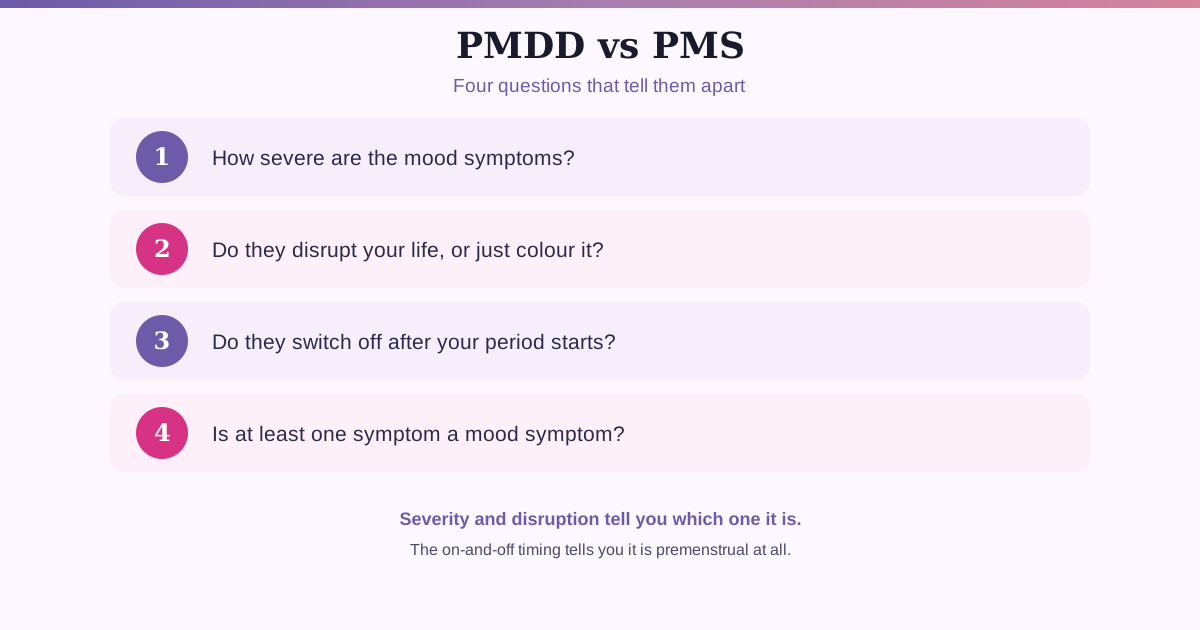
The four questions that separate them
When a woman describes her premenstrual week, I am listening for four things. You can ask yourself the same four.
1. How severe are the mood symptoms?
PMS mood symptoms are real but proportionate. You feel more irritable, a bit low, more tearful at a sad advertisement. PMDD mood symptoms are out of proportion and frightening in their intensity: a rage that scares you, a despair that feels bottomless, an anxiety that has no object. Women describe feeling possessed, or like a different person has taken the wheel. If your premenstrual mood feels like a personality change rather than a bad mood, that points toward PMDD.
2. Do they disrupt your life, or just colour it?
This is the single most important question. PMS colours your week; PMDD disrupts it. Ask yourself honestly: in the days before your period, do you call in sick, cancel plans, fight with your partner to the point of damage, struggle to care for your children, or find work genuinely impossible? Clinically significant interference with daily functioning is part of the PMDD definition. It is the difference between “I was snappy” and “I said things to my husband I am still apologising for.”
3. Do they switch off after your period starts?
Here is the test that does the most diagnostic work, and it cuts in both directions. In both PMS and PMDD, symptoms should clear within a few days of the period beginning and stay away for the week after. That symptom-free window is the signature of a premenstrual condition.
If, instead, your low mood and anxiety are present all month and merely get worse before your period, you may not have PMDD at all. You may have an underlying depression or anxiety disorder that flares premenstrually, which doctors call premenstrual exacerbation. The treatment for that is different, which is exactly why this question matters so much. If your bad feelings never fully lift, our guide on mood swings before your period and a proper assessment will help sort out what is really going on.
4. Is at least one symptom a core mood symptom?
PMDD is, at its heart, a mood disorder. To meet the diagnosis, at least one of your main symptoms must be marked mood swings, irritability or anger, depressed mood, or anxiety and tension. A woman whose premenstrual symptoms are almost entirely physical, bloating, breast pain, and headaches, has PMS, however uncomfortable, rather than PMDD.
A side-by-side picture
| PMS | PMDD | |
|---|---|---|
| How common (India) | ~43% of women | ~8% of women |
| Main symptoms | Physical and emotional, mixed | Mood symptoms dominate |
| Severity | Noticeable, manageable | Severe, often disabling |
| Effect on life | You function | Work, relationships disrupted |
| Timing | Luteal phase, eases after period | Luteal phase, eases after period |
| Is it a formal diagnosis? | No, a common experience | Yes, a DSM-5 disorder |
| Core feature | Discomfort | A cyclical mood disorder |
Notice that the one row identical for both is timing. That is the point. Timing tells you the symptoms are premenstrual; severity and disruption tell you whether it is PMS or PMDD.
The diagnosis you cannot make from memory
There is an important catch. None of these four questions can be answered reliably from memory, because memory is unkind here. After a hard premenstrual week, women tend to feel the symptoms were always there, and after a good fortnight they tend to forget how bad it was. This is why both major obstetric and psychiatric bodies recommend the same thing: chart your symptoms forward, day by day, across at least two cycles before settling on a diagnosis (Craner et al., 2014, Women & Health, PMID 24512469).
You do not need anything fancy. A note on your phone each evening, rating your mood and main symptoms, with your period days marked, will do. After two months you will be able to see, in your own data, whether the symptoms genuinely switch off after your period. That chart is the clearest answer to the PMS-or-PMDD question you can get, and it is the most useful thing you can bring to a doctor.
Why getting the distinction right matters
Some women ask why the label matters if the timing is the same. It matters because the labels lead to different doors.
If it is PMS, the foundation is lifestyle and symptom relief: exercise, sleep, reducing caffeine and salt before your period, and sometimes calcium or other supplements. Most women improve a great deal without medication.
If it is PMDD, lifestyle still helps, but you also have access to treatments that are specifically effective for it: SSRIs that can be taken only in the luteal phase, or a particular type of combined pill. Knowing it is PMDD is what unlocks those options instead of being told to simply cope. We cover the full ladder in PMDD treatment in India: what actually works.
And if it turns out to be premenstrual exacerbation of an underlying depression or anxiety disorder, that is important to know too, because treating the underlying condition is what brings the premenstrual worsening down with it.
In other words, the distinction is not about putting you in a box. It is about pointing you toward the help that fits.
A word about being believed
Many women have told me that the hardest part was not the symptoms, it was not being taken seriously. A premenstrual mood disorder is easy for others to wave away as being moody or difficult, especially when it lifts and you seem fine again. I want you to know that the medical view is clear: PMDD is a genuine condition, and so is significant PMS. You are not exaggerating, and you do not need to earn the right to feel better by proving how bad it is. If your premenstrual week is disrupting your life, that alone is reason enough to seek help.
Frequently Asked Questions
1. Can PMS turn into PMDD?
They are best understood as different conditions rather than stages of one. That said, premenstrual symptoms can worsen over time, especially in the years approaching menopause, and a woman who once had manageable PMS can develop more severe, disabling symptoms that meet criteria for PMDD. If your premenstrual experience has clearly worsened, it is worth a fresh assessment.
2. I only have physical symptoms before my period. Is that PMDD?
Probably not. PMDD requires at least one significant mood symptom, such as marked irritability, depressed mood, or anxiety. Purely physical symptoms like bloating, breast tenderness, and headaches point to PMS. They can still be treated, but the diagnosis and the approach differ.
3. My low mood never fully goes away. Could it still be PMDD?
If your symptoms are present all month and only worsen before your period, that pattern fits premenstrual exacerbation of an underlying depression or anxiety disorder rather than PMDD, which requires a clear symptom-free window after your period. The distinction changes the treatment, so it is worth charting carefully and getting assessed.
4. How long do I need to track before I know?
At least two full menstrual cycles. Daily ratings of your mood and main symptoms, with your period days marked, let you and your doctor see whether the symptoms truly follow the premenstrual pattern. Two months of honest tracking answers the question better than any single appointment.
5. Is PMDD more serious than PMS?
Yes, in the sense that it is more severe and more disruptive, and it is a recognised mood disorder rather than a common experience. It also carries a small but real risk of cyclical dark or suicidal thoughts, which PMS does not. This is part of why an accurate diagnosis matters.
6. Can I have PMDD with regular, normal periods?
Yes. PMDD has nothing to do with whether your cycle is regular or your hormone levels are normal, and most women with PMDD have entirely normal hormones. It reflects how the brain responds to ordinary cyclical hormone changes, not an imbalance in the hormones themselves.
7. Which doctor confirms whether it is PMS or PMDD?
Either a gynaecologist or a psychiatrist can assess you, often working together, using your symptom chart and a clinical interview. Our guide to which doctor to see for PMDD explains how to choose where to start.
What to do next
If reading these four questions made the answer clearer, trust that clarity. Whether you land on PMS or PMDD, both are real and both are treatable, and you do not have to keep navigating it alone or in silence.
If you recognised your own pattern in this article, the most useful next step is to start a daily symptom chart (our tracking guide shows you how). Two months of honest daily tracking is the single most valuable thing you can bring to any doctor.
If your symptoms are affecting your daily life, please seek help from a doctor.