Almost every woman who suspects she has premenstrual dysphoric disorder expects that a doctor will confirm it with a blood test. It is one of the first things I have to gently correct. There is no blood test for PMDD. The diagnosis is made by tracking your symptoms forward across your cycle, and the good news buried in that fact is that the single most powerful diagnostic tool is one you can start using tonight, before you ever see a doctor.
I am a psychiatrist, and I contribute educational content to Fertilia’s blog on women’s mental and hormonal health. This is my practical, step-by-step guide to doing that tracking properly. Our other guides explain why charting matters and which doctor to take it to; this one is about the how, in enough detail that your two months of data actually earn you a confident diagnosis instead of a shrug. If you are still unsure whether your symptoms point to PMDD or ordinary PMS, our psychiatrist’s guide to PMS and PMDD is the place to begin.
Why tracking, and not a single conversation, makes the diagnosis
PMDD is defined not by which symptoms you have, but by their timing. The symptoms of PMDD, irritability, low mood, anxiety, tearfulness, overwhelm, cluster in the luteal phase (the roughly two weeks before your period) and then clear within a few days of bleeding starting, leaving a calm stretch afterward. That on-off pattern, repeating cycle after cycle, is the signature.
Memory cannot establish this pattern reliably. When you are in a bad premenstrual week, it feels as though you have always felt this way; when you are in the good week, it is hard to believe the bad one was as severe as it was. This is exactly why the standard of care is to chart symptoms prospectively, forward in real time, across at least two menstrual cycles before confirming the diagnosis (Craner et al., 2014, Women & Health, PMID 24512469). Prospective tracking removes the distortion of memory and lets the true shape of your month appear on the page.
Step 1: Choose what to rate
You do not need to track everything. Pick the five to ten symptoms that matter most to you. A useful, well-validated set to draw from is the one used in the Daily Record of Severity of Problems, a tracking tool developed and tested specifically for premenstrual disorders (Endicott et al., 2006, Archives of Women’s Mental Health, PMID 16172836). It covers the symptoms that define PMDD, for example:
- Feeling sad, hopeless, or self-critical
- Feeling anxious, tense, or on edge
- Sudden mood swings or tearfulness
- Irritability, anger, or conflict with others
- Loss of interest in usual activities
- Difficulty concentrating
- Tiredness or lack of energy
- Changes in appetite or specific cravings
- Sleeping too much or too little
- Feeling overwhelmed or out of control
- Physical symptoms: breast tenderness, bloating, headaches, joint or muscle aches
Choose the ones that describe your own month. The point is to rate the same list every day so the comparison across the cycle is fair.
Step 2: Rate each symptom daily, on a simple scale
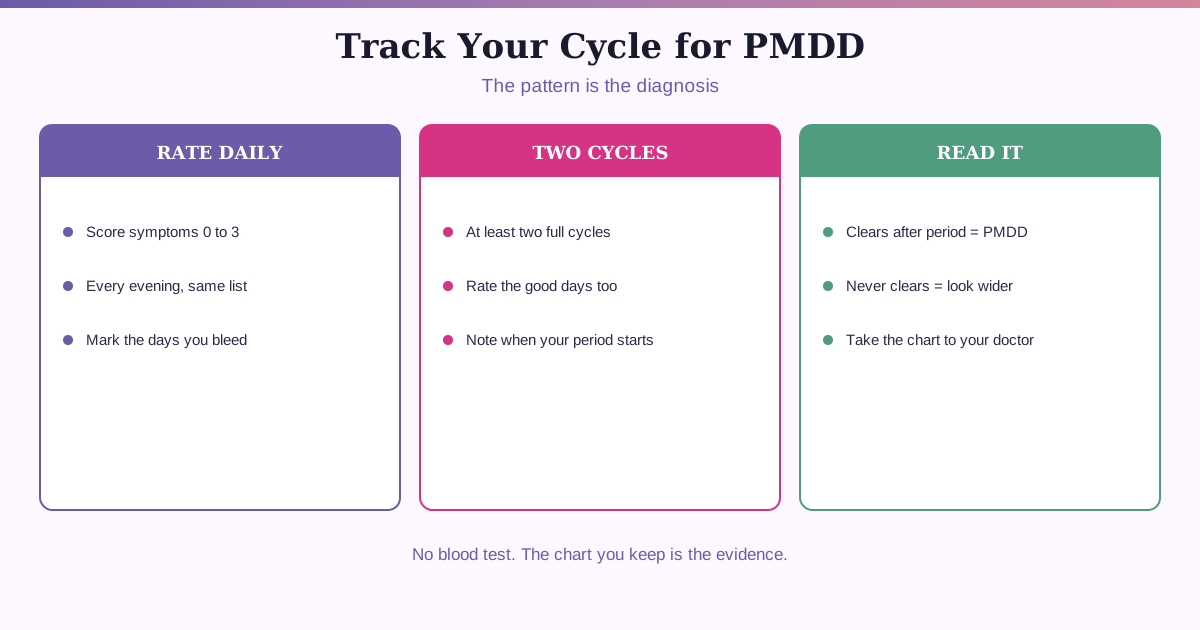
Every evening, score each of your chosen symptoms on a 0 to 3 scale: 0 for none, 1 for mild, 2 for moderate, 3 for severe. Evening works best because you are rating the whole day rather than guessing in the morning. It takes under a minute once it becomes a habit.
Two rules make the data trustworthy. Rate the same day it happens, never fill it in from memory two days later, and rate honestly on the good days too, marking the zeros. Those good days, the calm week after your period, are not filler; they are half the evidence, because PMDD is proven as much by the symptoms switching off as by them switching on.
Step 3: Mark the days you bleed
This is the anchor that makes everything else readable. Each day, note whether you are menstruating. Without your period marked on the same record, a wall of symptom scores means nothing; with it, the pattern of “symptoms rise before this line, fall after it” becomes visible at a glance. Marking the first day of each period also lets you see your cycle length and predict the next luteal phase, which is useful later if you and your doctor choose treatment timed to that window.
Step 4: Keep it up for at least two full cycles
One cycle is not enough, because a single bad month could be coincidence, a stressful event, or an ordinary rough patch. Two full cycles let the pattern repeat and prove itself. If you can manage three, even better, but two is the accepted minimum. A full cycle means from the first day of one period to the first day of the next, so you capture both the symptomatic luteal phase and the calm follicular phase each time.
Which tool: phone note, printed chart, or app
You have three good options, and none is wrong.
- A note on your phone is perfectly adequate. A simple daily line with your symptom scores and a mark for bleeding does the job.
- A printed grid with symptoms down the side and days across the top gives you the clearest visual picture, because the pattern literally appears as a shape you can see.
- A period or symptom-tracking app works if it lets you log mood symptoms daily and shows them against your cycle. Choose one that does not just predict periods but records how you feel each day.
Structured tools like the Daily Record of Severity of Problems exist if you prefer a validated format, but do not let the search for the perfect tool delay you. The best tracker is the one you will actually fill in every evening for two months.
Step 5: Read the pattern
After two cycles, look at the shape of your data. There are three broad pictures, and they point in different directions.
The PMDD pattern: symptoms climb in the week or two before each period, reach a peak in the last few days, then clear within a few days of bleeding starting, leaving a genuinely calm stretch after your period. Scores near zero in the follicular phase, rising to moderate or severe in the luteal phase, repeating both cycles. This is the classic PMDD signature.
The never-quite-clears pattern: symptoms that are present at some level all month and simply get worse before your period. If your follicular-phase scores never fall to near zero, this points away from pure PMDD and toward premenstrual exacerbation of an underlying depression or anxiety, which is treated differently. We explain that important distinction in PMDD or depression: why timing matters.
The no-clear-pattern picture: symptoms scattered without a consistent relationship to your cycle. This suggests the cause lies elsewhere, and a chart that shows no menstrual pattern is just as valuable, because it steers the diagnosis in a more useful direction.
Common charting mistakes to avoid
A few errors quietly undermine an otherwise good effort:
- Filling it in retrospectively. Reconstructing a week from memory reintroduces exactly the distortion that prospective tracking exists to remove.
- Only recording bad days. Missing the good days erases the evidence that your symptoms clear, which is half the diagnosis.
- Stopping after one cycle. One month cannot show a repeating pattern; two is the minimum.
- Forgetting to mark bleeding. Without the period anchor, the pattern is unreadable.
- Tracking too many symptoms. Twenty symptoms become a chore you abandon; five to ten that matter to you are sustainable.
What to do with your chart
Once you have two cycles, take the whole record to your appointment. A clinician who can see, in black and white, that your symptoms switch on before your period and off after it cannot easily dismiss them as “just PMS,” and cannot easily miss the cyclical nature either. It changes the conversation from “I think something is wrong” to “here is the pattern.” If you are unsure whether to take it to a gynaecologist or a psychiatrist, our guide to which doctor to see for PMDD walks you through that choice and what the first visit involves.
One thing that should not wait for two cycles
Tracking is the right approach for building a diagnosis, but it is not something to complete before getting help in one situation. If, during the premenstrual week, you have thoughts that life is not worth living or urges to harm yourself, even if those thoughts lift when your period comes, please do not wait out two more cycles. Cyclical suicidal thoughts are a recognised feature of severe PMDD and they are treatable. Speak to a doctor now, tell someone you trust, or call the free national mental health helpline KIRAN on 1800-599-0019, available around the clock. Getting help then is exactly right.
Frequently Asked Questions
1. How do I track my cycle to get a PMDD diagnosis?
Each evening, rate your main symptoms from 0 (none) to 3 (severe), mark whether you are bleeding, and keep it up for at least two full cycles. Then look at whether the symptoms rise before your period and clear after it. A phone note, printed grid, or symptom app all work.
2. How long do I need to track before I can be diagnosed?
At least two full menstrual cycles, from the first day of one period to the first day of the next (Craner et al., 2014, PMID 24512469). One cycle cannot show a repeating pattern. Three cycles are even better, but two is the accepted minimum for a confident diagnosis.
3. Is there a blood test for PMDD instead of tracking?
No. There is no blood test for PMDD. Because most women with PMDD have normal hormone levels, the diagnosis rests on the timing of symptoms, which only prospective daily tracking across two cycles can establish reliably.
4. What is the Daily Record of Severity of Problems?
It is a validated daily tracking tool developed specifically for premenstrual disorders, covering the mood and physical symptoms that define PMDD (Endicott et al., 2006, PMID 16172836). You can use it directly, or use its symptom list as a guide for a simpler phone or paper chart.
5. Which symptoms should I track for PMDD?
Pick five to ten that matter to you: low mood, anxiety, irritability, mood swings, tearfulness, loss of interest, poor concentration, fatigue, appetite or sleep changes, feeling overwhelmed, and physical symptoms like bloating or breast tenderness. Rate the same list every day so the comparison is fair.
6. What if my symptoms never fully go away after my period?
That is important information. Symptoms present all month that only worsen premenstrually point away from pure PMDD and toward premenstrual exacerbation of an underlying condition, which is treated differently. See PMDD or depression: why timing matters.
7. Can an app diagnose PMDD for me?
No app can make the diagnosis, but a good one can hold your daily data and show it against your cycle, which helps. The diagnosis still needs a clinician to review the pattern alongside your history and rule out other causes. Choose an app that logs daily mood, not just period dates.
Start tonight
The most useful thing you can do about a suspected premenstrual mood disorder costs nothing and can begin this evening. Open a note, list the handful of symptoms that describe your worst days, and give each a score. Mark whether you bled. Do it again tomorrow. In two cycles, you will be holding the single most valuable piece of evidence any doctor could ask for.
If you would like the bigger picture first, our psychiatrist’s guide to PMS and PMDD sets out the whole landscape. And if your symptoms are affecting your daily life, please seek help from a doctor.