She noticed it gradually. Or maybe it arrived quite suddenly after a medication change, a baby, or a difficult stretch of life. Something that used to feel natural now feels distant, and she is not entirely sure when the shift happened.
When women bring this to me in a consultation, they almost always carry some guilt alongside the confusion. They wonder whether something is wrong with them, whether they are letting their partner down, or whether this is simply who they are now. I want to address those questions directly before anything else.
I am a psychiatrist at Fertilia, and I work with women across a range of mental and psychosexual health concerns. Low sexual desire is one of the most common things I hear about, and it is also one of the most underexplored, not because answers do not exist, but because it is rarely discussed openly and women often do not know where to bring it.
This post covers what low desire means, why it changes, and what the evidence tells us about what helps.
What low sexual desire is, and how common it is
Sexual desire is not a fixed quantity. It shifts with age, life stage, relationship, stress, physical health, and medication. In that sense, noticing a change in your desire is normal and often temporary. What matters clinically is whether the change is causing you distress.
The formal clinical term used by psychiatrists is Female Sexual Interest/Arousal Disorder (FSIAD), defined in the DSM-5-TR. Older literature uses Hypoactive Sexual Desire Disorder (HSDD), which many women encounter when they search for their experience online. Both terms describe a reduction in sexual thoughts, fantasies, or desire for sexual activity that has persisted for at least six months and is causing personal distress or relationship difficulty.
A large American population study, the PRESIDE study (Shifren and colleagues, Obstetrics and Gynecology, 2008, PMID 18978095), found that 43.1% of women reported at least one sexual problem, and 12.0% had a sexual problem that was also causing them personal distress. That is a meaningful number, and although the study was in American women, nothing in my practice suggests Indian women are spared it. If you are in a room of ten women, at least one of them is likely navigating this, usually in silence.
It is also worth saying clearly: some women have consistently low or absent sexual desire throughout their lives, feel no distress about it, and have satisfying relationships and a full life. This is not a disorder. FSIAD applies only when low desire is something you yourself experience as a problem. Absence of distress means there is nothing that requires treatment.
The biopsychosocial frame: desire has more than one driver
The older clinical model treated desire as something that simply exists on its own, builds independently, and either fires or does not. Research over the past two decades has shifted that understanding considerably.
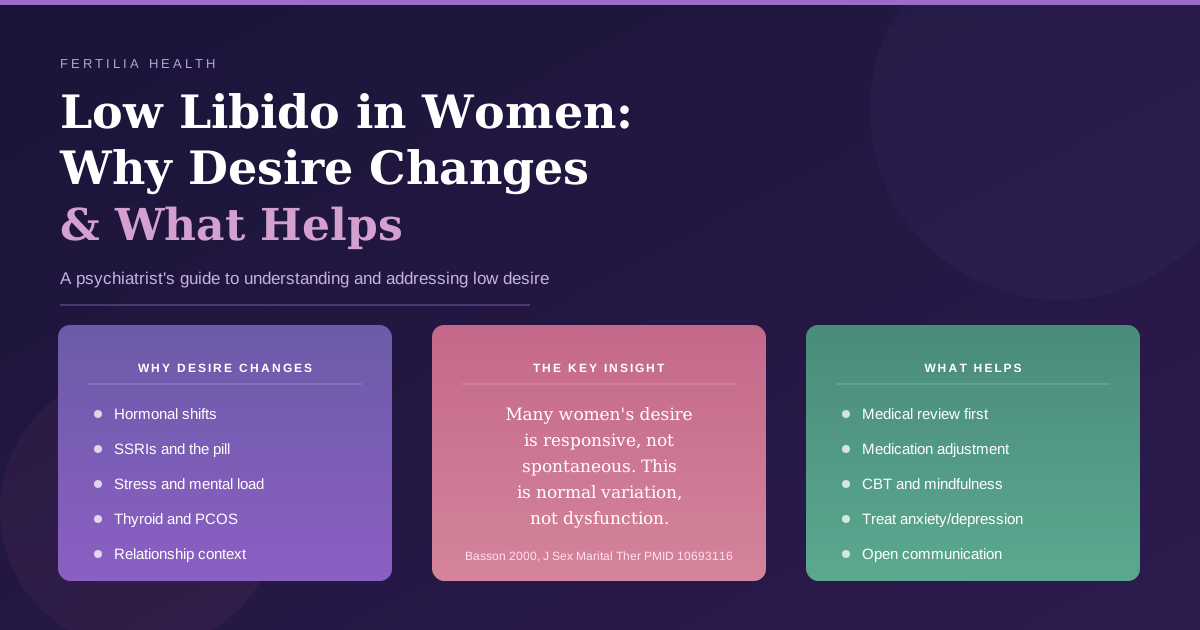
Rosemary Basson’s work on the female sexual response (Journal of Sex and Marital Therapy, 2000, PMID 10693116) described what many women recognise immediately when they hear it: that sexual desire in women often does not arise spontaneously and then lead to action. It arises in response to the right context. A context that feels safe, close, and positive. Desire emerges within an encounter rather than arriving reliably before it.
This matters because it means that a woman who says “I never feel like having sex until we are already close” is not describing a dysfunction. She is describing a common pattern of responsive desire. The clinical concern arises when even that responsiveness is absent, when the context stops feeling welcoming, or when desire that used to emerge no longer does.
This is why looking at desire through three lenses, biological, psychological, and relational, is more useful than searching for a single cause. Most women with low desire have more than one driver.
Hormonal reasons desire shifts
Several hormonal changes affect sexual desire directly.
Oestrogen: Oestrogen plays a role in both the physical and emotional aspects of desire. When it drops, which happens temporarily in the postpartum period, during breastfeeding, and more substantially in perimenopause and menopause, women often notice reduced desire alongside reduced vaginal lubrication. The postpartum drop is compounded by rising prolactin (the hormone that supports breastfeeding), which suppresses the brain signals that drive the ovaries, so oestrogen stays low while breastfeeding continues.
Testosterone: Women produce testosterone in small amounts, primarily in the ovaries and adrenal glands, and it has a documented role in sexual interest. Blood levels are a poor guide to desire in an individual woman, though: a community-based study of 1,423 Australian women (Davis SR et al., JAMA, 2005, PMID 15998895) found no clinically significant relationship between low sexual function and low testosterone levels, and concluded that no single androgen level predicts low female sexual function.
Thyroid function: Both underactive and overactive thyroid can affect sexual desire. A study in the Journal of Clinical Medicine (PMID 33478026) found that thyroid autoimmune disease was associated with impaired sexual function in young women, even when thyroid hormone levels were only mildly disrupted. This makes a thyroid check worthwhile early on if desire has changed without another clear explanation. Our guide to thyroid and fertility covers the broader effects of thyroid function on hormonal health.
PCOS: Women with PCOS often experience disrupted androgen balance alongside mood changes and the emotional weight of managing a chronic condition. The combination can reduce desire in ways that are hard to separate. Addressing the PCOS itself, with hormonal stabilisation and support if needed, tends to help. For more on what drives PCOS symptoms, see our PCOS guide.
Speak to Dr. Sandhiya on WhatsApp for a ₹399 online consultation to discuss what you are experiencing. Online, pan-India, by video call.
Medications that affect desire
This is an area where many women are caught off guard, because the connection is rarely mentioned when a medication is prescribed.
Antidepressants: SSRIs (selective serotonin reuptake inhibitors) and SNRIs are among the most widely used treatments for depression and anxiety, and they are also among the most common medication causes of reduced sexual desire and arousal. A meta-analysis by Serretti and Chiesa (Journal of Clinical Psychopharmacology, 2009, PMID 19440080) found that treatment-emergent sexual dysfunction occurred in 25% to over 80% of patients across studies, with prevalence varying significantly by medication type.
This does not mean the medication is wrong for you. Depression and anxiety both independently reduce desire, and effective treatment often improves sexual function overall. But if the change in your desire coincided with starting or adjusting an antidepressant, that connection is worth raising with your psychiatrist. There are options: adjusting the timing of the dose, adding a medication like buspirone, or exploring a switch to an agent with a different side-effect profile. None of these are decisions to make without guidance, but they are genuine options that I discuss with patients regularly.
The combined oral contraceptive pill: The pill raises sex hormone-binding globulin (SHBG), a protein that binds to testosterone and reduces the amount of free testosterone available to act in the body. For some women, this produces a noticeable reduction in desire. In a small before-and-after study of 83 women (Caruso S et al., Journal of Women’s Health, 2017, PMID 28323519), switching from an ethinylestradiol pill to one containing 17-beta-estradiol raised free testosterone and improved sexual desire scores over six months; it was not a controlled trial. If your desire changed after starting the pill, this is a useful conversation to have with your gynaecologist. See our guide to birth control pill side effects for a broader overview.
Other medications: Beta-blockers, spironolactone, antihistamines, and GnRH analogues used for endometriosis or fibroids can also reduce desire. If you are taking any of these and have noticed a change that coincides with when you started the medication, mention it to your doctor.
Psychological and relationship drivers
No account of low desire is complete without the mind and the space between two people.
Stress and mental load: When the mind is carrying a great deal, desire is often the first thing that recedes. This is not indifference. It is the nervous system prioritising what feels urgent. Women in India, as in most countries, frequently carry a disproportionate share of domestic and emotional labour alongside professional work. By the time the day is done, there is nothing left over. Our post on burnout and the mental load explores this pattern in depth.
Anxiety and depression: Both of these conditions reduce desire in their own ways. Anxiety keeps the nervous system in a state of alert, which is physiologically at odds with the relaxation that supports desire. Depression dulls interest across many areas of life, and sexual interest is no exception. Treating the underlying condition often leads to desire returning, even before any specific sexual health intervention. See our posts on anxiety in women and depression in women for more on recognising and addressing these.
Body image: The relationship between how a woman feels about her body and her willingness to be present in intimacy is well-documented. For women navigating postpartum body changes, weight fluctuations, or the internalised commentary that often arrives from family and culture, desire can take a back seat to self-consciousness. Our post on body image and confidence covers this in more detail.
Relationship factors: Desire does not live in a vacuum. Safety, trust, communication, and a sense of genuine connection all influence it. If there is unresolved tension, a gap in how intimacy is initiated, or an expectation mismatch that has been building for a while, desire can withdraw even when the emotional connection is present. Sometimes the most useful step is creating more space for closeness without a specific goal, time together without the pressure of where it is supposed to lead.
Life-stage patterns
Postpartum: Reduced desire in the months after birth is extremely common, and it makes physiological sense. Disrupted sleep, elevated prolactin from breastfeeding, low oestrogen, a body that has been through significant physical change, and an identity reorganising itself around being a parent all converge at the same time. For most women, this improves gradually as hormones normalise and rest becomes more possible. Being patient with yourself during this period matters enormously. So does naming it openly with your partner. Our postpartum anxiety guide covers the broader emotional landscape of the postpartum period.
Trying to conceive: When sex is scheduled around ovulation windows and carries the weight of a specific purpose, it can move from something you want to do to something you are supposed to do. This is a well-recognised pattern, and it often resolves once the TTC period ends. Our guide on trying to conceive and mental health covers how to protect your emotional wellbeing through that process.
Perimenopause: For women in their early-to-mid forties, falling oestrogen during the perimenopausal transition can produce desire changes that feel new and confusing. This is distinct from general low libido in younger women, and it has its own management pathway. Menolia, our menopause support platform, carries a full guide to sex and libido after menopause for women in that stage.
What can help
There is no single answer, because the cause varies. But the paths forward are well-established.
Start with a medical review. A thyroid function test (TSH), a hormone panel, and a review of all current medications are reasonable starting points. If there is a treatable physical driver, addressing it often improves desire without any additional intervention needed.
If medication is involved, speak to the prescribing doctor. Reduced sexual desire is a recognised and manageable side effect, not something you have to accept as permanent. Your prescribing psychiatrist or gynaecologist can help you explore the options.
Psychological support. Cognitive behavioural therapy (CBT) approaches for sexual dysfunction are well-supported by evidence. They address the thought patterns and avoidance cycles that often build up when desire has been low for a while. Mindfulness-based approaches have also shown benefit, particularly for women whose desire is disrupted by a mind that will not switch off. Our guide to therapy in India covers how to find the right support.
Treat underlying anxiety or depression. When the sex therapy piece is addressed, the sexual health picture often improves alongside it.
Communication in the relationship. Naming what you are experiencing, without blame and without a solution agenda, is one of the most useful things you can do. A partner who understands that this is not about them is in a much better position to support you through it.
When it makes sense to speak to someone
Bringing this to a psychiatrist or gynaecologist is worth considering if:
- The change in desire has lasted six months or more and is causing you distress
- It coincided with starting or changing a medication
- It is accompanied by mood changes, fatigue, or other physical symptoms
- It is affecting your relationship in a way that concerns you
- You have addressed the obvious practical factors (sleep, stress, communication) and the pattern has not shifted
Desire is not fixed for life. It changes across time, and those changes are usually addressable once you understand what is driving them.
WhatsApp us to book a ₹399 online consultation with Dr. Sandhiya Loganathan. Available pan-India by video call. You can describe what you are experiencing in your own words, and we will go from there.
Frequently Asked Questions
Is it normal for desire to decrease over time?
Desire in long-term relationships typically shifts from the intensity of early novelty to something more considered and context-dependent. This is a normal evolution. What is worth paying attention to is whether the change is causing you or your partner distress, or whether desire has moved from “sometimes present” to “consistently absent.” If it is the latter, understanding the driver is a useful starting point.
My desire dropped after starting antidepressants. What should I do?
Mention it to the doctor who prescribed the medication. Reduced sexual desire is a recognised and manageable side effect of several antidepressants. Options include adjusting the timing of the dose, adding a medication like buspirone, or exploring a switch to an agent with a different side-effect profile. Do not stop the medication on your own. Depression itself reduces desire, and stopping treatment may worsen both the mood and the sexual health picture.
I feel no desire after having a baby. Is something wrong with me?
Nothing is wrong with you. Low desire in the postpartum period is very common and has clear physiological explanations: elevated prolactin, low oestrogen, disrupted sleep, and a body in recovery. It usually improves over the months after birth, especially as breastfeeding tapers and hormones stabilise. If it persists beyond six to nine months or is accompanied by significant low mood, bringing it to your doctor is worthwhile.
Can PCOS cause low libido?
Yes, indirectly. The hormonal disruption in PCOS, particularly the combination of androgen imbalance, mood changes, and the emotional weight of managing a chronic condition, can all reduce desire. Body image concerns that often accompany PCOS also play a role. Addressing the PCOS as a whole, with hormonal stabilisation and emotional support if needed, tends to improve this over time.
Can the contraceptive pill reduce sexual desire?
For some women, yes. The combined pill raises SHBG (sex hormone-binding globulin), which binds testosterone and reduces the amount of free testosterone in the body. Since testosterone contributes to sexual desire in women, this can translate into reduced interest for some. If you have noticed a change since starting the pill, speak with your gynaecologist. Switching to a different formulation sometimes helps.
Sex ki ichha kam hona kya ek bimari hai? (Is low sexual desire a medical condition?)
Low sexual desire is considered a clinical concern when it persists for six months or more and causes distress or relationship difficulty. It is not a character flaw or a relationship failure. It has identifiable drivers, hormonal, medication-related, and psychological, and it responds to the right support. The fact that it is rarely discussed openly in India does not mean it is rare. Speaking to a psychiatrist or gynaecologist is the appropriate first step.
How long does treatment take to make a difference?
That depends on what is driving the low desire. If a medication side effect is identified and adjusted, improvement can be seen within weeks. If the driver is psychological, therapy typically produces change over three to six months, with many women noticing a shift earlier. If a hormonal issue like thyroid dysfunction is treated, the timeline follows the thyroid treatment response, usually a few months. Desire that has multiple drivers may take longer to address, but change is possible when you know what you are working with.