Women in my classes ask me some version of the same question almost every week: will yoga fix her vaginismus? Should she try it before anything else? Can she skip the clinical part altogether if she just practises consistently enough?
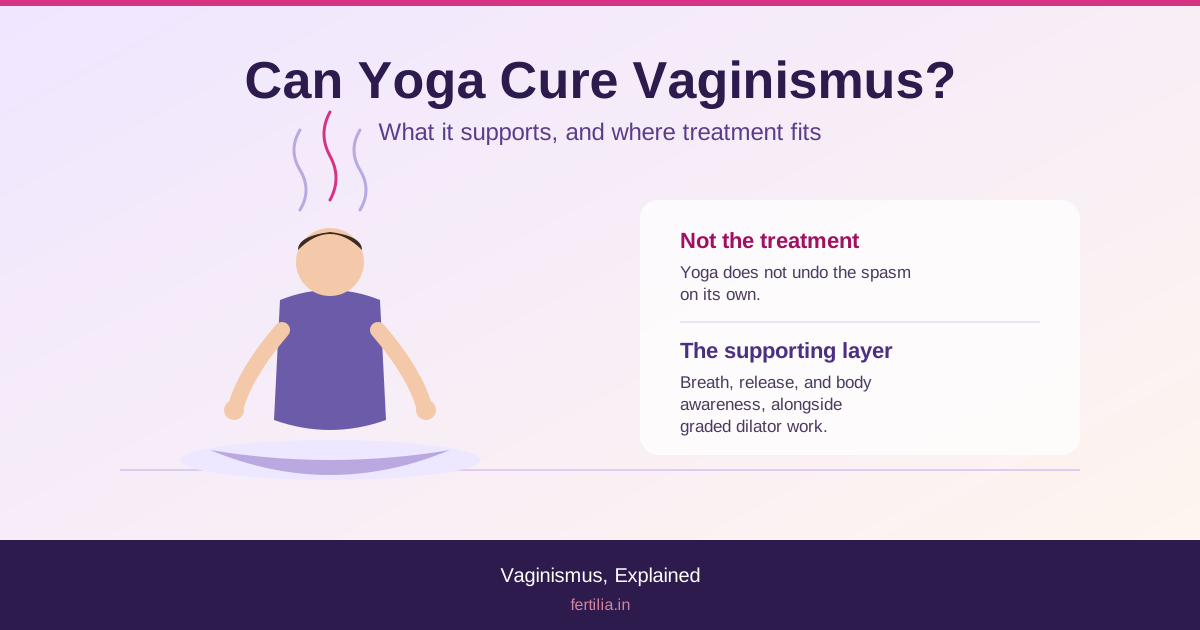
Here is the answer, plainly, before anything else: no, yoga does not cure vaginismus on its own. No pose, breath pattern or sequence undoes an involuntary spasm by itself. Vaginismus is treated as a package: a doctor works out what is causing the pain, psychosexual support addresses the fear underneath it, and pelvic floor work plus graded dilation does the physical retraining. The week-by-week shape of that last part is set out in the twelve-week dilator protocol.
The shapes that do help are child’s pose, supported reclined butterfly, legs up the wall and a deep squat, and the detail on each is further down.
What yoga does, and does well, is sit alongside that treatment. Not instead of it, and not ahead of it. It supports the part of recovery that has nothing to do with dilator sizes: the habit of gripping without noticing, the breath that gets held when something feels uncertain, and the general state a woman’s body is in before she even begins the clinical work.
I’m Shobhna Deepak. I teach yoga and movement, I founded ZenMums, and I write here as a guest. I do not diagnose vaginismus and I do not treat it. The vaginismus programme at Fertilia is run by its doctors. What I bring is the part that happens on a mat: breath, release, and the kind of body awareness that makes the clinical work easier to walk into.
Why women reach for yoga first
It makes complete sense that yoga is often the first thing a woman tries. It is private. It needs no appointment and no explaining yourself to a stranger. For many Indian women it is also familiar in a way that clinical treatment is not: you may have grown up around yoga, seen it practised at home, or done a few sun salutations in school without ever connecting it to anything medical.
There is nothing wrong with starting here. A woman who begins with breath and gentle movement before she is ready to think about a dilator set has chosen a reasonable, low-pressure first step. If you would like the fuller picture of what a structured, self-directed path can look like, this guide on treating vaginismus without a therapist shows where yoga fits among the other options.
Where this goes wrong is only when yoga becomes the whole plan for months at a time, standing in for the treatment rather than preparing the ground for it. That is not a failure on anyone’s part. It usually just means nobody explained clearly enough what yoga is for.
What yoga does for vaginismus
I want to be specific here, because vague reassurance (“yoga helps with stress”) is not much use to a woman trying to decide what to do tonight.
One thing to set out before the list: I am not aware of any trial showing that yoga treats vaginismus. What follows is what I see in class, and what the clinical team tells me makes their work easier.
The habit of gripping becomes visible. Many women with vaginismus brace without realising it, not only at the vaginal opening but through the jaw, the shoulders, the belly. On a mat, away from any pressure to perform, that bracing becomes noticeable for the first time. Noticing it in a low-stakes setting, with nothing at stake but a stretch, is the first step toward being able to release it elsewhere.
The exhale gets slower and longer. A great deal of yoga, at its simplest, is just breath: slow, steady, with the out-breath a little longer than the in-breath. The specific breath-and-release technique used in dilator sessions is called a reverse Kegel, and the short version of why it matters is that vaginismus involves a pelvic floor that is already too tight, so the work is teaching it to lengthen rather than to grip harder. Dr. Suganya’s guide to pelvic floor down-training covers it properly. A regular yoga practice is where many women first get comfortable with slow, controlled breath before they ever bring it into a dilator session.
Body awareness widens. Yoga asks you to pay attention to your own body without an agenda attached, which is a rare experience for a lot of women. That habit of paying attention without judging what you find carries directly into dilator work, where the same skill, noticing tension and staying with it, is exactly what is being practised.
The whole body settles. Slow movement paired with steady breath has a broadly calming effect, the kind most people feel after a restorative class even if they could not explain why. A woman who arrives at a dilator session already calm has an easier evening than one who arrives keyed up from a rushed day.
None of this replaces the graded, progressive stretch that dilation provides, or the assessment that comes before it. Those are specific pieces of clinical work, and yoga was never built to do them.
Before you start: get the diagnosis first
One thing I am firm about with the women I teach, because it sits outside what a movement teacher can judge.
Painful penetration is not always vaginismus. Several other conditions cause pain on entry and are treated completely differently: Dr. Suganya’s guide lists infection, lichen sclerosus, tissue thinning, endometriosis and post-delivery scarring among the causes she has to rule out. A woman who has never been assessed should get a diagnosis before self-directing a dilator programme at home, because the plan depends on which of these it is.
And some things are not mine to interpret at all. If there is bleeding after sex, discharge that is not usual for you, burning or itching, or pain that is there even when nothing is being attempted, I am not the person to tell you what any of it means. Get it looked at by a doctor before you build any plan, on a mat or anywhere else. The OB-GYN guide to vaginismus explains how a doctor tells these apart.
Yoga poses that help vaginismus: breath, hips, and stillness
These are the things I actually teach women who are working through vaginismus, described the way I would in a class, not as a clinical protocol.
Slow belly breath. Sit or lie down comfortably. Let your breath drop low, into your belly rather than your chest, so your hand resting there rises gently on the inhale. Make the exhale a little longer than the inhale, and let your shoulders soften every time you breathe out. In my classes, five to ten minutes of this is where most women first notice their body settling faster than it used to.
Child’s pose (Balasana). Kneel, sit your hips back toward your heels, and fold forward with your arms resting ahead of you or alongside your body. If your hips do not reach your heels comfortably, tuck a folded blanket between your thighs and calves. This is one of the gentlest hip-opening shapes there is, and most women can hold it for a couple of minutes without strain.
Supported reclined butterfly (Supta Baddha Konasana). Lie on your back, bring the soles of your feet together, and let your knees fall open to either side. Rest a cushion or folded blanket under each outer thigh if the stretch feels like too much without support. This is a slow opening through the hips and inner thighs, and it is entirely passive: gravity does the work, not effort.
Legs up the wall (Viparita Karani). Lie on your back with your legs resting up against a wall, arms loose at your sides. This is one of the most restful shapes in any yoga practice, and a good one to end a session with. Five minutes here, breathing slowly, is what most of the women I teach describe as the calmest part of their day.
Deep squat (Malasana). Stand with feet a little wider than hip width, toes turned slightly out, and lower into a squat, letting your elbows rest gently against the insides of your knees. If your heels lift off the floor, a folded towel underneath them helps. Many Indian women already know this shape from everyday tasks at home, which makes it feel far less foreign than it might otherwise.
Gentle seated forward fold. Sitting with legs extended or loosely crossed, fold forward only as far as feels easy, letting your spine round rather than forcing a flat back. This is not about touching your toes. It is a slow release through the lower back and hips.
A workable home sequence: five minutes of slow belly breath, three minutes in child’s pose, three minutes in supported reclined butterfly, and five minutes with legs up the wall. That is around fifteen to twenty minutes, and it works either as its own practice or as a way to settle your body before a dilator session.
A practical note, because most of the women I teach are not practising in a studio. If you share a room, or you live in a joint family and would rather nobody asked what this is for, none of these shapes look like anything other than stretching. Legs up the wall and child’s pose in particular read as ordinary back-ache relief, which is a complete and true answer if anyone asks. You do not need a mat: the bedroom floor with a bedsheet folded over twice is fine. A folded saree or a rolled dupatta makes a perfectly good bolster under the knees or along the spine, and a rolled hand towel under the heels sorts out a squat where the heels lift. Early morning before the house is up, or the half hour after everyone has eaten, tends to be the realistic window rather than a fixed practice time.
What to avoid on the mat
This matters as much as what to include, and it is where a well-meaning yoga habit can work against the treatment rather than alongside it.
Forceful or aggressive hip stretching. Deep hip openers held with real intensity, or a teacher who pushes you further into a stretch than feels easy, work against the goal here. The aim with vaginismus is a body learning that it is safe to soften, not one being pushed past its comfort in the name of flexibility.
Hot yoga, power yoga, and anything fast-paced or performance-oriented. These styles are built around pushing through discomfort and working hard, which is the wrong instruction for a nervous system trying to learn the opposite lesson.
Heavy core work. Vigorous ab sequences, boat pose held for long stretches, or any class marketed as “core and pelvic floor strengthening” is not what this moment calls for. Strengthening and bracing the pelvic floor is the opposite of what vaginismus treatment needs.
Any cue to squeeze and hold the pelvic floor. Some fitness and yoga classes fold in Kegel-style cues, asking you to actively contract and lift through the pelvic floor. For most people that is a perfectly good exercise. With vaginismus the muscle is already holding too much tension, so adding more contraction pulls against the treatment. Dr. Suganya’s guide to reverse Kegels sets out the reasoning in full. On the mat, what it means is simple: if a teacher or a video cues you to squeeze and lift through your pelvic floor, skip that instruction and keep breathing instead.
If a class or teacher does not know your history, it is entirely reasonable to skip the poses or cues that do not sit right and stay with the ones that do. You are not obliged to follow every instruction in a room.
Where yoga fits into treatment
Yoga is the supporting layer, never the treatment itself. The clinical side is what resolves vaginismus: the assessment, the psychosexual work, the pelvic floor retraining and the graded dilation, with the week-by-week structure set out in the twelve-week dilator protocol.
In practice the two fit together simply. A short breath-and-movement session before a dilator session helps a woman arrive already settled rather than tense. Some women also build a short practice into their week generally, separate from any dilator session, because a calmer, more aware body makes the whole process feel less like a battle.
At Fertilia, the vaginismus programme is run over video across India by a gynaecologist, a psychiatrist and a pelvic floor physiotherapist, and the pelvic floor sessions are conducted over video too, so there is no clinic table involved. The breath and movement work I teach is the kind of thing that sits comfortably alongside a plan like that. The clinical team handles diagnosis, the dilation progression, and any medical questions. I handle the part that happens on the mat.
💬 Not sure whether what you have is vaginismus at all? That question is worth putting to a doctor before you build a plan around it, and it can be answered over video without an examination. Message the Fertilia team on WhatsApp
If yoga alone hasn’t changed anything
If you have been practising for weeks and nothing has shifted, you have not failed at anything. A supporting layer doing its job well looks like a calmer body, an easier breath, less bracing through the day. It does not look like obvious progress toward penetration, because that was never its job.
If you have started dilator work and it has stalled, that is common, and it is covered thoroughly, including when to bring in a clinician, in this guide on treating vaginismus without a therapist. It means it is time to bring in the piece that was always meant to do the harder work.
Frequently Asked Questions
Can yoga cure vaginismus?
No, not on its own. Yoga does not resolve the involuntary spasm that defines vaginismus. That is done by the clinical side of treatment: assessment by a doctor, psychosexual support, pelvic floor work and graded dilation, described in the twelve-week protocol. Yoga is a useful supporting practice alongside it, offering breath, body awareness and a calmer nervous system.
Which yoga poses help vaginismus?
Gentle hip and pelvis openers held without force are the most useful: child’s pose, supported reclined butterfly, legs up the wall, a deep squat, and a slow seated forward fold. All of these are passive shapes rather than active stretches, which matters more than the specific pose you choose. If any of them makes you grip rather than soften, come out of it and go back to breathing. That reaction is information, not a failure.
Is butterfly pose good for vaginismus?
Yes, particularly the reclined, supported version. Lying on your back with the soles of your feet together and the knees supported by cushions gives a gentle, passive opening through the hips with no effort involved, which is the quality of movement that helps here. Support the knees generously. If the inner thighs are straining, the cushions are too low.
Can yoga replace dilator therapy for vaginismus?
No. Graded dilation is the structured, progressive physical retraining, and nothing in a yoga practice substitutes for that progression or for the assessment that should come before it. Yoga sits alongside as preparation and support.
Is it safe to do yoga during vaginismus treatment?
Generally yes, as long as the practice stays gentle: slow breath, passive hip openers, restorative shapes, nothing forceful. Avoid hot yoga, power yoga, heavy core sequences, and any cue to actively squeeze and hold the pelvic floor, since that works against what the treatment is teaching the body.
How often should I practise yoga for vaginismus?
There is no fixed schedule. A short session a few times a week, or a brief practice before a dilator session, is enough for most women to notice the calming effect. Consistency over weeks matters more than frequency, and there is no benefit to forcing a daily practice if it starts to feel like one more obligation. If a class-based practice has not started to feel calming after about a month, it is worth changing the style or the teacher rather than pushing on.
Can yoga help if I haven’t started dilator work yet?
Yes, it can be a reasonable place to begin, especially if you are not yet ready to think about a dilator set. Breath and gentle movement can help you feel calmer and more aware of your own body first. The one thing worth doing in parallel is getting the pain assessed, so that when you are ready, you are working on the right problem.
If you have been practising yoga and are ready to talk about the treatment that goes alongside it, the Fertilia team runs an online vaginismus recovery programme entirely over video across India, combining medical, psychosexual and pelvic floor work in one plan.