A woman came to see me two weeks after her Mirena was removed. She had spotted lightly for a few days right after the procedure and assumed her body was back to normal. Then nothing, for almost a month. “I had no periods for four years on the Mirena,” she said. “I don’t even remember what my own cycle feels like anymore. Is this spotting my period, or is something wrong?”
It’s a completely reasonable question, and one I hear often, whether the device removed was a copper T or a Mirena. I’m Dr. Suganya Venkat, an OB-GYN with over 15 years of experience, and at Fertilia I see this exact confusion regularly in women who come to us after IUD removal, often when they are ready to start trying to conceive. The short version is that what counts as “normal” after removal depends heavily on which device you had, and the timeline is genuinely different for each. (If you’re still deciding which device suits you, or comparing the two before insertion, our guide to Mirena vs Copper-T, which to choose covers that earlier decision.) Let me walk you through both.
What this post covers
- Why copper IUD removal and Mirena removal lead to very different cycle experiences
- The realistic timeline for your first true period after each device
- How to tell spotting from removal apart from your actual first period
- How quickly ovulation, and pregnancy, can happen after removal
- When bleeding after removal is not normal and needs a doctor’s opinion
Why copper and Mirena removal feel so different
This is the part that gets skipped in a rushed removal appointment, and it matters more than almost anything else in this post.
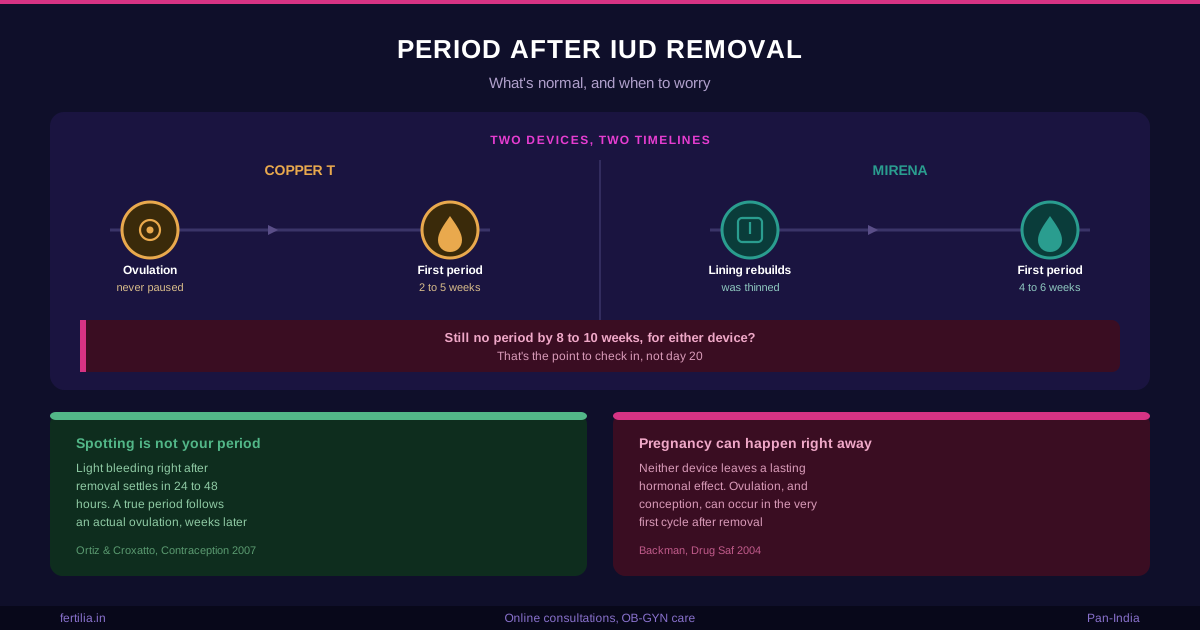
The copper T works entirely locally. The copper ions it releases are toxic to sperm and interfere with fertilisation, but the device does not touch your hormones at all. Your ovaries have been ovulating every month the entire time it was in place, and your own cycle has been running in the background, largely unaffected (Ortiz ME, Croxatto HB, Contraception, 2007, PMID 17531610). So when a copper T comes out, there is nothing to “restart.” Your cycle simply continues from wherever it was.
The Mirena works differently. It releases a small, localised dose of levonorgestrel that thickens cervical mucus and, importantly, thins the endometrial lining substantially. For many women on Mirena, periods become very light or stop altogether, not because ovulation has stopped, but because the lining is too thin to produce a visible bleed even when a cycle is happening underneath (Sivin I, Stern J, Coutinho E, Contraception, 1991, PMID 1797462). Once the device is removed, that thinned lining needs a cycle or two to rebuild to a normal thickness before it produces a period you can actually see and recognise as one.
This is why the woman in my clinic felt so unmoored. Her body had not “forgotten” how to have a period. Her lining simply needed time to rebuild after years of being deliberately kept thin.
The realistic timeline for each device
Copper T: Because ovulation was never suppressed, most women see their next period arrive close to where it would have anyway, often within a normal cycle length of removal, roughly 2 to 5 weeks. If your cycles were regular before the copper T, expect them to look similar to your pre-IUD pattern fairly quickly. For the fuller data on how fast fertility and periods return after a copper T is removed, including the Norwegian cohort data on conception rates, see our detailed guide on copper IUD and Mirena side effects and fertility.
Mirena: The first bleed after removal is often lighter or different from what becomes your settled pattern, because the endometrium is still rebuilding. Give it one full cycle, sometimes two, before you judge whether your period has “returned to normal.” Most women see a genuine period within about 4 to 6 weeks of removal, and a full cycle to establish a stable rhythm again. The same fertility-and-removal guide linked above covers the clinical trial data on how quickly normal cycles and fertility re-establish after Mirena comes out.
If you had Mirena for years with little to no bleeding: this is the group most likely to feel surprised or worried by the return of a real period. Heavier or crampier than you remember is common in this specific group, simply because you have not had an unmedicated period to compare it to in a long time. This is expected, not a sign that something has gone wrong.
Spotting from removal vs your first true period
Right after removal, some women have light spotting for a day or two. This is usually just from the mechanical act of removal, the device passing through the cervix, and is not a period at all. It typically settles within 24 to 48 hours.
Your first true period, whichever device you had, only follows an actual ovulation, with progesterone rising for about two weeks afterward and then falling to trigger a genuine bleed. (Our Menstrual Cycle 101 guide walks through this follicular-to-luteal sequence in more detail, if you want the fuller picture of what your body is doing month to month.) The practical way to tell them apart: removal spotting is brief, light, and happens in the first couple of days. A true period follows a couple of weeks later, is generally heavier, and lasts several days, closer to your usual period length.
If you are unsure which one you are looking at, that uncertainty on its own is not a red flag. It resolves within one cycle either way.
How quickly can you get pregnant after removal?
For the copper T, quickly. Since ovulation was never suppressed, pregnancy is possible in the very first cycle after removal, before you have had any period at all to confirm anything.
For Mirena, also quickly, once ovulation resumes, which for most women happens within the same cycle as removal, or very close to it (Backman T, Drug Saf, 2004, PMID 15588115). Unlike injectable contraception such as Depo-Provera, neither IUD leaves a lingering hormonal effect in your system after it comes out. There is no waiting period built into either device.
If you removed your IUD specifically to conceive, there is no medical reason to wait for a “reset” period before trying. This is a good stage to start tracking ovulation directly rather than waiting for a period to feel confident your cycle has “restarted.” Our guide on understanding your fertile window covers the practical side of that, and if you’d like more structured support, our 90-day Fertility program at Fertilia supports couples through this exact window, online, pan-India, with cycle tracking and timing guidance from the very first month after removal.
If you would like to talk through your specific situation, you can message Dr. Suganya Venkat over WhatsApp, entirely online, wherever you are in India.
Is heavier bleeding after removal something to worry about?
A somewhat heavier first period, especially after Mirena, is common and usually not a concern on its own, given the lining has just rebuilt itself and can shed a bit more than usual the first time. Watch for the difference between “heavier than my normal” and bleeding so heavy it soaks through a pad or tampon within an hour, or lasts well beyond your usual number of days. That level of bleeding deserves a conversation with your doctor rather than waiting it out.
Cramping in the days immediately after removal is also common and usually mild, similar to period cramps. Severe pain, fever, or unusual discharge in the days after removal is different, and is not explained by the normal cycle-return process. That combination points toward a possible infection and should be checked promptly rather than assumed to settle on its own.
When to see a doctor
Most cycle changes after IUD removal are expected and resolve within one to two cycles. Here is specifically when it is worth checking in rather than continuing to wait:
- No period at all by 8 to 10 weeks after removal, for either device, once you are confident it is not simply removal spotting you already had.
- Bleeding heavy enough to soak through protection within an hour, or that continues well beyond your usual period length.
- Severe pelvic pain, fever, or unusual discharge in the days following removal, which points toward possible infection rather than the normal return-of-cycle process.
- You are trying to conceive and have had no period at all, which makes tracking your fertile window difficult and is worth a hormone check.
- Any bleeding pattern that feels distinctly different from what you remember pre-IUD, especially if you also notice new acne, hair changes, or unexplained weight change alongside it.
A typical first step, if you fall into any of the above, is a pregnancy test, followed by a straightforward pelvic examination and, if needed, basic bloodwork. This is routine, low-anxiety, and mainly about ruling things in or out with confidence, not something to be alarmed about.
If it has been several weeks and you are not sure whether what you are seeing is normal, you can reach out to Dr. Suganya Venkat and the Fertilia team over WhatsApp, online, anywhere in India.
What you can do while you wait
- Know which device you had. Copper and Mirena genuinely behave differently after removal, so the same “week 3, still nothing” worry means something different for each.
- Give Mirena users an extra cycle of patience. The lining needs time to rebuild; judge your new normal after cycle two, not cycle one.
- Track from the day of removal, not from any spotting that happened on the day itself.
- If you’re trying to conceive, start tracking ovulation right away. There’s no benefit to waiting for a “confirming” period first, for either device.
- Note what your cycles looked like before you got the IUD, if you can recall. It’s useful history if a doctor does need to look into a delay.
Frequently asked questions
How long after Mirena removal will my period return? Most women see a period within 4 to 6 weeks, though the first one can be lighter or heavier than what becomes your settled pattern, because the endometrium needs a cycle or so to rebuild after being thinned by the device.
Is it normal to have no period for a month after copper IUD removal? Yes. Because the copper T never suppressed ovulation, most women return to close to their pre-IUD cycle length, but some individual variation of a few weeks either side is still within normal range.
Why is my period so heavy after Mirena removal? A heavier-than-usual first bleed is common, especially if you had little to no bleeding while the device was in place. The rebuilt lining can shed a bit more the first time. It typically settles by the second cycle. Soaking through protection within an hour, or bleeding that goes on far longer than usual, is the point to check in with your doctor.
Can I get pregnant right after my IUD is removed? Yes, for both devices. Neither the copper T nor Mirena leaves a lasting hormonal effect once removed, so ovulation, and the possibility of pregnancy, can happen in the very first cycle, before any period has occurred to confirm it.
What’s the difference between spotting after IUD removal and my actual period? Removal spotting is brief, light, and happens in the first day or two after the procedure, from the mechanical act of removal itself. Your actual first period follows an ovulation, arrives a couple of weeks later, and is generally heavier and closer to your usual period length.
Does having Mirena for years affect how my period looks when it comes back? It can feel unfamiliar, especially if you had very light or absent bleeding on the device, simply because you haven’t seen an unmedicated cycle in a while. It does not mean anything has gone wrong with your fertility or your cycle long-term.
When should I worry if my period hasn’t come back after IUD removal? If there’s still no period by 8 to 10 weeks, if bleeding is unusually heavy, or if you have severe pain, fever, or unusual discharge, it’s worth a doctor’s visit rather than waiting further.
A final word
The single most useful thing to hold on to is that copper and Mirena removal are not the same experience, and comparing your timeline to a friend who had the other device will only confuse you further. Give a copper T a few weeks and a Mirena one full cycle before you draw conclusions, and use the 8 to 10 week mark, for either device, as your genuine checkpoint rather than day 20.
If you’re somewhere in this window, whether you’re simply waiting to see what’s normal or actively trying to conceive, you can talk to Dr. Suganya Venkat and the Fertilia team over WhatsApp, entirely online, wherever you are in India.